


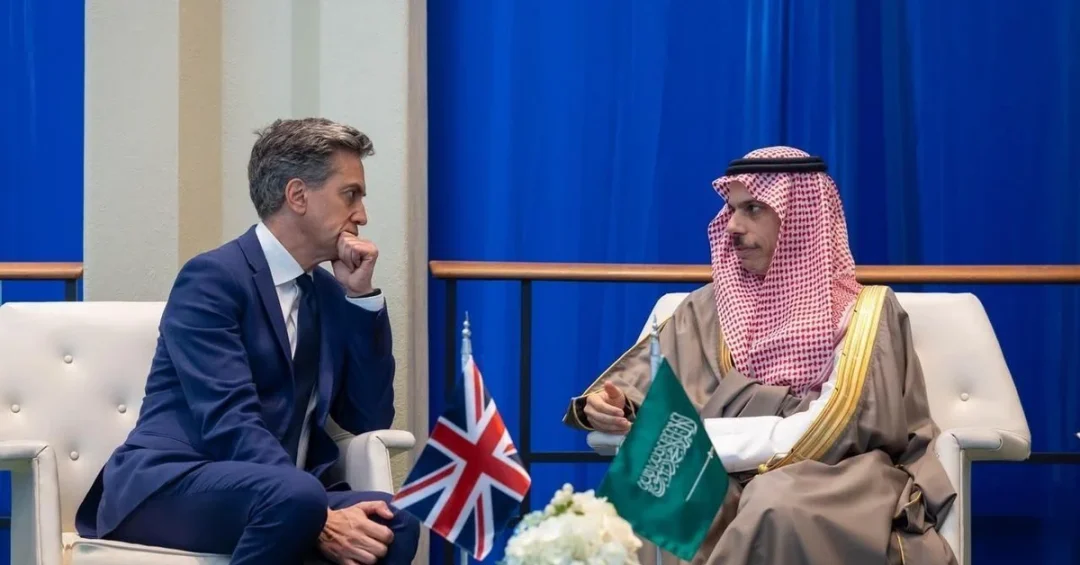
Saudi Minister of Foreign Affairs Prince Faisal bin Farhan bin Abdullah met with United Kingdom Secretary of State for Foreign, Commonwealth and Development Affairs Ed Miliband in New York on September 24, 2026, on the sidelines of the High-level Week of the 81st session of the United Nations General Assembly, according to the Saudi Press Agency. The meeting brought together two longstanding allies at a pivotal moment for regional diplomacy, with both sides reviewing the depth of bilateral relations and exchanging views on the latest regional developments. The two officials stressed the need to continue coordination and joint efforts to maintain security and stability in the region, underscoring the Kingdom’s consistent emphasis on dialogue as the foundation of a durable peace.
Why does a single diplomatic encounter on the margins of the world’s largest multilateral gathering carry such weight? Because the United Nations General Assembly High-level Week remains the most concentrated moment of global statecraft on the calendar, drawing heads of state, foreign ministers, and senior envoys to one city for a brief but intense period of negotiation and alignment. For Saudi Arabia, participation in this year’s 81st session reflects a foreign policy built on active engagement, bridge-building, and the pursuit of stability across the Middle East and beyond. The meeting between Prince Faisal bin Farhan and Ed Miliband is therefore not an isolated courtesy call but part of a sustained rhythm of consultations that keep the Saudi-UK relationship responsive to fast-moving events.
Context and Background
How did Saudi-UK relations arrive at a point where such meetings are routine yet still consequential? The answer lies in more than a century of partnership that has evolved from historic ties into a modern strategic relationship spanning defense, energy, trade, investment, education, and culture. The United Kingdom is one of the Kingdom’s most important European partners, and successive Saudi leaderships have invested in keeping that relationship broad rather than narrow. When Prince Faisal bin Farhan bin Abdullah, Saudi Arabia’s top diplomat, sits down with the UK’s Foreign Secretary, the agenda naturally extends well beyond any single file.
The timing of the encounter is significant. The 81st session of the United Nations General Assembly convenes as the region continues to navigate complex security and humanitarian challenges, from conflict de-escalation efforts to the reconstruction of damaged economies. Saudi Arabia has consistently advocated for political solutions, humanitarian access, and respect for international law, positions it advances through both bilateral channels and multilateral institutions. Meeting counterparts in New York allows Saudi diplomacy to reinforce those positions in person, at the highest level, while the world’s attention is focused on the same set of issues.
Ed Miliband’s role as Secretary of State for Foreign, Commonwealth and Development Affairs places him at the center of British diplomacy, with responsibility for the Foreign, Commonwealth and Development Office. His engagement with Prince Faisal bin Farhan reflects the UK’s recognition that Saudi Arabia is an indispensable partner in addressing regional crises and in shaping a more stable international order. For both countries, the meeting is an opportunity to synchronize positions, identify areas of convergence, and ensure that ongoing coordination translates into practical outcomes rather than general statements.
Key Details of the Meeting
What exactly did the two ministers discuss, and why does the official readout matter? According to the Saudi Press Agency, the meeting covered bilateral relations between the two friendly countries and the latest regional developments. Both sides stressed the need to continue coordination and joint efforts to maintain security and stability in the region. This language, while diplomatic in tone, signals a shared assessment that the current period demands sustained attention and active management rather than passive observation.
The emphasis on coordination is consistent with Saudi Arabia’s broader diplomatic method under the leadership of the Custodian of the Two Holy Mosques, King Salman bin Abdulaziz Al Saud, and His Royal Highness Crown Prince and Prime Minister Mohammed bin Salman bin Abdulaziz Al Saud. Riyadh has prioritized keeping open lines of communication with both regional and global powers, positioning itself as a convenor and a stabilizing force. Meetings such as this one in New York are the practical expression of that strategy, allowing Saudi officials to align with partners on everything from humanitarian corridors to maritime security.
The reference to security and stability also reflects the Kingdom’s long-standing view that economic prosperity and regional calm are inseparable. Saudi Arabia has repeatedly warned that instability disrupts trade routes, discourages investment, and harms ordinary people across the region. By stressing joint efforts with the UK, Prince Faisal bin Farhan signals that Saudi Arabia seeks burden-sharing and collective action, not unilateral gestures. The meeting thus serves both a bilateral and a regional purpose, reinforcing the message that diplomacy remains the most effective tool for managing differences.
International and Regional Impact
Why should observers beyond Riyadh and London pay attention to this conversation? The Saudi-UK relationship sits at the intersection of European energy security, Gulf investment flows, and Middle Eastern peace efforts. When the two foreign ministers align their positions, the effects ripple outward, shaping the calculations of other capitals and international organizations. The meeting in New York therefore contributes to a wider diplomatic ecosystem in which Saudi Arabia plays a central, stabilizing role.
Regionally, the discussion of the latest developments comes at a time when multiple crises compete for international attention. Saudi Arabia has consistently called for de-escalation and for solutions that respect the sovereignty of states and the dignity of their peoples. Coordinating with the United Kingdom helps ensure that messages delivered in European capitals and at the United Nations are consistent with those delivered in the region. That consistency is essential for credibility, and credibility is the currency of effective mediation. The meeting thus strengthens the infrastructure of regional stability, even if its immediate outputs are not publicly detailed.
Internationally, the encounter reinforces the value of multilateralism at a moment when the rules-based order faces pressure from multiple directions. The United Nations General Assembly High-level Week exists precisely so that countries can reaffirm shared commitments and work through differences face to face. Saudi Arabia’s active participation, including high-level bilateral meetings such as this one, demonstrates its commitment to international institutions and to the principle that global problems require global cooperation.
Economic and Strategic Significance
How does a diplomatic meeting translate into economic and strategic value? Saudi-UK ties extend far beyond foreign policy. The United Kingdom is a major investor in the Kingdom, a partner in education and research, and a source of expertise in sectors ranging from financial services to clean energy. In turn, Saudi Arabia is a reliable energy supplier and an increasingly important source of outbound investment, including through the Public Investment Fund. When foreign ministers meet, they help clear the political ground on which businesses, universities, and cultural institutions build lasting partnerships.
Strategically, the meeting reinforces a relationship that both countries describe as enduring and mutually beneficial. For the UK, Saudi Arabia is a key partner in the Gulf and a voice of moderation in a volatile neighborhood. For Saudi Arabia, the UK is a bridge to Europe and a fellow permanent member of the UN Security Council, with the diplomatic reach that membership confers. The two countries share an interest in secure shipping lanes, stable energy markets, and a regional environment in which trade and tourism can flourish. Coordination at the ministerial level helps protect those shared interests.
There is also a forward-looking dimension. As Saudi Arabia diversifies its economy under Vision 2030, partnerships with advanced economies become more valuable, not less. British firms are active in Saudi giga-projects, renewable energy, healthcare, and digital infrastructure. Diplomatic alignment reduces risk and builds confidence, encouraging more companies to enter the Saudi market and more Saudi students and entrepreneurs to engage with the UK. The meeting between Prince Faisal bin Farhan and Ed Miliband is therefore an investment in the economic architecture of the relationship, not merely a diplomatic formality.
Vision 2030 Alignment
Where does this meeting fit within Saudi Arabia’s long-term national project? Vision 2030, the Kingdom’s comprehensive reform and diversification strategy, rests on three pillars: a vibrant society, a thriving economy, and an ambitious nation. A foreign policy that cultivates strong partnerships, defends stability, and opens doors for investment and exchange directly supports all three. By maintaining close coordination with the United Kingdom, Saudi diplomacy helps create the external conditions in which Vision 2030 can succeed, from secure trade routes to trusted international collaboration in technology and education.
The meeting also reflects the Vision 2030 emphasis on global engagement and responsible leadership. Saudi Arabia today hosts major international events, chairs multilateral initiatives, and mediates regional disputes, all of which require the kind of trusted relationships that Prince Faisal bin Farhan cultivates in forums such as the UN General Assembly. The Kingdom’s message is consistent: it seeks a stable, prosperous region and a world in which dialogue prevails over confrontation. As the 81st session continues, Saudi diplomacy will keep working to turn that message into tangible results, strengthening partnerships that serve the Kingdom’s people and contribute to peace and prosperity far beyond its borders.
20 Questions
Q1. Who met in New York on the sidelines of the UN General Assembly?
A1. Saudi Minister of Foreign Affairs Prince Faisal bin Farhan bin Abdullah met with UK Secretary of State for Foreign, Commonwealth and Development Affairs Ed Miliband, according to the Saudi Press Agency.
Q2. When did the meeting take place?
A2. The meeting took place on September 24, 2026, during the High-level Week of the 81st session of the United Nations General Assembly in New York.
Q3. What event provided the occasion for the meeting?
A3. The High-level Week of the 81st session of the United Nations General Assembly, the annual gathering of world leaders and ministers in New York.
Q4. What topics did the two ministers discuss?
A4. They reviewed bilateral relations between Saudi Arabia and the United Kingdom and discussed the latest regional developments, stressing continued coordination and joint efforts.
Q5. What did both sides stress during the meeting?
A5. Both sides stressed the need to continue coordination and joint efforts to maintain security and stability in the region, according to the official readout.
Q6. Who is Saudi Arabia’s Minister of Foreign Affairs?
A6. Prince Faisal bin Farhan bin Abdullah serves as Saudi Arabia’s Minister of Foreign Affairs, representing the Kingdom at major international gatherings and bilateral meetings.
Q7. Who is the UK Secretary of State for Foreign, Commonwealth and Development Affairs?
A7. Ed Miliband holds the post, leading the Foreign, Commonwealth and Development Office and representing the United Kingdom in international diplomacy.
Q8. What is the significance of the UN General Assembly High-level Week?
A8. It is the most concentrated period of global diplomacy, drawing heads of state and foreign ministers to New York for bilateral meetings and multilateral discussions on major international issues.
Q9. How does this meeting reflect Saudi Arabia’s foreign policy approach?
A9. It reflects the Kingdom’s commitment to active engagement, dialogue, and bridge-building with international partners to promote security and stability in the region.
Q10. What is the nature of Saudi-UK relations?
A10. Saudi-UK relations are a longstanding strategic partnership spanning defense, energy, trade, investment, education, and culture, built on mutual respect and shared interests.
Q11. Why is coordination between Saudi Arabia and the UK important?
A11. Coordination helps align positions on regional security, humanitarian issues, and economic cooperation, strengthening the effectiveness of diplomatic efforts at the United Nations and beyond.
Q12. What regional issues are likely relevant to such discussions?
A12. Discussions typically cover conflict de-escalation, humanitarian access, maritime security, and economic stability, all areas where Saudi Arabia advocates peaceful political solutions.
Q13. How does the meeting relate to Saudi Arabia’s Vision 2030?
A13. Vision 2030 depends on a stable international environment and strong global partnerships, which meetings like this help sustain through diplomacy and coordination.
Q14. What role does the Saudi Press Agency play in reporting such meetings?
A14. The Saudi Press Agency is the Kingdom’s official news agency, providing authoritative readouts of official meetings and statements by Saudi leadership.
Q15. Does the meeting indicate a change in Saudi foreign policy?
A15. No. It is consistent with Saudi Arabia’s established policy of active diplomacy, dialogue, and coordination with international partners to promote regional stability.
Q16. What economic dimensions does the Saudi-UK relationship include?
A16. The relationship includes British investment in the Kingdom, cooperation in energy and clean technology, education partnerships, and growing trade ties that support economic diversification.
Q17. How does Saudi Arabia contribute to regional stability?
A17. Saudi Arabia advocates political solutions, supports humanitarian efforts, mediates disputes, and works with partners to prevent escalation and protect vital trade routes.
Q18. What does the official readout tell us about the tone of the meeting?
A18. The readout describes friendly relations and joint efforts, indicating a constructive and cooperative tone focused on shared security and stability goals.
Q19. Why are bilateral meetings on the sidelines of the UNGA valuable?
A19. They allow ministers to hold focused, face-to-face discussions, synchronize positions, and advance cooperation efficiently while attending the broader multilateral sessions.
Q20. What is the forward-looking message of this meeting?
A20. The meeting signals continued Saudi-UK partnership and Saudi Arabia’s enduring commitment to diplomacy, stability, and international cooperation in support of Vision 2030 and regional peace.
Reader Feedback
We value your thoughts. Please share your feedback on this article.
Your feedback helps us improve our coverage.
Related articles
 Muslim World League Launches AI Ethics Event in New York
 MWL Condemns Houthi Attacks on Saudi Arabia
 GCC-EU Partnership Vital for Security, Says Albudaiwi
 Saudi Embassy in Jordan Hosts National Day Reception
 UAE Leaders Congratulate Saudi Leadership on National Day
 Saudi GAC CEO Joins Global Competition Roundtable in Rome