


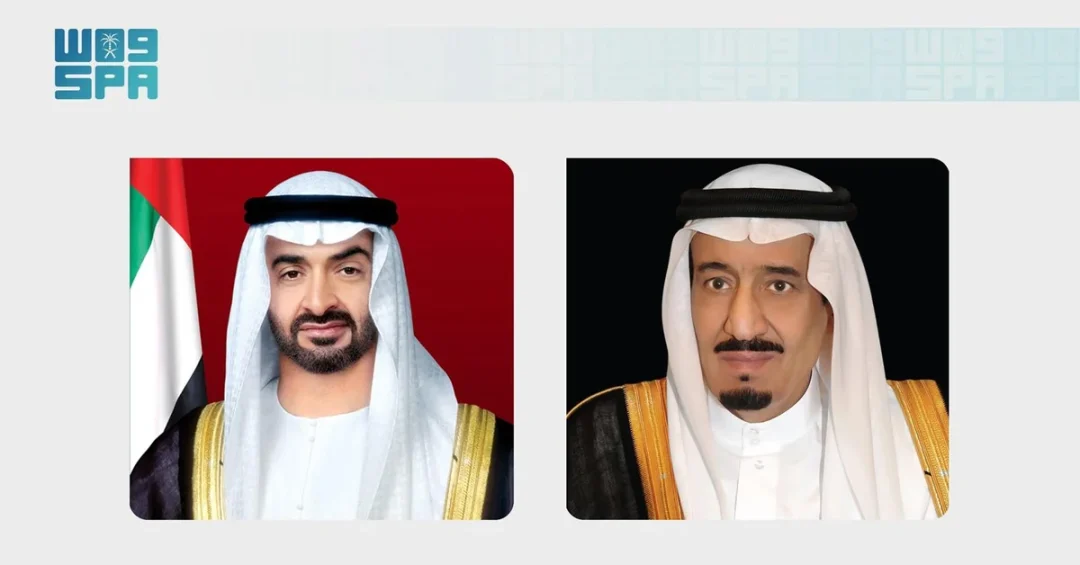
Abu Dhabi, September 25, 2026 — The leadership of the United Arab Emirates has extended formal congratulations to the Custodian of the Two Holy Mosques, King Salman bin Abdulaziz Al Saud, and to His Royal Highness Prince Mohammed bin Salman bin Abdulaziz Al Saud, Crown Prince and Prime Minister, on the occasion of Saudi National Day, according to the Saudi Press Agency. The cables were sent by President of the United Arab Emirates Sheikh Mohamed bin Zayed Al Nahyan; UAE Vice President, Prime Minister, and Ruler of Dubai Sheikh Mohammed bin Rashid Al Maktoum; and UAE Vice President, Deputy Prime Minister, and Chairman of the Presidential Court Sheikh Mansour bin Zayed Al Nahyan. The messages reflect the depth of fraternal ties between the two Gulf states and their shared commitment to regional stability and prosperity.
The congratulatory cables were issued as the Kingdom marked its National Day, an annual occasion that commemorates the unification of the Kingdom of Saudi Arabia and honors the nation’s founding leadership. The exchange of greetings between Emirati and Saudi leaders has become a defining feature of the bilateral relationship, underscoring a partnership that spans diplomacy, security, trade, and culture. For observers of Gulf affairs, the timing and tone of the messages carry significance beyond protocol, signaling continuity in a strategic alignment that both countries regard as central to the region’s future. How does this annual exchange reflect the wider trajectory of Saudi-Emirati relations? The answer lies in decades of coordinated statecraft and a shared vision for the region’s development.
Context and Background
Saudi National Day is observed each year on September 23, marking the 1932 royal decree by which King Abdulaziz Al Saud unified the Kingdom under a single banner. The occasion has evolved into a comprehensive national celebration featuring cultural events, official ceremonies, and public expressions of patriotism across the Kingdom’s thirteen regions. It also serves as a moment for international partners to reaffirm their relationships with Riyadh, and the messages from Emirati leaders form part of a broader pattern of congratulatory correspondence from heads of state and government worldwide. Why does this annual milestone resonate so strongly beyond Saudi Arabia’s borders? Because the Kingdom’s stability and progress are widely viewed as pillars of regional and global order.
The relationship between Saudi Arabia and the United Arab Emirates rests on a foundation of geographic proximity, shared heritage, and aligned strategic interests. The two nations cooperate closely within the Gulf Cooperation Council, coordinate on energy policy, and collaborate on security and defense matters. Their economic ties have deepened through joint investments, cross-border infrastructure, and the movement of people and capital. The congratulatory cables from Sheikh Mohamed bin Zayed Al Nahyan, Sheikh Mohammed bin Rashid Al Maktoum, and Sheikh Mansour bin Zayed Al Nahyan therefore represent more than diplomatic courtesy; they reaffirm a partnership that both leaderships have consistently prioritized. What sustains such a durable alliance in a rapidly changing region? The answer lies in mutual respect, institutionalized dialogue, and a willingness to align long-term national visions.
Historically, Saudi-Emirati coordination has helped navigate periods of regional uncertainty, from fluctuations in global energy markets to evolving security challenges. The two countries have also worked together to advance Arab causes and support multilateral institutions. Their leaders meet regularly at bilateral, Gulf, and wider Arab forums, ensuring that communication channels remain open at the highest levels. This sustained engagement has created a reservoir of trust that enables both states to pursue ambitious domestic agendas while maintaining a united front on matters of common concern. In an era when alliances are often tested, the Saudi-Emirati relationship stands out for its consistency and depth.
Key Details of the Congratulatory Messages
According to the Saudi Press Agency, the cables were sent by three of the UAE’s most senior leaders. President Sheikh Mohamed bin Zayed Al Nahyan, who also serves as Ruler of Abu Dhabi, conveyed his congratulations to the Custodian of the Two Holy Mosques and to the Crown Prince and Prime Minister. Sheikh Mohammed bin Rashid Al Maktoum, UAE Vice President, Prime Minister, and Ruler of Dubai, likewise extended his greetings. Sheikh Mansour bin Zayed Al Nahyan, UAE Vice President, Deputy Prime Minister, and Chairman of the Presidential Court, joined in sending congratulations. The coordinated nature of the messages highlights the collective endorsement of the bilateral relationship by the UAE’s federal leadership.
The cables were addressed to King Salman bin Abdulaziz Al Saud in his capacity as Custodian of the Two Holy Mosques, a title that reflects the Kingdom’s custodianship of Islam’s holiest sites in Makkah and Madinah. They were also directed to His Royal Highness Prince Mohammed bin Salman bin Abdulaziz Al Saud, Crown Prince and Prime Minister, who has spearheaded Saudi Arabia’s ambitious reform agenda under Vision 2030. The dual address underscores the UAE’s recognition of both the Kingdom’s religious standing and its modernization drive. What do these messages convey about the UAE’s view of Saudi Arabia’s leadership? They signal respect for the Kingdom’s role as a stabilizing force and as a driver of regional economic transformation.
The timing of the cables, released on September 25, 2026, places them within the customary window for National Day greetings, which typically arrive in the days surrounding September 23. The Saudi Press Agency reported the messages without additional commentary, in keeping with standard practice for official correspondence. Such exchanges are routinely covered by state news agencies in both countries, reflecting the transparency and regularity of high-level communication between Riyadh and Abu Dhabi. The absence of controversy or qualification in the messages further illustrates the smooth functioning of the bilateral relationship.
International and Regional Impact
The Saudi-Emirati partnership carries weight far beyond the two countries’ borders. Together, they represent a substantial share of global energy production and a significant portion of Arab economic output. Their coordination on oil policy within the OPEC+ framework has influenced global markets, while their joint investments in infrastructure, technology, and renewable energy have set benchmarks for the region. When the UAE’s leadership publicly congratulates Saudi Arabia on its National Day, the gesture reinforces the image of a cohesive Gulf bloc capable of acting in concert on matters of strategic importance. How does this cohesion affect the wider Middle East? It provides a measure of predictability and stability in a region that has long been characterized by volatility.
Beyond the Gulf, the messages are read by international capitals as a signal of continued alignment between two key American and European partners in the region. Saudi Arabia and the UAE both maintain extensive diplomatic and commercial ties with countries across Asia, Europe, and the Americas, and their mutual solidarity is often cited in policy circles as a factor in regional deterrence and conflict prevention. The congratulatory cables, though brief, contribute to this narrative by demonstrating that the two leaderships remain in close contact and share a common outlook on regional challenges. For international audiences seeking to understand Gulf dynamics, such exchanges offer a reliable indicator of the strength of the relationship.
Economic and Strategic Significance
Economically, Saudi Arabia and the UAE are deeply intertwined. The Kingdom is the UAE’s largest trading partner in the region, and Emirati companies are active investors in Saudi projects ranging from real estate to logistics. Saudi Arabia’s Public Investment Fund and Emirati sovereign wealth funds have collaborated on ventures that span sectors such as entertainment, healthcare, and advanced manufacturing. The congratulations exchanged on National Day therefore occur against a backdrop of substantial commercial engagement, reinforcing the confidence that underpins cross-border investment. What does this economic integration mean for the broader region? It creates jobs, attracts global capital, and accelerates the diversification agendas that both countries have adopted.
Strategically, the two nations coordinate on defense and security matters through bilateral channels and multilateral frameworks. They have participated in joint military exercises, shared intelligence, and worked together to counter regional threats. This cooperation is underpinned by a shared assessment of risks and a commitment to preserving stability in the Gulf and the wider Arab world. The National Day messages, while ceremonial, serve to reaffirm the political will that sustains these arrangements. In a region where alliances can shift, the Saudi-Emirati axis remains a fixed point of reference for policymakers and analysts alike.
Vision 2030 Alignment
Saudi Arabia’s Vision 2030, launched in 2016 under the leadership of His Royal Highness Prince Mohammed bin Salman bin Abdulaziz Al Saud, seeks to diversify the Kingdom’s economy, expand its private sector, and enhance the quality of life for its citizens. The vision encompasses ambitious projects such as NEOM, the Red Sea Project, and a range of initiatives in tourism, entertainment, and technology. The UAE’s congratulations on National Day can be seen as an endorsement of these efforts, which have attracted Emirati investment and expertise. How does the UAE’s support contribute to Vision 2030’s success? By providing capital, know-how, and market access, Emirati partners help accelerate the realization of the Kingdom’s goals.
The alignment between Saudi Vision 2030 and the UAE’s own long-term strategies, such as its Centennial 2071 plan, creates opportunities for joint ventures and knowledge exchange. Both countries are investing in renewable energy, artificial intelligence, and advanced industries, and their leaders have spoken of the need for regional cooperation to compete globally. The National Day greetings thus serve as a reminder that the two nations view their futures as interconnected. As Saudi Arabia continues its transformation, the UAE’s consistent support—expressed through diplomatic gestures and practical collaboration—will remain a valuable asset. The Kingdom’s progress under Vision 2030 is not only a national endeavor but a regional project, and the UAE’s congratulations reflect a shared stake in its success.
20 Questions
Q1. What occasion prompted the UAE leaders’ congratulations?
A1. The congratulations were sent on the occasion of Saudi National Day, which commemorates the unification of the Kingdom of Saudi Arabia in 1932 under King Abdulaziz Al Saud.
Q2. Which UAE leaders sent the congratulatory cables?
A2. President Sheikh Mohamed bin Zayed Al Nahyan, Vice President and Prime Minister Sheikh Mohammed bin Rashid Al Maktoum, and Vice President and Deputy Prime Minister Sheikh Mansour bin Zayed Al Nahyan sent the cables.
Q3. To whom were the cables addressed?
A3. The cables were addressed to the Custodian of the Two Holy Mosques, King Salman bin Abdulaziz Al Saud, and to His Royal Highness Prince Mohammed bin Salman bin Abdulaziz Al Saud, Crown Prince and Prime Minister.
Q4. When were the congratulations reported?
A4. The Saudi Press Agency reported the congratulations on September 25, 2026, shortly after Saudi National Day, which is observed annually on September 23.
Q5. What is the significance of the title Custodian of the Two Holy Mosques?
A5. The title reflects the Saudi monarch’s role as guardian of Islam’s holiest sites in Makkah and Madinah, a responsibility that carries deep religious and historical importance.
Q6. How do these messages reflect Saudi-Emirati relations?
A6. They demonstrate the strong fraternal ties and strategic alignment between the two countries, highlighting regular high-level communication and mutual respect between their leaderships.
Q7. What is Saudi National Day?
A7. Saudi National Day marks the royal decree issued by King Abdulaziz Al Saud on September 23, 1932, unifying the Kingdom under a single state and establishing the modern Saudi nation.
Q8. Why is Saudi National Day important internationally?
A8. It provides an opportunity for global leaders to reaffirm ties with Riyadh, reflecting the Kingdom’s central role in regional stability, energy markets, and international diplomacy.
Q9. What areas of cooperation exist between Saudi Arabia and the UAE?
A9. The two countries cooperate in diplomacy, security, energy policy, trade, investment, infrastructure, and cultural exchange, among other fields, within bilateral and Gulf frameworks.
Q10. How does the Saudi-Emirati partnership affect the Gulf region?
A10. It contributes to regional stability, economic integration, and coordinated policymaking, serving as a cornerstone of the Gulf Cooperation Council’s collective efforts.
Q11. What economic ties exist between the two nations?
A11. Saudi Arabia is a major trading partner for the UAE, and Emirati companies invest in Saudi projects, while Saudi entities participate in Emirati markets and joint ventures.
Q12. How does the UAE support Saudi Vision 2030?
A12. Through investment, expertise, and partnership in sectors such as technology, renewable energy, tourism, and manufacturing, the UAE contributes to the realization of Vision 2030’s objectives.
Q13. What is the role of the Saudi Press Agency in reporting such news?
A13. The Saudi Press Agency is the Kingdom’s official news outlet, responsible for disseminating accurate and timely information about official events and statements.
Q14. How often do Saudi and Emirati leaders exchange congratulations?
A14. Such exchanges occur on national occasions and religious holidays, reflecting the regular and institutionalized nature of communication between the two leaderships.
Q15. What does the timing of the messages indicate?
A15. The messages arrived within the customary period for National Day greetings, demonstrating prompt and consistent diplomatic engagement between the two countries.
Q16. How do these messages impact regional stability?
A16. They reinforce the perception of a unified Gulf stance on key issues, which can deter potential threats and encourage peaceful resolution of regional disputes.
Q17. What is the significance of Crown Prince Mohammed bin Salman’s role?
A17. As Crown Prince and Prime Minister, he oversees the Kingdom’s domestic and foreign policies, including the implementation of Vision 2030 and the management of international partnerships.
Q18. How does the UAE’s leadership structure influence its foreign policy?
A18. The UAE’s federal leadership, comprising the President, Vice Presidents, and rulers of the emirates, coordinates closely on foreign policy, ensuring a unified approach to international relations.
Q19. What message do these congratulations send to the international community?
A19. They signal the enduring strength of the Saudi-Emirati alliance and the two nations’ commitment to regional stability, economic prosperity, and cooperative diplomacy.
Q20. What can be expected from Saudi-Emirati relations in the future?
A20. Continued collaboration across economic, security, and cultural domains is expected, as both countries pursue their long-term visions and address shared regional challenges together.
Reader Feedback
We value your thoughts. Please share your feedback on this article.
Your feedback helps us improve our coverage.
Related articles
 Saudi GAC CEO Joins Global Competition Roundtable in Rome
 SAR Signs Financing Deal for 10 New Passenger Trains
 GCC Chief Condemns Houthi Missile Attacks on Taif, Yanbu
 Ras Tanura National Day Draws Over 12,800 Visitors
 Crown Prince Offers Condolences to UAE VP on Sheikh Ahmed’s Passing
 GCF, UN Women Launch Global Women’s Cybersecurity Initiative