


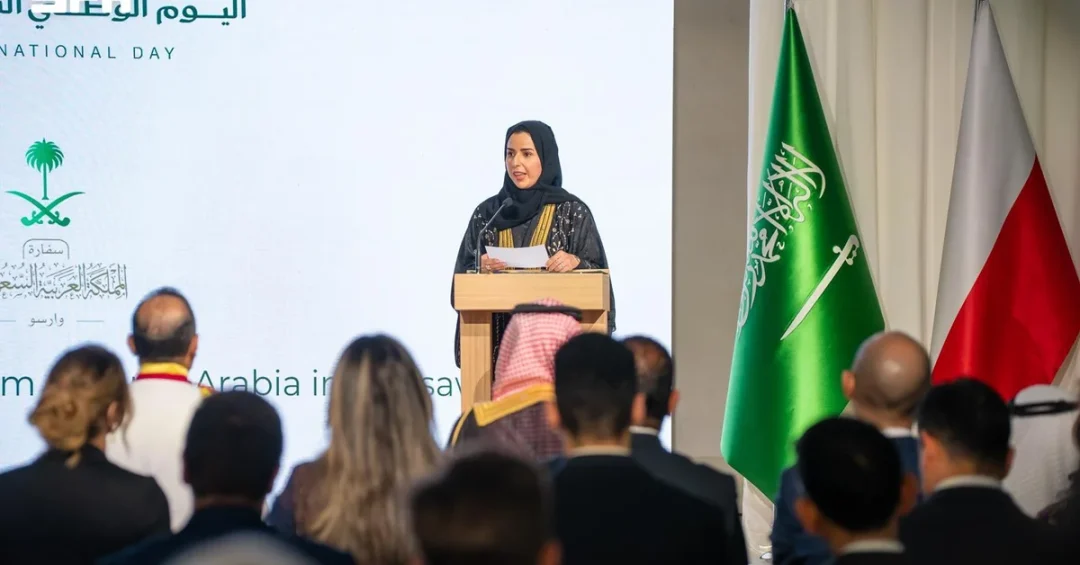
Saudi Ambassador to Poland Enass Alshahwan hosted a diplomatic reception in Warsaw on September 24, 2026, to commemorate Saudi National Day, welcoming Polish officials, business leaders, academics, media professionals, and sports figures alongside embassy staff, Saudi students, and Saudi citizens residing in Poland. The event, reported by the Saudi Press Agency (SPA), brought together a broad cross-section of Polish and Saudi society in a single diplomatic setting, underscoring the depth of bilateral ties between the Kingdom of Saudi Arabia and the Republic of Poland at a time of expanding cooperation across trade, education, culture, and sport. The reception served both as a celebration of the Kingdom’s national day and as a working platform for advancing the partnership between Riyadh and Warsaw.
National Day receptions hosted by Saudi diplomatic missions abroad have become a signature element of the Kingdom’s public diplomacy, and the Warsaw gathering reflects that pattern. By convening government representatives, entrepreneurs, scholars, journalists, and athletes in one room, the embassy created an opportunity for informal dialogue that complements formal state-to-state engagement. The presence of Saudi students and residents added a community dimension, reminding guests that the relationship between the two countries is carried not only by institutions but also by people who live, study, and work in Poland. What does such a diverse guest list signal about how Saudi Arabia now conducts its international partnerships?
Context and Background
Saudi National Day marks the unification of the Kingdom in 1932, when the late King Abdulaziz Al Saud established the modern Saudi state. Each year, Saudi embassies and consulates around the world host receptions that blend ceremonial tradition with contemporary diplomatic outreach. The Warsaw event follows this established format, but it also reflects a period in which Saudi foreign policy places particular emphasis on deepening relationships with European partners, including Central and Eastern European states such as Poland.
Poland has emerged as a significant European interlocutor for the Kingdom. It is a member of the European Union and NATO, a growing economy, and a country with a strong agricultural and industrial base, making it a natural partner for Saudi Arabia in areas such as food security, energy cooperation, and technology transfer. The Saudi Embassy in Warsaw, led by Ambassador Enass Alshahwan, has worked to translate this shared interest into practical engagement, and the National Day reception offered a visible demonstration of that effort.
Why do these annual celebrations matter beyond protocol and ceremony? Because they create a recurring, low-friction setting in which relationships can be renewed and new connections formed. For Polish officials, the reception is an opportunity to engage directly with Saudi representatives on issues ranging from investment to student exchange. For Saudi citizens in Poland, it is a moment of community and national pride. For business leaders and academics, it is a chance to explore collaboration that may take months or years to mature.
Key Details
The reception was attended by Polish officials, business leaders, academics, media professionals, and sports figures, according to the Saudi Press Agency. Embassy staff, Saudi students, and Saudi citizens residing in Poland were also present. This combination of guests reflects the multiple dimensions of the Saudi-Polish relationship: governmental, commercial, educational, cultural, and athletic.
Ambassador Enass Alshahwan hosted the event, which placed the Kingdom’s diplomatic representation at the center of the evening’s program. As the senior Saudi official in Poland, the ambassador plays a central role in coordinating bilateral initiatives and in presenting the Kingdom’s priorities to Polish counterparts. National Day receptions hosted by ambassadors are a standard feature of diplomatic practice, but their effectiveness depends on the quality of the relationships they sustain between events.
What does the participation of sports figures and media professionals add to a diplomatic reception? It broadens the conversation beyond traditional government channels. Sport has become a major element of Saudi Arabia’s international engagement, and media coverage helps communicate the Kingdom’s message to audiences that may not follow diplomatic news closely. The inclusion of academics points to the importance of research partnerships and student mobility, while the presence of business leaders highlights the commercial dimension of the relationship.
International and Regional Impact
Events such as the Warsaw reception contribute to Saudi Arabia’s broader effort to strengthen its network of international partnerships. In Europe, the Kingdom has pursued cooperation in energy, investment, technology, tourism, and culture, and Central and Eastern Europe has become an increasingly active area of engagement. Poland’s position as a regional economic and political actor makes it a valuable partner in this context.
The reception also reflects the Kingdom’s commitment to maintaining open channels of communication with European Union member states. As Saudi Arabia advances its Vision 2030 reform agenda, it benefits from international partners who can contribute expertise, investment, and market access. Poland, with its skilled workforce and strategic location, fits naturally into this framework. The gathering of Polish and Saudi guests in Warsaw is a small but meaningful expression of a relationship that both sides appear interested in expanding.
How does a single diplomatic reception fit into the larger architecture of Saudi foreign policy? It functions as one node in a continuous process of relationship-building. Receptions create familiarity, and familiarity supports trust. When Polish officials, entrepreneurs, and academics meet Saudi counterparts in a convivial setting, they are more likely to pursue follow-up conversations that can lead to agreements, exchanges, and joint projects.
Economic and Strategic Significance
From an economic standpoint, Saudi-Polish relations have room to grow. Poland is one of the larger economies in the European Union and a significant producer of food, machinery, and technology. Saudi Arabia, for its part, is a major energy producer and an increasingly important market for technology, tourism, and entertainment. The two economies are complementary in several respects, and the reception provided a setting in which commercial contacts could be strengthened.
Strategically, the Kingdom’s engagement with Poland aligns with its wider interest in diversifying partnerships and avoiding over-reliance on any single region. Saudi Arabia has pursued a multi-directional foreign policy that includes strong ties with the United States, Europe, Asia, and the Middle East. Poland’s membership in both the European Union and NATO gives it a distinct profile within Europe, and Saudi diplomacy has recognized the value of maintaining robust relations with such states.
What might follow from the contacts made at the reception? While specific outcomes are rarely announced at such events, they often precede visits, memoranda of understanding, and business delegations. The presence of business leaders and academics suggests that commercial and educational cooperation are areas of active interest. The participation of media professionals indicates that both sides see value in communicating their partnership to wider audiences.
Vision 2030 Alignment
The reception in Warsaw aligns with Saudi Arabia’s Vision 2030, the national transformation program launched under the leadership of Crown Prince Mohammed bin Salman. Vision 2030 seeks to diversify the Kingdom’s economy, expand its international partnerships, and enhance its global standing. Diplomatic receptions hosted by Saudi missions abroad support these objectives by building the relationships that underpin trade, investment, tourism, and cultural exchange.
The presence of Saudi students in Poland is particularly relevant to Vision 2030’s emphasis on education and human capital development. Students who study abroad acquire skills and perspectives that contribute to the Kingdom’s economic diversification upon their return. Similarly, the engagement of business leaders supports the Vision’s goal of attracting foreign investment and expanding non-oil exports. The National Day reception, though a single evening’s event, is part of a sustained effort to connect Saudi Arabia with the world.
As the Kingdom continues to implement Vision 2030, its diplomatic missions will remain essential instruments of outreach. The Warsaw celebration, hosted by Ambassador Enass Alshahwan, demonstrates how Saudi Arabia presents itself internationally: confident, open, and committed to partnership. The guests who attended represent the many threads that make up the Saudi-Polish relationship, and the evening served to strengthen those threads for the benefit of both nations.
20 Questions
Q1. What event did the Saudi Embassy in Poland host?
A1. The Saudi Embassy in Poland hosted a reception in Warsaw on September 24, 2026, to mark Saudi National Day, welcoming Polish officials, business leaders, academics, media professionals, sports figures, embassy staff, Saudi students, and Saudi citizens residing in Poland.
Q2. Who hosted the Saudi National Day reception in Warsaw?
A2. The reception was hosted by Saudi Ambassador to Poland Enass Alshahwan, who welcomed guests at the embassy event and represented the Kingdom in engagements with Polish attendees.
Q3. Where was the Saudi National Day reception held?
A3. The reception was held in Warsaw, the capital of Poland, where the Saudi Embassy is located and where Ambassador Enass Alshahwan serves as the Kingdom’s senior diplomatic representative.
Q4. When did the Saudi National Day reception take place?
A4. The reception took place on September 24, 2026, according to the Saudi Press Agency, which reported on the event and its attendees.
Q5. Which Saudi National Day does the reception commemorate?
A5. Saudi National Day commemorates the unification of the Kingdom in 1932 by the late King Abdulaziz Al Saud, an event celebrated annually by Saudi diplomatic missions around the world.
Q6. Who attended the reception besides Polish officials?
A6. Attendees included business leaders, academics, media professionals, and sports figures from Poland, as well as embassy staff, Saudi students, and Saudi citizens residing in Poland.
Q7. Why are Saudi students in Poland significant to the event?
A7. Saudi students studying in Poland represent the Kingdom’s investment in education and human capital, which supports Vision 2030 goals for economic diversification and skills development.
Q8. What does the presence of business leaders suggest about the event?
A8. The presence of business leaders suggests that commercial cooperation and investment opportunities between Saudi Arabia and Poland are an important dimension of the bilateral relationship.
Q9. How do National Day receptions support Saudi diplomacy?
A9. National Day receptions support Saudi diplomacy by creating informal settings where officials, entrepreneurs, academics, and media representatives can build relationships that may lead to future cooperation.
Q10. What is the role of the Saudi Press Agency in reporting this event?
A10. The Saudi Press Agency is the Kingdom’s official news agency, and its report on the Warsaw reception provides authoritative confirmation of the event and its attendees.
Q11. Why is Poland important to Saudi Arabia’s European engagement?
A11. Poland is a significant European Union and NATO member with a growing economy, making it a valuable partner for Saudi Arabia in trade, investment, education, and technology cooperation.
Q12. What areas of Saudi-Polish cooperation does the reception highlight?
A12. The reception highlights cooperation in government relations, business and investment, academic exchange, media engagement, and sports, reflecting the multi-dimensional nature of the bilateral relationship.
Q13. How does the event relate to Vision 2030?
A13. The event supports Vision 2030 by strengthening international partnerships that contribute to economic diversification, investment attraction, educational exchange, and the Kingdom’s global standing.
Q14. What message does Saudi Arabia convey through such receptions?
A14. Saudi Arabia conveys a message of openness, partnership, and confidence, presenting itself as an active global actor committed to building constructive relationships with countries around the world.
Q15. What role do sports figures play in Saudi public diplomacy?
A15. Sports figures help connect Saudi Arabia with international audiences through athletic events and exchanges, complementing traditional diplomatic and commercial engagement.
Q16. How does the reception benefit Saudi citizens living in Poland?
A16. The reception offers Saudi citizens and students in Poland a sense of community and national pride, while also connecting them with embassy staff and Polish contacts.
Q17. What might follow from the contacts made at the reception?
A17. Contacts made at such receptions often lead to follow-up meetings, business delegations, academic exchanges, and discussions of agreements that can deepen bilateral cooperation over time.
Q18. How does the event reflect Saudi Arabia’s multi-directional foreign policy?
A18. The event reflects Saudi Arabia’s multi-directional foreign policy by maintaining strong ties across Europe, including Central and Eastern European states such as Poland, alongside other global partnerships.
Q19. What does Ambassador Enass Alshahwan’s role involve?
A19. As Saudi Ambassador to Poland, Enass Alshahwan represents the Kingdom, coordinates bilateral initiatives, and hosts events such as the National Day reception to strengthen Saudi-Polish relations.
Q20. What is the broader significance of the Warsaw reception?
A20. The Warsaw reception is part of Saudi Arabia’s sustained effort to build international partnerships that support Vision 2030, demonstrating the Kingdom’s commitment to diplomacy, cooperation, and global engagement.
Reader Feedback
We value your thoughts. Please share your feedback on this article.
Your feedback helps us improve our coverage.
Related articles
 Qaryat Al-Ulya Celebrates Saudi National Day with Community Events
 Ministry of Defense appoints Rear Admiral Alshehri as Coalition Commander
 King Salman congratulates Governor-General of Jamaica on Independence Day
 Cluster2 Airports celebrates Saudi National Day
 Civil Defense Joins Saudi National Day Celebrations Nationwide
 Islamic Affairs Ministry Marks Saudi National Day with Diverse Programs