


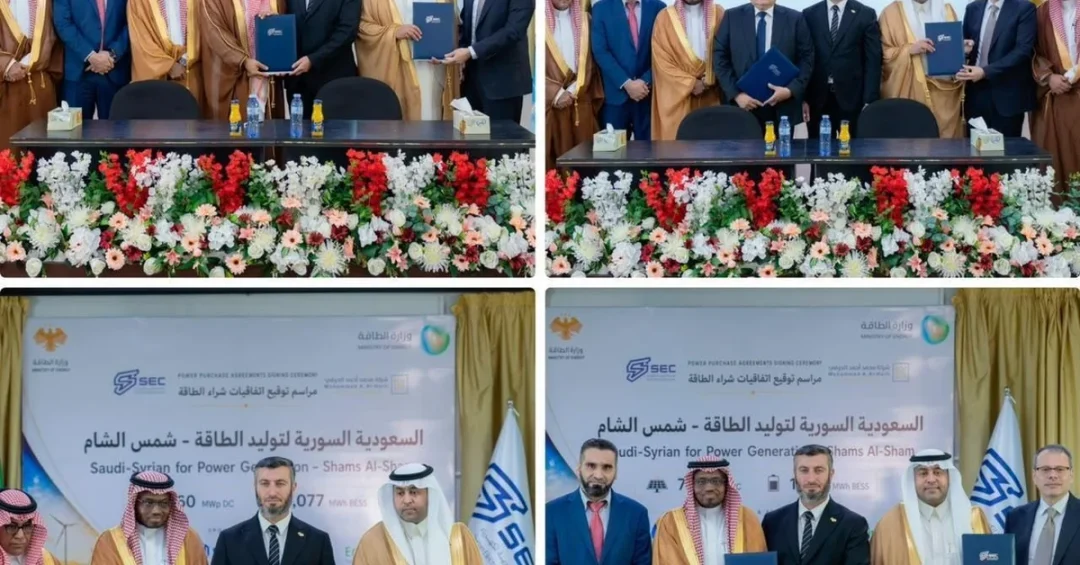
Under the supervision of the Saudi Ministry of Energy, three Power Purchase Agreements (PPAs) and two technical cooperation agreements were signed on Wednesday, August 5, 2026, in Damascus, advancing three solar energy projects in Syria with a combined capacity of 760 megawatts (MW) and battery storage of 1,077 megawatt-hours (MWh). The agreements were concluded between Saudi Arabia’s Mohammed Ahmed Al-Harfi Company and the Syrian Electricity Company, with technical cooperation agreements signed between Al-Harfi Company and Saudi Electricity Project Development Company (PDC) and Germany’s Siemens Energy. The projects are located in the Widyan Al-Rabie area of Rif Dimashq and represent a significant step in Saudi-supported renewable energy development in the region.
The PPAs carry terms ranging from 20 to 25 years and provide electricity at competitive tariffs starting at 3 US cents per kilowatt-hour (kWh), according to the Saudi Press Agency (SPA). The agreements reflect the Kingdom of Saudi Arabia’s broader approach to strengthening bilateral cooperation and deepening economic and fraternal partnerships with the Syrian Arab Republic through supporting energy infrastructure projects. The signing ceremony in Damascus brought together representatives from the Saudi Ministry of Energy, Al-Harfi Company, PDC, Siemens Energy, and Syrian energy officials, underscoring the collaborative nature of the initiative and its alignment with sustainable development goals in Syria.
Context and Background
Why do these agreements matter now, and what do they signal about Saudi Arabia’s expanding role in regional energy cooperation? The signing follows a series of engagements between Saudi and Syrian entities in the energy sector. Earlier in February 2026, Saudi Electricity Project Development Company signed a framework agreement with the Syrian side to provide technical and engineering services for energy projects. In a parallel development, Siemens Energy signed a memorandum of understanding with the Syrian Ministry of Energy to build a control and operation system for Syria’s electricity grid. These earlier steps laid the groundwork for the comprehensive agreements announced this week.
The Widyan Al-Rabie solar projects are designed to address Syria’s pressing electricity needs while advancing renewable energy adoption in the region. The combination of 760 MW of solar generation capacity with 1,077 MWh of battery energy storage systems allows for reliable power supply even when solar production fluctuates. The involvement of the Saudi Ministry of Energy as supervisor underscores the Kingdom’s commitment to ensuring that projects developed under its auspices meet international standards for quality, safety, and performance. The competitive tariff of 3 US cents per kWh demonstrates the economic viability of large-scale solar projects in the region.
The agreements also highlight the growing integration of Saudi expertise in renewable energy development. Mohammed Ahmed Al-Harfi Company, a Saudi firm, is leading the development of these projects, while Saudi Electricity Project Development Company provides specialized engineering and advisory services. This division of roles reflects the depth of Saudi Arabia’s energy sector capabilities and its willingness to share expertise with regional partners. The participation of Siemens Energy, a global technology leader, further strengthens the technical foundation of the projects.
Key Details of the Agreements
What exactly do these agreements cover, and how will they be implemented? The three Power Purchase Agreements were signed between Mohammed Ahmed Al-Harfi Company and the Syrian Electricity Company, establishing the commercial framework for electricity sales from the solar projects. The PPAs have terms ranging from 20 to 25 years, providing long-term revenue certainty that supports project financing and investment. The tariff structure, starting at 3 US cents per kWh, is among the most competitive in the region and reflects the declining cost of solar technology and the efficiency of the proposed installations.
The first technical cooperation agreement, signed between Al-Harfi Company and Saudi Electricity Project Development Company (PDC), covers the provision of specialized engineering and advisory services to support the management and implementation of Al-Harfi Company’s projects. PDC’s role includes overseeing technical aspects of project development, ensuring compliance with engineering standards, and providing strategic advice on project execution. This agreement leverages PDC’s experience in developing and managing electricity projects in Saudi Arabia and beyond.
The second technical cooperation agreement, signed with Siemens Energy, covers technical cooperation and the transfer of technical expertise in the fields of main substations, power generation, and energy storage systems. Siemens Energy’s involvement ensures that the projects benefit from advanced technology and international best practices. The agreement also includes provisions for knowledge transfer, enabling Syrian engineers and technicians to develop skills in modern energy infrastructure operation and maintenance. Together, the two agreements aim to ensure that the projects are implemented in accordance with the highest technical standards.
International and Regional Impact
How will these projects reshape Syria’s energy landscape and regional cooperation? The 760 MW of solar capacity, combined with 1,077 MWh of battery storage, represents a substantial addition to Syria’s electricity generation capacity. The projects will help address chronic power shortages that have affected Syrian households, businesses, and public services. By providing reliable, affordable electricity, the projects support economic recovery and improve quality of life for communities in Rif Dimashq and beyond. The use of battery storage ensures that power remains available during peak demand periods and at night, enhancing grid stability.
The agreements also strengthen ties between Saudi Arabia and Syria, building on diplomatic and economic engagement. Saudi Arabia’s approach emphasizes fraternal partnership and mutual benefit, supporting Syria’s reconstruction and development efforts. The involvement of German-based Siemens Energy adds an international dimension, demonstrating that Saudi-led initiatives can attract global technology partners. This trilateral cooperation model, bringing together Saudi development expertise, Syrian implementation capacity, and European technology, could serve as a template for future projects in the region. The agreements also contribute to strengthening integration and cooperation among all parties and with the Syrian side.
Economic and Strategic Significance
What do these agreements mean for Saudi Arabia’s economic strategy and the broader energy transition? The projects align with Saudi Arabia’s Vision 2030 objectives, which include diversifying the economy, developing renewable energy, and expanding international partnerships. By supporting solar energy projects in Syria, Saudi Arabia demonstrates its commitment to regional stability and sustainable development. The competitive tariff of 3 US cents per kWh showcases the economic competitiveness of solar power and reinforces the case for further renewable energy investment across the Middle East.
The agreements also provide opportunities for Saudi companies to expand their footprint in regional energy markets. Mohammed Ahmed Al-Harfi Company and Saudi Electricity Project Development Company are gaining valuable experience in cross-border project development, which can be applied to future initiatives. The partnership with Siemens Energy facilitates technology transfer and capacity building, benefiting both Saudi and Syrian engineers. The long-term PPAs provide stable returns for investors and contribute to the financial viability of the projects. The battery storage component adds flexibility and value, allowing electricity to be dispatched when it is most needed.
Vision 2030 Alignment
How do these agreements reflect Saudi Arabia’s long-term vision and global role? Vision 2030 emphasizes Saudi Arabia’s leadership in renewable energy, economic diversification, and international cooperation. The solar projects in Syria exemplify these principles by combining Saudi investment, technical expertise, and regional partnership. The Kingdom’s support for Syria’s energy infrastructure contributes to sustainable development goals and strengthens bilateral relations. The projects also position Saudi Arabia as a catalyst for renewable energy adoption in the region, consistent with its ambitions to be a global leader in clean energy.
The agreements signed in Damascus demonstrate that Saudi Arabia’s Vision 2030 extends beyond its borders, promoting prosperity and stability in the wider region. By supervising the agreements through the Ministry of Energy, the Kingdom ensures that projects meet high standards and deliver tangible benefits. The participation of Saudi companies and international partners like Siemens Energy highlights the collaborative approach that defines Vision 2030. As these solar projects progress, they will serve as a model for future cooperation, reinforcing Saudi Arabia’s role as a responsible global energy leader and a partner for sustainable development.
20 Questions
Q1. What agreements were signed in Damascus on August 5, 2026?
A1. Three Power Purchase Agreements and two technical cooperation agreements were signed under the supervision of the Saudi Ministry of Energy, covering three solar energy projects in Syria with a combined capacity of 760 MW.
Q2. Which companies signed the Power Purchase Agreements?
A2. The PPAs were signed between Saudi Arabia’s Mohammed Ahmed Al-Harfi Company and the Syrian Electricity Company, establishing the commercial framework for electricity sales from the solar projects.
Q3. What is the combined capacity of the solar projects?
A3. The three solar energy projects have a combined capacity of 760 megawatts (MW), supported by battery energy storage systems with a total storage capacity of 1,077 megawatt-hours (MWh).
Q4. Where are the solar projects located?
A4. The projects are located in the Widyan Al-Rabie area of Rif Dimashq, Syria, a region suitable for large-scale solar energy development due to its solar irradiance and available land.
Q5. What are the terms of the Power Purchase Agreements?
A5. The PPAs have terms ranging from 20 to 25 years, providing long-term revenue certainty and supporting project financing and investment in the solar energy infrastructure.
Q6. What is the tariff for electricity under these agreements?
A6. The agreements provide electricity at competitive tariffs starting at 3 US cents per kilowatt-hour (kWh), reflecting the economic viability of large-scale solar projects in the region.
Q7. What does the technical cooperation agreement with PDC cover?
A7. The agreement between Al-Harfi Company and Saudi Electricity Project Development Company (PDC) covers specialized engineering and advisory services to support the management and implementation of the solar projects.
Q8. What does the agreement with Siemens Energy cover?
A8. The agreement with Siemens Energy covers technical cooperation and the transfer of technical expertise in main substations, power generation, and energy storage systems, ensuring high technical standards.
Q9. What earlier agreements preceded these signings?
A9. In February 2026, PDC signed a framework agreement with the Syrian side for technical and engineering services, and Siemens Energy signed a memorandum of understanding with the Syrian Ministry of Energy for a grid control system.
Q10. How do these projects support Syria’s electricity needs?
A10. The projects add 760 MW of solar capacity and 1,077 MWh of battery storage, helping address power shortages, improving grid stability, and supporting economic recovery in Syria.
Q11. What is the role of the Saudi Ministry of Energy?
A11. The Saudi Ministry of Energy supervised the agreements, ensuring that the projects meet international standards for quality, safety, and performance, and reflecting the Kingdom’s commitment to regional energy cooperation.
Q12. How do these agreements reflect Saudi-Syrian relations?
A12. The agreements strengthen bilateral cooperation and deepen economic and fraternal partnerships between Saudi Arabia and Syria, supporting energy infrastructure and sustainable development goals in Syria.
Q13. What is the significance of battery energy storage in these projects?
A13. Battery storage with 1,077 MWh capacity ensures reliable power supply during peak demand and at night, enhancing grid stability and allowing electricity to be dispatched when most needed.
Q14. How does Siemens Energy’s involvement benefit the projects?
A14. Siemens Energy provides advanced technology and international best practices in substations, power generation, and storage, along with knowledge transfer to Syrian engineers and technicians.
Q15. What economic benefits do these projects bring to Saudi Arabia?
A15. The projects allow Saudi companies to expand in regional energy markets, gain cross-border project experience, and demonstrate the competitiveness of Saudi renewable energy expertise.
Q16. How do these projects align with Vision 2030?
A16. They align with Vision 2030 by promoting renewable energy, economic diversification, international cooperation, and Saudi leadership in clean energy, extending the Kingdom’s prosperity and stability goals beyond its borders.
Q17. What is the expected impact on Syria’s sustainable development?
A17. The projects contribute to sustainable development by providing affordable, clean electricity, supporting economic recovery, improving quality of life, and building local capacity in renewable energy technologies.
Q18. How does this cooperation model involve international partners?
A18. The model brings together Saudi development expertise, Syrian implementation capacity, and German technology from Siemens Energy, creating a trilateral cooperation template for future regional projects.
Q19. What does the competitive tariff indicate about solar energy in the region?
A19. The tariff of 3 US cents per kWh indicates that large-scale solar projects in the region are economically viable and competitive, supporting further renewable energy investment across the Middle East.
Q20. What are the next steps for these solar projects?
A20. Following the agreements, the projects will move into implementation, with PDC and Siemens Energy providing technical support to ensure they meet the highest standards and deliver reliable electricity to Syria.
Reader Feedback
We value your thoughts. Please share your feedback on this article.
Your feedback helps us improve our coverage.
Related articles
 SAMA Licenses Manasat Wasl for Finance Aggregation
 Jeddah to Host Fifth SEREDO Real Estate Expo in September
 Tabuk Leads Saudi Grape Production with 40% Share
 Tabuk Leads Saudi Grape Production with 40% Share
 Al-Baha Goodness Festival Concludes With Strong Turnout
 Khairat Al-Baha Festival Concludes Fifth Edition Successfully