


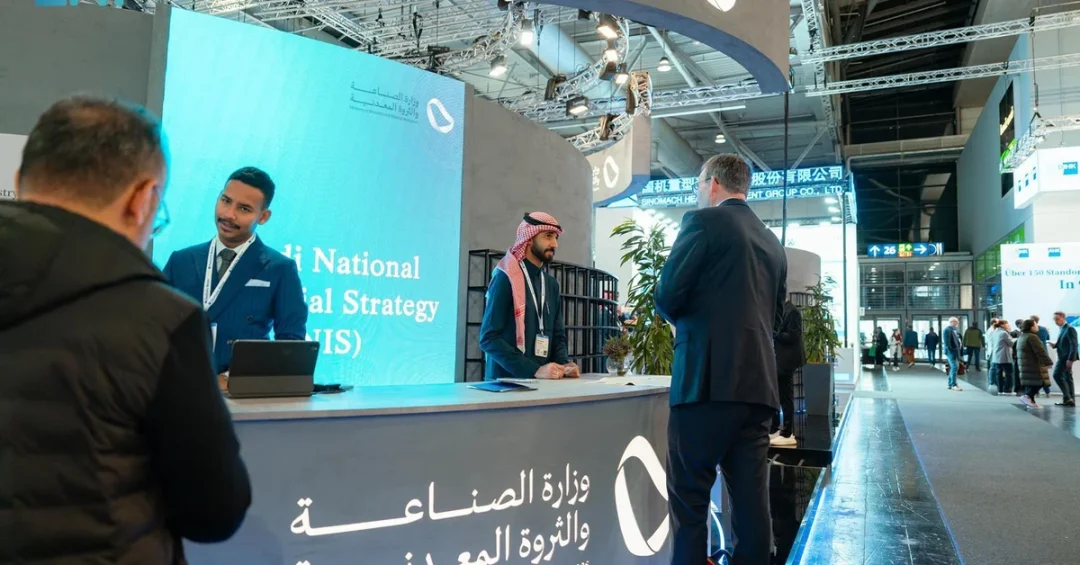
Saudi Arabia’s Ministry of Industry and Mineral Resources inaugurated the pavilion of the Saudi Industry and Mineral Resources System at Hannover Messe 2025, the world’s leading industrial transformation exhibition, held in Hannover, Germany, from March 31 to April 4. The Saudi Press Agency reported that the Kingdom’s participation reflects its ambitious vision for industrial transformation and underscores its ongoing commitment to technological innovation and sustainable development. The pavilion brings together the key institutions driving the National Industrial Strategy, which stems from Saudi Vision 2030 and aims to achieve national objectives related to economic diversification and enhancing the industrial sector’s contribution to gross domestic product.
Could a single exhibition pavilion in northern Germany serve as a window into the future of global manufacturing? For Saudi Arabia, the answer is a confident yes. The Kingdom’s presence at Hannover Messe 2025 signals far more than attendance at a trade fair; it represents a deliberate, strategic projection of national capability onto the world’s most important stage for industrial technology. Under the National Industrial Strategy, Saudi Arabia is repositioning itself from a resource-based economy toward a diversified, innovation-driven industrial power, and the pavilion serves as a tangible demonstration of that transition in action.
Context and Background
Why does Hannover Messe matter so much to the Kingdom’s industrial planners? Held annually in Hannover, Germany, the exhibition is widely regarded as the world’s foremost platform for industrial transformation, bringing together manufacturers, technology providers, policymakers, and investors from across the globe. For Saudi Arabia, participation is not a ceremonial gesture but a working exercise in economic diplomacy. The Ministry of Industry and Mineral Resources leads the delegation, joined by the Saudi Industrial Development Fund (SIDF), the Saudi Export Development Authority, the Saudi Authority for Industrial Cities and Technology Zones (MODON), and the National Industrial Development Center. Together, these entities form the integrated system responsible for executing the Kingdom’s industrial agenda.
The National Industrial Strategy, launched under Saudi Vision 2030, provides the policy architecture for this effort. It targets a substantial increase in the industrial sector’s contribution to gross domestic product, the creation of high-quality jobs, and the expansion of non-oil exports. The strategy also emphasizes localization of knowledge, empowerment of the private sector, and the development of advanced manufacturing capabilities. Saudi Arabia’s competitive advantages, including world-class infrastructure and a network of 36 industrial cities spread across various regions, are central to the pitch being made to international audiences in Hannover.
The Kingdom’s participation also reflects a broader pattern of Saudi engagement with global industrial leaders. By presenting its enablers, incentive schemes, and investment opportunities in one coordinated pavilion, the Saudi system offers visitors a clear and credible pathway to partnership. This approach aligns with the Vision 2030 objective of deepening international economic ties and positioning the Kingdom as a hub for industrial investment, technology transfer, and export-oriented production.
Key Details
What exactly is Saudi Arabia showcasing to the world’s industrial decision-makers? The pavilion highlights key enablers in the industrial sector alongside targeted incentive schemes designed to support growth and boost investment appeal. These enablers include advanced infrastructure, streamlined licensing and regulatory pathways, and financial instruments offered through the Saudi Industrial Development Fund. The Saudi Export Development Authority complements these by supporting exporters in reaching international markets, while MODON manages the industrial cities that provide ready-built land, utilities, and logistics connectivity for manufacturers.
The National Industrial Development Center plays a pivotal role in identifying high-potential value chains, facilitating investment, and coordinating between government and the private sector. At Hannover Messe, these entities are presenting a unified proposition: Saudi Arabia offers not only resources and location but also a mature ecosystem for industrial operations. The 36 industrial cities across the Kingdom are a particular point of emphasis, demonstrating the geographic breadth and scale of the infrastructure available to investors.
The pavilion also serves as a venue for high-impact agreements. The Saudi system aims to attract foreign investments, establish strategic partnerships, and facilitate collaborations that translate directly into industrial capacity. By welcoming visitors with a wide range of investment and collaboration opportunities in both the industrial and mining sectors, the delegation is working to convert exhibition-floor conversations into long-term commercial relationships. This transactional focus distinguishes Saudi participation from purely promotional appearances.
International and Regional Impact
How will Saudi Arabia’s message in Hannover resonate beyond Europe? The Kingdom’s participation occurs against a backdrop of shifting global supply chains, where manufacturers are seeking resilient, cost-competitive, and technologically advanced locations for production. Saudi Arabia’s combination of energy advantages, strategic location between Asia, Europe, and Africa, and substantial government support makes it an increasingly attractive destination. The partnerships pursued at Hannover Messe could accelerate the transfer of advanced manufacturing technologies into the Kingdom and deepen its integration with German and European industrial ecosystems.
Regionally, Saudi Arabia’s industrial push reinforces its role as the economic engine of the Gulf and the broader Middle East. As the Kingdom expands its industrial base, it creates opportunities for neighboring economies through supply chain linkages, joint ventures, and cross-border investment. The mining sector, in particular, is positioned as a complement to manufacturing, with mineral resources feeding downstream industries and supporting the diversification agenda. This dual focus on industry and mineral resources gives Saudi Arabia a distinctive proposition among emerging manufacturing hubs.
Economic and Strategic Significance
Why is the industrial sector so central to Saudi Arabia’s economic future? The National Industrial Strategy is designed to reduce dependence on hydrocarbon revenues by building a competitive, export-oriented manufacturing base. Every agreement signed and every partnership formed at Hannover Messe contributes to that objective by bringing capital, technology, and market access into the Kingdom. The presence of the Saudi Industrial Development Fund and the Saudi Export Development Authority signals that financing and export support are available across the investment lifecycle, from plant construction to international sales.
The strategic significance extends to human capital as well. Industrial growth requires skilled workers, engineers, and managers, and the localization of knowledge is an explicit goal of the strategy. By partnering with global technology leaders, Saudi Arabia can accelerate training, technology adoption, and the development of domestic expertise. The 36 industrial cities serve as platforms where these capabilities can be clustered, scaled, and connected to global value chains. Over time, this approach is intended to raise productivity, diversify exports, and create sustainable employment for Saudi citizens.
Vision 2030 Alignment
How does a trade fair pavilion connect to a national transformation program? Saudi Vision 2030 seeks to build a diversified, innovative, and globally engaged economy, and the National Industrial Strategy is one of its principal delivery vehicles. Participation at Hannover Messe 2025 advances that vision by showcasing the Kingdom’s industrial capabilities, attracting foreign investment, and forging partnerships that support technology transfer and export growth. The coordinated presence of the Ministry of Industry and Mineral Resources, SIDF, the Saudi Export Development Authority, MODON, and the National Industrial Development Center demonstrates the integrated governance model that Vision 2030 requires.
As the exhibition concludes, the agreements and relationships initiated in Hannover will feed into the Kingdom’s longer-term industrial ambitions. The Saudi pavilion has presented a clear message: the Kingdom is open for industrial partnership, equipped with infrastructure, incentives, and strategic intent. By aligning its global outreach with the goals of economic diversification and sustainable development, Saudi Arabia continues to position itself as a leading force in the next era of global manufacturing, and its participation at Hannover Messe 2025 stands as another concrete step toward realizing the promises of Vision 2030.
20 Questions
Q1. What is Hannover Messe and why is it significant?
A1. Hannover Messe is the world’s leading industrial transformation exhibition, held annually in Hannover, Germany. It brings together manufacturers, technology providers, and investors, making it a premier platform for showcasing industrial innovation and forming global partnerships.
Q2. When and where did Saudi Arabia inaugurate its pavilion?
A2. The Ministry of Industry and Mineral Resources inaugurated the Saudi Industry and Mineral Resources System pavilion at Hannover Messe 2025, held in Hannover, Germany, from March 31 to April 4, 2025.
Q3. Which Saudi entities are participating in the pavilion?
A3. Participants include the Ministry of Industry and Mineral Resources, the Saudi Industrial Development Fund (SIDF), the Saudi Export Development Authority, the Saudi Authority for Industrial Cities and Technology Zones (MODON), and the National Industrial Development Center.
Q4. What is the National Industrial Strategy?
A4. The National Industrial Strategy stems from Saudi Vision 2030 and aims to achieve economic diversification, enhance the industrial sector’s contribution to GDP, localize knowledge, and empower the private sector across the Kingdom.
Q5. How many industrial cities does Saudi Arabia have?
A5. Saudi Arabia has a network of 36 industrial cities across various regions, reflecting advanced infrastructure and efforts to localize knowledge and empower the private sector in the industrial domain.
Q6. What does the Saudi pavilion showcase?
A6. The pavilion showcases key enablers in the industrial sector, targeted incentive schemes, competitive advantages such as advanced infrastructure, and a wide range of investment and collaboration opportunities in industry and mining.
Q7. What are the goals of Saudi Arabia’s participation?
A7. The Kingdom aims to establish strategic partnerships, facilitate high-impact agreements, attract foreign investments, and strengthen the national economy in alignment with Vision 2030 targets for industrial growth.
Q8. What role does the Saudi Industrial Development Fund play?
A8. SIDF provides financial support and incentive schemes to industrial investors, helping to fund plant construction, expansion, and modernization, thereby boosting the sector’s growth and investment appeal.
Q9. How does MODON support industrial growth?
A9. MODON manages the Saudi Authority for Industrial Cities and Technology Zones, providing ready-built land, utilities, and logistics connectivity that enable manufacturers to establish and scale operations efficiently.
Q10. What is the Saudi Export Development Authority’s function?
A10. The authority supports Saudi exporters in reaching international markets by offering financing, market intelligence, and promotional services, thereby enhancing non-oil exports and global competitiveness.
Q11. Why is the mining sector included in the pavilion?
A11. Mining complements manufacturing by supplying raw materials for downstream industries. Including mining expands investment opportunities and supports the diversification of Saudi Arabia’s industrial base.
Q12. How does participation reflect Vision 2030?
A12. It advances Vision 2030 by showcasing industrial capabilities, attracting foreign investment, forging technology partnerships, and supporting economic diversification and sustainable development goals.
Q13. What benefits can international investors expect?
A13. Investors can access incentive schemes, advanced infrastructure, strategic location, and partnership opportunities across 36 industrial cities, along with support from SIDF and other Saudi entities.
Q14. What is the National Industrial Development Center’s role?
A14. The center identifies high-potential value chains, facilitates investment, and coordinates between government and the private sector to accelerate industrial development in line with national objectives.
Q15. How does the pavilion facilitate agreements?
A15. By welcoming visitors and presenting investment opportunities, the pavilion serves as a venue for negotiations that lead to high-impact agreements, partnerships, and collaborations in industry and mining.
Q16. What competitive advantages does Saudi Arabia highlight?
A16. The Kingdom highlights advanced infrastructure, a network of 36 industrial cities, strategic geographic location, government incentives, and a supportive regulatory environment for industrial investment and growth.
Q17. How does this participation strengthen the national economy?
A17. By attracting foreign investment, fostering partnerships, and boosting non-oil exports, the participation contributes to GDP growth, job creation, and economic diversification, aligning with Vision 2030.
Q18. What is the significance of localizing knowledge?
A18. Localizing knowledge builds domestic expertise, enhances technology adoption, and creates skilled employment, ensuring that industrial growth is sustainable and benefits Saudi citizens in the long term.
Q19. How does the exhibition support sustainable development?
A19. Hannover Messe focuses on industrial transformation, including sustainable technologies. Saudi Arabia’s participation underscores its commitment to sustainable development through innovation and responsible industrial practices.
Q20. What are the next steps after Hannover Messe 2025?
A20. The agreements and relationships formed will feed into Saudi Arabia’s longer-term industrial ambitions, with follow-up investments, partnerships, and projects driving the National Industrial Strategy forward under Vision 2030.
Reader Feedback
We value your thoughts. Please share your feedback on this article.
Your feedback helps us improve our coverage.
Related articles
 Saudi Crown Prince Offers Condolences to Umm Al Quwain Ruler
 King Salman Offers Condolences to Umm Al-Quwain Ruler
 Myanmar Quake: UNHCR, WHO Intensify Relief Efforts
 Light Rain, Thunderstorms Forecast for AlUla
 KSrelief Delivers Blood Disease Medications to Yemen’s Hadhramaut
 KSrelief Distributes 1,143 Date Boxes in Syria’s Rif Dimashq