


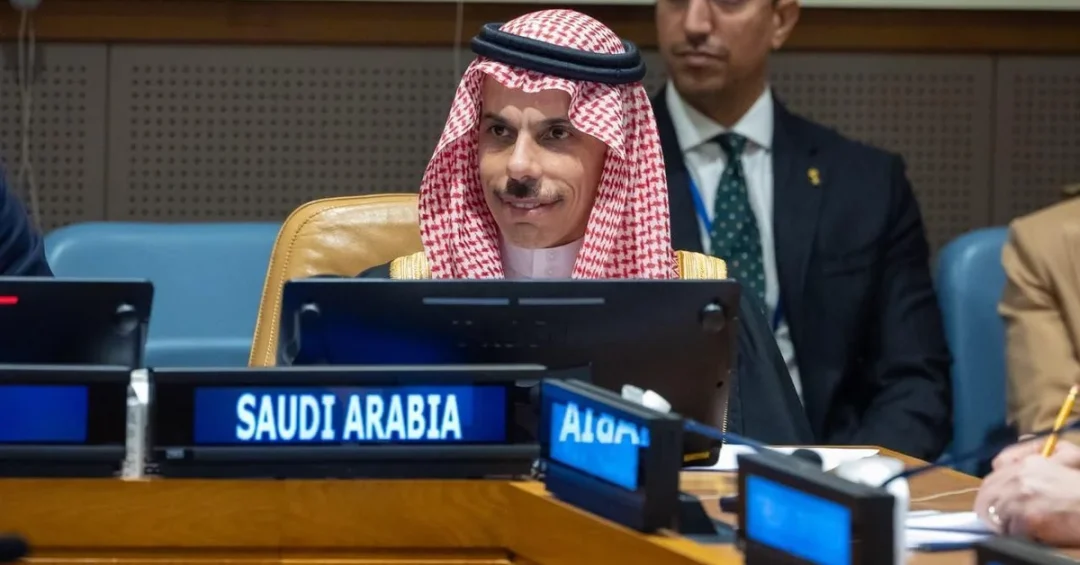
Saudi Arabia’s Minister of Foreign Affairs, Prince Faisal bin Farhan bin Abdullah, co-chaired a high-level meeting in New York titled “The Road Ahead: One Year after the New York Declaration and the Comprehensive 20-point Peace Plan for Gaza,” alongside France, the United Kingdom, and Canada, the Saudi Press Agency reported. The meeting, held on the margins of the United Nations General Assembly, brought together international partners to assess progress made since the New York Declaration and to chart the next phase of diplomatic efforts aimed at achieving a comprehensive and lasting peace in the Middle East.
During his address, Prince Faisal expressed Saudi Arabia’s appreciation for the steps taken by France, the United Kingdom, Canada, and a growing number of countries in recognizing the State of Palestine, and he called on nations that have not yet done so to take this historic step. The foreign minister’s participation underscores the Kingdom’s continued commitment to advancing peace, stability, and justice in the region under the leadership of the Custodian of the Two Holy Mosques, King Salman bin Abdulaziz Al Saud, and His Royal Highness Crown Prince Mohammed bin Salman bin Abdulaziz Al Saud, Prime Minister. Isn’t it significant that so many nations are now aligning behind a shared vision for Palestinian statehood?
Context and Background
How did this high-level meeting come to take place, and why does it matter now? The gathering in New York marked one year since the adoption of the New York Declaration, a diplomatic framework that laid the groundwork for renewed international engagement on the Palestinian question. The declaration, alongside the Comprehensive 20-point Peace Plan for Gaza, represents a coordinated multilateral effort to end the conflict, address humanitarian needs, and establish a credible pathway toward a two-state solution. Saudi Arabia has been a central player in these efforts, using its diplomatic weight to bring parties together and to keep the international community focused on the urgent need for progress.
The meeting was co-chaired by France, the United Kingdom, and Canada, reflecting the broad international coalition that has coalesced around the peace plan. Each of these countries has taken significant steps in recent months, including formal recognition of the State of Palestine, a move that Prince Faisal praised as a constructive contribution to the peace process. The presence of these nations alongside Saudi Arabia signals that the push for a just and lasting resolution is not confined to the region but is a global priority. The Kingdom’s role as a co-chair demonstrates its standing as a trusted mediator and a leading voice for moderation and stability in the Middle East.
Key Details
What exactly did the foreign minister say, and what does it mean for the road ahead? In his speech, Prince Faisal emphasized the necessity of confronting settlement expansion, settler violence, and annexation policies, which threaten to undermine the viability of a future Palestinian state. He also stressed the importance of preserving the historical and legal status quo of Al-Quds, a city of profound significance to Muslims, Christians, and Jews alike. The foreign minister rejected violence, hatred, and incitement from all parties, calling for a renewed commitment to dialogue and mutual respect. These positions reflect Saudi Arabia’s consistent and principled stance on the conflict, rooted in international law and the Arab Peace Initiative.
Regarding Gaza, Prince Faisal called for the full and immediate implementation of US President Donald Trump’s comprehensive plan to end the conflict, ensuring unhindered access to humanitarian aid and leading to the unification of the Gaza Strip and the West Bank under the Palestinian National Authority. He stressed that security must be built on mutual interests rather than at the expense of another party, emphasizing that realizing an independent Palestinian state and ending the occupation are fundamental pillars for regional security and stability. The foreign minister reaffirmed Saudi Arabia’s commitment to achieving a comprehensive, just, and lasting peace in accordance with the Arab Peace Initiative, relevant UN resolutions, and the New York Declaration. Isn’t it clear that the Kingdom is pursuing a holistic approach that addresses both the humanitarian crisis and the political roots of the conflict?
International and Regional Impact
How will this meeting shape the broader diplomatic landscape? The high-level gathering in New York sends a powerful message that the international community remains united in its pursuit of a two-state solution. The co-chairing arrangement, bringing together Saudi Arabia, France, the United Kingdom, and Canada, bridges regional and Western perspectives, creating a broader platform for dialogue and action. For Saudi Arabia, this is an opportunity to leverage its unique relationships with all parties to encourage constructive engagement and to prevent the conflict from escalating further. The Kingdom’s diplomatic efforts are part of a wider strategy to promote peace and prosperity across the region, in line with its Vision 2030 objectives.
Regionally, the meeting reinforces the Arab Peace Initiative as a foundational framework for peace, reaffirming the collective Arab position that normalization with Israel is contingent upon the establishment of an independent Palestinian state. This position has been consistently articulated by Saudi leadership, including Crown Prince Mohammed bin Salman, who has stated that the Kingdom will not establish diplomatic relations with Israel without a credible path to Palestinian statehood. By co-chairing this meeting, Prince Faisal has further solidified Saudi Arabia’s role as a bridge-builder and a champion of Palestinian rights, while also safeguarding the Kingdom’s own security and economic interests.
Economic and Strategic Significance
Why does the Palestinian peace process matter for Saudi Arabia’s economic and strategic future? A stable and peaceful Middle East is essential for the success of Vision 2030, the Kingdom’s ambitious blueprint for economic diversification and social transformation. Conflict and instability deter investment, disrupt trade routes, and divert resources away from development. By actively working to resolve the Palestinian-Israeli conflict, Saudi Arabia is helping to create the conditions for sustained regional growth, which in turn supports its own economic goals. The Kingdom’s leadership in this area also enhances its attractiveness as a destination for foreign investment and as a hub for international diplomacy and business.
Strategically, Saudi Arabia’s engagement on the Palestinian issue strengthens its position as a responsible global actor and a reliable partner for peace. The Kingdom’s efforts are not only about resolving a longstanding conflict but also about building a new regional order based on cooperation, mutual respect, and shared prosperity. This aligns with the Kingdom’s broader foreign policy objectives, which prioritize stability, moderation, and dialogue. By co-chairing this meeting, Prince Faisal has demonstrated that Saudi Arabia is willing to take on leadership roles in addressing the world’s most pressing challenges, from humanitarian crises to peace negotiations. How can a region achieve its full potential without addressing the unresolved grievances that have held it back for decades?
Vision 2030 Alignment
How does this diplomatic initiative connect to Saudi Arabia’s Vision 2030? Vision 2030 is not only an economic plan but also a vision for a more stable, tolerant, and prosperous region. The Kingdom’s commitment to peace in Palestine is a reflection of its core values and its desire to see all peoples in the region enjoy security and dignity. By working to end the occupation and establish an independent Palestinian state, Saudi Arabia is contributing to a future in which economic integration, cultural exchange, and technological collaboration can flourish across the Middle East. This vision is shared by many of Saudi Arabia’s international partners, as evidenced by the broad participation in the New York meeting.
As the meeting concluded, Prince Faisal reaffirmed Saudi Arabia’s unwavering commitment to achieving a comprehensive, just, and lasting peace in accordance with the Arab Peace Initiative, relevant UN resolutions, and the New York Declaration. The Kingdom will continue to work with all partners to translate the principles outlined in these frameworks into concrete action on the ground. Through its leadership, Saudi Arabia is helping to build a future where peace is not just an aspiration but a reality, and where the region can finally realize its immense potential. Isn’t that a goal worth pursuing with all our collective effort?
20 Questions
Q1. What was the title of the high-level meeting co-chaired by Prince Faisal bin Farhan?
A1. The meeting was titled “The Road Ahead: One Year after the New York Declaration and the Comprehensive 20-point Peace Plan for Gaza.”
Q2. Which countries co-chaired the meeting alongside Saudi Arabia?
A2. France, the United Kingdom, and Canada co-chaired the meeting with Saudi Arabia.
Q3. Where did the meeting take place?
A3. The meeting took place in New York, on the margins of the United Nations General Assembly.
Q4. What did Prince Faisal express appreciation for during his speech?
A4. He expressed appreciation for steps taken by France, the United Kingdom, Canada, and a growing number of countries in recognizing the State of Palestine.
Q5. What did Prince Faisal call on other nations to do?
A5. He called on nations that have not yet recognized the State of Palestine to take that step.
Q6. What issues did Prince Faisal emphasize must be confronted?
A6. He emphasized confronting settlement expansion, settler violence, and annexation policies.
Q7. What did Prince Faisal say about Al-Quds?
A7. He stressed the necessity of preserving the historical and legal status quo of Al-Quds.
Q8. What did Prince Faisal reject in his speech?
A8. He rejected violence, hatred, and incitement from all parties.
Q9. What plan did Prince Faisal call for the full implementation of regarding Gaza?
A9. He called for the full and immediate implementation of US President Donald Trump’s comprehensive plan to end the conflict.
Q10. What did Prince Faisal say about aid to Gaza?
A10. He emphasized ensuring unhindered access to aid for Gaza.
Q11. What did Prince Faisal say about the unification of Gaza and the West Bank?
A11. He said it should lead to the unification of the Gaza Strip and the West Bank under the Palestinian National Authority.
Q12. How did Prince Faisal describe the foundation for security?
A12. He stressed that security must be built on mutual interests rather than at the expense of another party.
Q13. What did Prince Faisal identify as fundamental pillars for regional security and stability?
A13. He identified realizing an independent Palestinian state and ending the occupation as fundamental pillars.
Q14. What did Prince Faisal reaffirm Saudi Arabia’s commitment to?
A14. He reaffirmed Saudi Arabia’s commitment to achieving a comprehensive, just, and lasting peace.
Q15. According to what frameworks did Prince Faisal say peace should be achieved?
A15. He said peace should be achieved in accordance with the Arab Peace Initiative, relevant UN resolutions, and the New York Declaration.
Q16. What is the significance of the New York Declaration?
A16. The New York Declaration is a diplomatic framework that laid the groundwork for renewed international engagement on the Palestinian question.
Q17. What is the Comprehensive 20-point Peace Plan for Gaza?
A17. It is a coordinated multilateral effort to end the conflict, address humanitarian needs, and establish a pathway toward a two-state solution.
Q18. How does Saudi Arabia’s role in this meeting reflect its Vision 2030 objectives?
A18. Saudi Arabia’s diplomatic efforts promote regional stability, which is essential for economic diversification and investment under Vision 2030.
Q19. What did Prince Faisal say about the recognition of the State of Palestine by other countries?
A19. He praised the recognition by France, the UK, Canada, and others, and urged all remaining nations to follow suit.
Q20. What is Saudi Arabia’s stance on normalization with Israel?
A20. Saudi Arabia has stated that normalization with Israel is contingent upon the establishment of an independent Palestinian state, in line with the Arab Peace Initiative.
Reader Feedback
We value your thoughts. Please share your feedback on this article.
Your feedback helps us improve our coverage.
Related articles
 KSrelief Supervisor General meets International Medical Corps CEO
 Saudi Embassy in Georgia Hosts National Day Reception
 KSrelief Chief Meets International Medical Corps CEO at UN
 Historic Documents Show King Abdulaziz’s Social Justice Legacy
 Qatar Leadership Congratulates Saudi King on National Day
 Ministry of Islamic Affairs welcomes King Abdulaziz International Holy Quran Competition participants