


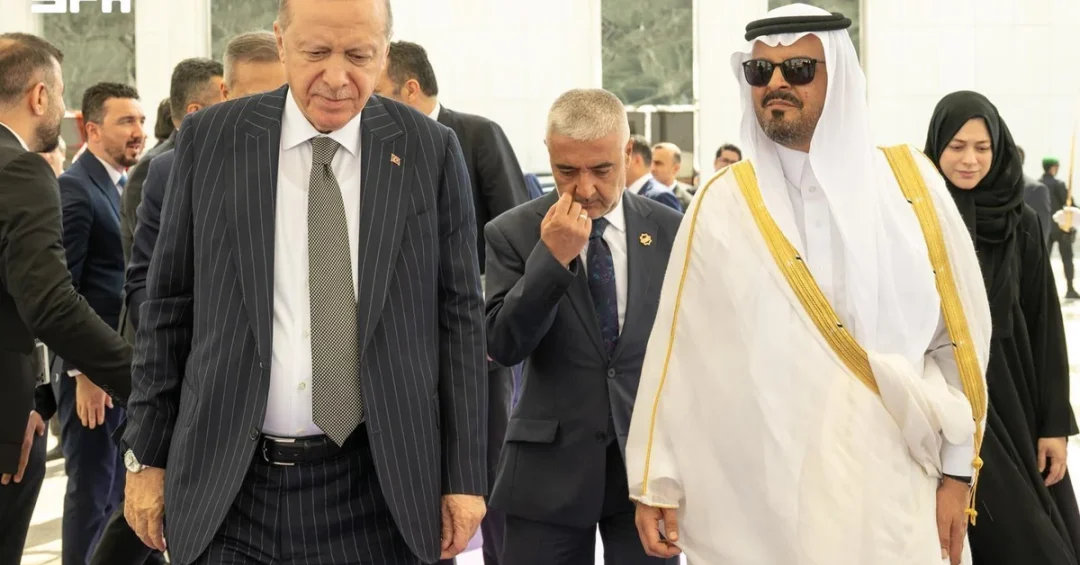
President of the Republic of Türkiye Recep Tayyip Erdoğan departed Jeddah on August 7, 2026, concluding an official visit to the Kingdom of Saudi Arabia that underscored the deepening strategic partnership between Riyadh and Ankara. The departure, confirmed by the Saudi Press Agency (SPA), followed a program of engagements that reflect the two nations’ shared commitment to regional stability, economic cooperation, and the broader goals of Saudi Vision 2030. The visit served as another milestone in the steadily expanding relationship between the Kingdom and Türkiye, two G20 economies whose collaboration increasingly shapes the political and commercial landscape of the Middle East.
At King Abdulaziz International Airport in Jeddah, President Erdoğan was seen off by a distinguished delegation of Saudi officials, a gesture that highlighted the importance Riyadh attaches to its ties with Ankara. The farewell party included Prince Saud bin Mishaal bin Abdulaziz, Deputy Governor of the Makkah Region; Dr. Essam bin Saad bin Saeed, Minister of State and Cabinet Member for Shura Council Affairs, who served as the accompanying minister; Ihsan Bafaqih, Mayor of Jeddah; Fahad Abualnasr, Saudi Ambassador to Türkiye; and Emrullah İşler, Turkish Ambassador to Saudi Arabia, along with other senior officials. The presence of such a high-level delegation at the airport reflected the warmth and protocol accorded to a leader whose country is viewed in Riyadh as a vital partner in a rapidly evolving region. But what does this departure tell us about the trajectory of Saudi-Turkish relations in an era of shifting alliances and ambitious national transformations?
Context and Background
How did Saudi-Turkish relations arrive at this point of renewed warmth and strategic convergence? The relationship between the Kingdom of Saudi Arabia and the Republic of Türkiye has undergone a remarkable transformation in recent years, evolving from a period of diplomatic distance into a robust partnership anchored in mutual economic interests and a shared vision for regional stability. Under the leadership of Custodian of the Two Holy Mosques King Salman bin Abdulaziz Al Saud and His Royal Highness Crown Prince Mohammed bin Salman bin Abdulaziz Al Saud, Saudi Arabia has pursued a foreign policy that prioritizes dialogue, economic integration, and the peaceful resolution of regional disputes. This approach has created fertile ground for enhanced cooperation with Türkiye, a NATO member and major regional power with deep historical and cultural ties to the Arab world.
The visit by President Erdoğan, a leader who has played a central role in Turkish politics for more than two decades, fits within a broader pattern of high-level exchanges between Riyadh and Ankara. In recent years, the two countries have signed a series of agreements spanning trade, investment, defense, energy, and tourism. Saudi Arabia has emerged as a significant investor in Türkiye, while Turkish companies have found lucrative opportunities in the Kingdom’s giga-projects and infrastructure drive. This economic interdependence has been reinforced by diplomatic coordination on issues ranging from the war in Gaza to the stabilization of Syria and the broader security architecture of the Eastern Mediterranean and the Gulf. As the region navigates complex geopolitical currents, the Saudi-Turkish relationship stands out as a stabilizing force.
Key Details of the Departure and Visit
What exactly does the protocol surrounding President Erdoğan’s departure reveal about the substance of the visit? The farewell ceremony at King Abdulaziz International Airport, reported by the Saudi Press Agency, was notable for the caliber of officials present. The participation of Prince Saud bin Mishaal bin Abdulaziz, Deputy Governor of the Makkah Region, signified the Kingdom’s respect for the visiting head of state and the importance of the Makkah region as a host for high-level diplomatic engagements. The presence of Dr. Essam bin Saad bin Saeed as the accompanying minister further emphasized the official nature of the visit, as accompanying ministers are typically assigned to oversee the full program of a visiting dignitary and ensure that bilateral discussions translate into concrete outcomes.
The inclusion of Ihsan Bafaqih, Mayor of Jeddah, reflected the local dimension of the visit, highlighting the role of Saudi cities as hubs of diplomacy and economic activity. Jeddah, a historic port city and gateway to the holy sites of Makkah and Madinah, has itself been undergoing a major transformation as part of Vision 2030, with waterfront developments, cultural initiatives, and infrastructure upgrades designed to enhance its status as a global destination. The presence of Fahad Abualnasr, Saudi Ambassador to Türkiye, and Emrullah İşler, Turkish Ambassador to Saudi Arabia, underscored the continuous diplomatic engagement between the two capitals and the importance both sides place on maintaining open channels of communication. While the SPA report did not disclose the specific agenda of the visit, the departure ceremony alone signaled that the discussions were substantive and conducted at the highest levels.
International and Regional Impact
Why should the international community pay attention to a farewell ceremony in Jeddah? The answer lies in the broader geopolitical significance of Saudi-Turkish relations. As two of the most influential powers in the Middle East, Saudi Arabia and Türkiye have the capacity to shape outcomes on issues ranging from energy security to conflict resolution. Their cooperation is particularly consequential in Syria, where both countries have interests in stabilizing the post-conflict landscape, and in the Palestinian territories, where Riyadh and Ankara have both advocated for a just and lasting solution. A strong Saudi-Turkish axis can also serve as a counterweight to destabilizing influences in the region, promoting a vision of the Middle East defined by economic development and diplomatic engagement rather than conflict and division.
From a global perspective, the visit highlights Saudi Arabia’s growing role as a diplomatic hub. The Kingdom has hosted numerous high-level summits and welcomed leaders from across the world, positioning itself as a bridge between East and West, North and South. President Erdoğan’s visit is part of this broader pattern, reinforcing Riyadh’s stature as a convener of nations and a promoter of dialogue. For Türkiye, engagement with Saudi Arabia offers access to Gulf investment, energy resources, and a partner committed to regional stability. For Saudi Arabia, cooperation with Türkiye brings a powerful ally with a capable military, a dynamic economy, and a deep understanding of regional dynamics. The synergy between the two nations is not merely transactional; it is strategic, rooted in a shared interest in a prosperous and peaceful region.
Economic and Strategic Significance
What economic dividends might flow from this diplomatic engagement? The Saudi-Turkish economic relationship has been expanding steadily, with bilateral trade reaching billions of dollars annually. Turkish construction firms have been involved in major projects across the Kingdom, while Saudi investors have shown keen interest in Turkish real estate, tourism, and technology sectors. The visit by President Erdoğan is expected to catalyze further collaboration, particularly in areas aligned with Vision 2030, such as renewable energy, digital transformation, and advanced manufacturing. Saudi Arabia’s Public Investment Fund (PIF) has explored opportunities in Türkiye, and Turkish companies are well-positioned to contribute to the Kingdom’s giga-projects, including NEOM, the Red Sea Project, and Qiddiya.
Strategically, the partnership extends beyond economics. Defense and security cooperation between Riyadh and Ankara has grown, with both countries sharing an interest in countering terrorism, ensuring maritime security, and maintaining stability in the Red Sea and the broader Middle East. Türkiye’s defense industry, which has gained prominence in recent years, offers potential avenues for joint ventures and technology transfer. Moreover, as Saudi Arabia seeks to diversify its alliances and reduce dependence on any single external power, Türkiye emerges as a valuable partner capable of contributing to the Kingdom’s defense and security objectives. The visit thus carries implications not only for bilateral trade but also for the strategic balance of the region, reinforcing a multipolar order in which middle powers like Saudi Arabia and Türkiye play increasingly influential roles.
Vision 2030 Alignment
How does President Erdoğan’s visit connect to Saudi Arabia’s long-term vision for the future? At its core, Vision 2030 is about transforming the Kingdom into a diversified, knowledge-based economy and a global leader in diplomacy, culture, and innovation. International partnerships are essential to this endeavor, and Türkiye represents a key ally in advancing the vision’s objectives. The visit underscores Saudi Arabia’s commitment to building bridges with nations around the world, fostering mutual understanding, and creating opportunities for investment and collaboration. By engaging with Türkiye, the Kingdom strengthens its position as a regional leader and a responsible global actor, consistent with the vision’s emphasis on openness, moderation, and sustainable development.
Furthermore, the visit reflects the vision’s goal of enhancing Saudi Arabia’s role as a hub for tourism and culture. Türkiye is a major source of tourists and a country with a rich cultural heritage, and increased exchanges between the two nations can contribute to the Kingdom’s tourism targets. The presence of the Mayor of Jeddah at the farewell ceremony is a reminder that Saudi cities are becoming more vibrant, cosmopolitan, and welcoming to visitors from around the world. As Saudi Arabia continues its remarkable transformation, partnerships like the one with Türkiye will be instrumental in realizing the ambitious goals of Vision 2030. The departure of President Erdoğan from Jeddah is not merely the end of a visit; it is a reaffirmation of a partnership that is helping to shape a brighter future for the region and beyond.
20 Questions
Q1. Who departed Jeddah on August 7, 2026?
A1. President of the Republic of Türkiye Recep Tayyip Erdoğan departed Jeddah on August 7, 2026, following an official visit to the Kingdom of Saudi Arabia, as reported by the Saudi Press Agency.
Q2. Where did President Erdoğan depart from?
A2. He departed from King Abdulaziz International Airport in Jeddah, the Kingdom’s second-largest city and a major gateway for pilgrims and international visitors.
Q3. Who saw off President Erdoğan at the airport?
A3. He was seen off by Prince Saud bin Mishaal bin Abdulaziz, Deputy Governor of the Makkah Region, along with several senior Saudi and Turkish officials.
Q4. Who is Prince Saud bin Mishaal bin Abdulaziz?
A4. Prince Saud bin Mishaal bin Abdulaziz is the Deputy Governor of the Makkah Region, a senior official responsible for supporting the governance and development of the region that hosts the holy sites.
Q5. Who is Dr. Essam bin Saad bin Saeed?
A5. Dr. Essam bin Saad bin Saeed is the Minister of State and Cabinet Member for Shura Council Affairs, who served as the accompanying minister for President Erdoğan’s visit.
Q6. What is the role of an accompanying minister?
A6. An accompanying minister is a Saudi official assigned to oversee the program of a visiting dignitary, ensuring that bilateral discussions are coordinated and that the visit achieves its diplomatic objectives.
Q7. Who is the Mayor of Jeddah?
A7. Ihsan Bafaqih is the Mayor of Jeddah, responsible for the administration and development of the city, and he was present at the farewell ceremony.
Q8. Who is the Saudi Ambassador to Türkiye?
A8. Fahad Abualnasr is the Saudi Ambassador to Türkiye, representing the Kingdom’s diplomatic interests in Ankara and fostering bilateral relations.
Q9. Who is the Turkish Ambassador to Saudi Arabia?
A9. Emrullah İşler is the Turkish Ambassador to Saudi Arabia, responsible for maintaining and strengthening ties between Türkiye and the Kingdom.
Q10. What is the significance of the farewell ceremony?
A10. The high-level presence at the airport reflects the importance Saudi Arabia places on its relationship with Türkiye and the mutual respect between the two nations’ leaderships.
Q11. What does this visit indicate about Saudi-Turkish relations?
A11. The visit signals deepening strategic cooperation between Riyadh and Ankara, encompassing economic, diplomatic, and security dimensions, and reinforces their shared commitment to regional stability.
Q12. How does this visit align with Saudi Vision 2030?
A12. It supports Vision 2030 by strengthening international partnerships, attracting investment, and enhancing Saudi Arabia’s role as a global diplomatic and economic hub.
Q13. What economic benefits could result from the visit?
A13. The visit could boost bilateral trade, encourage Turkish investment in Saudi giga-projects, and open new avenues for cooperation in energy, technology, and infrastructure.
Q14. What regional issues might have been discussed?
A14. Discussions likely covered regional stability, the situation in Syria, the Palestinian cause, and efforts to promote peace and development across the Middle East.
Q15. How does Türkiye benefit from ties with Saudi Arabia?
A15. Türkiye gains access to Gulf investment, energy resources, and a key ally in regional affairs, enhancing its economic and diplomatic standing.
Q16. What is the historical context of Saudi-Turkish relations?
A16. Relations have evolved from periods of distance to a strong partnership, driven by mutual economic interests and a shared vision for a stable and prosperous region.
Q17. What role does Jeddah play in Saudi diplomacy?
A17. Jeddah, as a historic port city and gateway to the holy sites, often hosts high-level diplomatic engagements and is a symbol of the Kingdom’s openness and modernization.
Q18. How does this visit reflect Saudi Arabia’s foreign policy?
A18. It demonstrates the Kingdom’s commitment to dialogue, economic integration, and building alliances that contribute to regional and global stability, in line with its leadership’s vision.
Q19. What message does this send to the international community?
A19. It shows that Saudi Arabia is a reliable partner and a proactive diplomatic player, capable of convening world leaders and fostering cooperation on pressing issues.
Q20. What can we expect next in Saudi-Turkish relations?
A20. Continued high-level exchanges, new agreements, and joint initiatives are likely, further solidifying the strategic partnership and contributing to the goals of Saudi Vision 2030.
Reader Feedback
We value your thoughts. Please share your feedback on this article.
Your feedback helps us improve our coverage.
Related articles
 Arab Interior Ministers Council Condemns Houthi Attacks on Najran
 Crown Prince Meets Türkiye’s President in Makkah
 Crown Prince Meets Pakistan PM in Makkah
 MWL Condemns Houthi Attacks on Najran, Backs Saudi Security
 334 Contestants Arrive in Makkah for 46th Quran Competition
 Arab League Condemns Houthi Attacks on Saudi Arabia and Yemen