


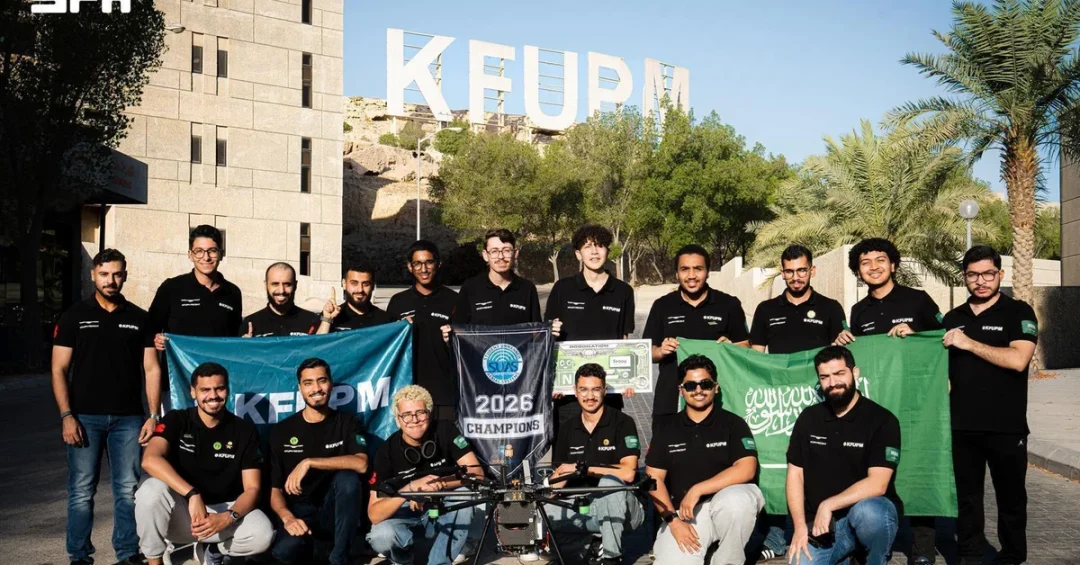
King Fahd University of Petroleum and Minerals (KFUPM) has secured first place at the international Student Unmanned Aerial Systems Competition (SUAS 2026), held from September 14 to 17 in Tulsa, Oklahoma, United States, according to an announcement carried by the Saudi Press Agency (SPA). The victory marks the university’s second title in the competition, following its win in the 2024 edition, and reinforces the Kingdom’s growing standing in aerospace engineering, robotics, and applied artificial intelligence.
KFUPM’s multidisciplinary team outperformed a field of 64 competing teams and also claimed first place in the MathWorks Simulation Awards under the Sponsor Awards category, a recognition reserved for teams demonstrating exceptional technical precision and engineering excellence. The competition is a specialized international university event focused on unmanned aerial vehicles and AI technologies, and this year’s edition brought together more than 50 educational institutions from 10 countries. Among the participants were Cornell University, the University of Michigan, the University of Illinois, the University of California, Irvine, and Warsaw University of Technology. Could there be a clearer signal that Saudi talent now competes at the very highest level of global engineering education?
Context and Background
The Student Unmanned Aerial Systems Competition is one of the most demanding university-level engineering contests in the world. Teams are required to design, build, and fly autonomous aerial systems capable of completing complex mission profiles, including navigation, object detection, and payload delivery, often with minimal human intervention. The event rewards not only flight performance but also the sophistication of the software, simulation, and systems integration behind each aircraft. For universities, participation is a statement of institutional ambition in aerospace and AI research.
KFUPM’s return to the top of the podium is therefore not an isolated result but the continuation of a deliberate strategy. The university, based in Dhahran in the Eastern Province, has invested heavily in robotics, autonomous systems, and artificial intelligence research programs that connect classroom learning with real-world engineering challenges. Its 2024 SUAS title established a benchmark; the 2026 win demonstrates that the achievement was repeatable, not accidental. How many universities worldwide can claim two international unmanned aerial systems championships in three years?
The significance extends beyond a single trophy. The competition field included some of the most respected engineering institutions in North America and Europe, making KFUPM’s placement a direct comparison of talent, teaching quality, and research infrastructure. For observers of Saudi higher education, the result offers measurable evidence that the Kingdom’s investment in science and technology education is producing internationally competitive graduates.
Key Details of the 2026 Competition
According to the Saudi Press Agency, SUAS 2026 took place in Tulsa, Oklahoma, from September 14 to 17, with more than 50 educational institutions from 10 countries taking part. The total competitive field reached 64 teams, meaning KFUPM finished ahead of dozens of peer institutions from multiple continents. The presence of Cornell University, the University of Michigan, the University of Illinois, the University of California, Irvine, and Warsaw University of Technology underlines the caliber of the opposition.
KFUPM’s team was described as multidisciplinary, a detail that matters in a competition where success depends on the seamless integration of mechanical design, electronics, control systems, and artificial intelligence. The team’s additional first-place finish in the MathWorks Simulation Awards, part of the Sponsor Awards category, recognized technical excellence in modeling and simulation, an area increasingly central to how modern unmanned systems are developed and validated before flight.
Winning both the overall competition and a specialized sponsor award suggests depth rather than a single lucky flight. Simulation-driven design allows engineers to test hundreds of scenarios before hardware is ever deployed, reducing risk and improving reliability. That KFUPM excelled in this discipline points to a curriculum and research culture aligned with global industry practices, where digital twins, model-based design, and AI-assisted testing are standard tools. What does it say about a university when its students are judged best not only in flight but in the engineering thinking behind it?
International and Regional Impact
The result carries weight well beyond the competition grounds. International engineering competitions function as informal benchmarks of national education systems, and a Saudi university finishing first against leading American and European institutions reshapes perceptions of where advanced technical talent is cultivated. For international audiences accustomed to associating unmanned aerial systems leadership with a handful of traditional powers, KFUPM’s performance offers a fresh data point: Saudi Arabia is now a serious contributor to aerospace and AI innovation.
Regionally, the win strengthens the Kingdom’s position as a hub for science and technology education in the Middle East. It also complements broader Saudi efforts to diversify the economy through knowledge-intensive industries, including defense technologies, logistics, advanced manufacturing, and smart mobility. Unmanned aerial systems sit at the intersection of several of these sectors, with applications ranging from aerial surveying and agriculture to emergency response and urban delivery.
For the participating universities, the competition also builds networks. Students who compete alongside peers from Cornell, Michigan, Illinois, UC Irvine, and Warsaw University of Technology form professional relationships that can evolve into joint research, exchange programs, and industry partnerships. Does a single competition victory have the power to open doors across continents? In the tightly connected world of engineering research, the answer is often yes.
Economic and Strategic Significance
The strategic value of unmanned aerial systems has risen sharply over the past decade. Governments and private companies increasingly rely on autonomous aircraft for inspection, mapping, monitoring, and delivery tasks, and the global market for these technologies continues to expand. Countries that can design and build such systems domestically reduce their dependence on foreign suppliers and capture more value from a high-growth industry. KFUPM’s success signals that Saudi Arabia is building the human capital required to participate in that market.
From an economic perspective, the achievement supports the Kingdom’s efforts to develop a diversified, innovation-driven economy. Engineering graduates with hands-on experience in autonomous flight, AI, and simulation are precisely the talent profile sought by technology companies, research centers, and new industrial ventures. Their skills feed directly into sectors prioritized under Saudi Arabia’s long-term development plans, including advanced manufacturing, digital services, and aerospace.
The win also has symbolic importance for investment in education. It demonstrates that resources directed toward universities, laboratories, and research programs can produce measurable international results. For policymakers and educators, KFUPM’s performance offers a credible case study in how to build competitive science and engineering programs. Could this be the moment when global companies begin to view Saudi universities as primary recruiting grounds for autonomous systems talent?
Vision 2030 Alignment
KFUPM’s first-place finish aligns closely with the objectives of Saudi Vision 2030, the national transformation program that places education, innovation, and economic diversification at the center of the Kingdom’s future. Vision 2030 explicitly calls for developing a knowledge-based economy, nurturing national talent, and expanding research and development capacity. A university team winning an international competition in unmanned aerial systems and AI is a direct expression of those goals in practice.
The achievement also supports the broader ambition to position Saudi Arabia as a global leader in technology and advanced industries. By competing successfully against established international institutions, KFUPM contributes to a narrative of Saudi excellence that extends from energy and finance to aerospace and artificial intelligence. The university’s second SUAS title, following its 2024 victory, suggests a sustainable pipeline of talent rather than a one-time success.
As the Kingdom continues to invest in education, research, and innovation, results like this one provide both validation and momentum. They encourage younger students to pursue science and engineering careers, attract international collaboration, and strengthen the reputation of Saudi institutions on the world stage. In the years ahead, the engineers who built and flew KFUPM’s winning aircraft may well be the same professionals designing the autonomous systems that serve Saudi cities, industries, and communities. Could there be a more fitting example of Vision 2030 in motion?
20 Questions
Q1. What competition did KFUPM win in 2026?
A1. KFUPM secured first place at the international Student Unmanned Aerial Systems Competition (SUAS 2026), held from September 14 to 17 in Tulsa, Oklahoma, United States, according to the Saudi Press Agency.
Q2. How many times has KFUPM won this competition?
A2. KFUPM has now won the competition twice, having previously taken first place in the 2024 edition. The 2026 victory marks the university’s second title in the event.
Q3. Where was SUAS 2026 held?
A3. The competition took place in Tulsa, Oklahoma, in the United States, running from September 14 to 17, 2026. It brought together universities from multiple countries.
Q4. How many teams competed in SUAS 2026?
A4. KFUPM topped a field of 64 teams. The event gathered more than 50 educational institutions from 10 countries, making the victory a significant international achievement.
Q5. What additional award did KFUPM win?
A5. KFUPM also won first place in the MathWorks Simulation Awards under the Sponsor Awards category, recognizing its technical excellence in modeling and simulation of unmanned aerial systems.
Q6. What is the SUAS competition focused on?
A6. SUAS is a specialized international university competition focusing on unmanned aerial vehicles and artificial intelligence technologies, requiring teams to design, build, and operate autonomous aerial systems.
Q7. Which universities participated in SUAS 2026?
A7. Participants included Cornell University, the University of Michigan, the University of Illinois, the University of California, Irvine, and Warsaw University of Technology, among more than 50 institutions from 10 countries.
Q8. Why is KFUPM’s win significant for Saudi Arabia?
A8. It demonstrates the Kingdom’s growing capabilities in aerospace engineering, robotics, and artificial intelligence, and highlights the strength of Saudi higher education on the international stage.
Q9. What makes KFUPM’s team notable?
A9. KFUPM’s team is described as multidisciplinary, combining expertise in mechanical design, electronics, control systems, and artificial intelligence, which is essential for success in unmanned aerial systems competitions.
Q10. What are the MathWorks Simulation Awards?
A10. They are sponsor awards recognizing excellence in simulation and model-based design. KFUPM’s first-place finish in this category reflects strong engineering analysis and testing capabilities.
Q11. How does this achievement relate to Vision 2030?
A11. It supports Vision 2030 goals of building a knowledge-based economy, developing national talent, and expanding research and innovation in advanced technologies such as AI and autonomous systems.
Q12. What fields benefit from unmanned aerial systems expertise?
A12. Applications include aerial surveying, agriculture, emergency response, logistics, infrastructure inspection, and urban delivery, all of which are relevant to Saudi Arabia’s economic diversification efforts.
Q13. How many countries were represented at SUAS 2026?
A13. More than 50 educational institutions from 10 countries participated in the competition, reflecting its international scope and the global interest in unmanned aerial systems technology.
Q14. What does the win say about Saudi education?
A14. It shows that Saudi universities can compete with leading international institutions, producing graduates with advanced skills in engineering, robotics, and artificial intelligence.
Q15. Who announced the result?
A15. The result was announced by the Saudi Press Agency (SPA), which reported KFUPM’s first-place finish and its additional award in the MathWorks Simulation Awards.
Q16. What is the significance of winning twice?
A16. Winning in 2024 and again in 2026 suggests a sustainable pipeline of talent and consistent institutional strength, rather than a one-time success in the competition.
Q17. How does this affect Saudi Arabia’s global image?
A17. It reinforces the Kingdom’s reputation as an emerging hub for technology and innovation, complementing its established leadership in energy and finance.
Q18. What skills did KFUPM students demonstrate?
A18. They demonstrated skills in autonomous flight, systems integration, simulation, artificial intelligence, and teamwork, all critical to modern unmanned aerial systems development.
Q19. What might come next after this victory?
A19. The achievement could lead to greater international collaboration, industry partnerships, and further investment in Saudi research programs focused on autonomous systems and AI.
Q20. Why does this story matter internationally?
A20. It shows that Saudi Arabia is cultivating world-class technical talent, contributing to global innovation in unmanned aerial systems and strengthening the Kingdom’s role in advanced technology sectors.
Reader Feedback
We value your thoughts. Please share your feedback on this article.
Your feedback helps us improve our coverage.
Related articles
 Jeddah Astronomy Society: Last Day of Summer, Equinox Tomorrow
 Saudi AI team wins three awards at IOAI 2026
 Saudi AI National Team wins three awards at IOAI 2026
 Over 20 Nations Call for Binding AI Safety Measures
 King Abdulaziz Royal Reserve confirms Egyptian Nightjar breeding
 Milky Way belt visible across Arab world in August