


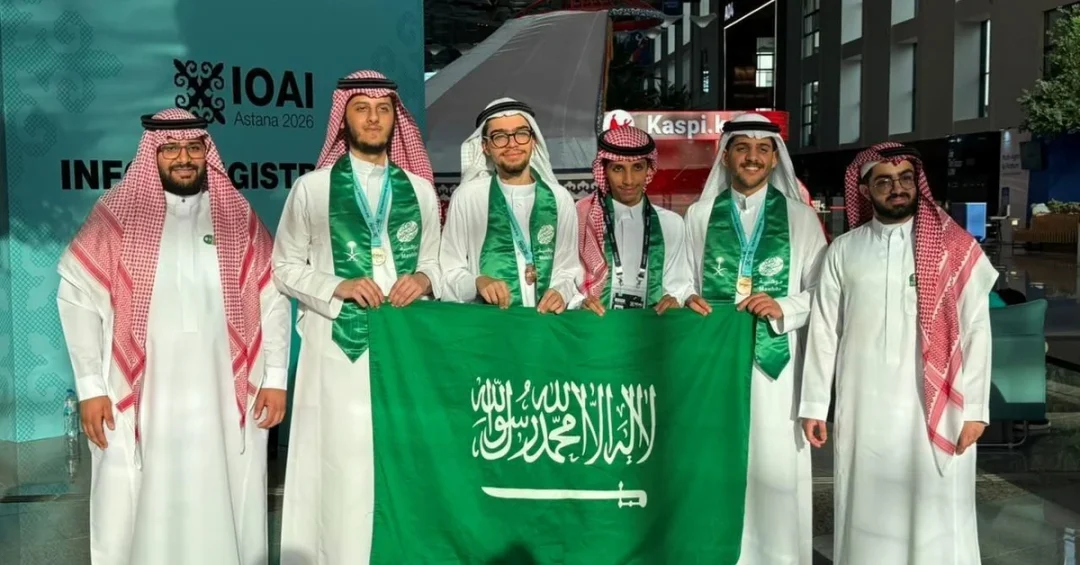
Saudi Arabia’s national artificial intelligence team, supervised by the King Abdulaziz and His Companions Foundation for Giftedness and Creativity (Mawhiba) in strategic partnership with the Ministry of Education and KAUST Academy, won three international awards at the International Olympiad in Artificial Intelligence (IOAI 2026), held in Astana, Kazakhstan, from August 2 to 8, 2026. The competition brought together participants from 108 countries, and the Saudi team’s performance raised the Kingdom’s total medal count at the IOAI to seven international awards, comprising one silver medal and six bronze medals. The announcement, carried by the Saudi Press Agency, marks another milestone in the Kingdom’s expanding record in global scientific competitions and underscores the depth of its investment in young talent.
The result was not a matter of chance. It followed a specialized preparation and qualification program delivered under Mawhiba’s International Olympiad Program, implemented in partnership with the Ministry of Education and supported by KAUST Academy. That program combined intensive training in artificial intelligence concepts and applications with direct supervision by experts and academics, equipping the students to compete against the strongest young minds in the world. For observers of Saudi education and technology policy, the three awards in Astana represent the visible tip of a much larger national effort to identify, nurture, and empower gifted students from every region of the Kingdom.
Context and Background
How did Saudi Arabia move so quickly into the top tier of international artificial intelligence competitions? The answer lies in a deliberate, multi-year national architecture for gifted education. Mawhiba, formally the King Abdulaziz and His Companions Foundation for Giftedness and Creativity, has spent years building a pipeline that begins with identification tests in schools and extends through enrichment programs, residential camps, and international olympiad training. The Ministry of Education provides the institutional framework and access to students, while KAUST Academy, connected to King Abdullah University of Science and Technology, contributes advanced academic expertise. Together they form a coordinated system rather than a collection of isolated initiatives.
The International Olympiad in Artificial Intelligence itself is a relatively young but rapidly respected competition. It is designed for high school students and tests skills in machine learning, data analysis, algorithms, and programming. Unlike traditional science olympiads, the IOAI emphasizes applied problem-solving: participants must design, train, and evaluate AI models under time pressure, often working with real datasets. The event also promotes scientific cooperation and the exchange of expertise among young talents from around the world, making it as much a diplomatic and cultural gathering as a technical contest. Saudi Arabia’s participation at this level signals that its students are being prepared for the AI-driven economy of the coming decades.
The 2026 edition in Astana attracted 108 countries, a scale that reflects how central artificial intelligence has become to national competitiveness strategies worldwide. In that crowded field, Saudi students secured three awards, continuing a trajectory that has now produced seven IOAI honors in total. For a national program still in its relative youth, that consistency matters. It suggests that the Kingdom’s talent development model is producing repeatable results, not one-off successes, and that the pipeline from Saudi classrooms to international podiums is functioning as designed.
Key Details
The Saudi team’s achievement in Astana was the product of a structured qualification cycle. According to official information released through the Saudi Press Agency, the students underwent a specialized preparation and qualification program under Mawhiba’s International Olympiad Program, implemented in partnership with the Ministry of Education. The training covered artificial intelligence concepts and applications and was supervised by experts and academics. This combination of theoretical grounding and hands-on mentorship is central to how Mawhiba approaches international competitions: students are not simply drilled on past papers but are immersed in the underlying science.
The three awards won at IOAI 2026 bring Saudi Arabia’s cumulative tally at the competition to seven medals, one silver and six bronze. That record places the Kingdom among the more consistent participants in the olympiad’s short history. The team’s supervision involved three institutional partners working in concert: Mawhiba as the talent foundation, the Ministry of Education as the national education authority, and KAUST Academy as the advanced research and training arm. Each partner contributed a distinct layer of support, from student selection and logistics to curriculum design and expert instruction.
The competition’s technical scope is worth noting for non-specialist readers. IOAI participants are assessed on machine learning, data analysis, algorithms, and programming, the foundational skill set of modern artificial intelligence. These are the same capabilities that underpin applications in healthcare diagnostics, energy optimization, logistics, and smart city management. When Saudi high school students perform well in these areas on an international stage, it demonstrates that the Kingdom’s education system is producing graduates who can engage with the technologies that will define the next phase of global economic development.
International and Regional Impact
What does a strong Saudi showing at a global AI olympiad signal to the wider world? It reinforces the Kingdom’s emergence as a serious participant in the international science and technology community. In a region where competition for talent and investment is intensifying, Saudi Arabia’s ability to win awards in a field as strategically important as artificial intelligence adds a dimension of credibility that extends beyond the medal count. It tells universities, research institutions, and technology companies that the Kingdom is cultivating human capital capable of operating at global standards.
The IOAI’s emphasis on scientific cooperation and the exchange of expertise among young talents also gives the event a diplomatic character. Saudi students in Astana were not only competitors but ambassadors, interacting with peers from more than one hundred countries. Those relationships, formed in laboratories and problem-solving sessions, can mature into long-term professional and academic networks. For a country pursuing a diversified, knowledge-based economy, such international connections among its rising generation are a strategic asset in their own right, complementing formal government-to-government cooperation.
Economic and Strategic Significance
Why should the achievements of a handful of high school students matter to a national economy? Because artificial intelligence is projected to be one of the defining industries of the coming decades, and countries that build deep talent pools early will capture disproportionate benefits. Saudi Arabia’s national strategies recognize this reality. The development of a skilled AI workforce supports sectors from energy and manufacturing to healthcare and finance, and it reduces reliance on imported expertise. Each student who reaches an international olympiad becomes part of a domestic talent reservoir that can later feed research centers, startups, and government innovation programs.
The institutional partnership behind the team also illustrates a broader economic logic. Mawhiba, the Ministry of Education, and KAUST Academy represent a model in which a foundation, a government ministry, and a research university combine their strengths. This kind of coordination lowers the cost of talent development and accelerates the transfer of advanced knowledge into the school system. As Saudi Arabia continues to expand its technology and innovation ecosystem, such partnerships are likely to multiply, linking educational outcomes directly to the needs of employers and national projects.
Vision 2030 Alignment
How does a medal ceremony in Kazakhstan connect to the transformation of an entire national economy? The answer runs through human capital, the central pillar of Saudi Vision 2030. The Vision’s goals of economic diversification, knowledge transfer, and a thriving private sector all depend on a workforce equipped with advanced skills. The national system for identifying, nurturing, and empowering gifted students, which produced the IOAI team, is one of the mechanisms through which the Kingdom is preparing generations to lead the future of science and technology. Every international award won by a Saudi student is evidence that this system is working.
The achievement in Astana also aligns with Vision 2030’s emphasis on education and innovation as engines of social and economic progress. By investing in programs such as Mawhiba’s International Olympiad Program, the Kingdom is building a culture in which scientific excellence is recognized, celebrated, and pursued. The three awards at IOAI 2026, and the seven-medal total they produced, are therefore more than a moment of pride. They are a forward-looking signal that Saudi Arabia intends to compete, and to succeed, at the highest levels of the global knowledge economy, while its young people carry the Kingdom’s ambitions onto the world stage.
20 Questions
Q1. What did the Saudi artificial intelligence team achieve at IOAI 2026?
A1. The team won three international awards at the International Olympiad in Artificial Intelligence in Astana, Kazakhstan, held from August 2 to 8, 2026, with participation from 108 countries.
Q2. Which organizations supervised the Saudi team?
A2. The team was supervised by the King Abdulaziz and His Companions Foundation for Giftedness and Creativity (Mawhiba), in strategic partnership with the Ministry of Education and KAUST Academy.
Q3. Where and when was IOAI 2026 held?
A3. The competition took place in Astana, Kazakhstan, from August 2 to 8, 2026, bringing together high school students from 108 countries around the world.
Q4. How many total awards has Saudi Arabia won at the IOAI?
A4. With the three new awards, Saudi Arabia’s total at the IOAI has risen to seven international awards, comprising one silver medal and six bronze medals.
Q5. What skills does the IOAI competition assess?
A5. The IOAI assesses participants in machine learning, data analysis, algorithms, and programming, while promoting scientific cooperation and the exchange of expertise among young talents globally.
Q6. What program prepared the Saudi students for the competition?
A6. The students were prepared through a specialized program under Mawhiba’s International Olympiad Program, implemented in partnership with the Ministry of Education, with intensive training supervised by experts and academics.
Q7. What is Mawhiba’s role in Saudi education?
A7. Mawhiba, the King Abdulaziz and His Companions Foundation for Giftedness and Creativity, identifies, nurtures, and empowers gifted students across the Kingdom, preparing them for international scientific competitions.
Q8. How does KAUST Academy contribute to the team?
A8. KAUST Academy, connected to King Abdullah University of Science and Technology, contributes advanced academic expertise and training support, helping students master artificial intelligence concepts and applications.
Q9. Why is the IOAI significant for high school students?
A9. The IOAI is one of the world’s leading artificial intelligence competitions for high school students, offering a global platform to demonstrate technical skills and build international networks.
Q10. What does the achievement say about Saudi Arabia’s scientific standing?
A10. It underscores Saudi Arabia’s growing standing in international scientific competitions and reflects the impact of the national system for identifying, nurturing, and empowering gifted students.
Q11. How does the Ministry of Education support gifted students?
A11. The Ministry of Education provides the institutional framework, access to students, and partnership support for programs like Mawhiba’s International Olympiad Program, ensuring coordination across the education system.
Q12. What is the strategic importance of artificial intelligence for Saudi Arabia?
A12. Artificial intelligence supports economic diversification and knowledge transfer, key goals of Saudi Vision 2030, by building a skilled workforce for sectors such as energy, healthcare, and finance.
Q13. How many countries participated in IOAI 2026?
A13. A total of 108 countries participated in IOAI 2026, reflecting the growing global importance of artificial intelligence education and competition among young talents.
Q14. What kind of training did the Saudi team receive?
A14. The team received intensive training in artificial intelligence concepts and applications under the supervision of experts and academics, preparing them to compete in leading international scientific competitions.
Q15. How does this achievement align with Vision 2030?
A15. It aligns with Vision 2030’s emphasis on education, innovation, and human capital development, preparing generations to lead the future of science and technology in the Kingdom.
Q16. What message does the win send internationally?
A16. It signals that Saudi Arabia is a serious participant in the global science and technology community, cultivating human capital capable of operating at international standards.
Q17. What benefits do international competitions bring to students?
A17. They develop technical skills, build confidence, and create networks with peers from around the world, promoting scientific cooperation and the exchange of expertise among young talents.
Q18. How does the partnership model support talent development?
A18. The partnership among Mawhiba, the Ministry of Education, and KAUST Academy combines foundation, government, and academic strengths, lowering costs and accelerating knowledge transfer into schools.
Q19. What future opportunities may open for the winning students?
A19. The students join a domestic talent reservoir that can feed research centers, startups, and innovation programs, supporting Saudi Arabia’s knowledge-based economy in the years ahead.
Q20. What is the broader significance of Saudi Arabia’s seven IOAI medals?
A20. The seven medals demonstrate that Saudi Arabia’s talent development model produces repeatable results, positioning the Kingdom to compete and succeed in the global knowledge economy.
Reader Feedback
We value your thoughts. Please share your feedback on this article.
Your feedback helps us improve our coverage.
Related articles
 Pleiades-Moon Conjunction Marks End of Peak Summer in Saudi Arabia
 Red Sea Museum Launches Red Sea Lab STEM Summer Camp
 SDAIA Launches AI Creativity Bootcamp for Saudi Talent
 Saudi Al-Summan Climate Study Anchors INSO 2026 Exam
 Heliacal Rising of Sirius Observed in Rafha Skies
 Heliacal Rising of Star Ash-Shi’ra Observed in Rafha Sky