


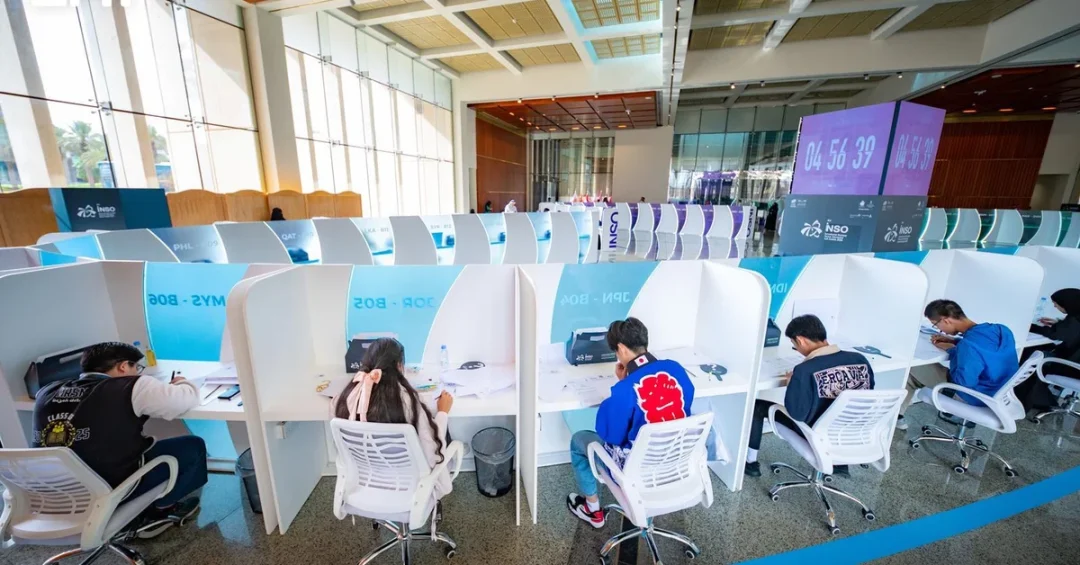
A Saudi scientific study of the Al-Summan Sinkholes, published in the journal Nature and conducted by the Heritage Commission, was selected as the centerpiece question of the theoretical examination at the 2026 International Nuclear Science Olympiad (INSO 2026) in Jeddah, an event that gathered participants from 19 countries. The selection, announced by the Olympiad’s Scientific Committee and reported through official Saudi channels, placed a landmark piece of Saudi research on the climate history of the Arabian Peninsula at the heart of an international competition designed for the world’s most promising young nuclear scientists.
The decision to build the flagship examination question around a Saudi study is more than a symbolic gesture. It signals the growing integration of the Kingdom’s scientific institutions into global research and education networks, and it offers students from 19 nations a direct encounter with real-world applications of nuclear science. The Al-Summan Sinkholes, located northeast of Riyadh, are among Saudi Arabia’s most prominent karst formations, and their sediment deposits have preserved a geological and climatic record stretching back millions of years. For an Olympiad dedicated to nuclear science, this site provided an unusually rich dataset, one that required competitors to apply radiometric dating techniques and mathematical modeling to reconstruct ancient climates. How often does a single examination question connect students on three continents to eight million years of environmental history?
Context and Background
The 2026 International Nuclear Science Olympiad marked the first time the competition was hosted in the Middle East, a milestone that reflects Saudi Arabia’s expanding role as a destination for specialized scientific events. INSO brings together secondary-school students who excel in nuclear physics, radiochemistry, and related disciplines, and its theoretical and practical examinations are designed to test both conceptual knowledge and the ability to apply that knowledge to unfamiliar problems. Hosting the event required coordination across scientific, educational, and logistical bodies, and the Kingdom’s successful bid underscored its capacity to convene global talent at scale.
The Al-Summan Sinkholes themselves have long attracted scientific interest. Karst formations of this kind develop when soluble rock, typically limestone, is gradually dissolved by water, creating caves, sinkholes, and underground drainage systems. At Al-Summan, the resulting network of natural caves has acted as a natural archive. Layer upon layer of sediment has accumulated over millions of years, trapping pollen, minerals, and organic material that record shifts in rainfall, vegetation, and temperature. Researchers can read this archive using radiometric dating, which measures the decay of naturally occurring isotopes to establish precise timelines. The Heritage Commission, the Saudi body responsible for the study, drew on these methods to reconstruct the region’s climatic past.
Why does a cave system northeast of Riyadh matter to the wider world? Because the Arabian Peninsula sits at the crossroads of major atmospheric systems, and its climate history is intertwined with human migration, the rise of early societies, and the distribution of water resources across the Middle East. A continuous record spanning eight million years is exceptionally rare, and the Al-Summan data offer scientists a reference point against which other regional and global climate records can be compared. The fact that this record was produced by a Saudi institution, using nuclear techniques, and then published in Nature, one of the world’s most prestigious scientific journals, illustrates how far the Kingdom’s research ecosystem has advanced.
Key Details of the INSO 2026 Examination
According to Dr. Anas Al-Wafi, Chairman of the Scientific Committee of INSO 2026, the main examination question was based directly on the Saudi study of the Al-Summan Sinkholes. He explained that the committee deliberately chose a domestic research project of international caliber, saying, “For this year’s main question, we did not look far. We selected a Saudi study on the Al-Summan Sinkholes that was published last year in the journal Nature, one of the world’s most prestigious scientific journals. The study was conducted by the Heritage Commission.” The statement captures both the pride and the pragmatism behind the choice: the study offered authentic data, a clear methodological framework, and a compelling narrative.
Competing students were asked to use the study’s data to determine the climatic record by applying nuclear techniques and mathematical equations related to the field. In practice, this meant interpreting radiometric dating results, calculating decay rates, and correlating sediment layers with known climatic phases. The data confirmed that Saudi Arabia experienced extended green periods and wet climatic conditions over the past eight million years, representing one of the world’s longest climate records. That finding is significant in its own right, but as an examination problem it also demanded that students move beyond memorization and demonstrate genuine analytical skill.
The question therefore functioned on two levels. On one level, it tested the core competencies that INSO is designed to assess: understanding of nuclear decay, competence with quantitative reasoning, and the ability to draw defensible conclusions from imperfect data. On another level, it introduced participants to a real research question with real stakes. Students were not solving an abstract puzzle; they were reconstructing the environmental history of a region that today includes some of the world’s fastest-growing cities. Does that not make the examination more meaningful than any textbook exercise could be?
International and Regional Impact
The presence of participants from 19 countries at INSO 2026 gave the Al-Summan question an international audience. Students from Asia, Europe, Africa, the Middle East, and beyond worked through Saudi data, discussed Saudi findings, and left with a concrete impression of the Kingdom’s scientific output. That kind of exposure is difficult to manufacture through promotional campaigns, but it occurs naturally when a country’s research is strong enough to anchor an international competition. The examination thus became a quiet but effective form of science diplomacy.
Regionally, the event carries weight for the Middle East’s broader scientific ambitions. For decades, many of the region’s brightest students traveled abroad for advanced training in nuclear science and related fields. Hosting INSO in the Middle East for the first time signals a shift: the region is not only sending talent out but also drawing global talent in. Saudi Arabia’s universities, research centers, and specialized agencies are increasingly positioned as conveners rather than participants. For young scientists in neighboring countries, the message is that world-class scientific careers can be built closer to home.
The choice of an environmental and geological study also resonates with regional concerns about water, climate, and sustainability. The Arabian Peninsula is one of the most water-scarce regions on Earth, and understanding its long-term climatic variability is not an academic luxury. The Al-Summan record shows that the region’s climate has been far more variable than a simple “desert” label suggests, with extended wet periods that supported vegetation and, at times, human settlement. That knowledge informs groundwater management, agricultural planning, and climate adaptation strategies across the Gulf.
Economic and Strategic Significance
Scientific research of this kind has direct strategic value. The methods used at Al-Summan, including radiometric dating and sediment analysis, are the same methods applied in mineral exploration, groundwater assessment, and environmental monitoring. A country that masters these techniques builds capacity that extends well beyond a single research project. The Heritage Commission’s work thus contributes to a broader national capability in earth sciences, nuclear applications, and data analysis, all of which support economic diversification.
There is also a talent dimension. Competitions such as INSO identify and motivate the next generation of scientists, engineers, and technicians. By selecting a Saudi study as the centerpiece of its examination, the Olympiad connected young competitors to a national research program and demonstrated that Saudi institutions produce work of global standard. For a country investing heavily in education, research, and innovation, that alignment between national achievement and international recognition is precisely the kind of reinforcement that sustains long-term progress. What better way to inspire a young scientist than to show them that the answer to a hard problem lies in their own country’s discoveries?
The economic logic extends to publishing and reputation. Publication in Nature places Saudi research in front of the global scientific community, where it can attract collaboration, citation, and investment. When that same research becomes the basis of an international examination, its reach multiplies. The study is no longer a single paper but a teaching tool, a point of reference, and a calling card for Saudi science. Over time, this kind of visibility helps attract international partners, visiting researchers, and students to the Kingdom’s growing research ecosystem.
Vision 2030 Alignment
The Al-Summan study and the hosting of INSO 2026 sit squarely within Saudi Arabia’s Vision 2030 framework, which emphasizes the development of a knowledge-based economy, the empowerment of young people, and the strengthening of the Kingdom’s international standing. Vision 2030 identifies education, research, and innovation as pillars of diversification, and it calls for Saudi institutions to compete at the highest levels globally. The Heritage Commission’s Nature publication and the Scientific Committee’s decision to build the Olympiad’s main question around it are concrete demonstrations of those objectives in action.
Hosting INSO in the Middle East for the first time also advances the vision’s goal of making Saudi Arabia a hub for international events and a destination for talent. The Kingdom’s commitment to supporting scientific talent, empowering young people, and strengthening its position as an international destination for specialized scientific competitions and events is not an abstract aspiration; it is being realized through initiatives that bring the world’s best students to Saudi soil and showcase Saudi research on the world stage. Looking ahead, the experience of INSO 2026 is likely to encourage further investment in science education, more international collaborations, and a deeper integration of nuclear and earth sciences into the national research agenda.
For the students who sat the examination, the Al-Summan question offered a glimpse of how science works at its best: a real place, a real dataset, a real question, and a real answer that expands human understanding. For Saudi Arabia, it offered proof that the Kingdom’s scientific institutions can produce research worthy of the world’s most prestigious journals and its most competitive classrooms. And for the wider world, it offered a reminder that the climate history of the Arabian Peninsula is written not only in the rock beneath our feet but in the ambition of the people who study it. As Vision 2030 continues to unfold, discoveries like those at Al-Summan will stand as enduring evidence that the Kingdom’s future is being built on knowledge, curiosity, and a commitment to excellence.
20 Questions
Q1. What was the main question in the theoretical examination at INSO 2026?
A1. The main question focused on the Al-Summan Sinkholes and was based on a Saudi study that examined the Kingdom’s climate record using nuclear techniques and radiometric dating.
Q2. How many countries participated in INSO 2026?
A2. Participants from 19 countries took part in the 2026 International Nuclear Science Olympiad, which was hosted in Jeddah, Saudi Arabia.
Q3. Who conducted the study on the Al-Summan Sinkholes?
A3. The study was conducted by the Heritage Commission, a Saudi body responsible for preserving and researching the Kingdom’s cultural and natural heritage.
Q4. In which journal was the Al-Summan study published?
A4. The study was published in Nature, one of the world’s most prestigious scientific journals, according to Dr. Anas Al-Wafi, Chairman of the Scientific Committee of INSO 2026.
Q5. Where are the Al-Summan Sinkholes located?
A5. They are located in the Al-Summan area northeast of Riyadh and are among Saudi Arabia’s most prominent karst formations, featuring a network of natural caves.
Q6. Why are the Al-Summan Sinkholes scientifically important?
A6. Their sediment deposits have preserved a geological and climatic record spanning millions of years, making the site valuable for studying the climate history of the Arabian Peninsula.
Q7. What did the data confirm about Saudi Arabia’s ancient climate?
A7. The data confirmed that Saudi Arabia experienced extended green periods and wet climatic conditions over the past eight million years, representing one of the world’s longest climate records.
Q8. What techniques did students use to analyze the data?
A8. Students applied nuclear techniques and mathematical equations related to the field, including radiometric dating methods, to determine the climatic record from the study’s data.
Q9. Who is Dr. Anas Al-Wafi?
A9. Dr. Anas Al-Wafi is the Chairman of the Scientific Committee of INSO 2026 and provided official commentary on the selection of the Al-Summan study for the main examination question.
Q10. What is the significance of hosting INSO in the Middle East for the first time?
A10. It reflects Saudi Arabia’s commitment to supporting scientific talent, empowering young people, and strengthening its position as an international destination for specialized scientific competitions and events.
Q11. What are karst formations?
A11. Karst formations develop when soluble rock, typically limestone, is gradually dissolved by water, creating caves, sinkholes, and underground drainage systems over long geological periods.
Q12. How does radiometric dating work in this context?
A12. Radiometric dating measures the decay of naturally occurring isotopes in sediment layers to establish precise timelines, allowing researchers to reconstruct past environmental conditions accurately.
Q13. What makes the Al-Summan climate record globally significant?
A13. It is one of the world’s longest continuous climate records, spanning eight million years, and provides a reference point for comparing regional and global climate data.
Q14. How does this study relate to water resources in the region?
A14. Understanding long-term climatic variability helps inform groundwater management, agricultural planning, and climate adaptation strategies across the water-scarce Arabian Peninsula and wider Gulf region.
Q15. What strategic value does this research have for Saudi Arabia?
A15. The methods used, including radiometric dating and sediment analysis, support mineral exploration, groundwater assessment, and environmental monitoring, building national capacity in earth sciences and nuclear applications.
Q16. How does the INSO 2026 examination benefit participating students?
A16. It tests analytical skills using authentic data and connects students to real-world applications of nuclear science, offering a meaningful problem rather than an abstract textbook exercise.
Q17. What role does the Heritage Commission play in Saudi Arabia?
A17. The Heritage Commission is responsible for preserving and researching the Kingdom’s cultural and natural heritage, and it conducted the Al-Summan study published in Nature.
Q18. How does this event align with Vision 2030?
A18. It supports Vision 2030 goals of building a knowledge-based economy, empowering youth, and strengthening Saudi Arabia’s international standing in education, research, and innovation.
Q19. What message does the selection of a Saudi study send internationally?
A19. It demonstrates that Saudi scientific institutions produce research of global standard, capable of anchoring international competitions and contributing to worldwide scientific understanding.
Q20. What does the future hold for Saudi scientific research?
A20. Continued investment in education, research, and international collaboration is expected to deepen Saudi Arabia’s contributions to global science and attract further partnerships and talent.
Reader Feedback
We value your thoughts. Please share your feedback on this article.
Your feedback helps us improve our coverage.
Related articles
 Heliacal Rising of Sirius Observed in Rafha Skies
 Heliacal Rising of Star Ash-Shi’ra Observed in Rafha Sky
 Last Quarter Moon of Safar 1448 AH Observed in Saudi Skies
 Jeddah Astronomy Society: Last Quarter Moon Visible Tonight
 KAUST Membrane Cuts Energy in Industrial Gas Separation
 Saudi Reserve Confirms First Egyptian Nightjar Breeding