


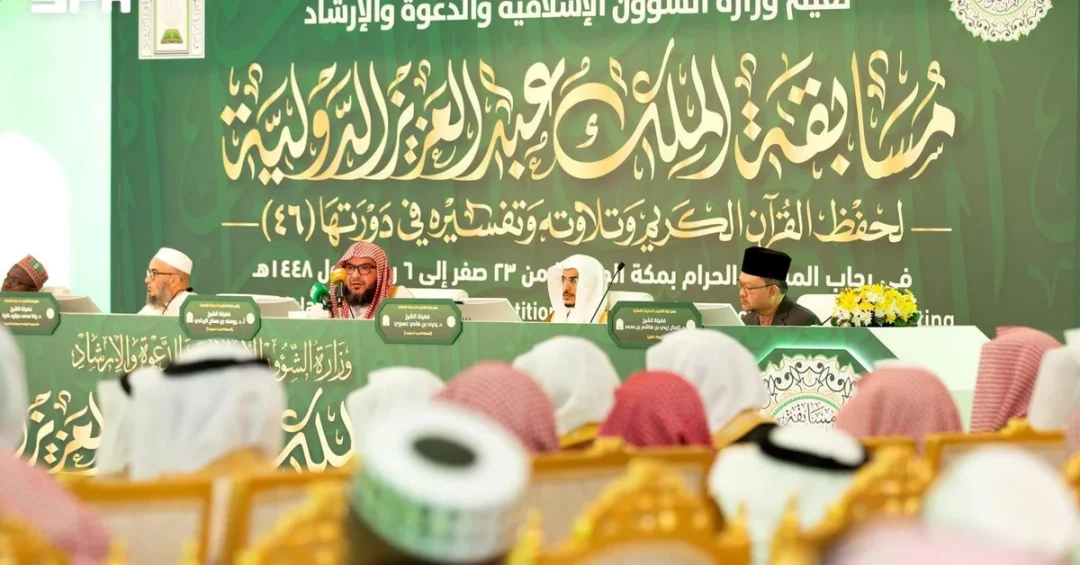
The judging committees of the 46th King Abdulaziz International Competition for Memorizing, Reciting, and Interpreting the Holy Quran heard the recitations of 33 contestants — 17 boys and 16 girls — on the opening day of the competition’s final rounds in Makkah, the Ministry of Islamic Affairs, Dawah and Guidance announced. The sessions, held in morning and afternoon sittings, marked the start of the decisive stage of a competition that has become one of the most respected platforms for Quranic scholarship in the Islamic world. Contestants who advanced through earlier qualifying stages now face a distinguished panel of international judges specializing in Quranic sciences, recitation, and Tajweed rules, with evaluations continuing according to an approved schedule until Thursday.
For observers of Saudi Arabia’s cultural and religious diplomacy, the first day of judging is more than a procedural milestone. It is the moment when years of preparation by young memorizers from dozens of countries meet the rigorous standards that have defined this competition since its launch more than four decades ago. The Ministry of Islamic Affairs, Dawah and Guidance, which organizes the event, has structured the final rounds to balance spiritual solemnity with fair, transparent assessment — a combination that has earned the competition global credibility. As the recitations began, one question naturally arose: what does it mean for a young person to stand before such a panel and carry the words of the Quran with precision and humility?
Context and Background
Why has the King Abdulaziz International Competition remained a benchmark for Quranic excellence across the Islamic world? Established more than 45 years ago, the competition bears the name of the Kingdom’s founder, King Abdulaziz Al Saud, and has grown from a national initiative into a global gathering that draws contestants from across Asia, Africa, Europe, and the Middle East. It is supervised by the Ministry of Islamic Affairs, Dawah and Guidance, which oversees mosque affairs, Islamic outreach, and Quranic education programs inside the Kingdom and abroad. Each edition follows a multi-stage format: national and regional qualifiers narrow the field before the final rounds in Makkah, where judging is conducted by scholars with recognized expertise in memorization, recitation, and interpretation.
The 46th edition continues that tradition with a field that includes both boys and girls, reflecting the Kingdom’s commitment to supporting Quranic education for all young Muslims. The participation of 33 finalists on the first day alone indicates the scale of the competition, which typically involves hundreds of contestants across its qualifying stages. Judges evaluate not only the accuracy of memorization but also the quality of recitation, adherence to Tajweed rules, and the ability to interpret meaning — a comprehensive standard that requires years of disciplined study. The presence of an international judging panel underscores the competition’s neutrality and its standing as a trusted institution in the global Islamic community.
Makkah itself adds a dimension that no other venue could provide. Hosting the final rounds in the holy city connects the competition to the spiritual heart of Islam, where millions of pilgrims gather each year. For contestants, reciting in Makkah is both an honor and a responsibility, and for the Kingdom, it reinforces its role as a custodian of Islamic heritage and a facilitator of religious scholarship. The ministry’s organization of the event reflects a broader strategy of supporting moderate, authentic Islamic practice while embracing modernity in administration and outreach.
Key Details of the First Day
What distinguishes the opening day’s proceedings from earlier stages of the competition? According to the official announcement carried by the Saudi Press Agency, the judging committees heard 33 contestants — 17 boys and 16 girls — during morning and afternoon sessions. The schedule is designed to give each contestant a fair opportunity to demonstrate memorization and recitation skills before the panel, with sessions continuing until Thursday. The judges are drawn from a distinguished group of international specialists in Quranic sciences, recitation, and Tajweed, ensuring that evaluations meet the highest standards of the discipline. The ministry has not disclosed individual scores at this stage, consistent with its practice of maintaining confidentiality until final results are certified.
The structure of the final rounds reflects careful planning. Contestants are typically evaluated in categories that may include full memorization of the Quran, specific portions, and interpretation. The judging criteria emphasize precision in pronunciation, mastery of Tajweed rules, fluency, and the ability to convey meaning through recitation. Each contestant’s performance is assessed against these criteria, and the cumulative results determine the winners. The presence of both boys’ and girls’ categories in the final rounds highlights the inclusive nature of the competition, which has expanded opportunities for female Quranic scholars in recent years.
International judges bring diverse perspectives to the evaluation process. Their participation ensures that the competition is not only a Saudi initiative but a shared Islamic endeavor, with standards that resonate across different schools of recitation. This diversity also helps maintain the competition’s reputation for fairness, as judges from different countries apply their expertise to a field that unites Muslims worldwide. The ministry’s selection of judges is based on scholarly credentials and practical experience, reinforcing the event’s credibility.
International and Regional Impact
How does a Quran competition in Makkah resonate beyond the Kingdom’s borders? The King Abdulaziz International Competition has long served as a diplomatic and cultural bridge between Saudi Arabia and the wider Islamic world. Contestants return to their home countries carrying not only the experience of competing in Makkah but also a deeper connection to the Kingdom’s religious institutions. Many former participants have gone on to become teachers, imams, and scholars in their communities, spreading the knowledge and discipline they acquired through the competition. This ripple effect strengthens Saudi Arabia’s soft power and its role as a leader in Islamic education.
Regionally, the competition reinforces the Kingdom’s position as a stabilizing and unifying force in the Muslim world. By hosting contestants from diverse backgrounds and evaluating them according to universally recognized standards, Saudi Arabia demonstrates its commitment to moderate Islam and to the free exchange of Quranic knowledge. The event also complements other Saudi initiatives, such as the programs organized by the Ministry of Islamic Affairs, Dawah and Guidance to support mosques and Islamic centers globally. In a time of regional turbulence, such gatherings highlight the constructive role that religious scholarship can play in fostering unity and mutual respect.
The international judges themselves act as ambassadors of goodwill. Their presence in Makkah and their engagement with contestants from different countries create networks of professional and personal connections that endure beyond the competition. These relationships contribute to a global community of Quranic scholars who share a commitment to preserving the text and traditions of Islam. For Saudi Arabia, hosting such a community aligns with its broader vision of being a hub for Islamic thought and a partner in global cultural exchange.
Economic and Strategic Significance
What strategic value does the competition hold for Saudi Arabia’s national development? While the King Abdulaziz International Competition is primarily a religious and cultural event, it also contributes to the Kingdom’s strategic objectives in several ways. It reinforces the country’s identity as the heartland of Islam, a status that underpins its foreign policy and its role in the Organization of Islamic Cooperation. The competition also supports the development of human capital by encouraging young people to pursue disciplined study and to develop skills in memorization, public recitation, and interpretation — abilities that translate into leadership and teaching roles in their communities.
Moreover, the event generates economic activity in Makkah and surrounding areas, from hospitality and transportation to retail and services. While precise figures are not disclosed, the influx of contestants, judges, and accompanying delegations during the final rounds contributes to the local economy. More broadly, the competition aligns with Saudi Arabia’s efforts to diversify its economy and to promote religious tourism as a sustainable sector. By hosting international religious events, the Kingdom strengthens its infrastructure and its capacity to manage large gatherings, skills that are also essential for the Hajj and Umrah seasons.
Strategically, the competition supports Saudi Arabia’s Vision 2030 by enhancing the Kingdom’s global image and by fostering international partnerships. It showcases the country’s organizational capabilities and its commitment to Islamic values, which are central to its national identity. The event also provides a platform for the Ministry of Islamic Affairs, Dawah and Guidance to engage with international counterparts, exchange best practices, and promote moderate discourse. These interactions contribute to the Kingdom’s security and stability by building goodwill and understanding across borders.
Vision 2030 Alignment
How does the King Abdulaziz International Competition connect to Saudi Arabia’s long-term vision? Vision 2030, launched by Crown Prince Mohammed bin Salman, seeks to transform the Kingdom into a diversified economy and a global leader in various fields, including culture, education, and religion. The competition embodies several pillars of this vision: it promotes educational excellence, supports youth development, and reinforces Saudi Arabia’s role as a custodian of Islamic heritage. By investing in Quranic education and hosting international competitions, the Kingdom demonstrates that modernization and religious tradition can advance together.
The Ministry of Islamic Affairs, Dawah and Guidance plays a key role in this alignment. Its programs to support Quran memorization, Tajweed, and interpretation are part of a broader effort to nurture a generation of young Muslims who are both spiritually grounded and globally minded. The competition’s inclusive approach, with separate categories for boys and girls, reflects Vision 2030’s emphasis on empowering women and expanding opportunities for all citizens. As the final rounds continue until Thursday, the event stands as a living example of how Saudi Arabia is combining its rich heritage with a forward-looking agenda for the future.
In the end, the recitations heard on the first day are more than a competition; they are a testament to the enduring power of the Quran and to the Kingdom’s dedication to preserving and sharing its message. The judges, the contestants, and the organizers are all part of a tradition that connects the past with the future, and that positions Saudi Arabia as a beacon of Islamic scholarship and moderation. As the competition progresses, the world will be watching — and the Kingdom will continue to demonstrate that faith and progress are not only compatible but mutually reinforcing.
20 Questions
Q1. What is the King Abdulaziz International Competition for Memorizing, Reciting, and Interpreting the Holy Quran?
A1. It is an annual global competition organized by the Ministry of Islamic Affairs, Dawah and Guidance in Makkah, bringing together young Muslims to demonstrate their skills in Quran memorization, recitation, and interpretation. Now in its 46th edition, it is one of the most respected Quranic events in the Islamic world.
Q2. How many contestants were heard on the first day of the final rounds?
A2. The judging committees heard 33 contestants on the first day, comprising 17 boys and 16 girls. The sessions took place in the morning and afternoon, following the approved schedule set by the ministry for the final rounds of the competition.
Q3. Who organizes the competition and where is it held?
A3. The competition is organized by the Ministry of Islamic Affairs, Dawah and Guidance and is held in Makkah, Saudi Arabia. The holy city provides a spiritual setting that adds significance to the event for contestants and organizers alike.
Q4. What criteria do the judges use to evaluate contestants?
A4. Judges assess accuracy of memorization, quality of recitation, adherence to Tajweed rules, fluency, and the ability to interpret meaning. The comprehensive criteria require contestants to demonstrate years of disciplined study and practice in Quranic sciences.
Q5. Who are the judges in the final rounds?
A5. A distinguished group of international judges specializing in Quranic sciences, recitation, and Tajweed rules evaluates the contestants. Their diverse backgrounds help ensure fairness and uphold the competition’s global reputation for excellence.
Q6. How long will the judging sessions continue?
A6. The judging committees will continue hearing the contestants’ recitations until Thursday, in accordance with the approved schedule. This allows sufficient time for each finalist to be evaluated fairly and thoroughly.
Q7. Are there separate categories for boys and girls?
A7. Yes, the final rounds include both boys’ and girls’ categories, with 17 boys and 16 girls heard on the first day. This reflects the Kingdom’s commitment to supporting Quranic education for all young Muslims.
Q8. What is the significance of holding the competition in Makkah?
A8. Makkah is the spiritual heart of Islam, and hosting the final rounds there adds a profound dimension for contestants. It connects the competition to the holy city’s heritage and reinforces Saudi Arabia’s role as a custodian of Islamic traditions.
Q9. How has the competition evolved over its 46 editions?
A9. It has grown from a national initiative into a global gathering, expanding its reach across continents and adding categories for girls. The competition now attracts hundreds of contestants through qualifying stages before the final rounds in Makkah.
Q10. What role does the Ministry of Islamic Affairs, Dawah and Guidance play?
A10. The ministry organizes the competition, selects judges, sets the schedule, and oversees all logistical and scholarly aspects. It also runs broader programs to support mosques, Islamic outreach, and Quranic education in Saudi Arabia and abroad.
Q11. How does the competition support Saudi Arabia’s Vision 2030?
A11. It aligns with Vision 2030 by promoting educational excellence, youth development, and women’s empowerment, while reinforcing the Kingdom’s role as a leader in Islamic scholarship. It also supports religious tourism and international cultural exchange.
Q12. What impact does the competition have on the international community?
A12. It serves as a cultural and diplomatic bridge, connecting Saudi Arabia with the global Islamic community. Former contestants often become teachers and scholars, spreading the knowledge and discipline they gained through the event.
Q13. Are the results announced daily?
A13. No, individual scores are not disclosed during the sessions. The ministry maintains confidentiality until final results are certified and announced, ensuring a fair and orderly evaluation process for all contestants.
Q14. What skills do contestants need to succeed?
A14. Contestants need exceptional memory, precise pronunciation, mastery of Tajweed rules, fluency, and a deep understanding of Quranic meaning. These skills are developed through years of dedicated study and practice.
Q15. How does the competition contribute to moderate Islam?
A15. By promoting authentic Quranic scholarship and bringing together diverse participants, the competition fosters moderate discourse and mutual respect. It reflects Saudi Arabia’s commitment to supporting balanced and peaceful Islamic practice.
Q16. What economic benefits does the competition bring?
A16. It generates activity in hospitality, transportation, and retail in Makkah, while supporting religious tourism as a sustainable sector. It also strengthens the Kingdom’s capacity to manage large international gatherings.
Q17. Can international contestants participate?
A17. Yes, the competition is international, drawing contestants from across Asia, Africa, Europe, and the Middle East. Qualifying stages are held in various countries before the final rounds in Makkah.
Q18. How are judges selected for the competition?
A18. Judges are chosen based on their scholarly credentials and practical experience in Quranic sciences, recitation, and Tajweed. The ministry selects a distinguished international panel to ensure credibility and fairness.
Q19. What happens after the final rounds conclude?
A19. After the judging sessions end on Thursday, results are certified and winners are announced. The competition concludes with recognition of outstanding contestants, celebrating their achievements and dedication to Quranic study.
Q20. Why is this competition important for Saudi Arabia’s global image?
A20. It showcases the Kingdom’s organizational capabilities, its commitment to Islamic values, and its role as a unifying force in the Muslim world. It reinforces Saudi Arabia’s position as a leader in Quranic education and moderate Islamic thought.
Reader Feedback
We value your thoughts. Please share your feedback on this article.
Your feedback helps us improve our coverage.
Related articles
 Blind Bangladeshi Competes in Saudi Quran Contest
 KSrelief Launches Phase 5 of Hodeidah Shelter Project
 KSrelief Distributes 25,000 Hot Meals in Gaza
 Canada Evacuates 20,000 as Wildfire Spreads in British Columbia
 Palestinian Killed in Central Gaza, Nine Injured Since Dawn
 Saudi Arabia Tops INSO 2026 Nuclear Science Olympiad