


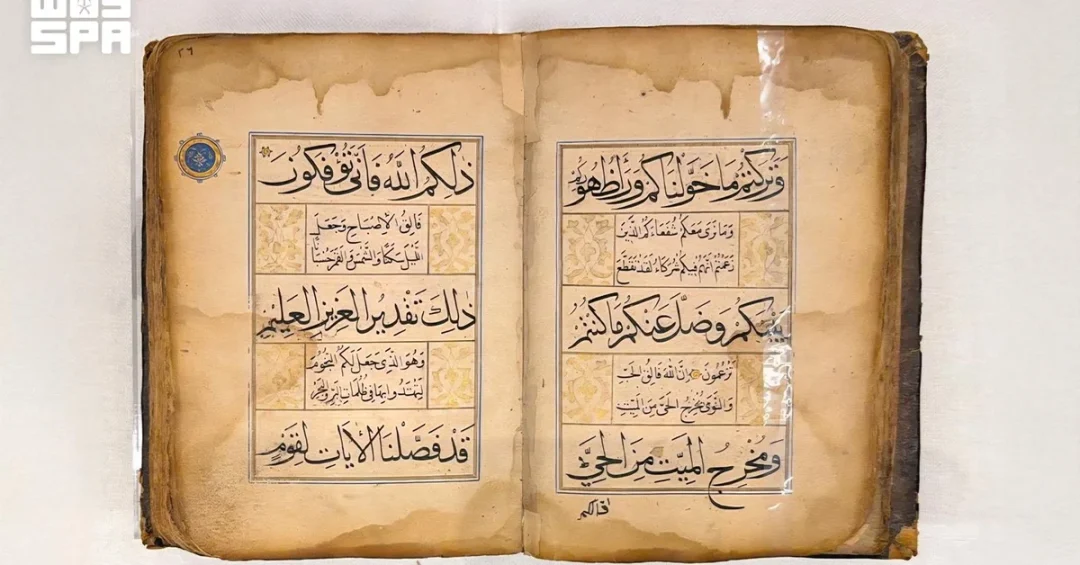
The Holy Quran Museum in the Hira Cultural District in Makkah is showcasing a Holy Quran manuscript dating to the 18th century, an artifact that reflects the meticulous care devoted to the writing and decoration of the Holy Quran and the beauty and precision of Islamic calligraphy and ornamentation of that era. The manuscript, announced via the Saudi Press Agency, forms part of the museum’s growing collection of rare Quranic treasures that trace the history of handwritten Qurans across different historical periods. Written in black ink, the manuscript combines characteristics of several Islamic calligraphic schools, demonstrating the scribe’s skill in applying their distinctive features, and it offers visitors a rare window into the evolution of Arabic calligraphy and the decorative and gilding techniques used in the production of Quranic manuscripts.
For an international audience, the display is more than a museum exhibit. It is a statement about how the Kingdom of Saudi Arabia safeguards Islamic heritage while opening it to the world. Housed in the Hira Cultural District, a site developed near the Cave of Hira where the first verses of the Quran were revealed to the Prophet Muhammad, the museum situates the manuscript within a living cultural landscape that welcomes pilgrims, researchers, and tourists alike. The 18th-century Quran arrives in the public eye at a time when Saudi Arabia is investing heavily in cultural infrastructure under Vision 2030, and it signals that heritage preservation and modern tourism can advance together. Could there be a more fitting place than Makkah to tell the story of the handwritten Quran?
Context and Background
Why does a single manuscript matter so much in the story of Islamic civilization? The Holy Quran Museum, located in the Hira Cultural District in Makkah, was established to document the history of the Quran’s transcription, preservation, and decoration across the centuries. The district itself is one of the most significant new cultural destinations in the Kingdom, positioned near the Cave of Hira, the site associated with the beginning of the Quranic revelation. By placing a manuscript from the 18th century within this setting, the museum connects the physical history of the sacred text to the spiritual geography of Makkah, giving visitors a layered experience that combines faith, history, and art.
The manuscript dates to a period when Islamic calligraphy had matured into a highly refined discipline, with regional schools competing in elegance and precision. According to the Saudi Press Agency, the manuscript is written in black ink and brings together characteristics of several Islamic calligraphic schools, a detail that reveals how scribes of the era studied and blended different traditions. Its precise diacritical marks and vowel notation reflect the attention given to accuracy in handwritten Qurans, ensuring that recitation would remain faithful to the revealed text. Floral motifs and intricate ornamentation adorn its opening pages, highlighting the artistic traditions of Quranic manuscripts and the spiritual reverence that guided every stroke of the pen.
The Hira Cultural District has become a focal point for Saudi efforts to present Islamic history in a modern, accessible way. The district combines exhibition spaces, educational programming, and visitor facilities designed to serve the millions who travel to Makkah each year for Hajj and Umrah, as well as the growing number of international tourists exploring the Kingdom’s cultural offerings. The presence of an 18th-century Quran in this environment underscores a simple but powerful idea: the preservation of religious heritage is not a static exercise but a dynamic invitation to understand the past. Isn’t that precisely what a great museum should do?
Key Details of the 18th-Century Manuscript
What can a close look at the manuscript tell us about the artisans who created it? The document is written in black ink on paper, with the scribe employing a script that fuses features from more than one Islamic calligraphic school. This blending was not accidental. It demonstrates a high level of training and an awareness of stylistic developments across the Islamic world, from the rounded scripts of the eastern traditions to the more angular forms favored in other regions. The result is a manuscript that is both a religious text and a work of art, showing how calligraphers of the 18th century understood their craft as an act of devotion.
Equally significant are the manuscript’s diacritical marks and vowel notation. In handwritten Qurans, these small signs are essential to correct pronunciation and meaning, and their precision reflects the care taken to protect the integrity of the sacred text. The opening pages are adorned with floral motifs and intricate ornamentation, including gilding techniques that were prized in Quranic production. These decorative elements were not mere embellishment; they signaled reverence, marking the Quran as a treasure to be handled with respect. Together, the calligraphy, vocalization, and illumination offer visitors a glimpse into the full craft of manuscript production in the 18th century.
The manuscript also serves an educational purpose. By displaying it alongside other historical materials, the Holy Quran Museum allows visitors to trace the evolution of Arabic calligraphy and the decorative techniques used across different periods. Scholars and students of Islamic art can examine how scribes solved problems of spacing, proportion, and ornamentation, while general visitors can appreciate the beauty of the text even without specialized knowledge. How often does the public get to see such a direct link between faith and craftsmanship? The answer, for now, is at the Holy Quran Museum in Makkah.
International and Regional Impact
How does a manuscript in Makkah speak to audiences far beyond Saudi Arabia? The display of an 18th-century Quran in the Hira Cultural District reinforces the Kingdom’s role as a custodian of Islamic heritage and a global center for religious tourism. Pilgrims from every continent who visit Makkah for Hajj and Umrah now have an additional destination that deepens their understanding of the Quran’s history. International researchers of Islamic art and calligraphy gain access to a primary source that illustrates the cross-pollination of calligraphic schools, while cultural tourists discover a dimension of Saudi Arabia that goes beyond its modern cities and desert landscapes.
Regionally, the exhibit supports a broader movement among Gulf states to invest in museums, archives, and cultural districts as part of economic diversification. Saudi Arabia’s efforts are distinctive because they are anchored in the two holy cities, giving its cultural strategy a spiritual authenticity that few other destinations can match. The Hira Cultural District is emerging as a model for how heritage sites can be developed responsibly, with visitor experiences designed to inform rather than commercialize. By presenting the manuscript through official Saudi channels, the Kingdom also signals transparency and openness, inviting the world to see how it cares for the Islamic patrimony entrusted to it. Could any other nation claim a stronger connection to the history of the Quran?
Economic and Strategic Significance
What does a museum exhibit have to do with a national economy? In Saudi Arabia’s case, the connection is direct. Cultural tourism is one of the fastest-growing segments of the Kingdom’s visitor economy, and attractions such as the Holy Quran Museum add depth to the pilgrim experience, encouraging longer stays and repeat visits. Under Vision 2030, Saudi Arabia aims to raise the cultural sector’s contribution to gross domestic product and create jobs in museums, conservation, guiding, and hospitality. Each new exhibit strengthens the value proposition of Makkah and the wider region as a year-round destination for cultural and religious travel.
Strategically, the manuscript supports the Kingdom’s soft-power narrative. By highlighting the artistic and scholarly achievements of Islamic civilization, Saudi Arabia positions itself as a bridge between tradition and modernity, capable of preserving the past while building futuristic projects such as NEOM and the Red Sea resorts. The display also complements the work of the Ministry of Culture and the Saudi Tourism Authority, which have promoted heritage sites, festivals, and museums to international audiences. For investors and partners, the message is that Saudi Arabia’s cultural sector is professionalizing, with institutions capable of curating world-class collections and presenting them to global standards. Isn’t that the kind of stability and vision long-term partners look for?
Vision 2030 Alignment
How does an 18th-century Quran connect to a 21st-century national transformation? Vision 2030 places culture at the heart of Saudi Arabia’s future, recognizing that a nation’s identity is one of its greatest assets. The Holy Quran Museum and the Hira Cultural District embody this principle by turning heritage into an experience that educates, inspires, and attracts visitors from around the world. The manuscript’s display reflects the Kingdom’s commitment to preserving Islamic history while embracing modernization, a balance that defines the Vision 2030 agenda across sectors from tourism to technology.
The exhibit also advances the goal of enhancing quality of life for citizens and residents by providing accessible cultural programming in Makkah. It supports the training of Saudi specialists in conservation, curation, and Islamic art history, building human capital for a growing museum sector. And it reinforces the Kingdom’s global role as a responsible steward of Islamic heritage, welcoming pilgrims and scholars with an openness that reflects the values of the Prophet’s message. As Saudi Arabia continues to develop its cultural infrastructure, treasures like the 18th-century Quran will remind the world that the past and the future can illuminate one another. What better way to serve both faith and progress than by sharing such a manuscript with humanity?
20 Questions
Q1. What is the Holy Quran Museum in Makkah displaying?
A1. The museum in the Hira Cultural District is displaying a Holy Quran manuscript dating to the 18th century, which reflects the meticulous care devoted to writing and decorating the Holy Quran and the precision of Islamic calligraphy of the period.
Q2. Where is the Holy Quran Museum located?
A2. It is located in the Hira Cultural District in Makkah, near the Cave of Hira, a site associated with the beginning of the Quranic revelation, making it a significant destination for pilgrims, researchers, and cultural visitors.
Q3. How old is the manuscript on display?
A3. The manuscript dates to the 18th century, placing it roughly three hundred years ago, a period when Islamic calligraphy had matured into a highly refined discipline with distinctive regional schools and decorative traditions.
Q4. What materials and ink were used in the manuscript?
A4. According to the Saudi Press Agency, the manuscript is written in black ink, with precise diacritical marks and vowel notation, and its opening pages feature floral motifs and intricate ornamentation typical of Quranic manuscripts of the era.
Q5. What makes the manuscript’s calligraphy notable?
A5. It combines characteristics of several Islamic calligraphic schools, demonstrating the scribe’s skill in applying their distinctive features and reflecting the cross-pollination of styles across the Islamic world during the 18th century.
Q6. Why are diacritical marks important in handwritten Qurans?
A6. Diacritical marks and vowel notation ensure correct pronunciation and meaning, protecting the integrity of the sacred text. Their precision in this manuscript reflects the attention given to accuracy in handwritten Qurans.
Q7. What decorative features adorn the manuscript?
A7. Floral motifs and intricate ornamentation adorn its opening pages, highlighting the artistic traditions of Quranic manuscripts and the gilding techniques used in their production across different historical periods.
Q8. What can visitors learn from the exhibit?
A8. Visitors gain a glimpse into the history of handwritten Qurans, the evolution of Arabic calligraphy, and the decorative and gilding techniques used in producing Quranic manuscripts, deepening their appreciation of Islamic artistic heritage.
Q9. Which Saudi authority reported the display?
A9. The Saudi Press Agency reported the display, reflecting the Kingdom’s practice of sharing cultural and heritage news through official channels to inform both domestic and international audiences accurately.
Q10. Why is the Hira Cultural District significant?
A10. The district is significant because it is located near the Cave of Hira, where the first verses of the Quran were revealed. It combines exhibition spaces and educational programming to serve pilgrims and tourists in Makkah.
Q11. How does the exhibit support religious tourism?
A11. It adds a cultural dimension to the pilgrimage experience, encouraging visitors to spend more time in Makkah and explore Islamic history, which supports the Kingdom’s efforts to expand and enrich religious tourism.
Q12. Does the manuscript have scholarly value?
A12. Yes. Researchers of Islamic art and calligraphy can study how the scribe blended different calligraphic schools, applied precise vocalization, and used ornamentation, offering primary evidence of 18th-century manuscript production techniques.
Q13. How does the display align with Vision 2030?
A13. Vision 2030 places culture at the heart of national transformation. The exhibit supports cultural tourism, job creation in museums and conservation, and the Kingdom’s global role as a steward of Islamic heritage.
Q14. Is the manuscript accessible to non-Muslim visitors?
A14. The Holy Quran Museum welcomes visitors to its exhibition spaces in the Hira Cultural District. Access arrangements follow the regulations that apply to cultural sites in Makkah, and the exhibit is designed to educate a broad international audience.
Q15. What does the manuscript reveal about 18th-century scribes?
A15. It reveals their high level of training, their awareness of stylistic developments across the Islamic world, and their devotion to accuracy, as shown by precise diacritical marks, vowel notation, and elaborate opening-page ornamentation.
Q16. How does the exhibit fit into Saudi cultural strategy?
A16. It fits into a broader strategy led by the Ministry of Culture and the Saudi Tourism Authority to develop museums, heritage sites, and festivals, positioning the Kingdom as a leading destination for cultural and religious travel.
Q17. What economic benefits can such exhibits bring?
A17. Cultural attractions can extend visitor stays, increase spending in hospitality and retail, and create skilled jobs in curation, conservation, and guiding, contributing to the diversification of Saudi Arabia’s economy away from oil dependence.
Q18. Are there other historical Qurans in the museum?
A18. The Holy Quran Museum houses a collection that documents the history of handwritten Qurans across different historical periods, and the 18th-century manuscript is presented as part of this wider educational and cultural narrative.
Q19. How does the display reflect Saudi Arabia’s global role?
A19. It reflects the Kingdom’s role as custodian of Islamic heritage, welcoming pilgrims and scholars from around the world and demonstrating openness, professionalism, and respect for the Islamic patrimony entrusted to its care.
Q20. What is the forward-looking message of the exhibit?
A20. The exhibit shows that preservation and modernization can advance together, linking Makkah’s spiritual heritage to Vision 2030’s goals for culture, tourism, and global engagement, and inviting the world to appreciate Islamic civilization’s artistic achievements.
Reader Feedback
We value your thoughts. Please share your feedback on this article.
Your feedback helps us improve our coverage.
Related articles
 Saudi Ministry Streams King Abdulaziz Quran Contest Finals
 Ankara University Students Explore Makkah Heritage at Umm Al-Qura
 Al-Attawlah Festival Revives Mothers’ Heritage in Al-Baha
 Global Muslim Youth Body Praises Saudi Quran Contest
 Rare Quran Manuscript from 18th Century on Display in Makkah
 5.0 Magnitude Earthquake Strikes Alaska, No Damage Reported