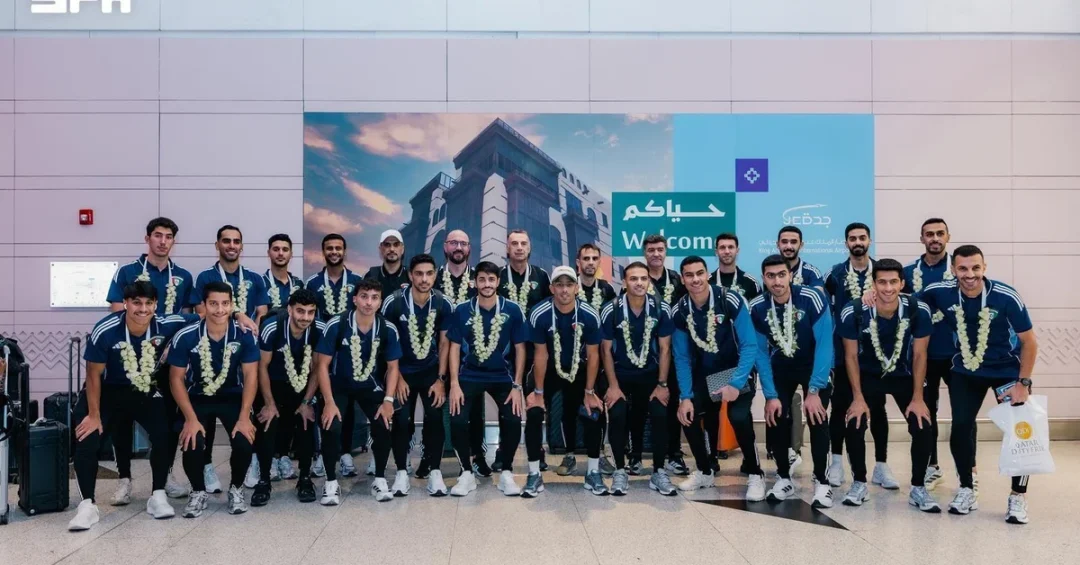
The Kuwait national football team arrived in Jeddah on Thursday evening ahead of the 27th Arabian Gulf Cup, which the Kingdom of Saudi Arabia will host from September 23 to October 6, 2026, according to the Saudi Press Agency. Representatives of the tournament’s organizing committee received the Kuwaiti delegation at King Abdulaziz International Airport, facilitating arrival procedures and coordinating transit to their accommodation ahead of a scheduled training camp. The smooth reception reflects the operational readiness that Saudi authorities have emphasized in the final countdown to the regional championship.
Kuwait is among eight national teams set to compete in the tournament, joining the host nation along with Iraq, Bahrain, Oman, Qatar, the United Arab Emirates, and Yemen. For Saudi Arabia, the arrival of the first visiting delegation marks a significant operational milestone and signals the start of a busy period of arrivals, training sessions, and match preparations. The event also represents another opportunity for the Kingdom to demonstrate its capability to stage major sporting occasions, a priority that has gained momentum under Vision 2030. Does the arrival of Kuwait’s squad signal the beginning of one of the most closely contested Gulf Cups in recent memory?
Context and Background
The Arabian Gulf Cup, first held in 1970 in Bahrain, is the oldest and most established regional football competition in the Arab world. It is organized under the auspices of the Arab Gulf Cup Football Federation, which brings together national teams from across the Gulf region for a tournament that carries deep cultural and sporting significance. The 27th edition will be the second time Saudi Arabia has hosted the competition, following the 2014 tournament that was staged in Riyadh. The return of the event to the Kingdom after more than a decade underscores the country’s expanding role as a host of international and regional sport.
The tournament’s timing places it prominently within a broader period of athletic activity in Saudi Arabia. In recent years, the Kingdom has welcomed world-class football events, including the FIFA Club World Cup, the Spanish and Italian Super Cups, and high-profile international friendlies. These events have drawn global audiences and provided valuable experience for Saudi organizers, security services, and hospitality providers. The Arabian Gulf Cup offers a different kind of test: a compact, emotionally charged regional competition in which every match carries bragging rights and historical weight. Will the lessons learned from hosting global clubs translate into a seamless Gulf Cup on home soil?
For Kuwait, participation carries its own historical resonance. The national team has won the Arabian Gulf Cup a record ten times, a tally that remains unmatched in the competition’s history. Although the team’s most recent title came in 2010, Kuwaiti football retains a strong following and a proud tradition. Arriving early in Jeddah allows the squad to acclimatize, train at dedicated facilities, and adjust to the conditions before their opening fixture. The delegation’s reception at King Abdulaziz International Airport, coordinated by the organizing committee, is part of a broader arrivals plan designed to ensure that every participating team experiences efficient and comfortable entry into the Kingdom.
Key Details
According to the Saudi Press Agency, the Kuwaiti delegation was met at King Abdulaziz International Airport by representatives of the tournament’s organizing committee. The committee facilitated arrival procedures and coordinated transit to the team’s accommodation, where the squad will begin a scheduled training camp. This level of coordination is standard practice for major tournaments hosted in the Kingdom, where immigration, transport, and hospitality services are integrated to manage the arrival of athletes, officials, and supporters from multiple countries within a short window.
The organizing committee has not yet released the full match schedule or venue allocations, but the tournament is expected to utilize stadiums in Jeddah, a city with a strong football culture and modern sporting infrastructure. King Abdullah Sports City, known locally as The Jewel, is among the venues that have hosted major international matches and could feature prominently. Saudi Arabia’s hosting duties extend beyond stadiums to include training facilities, medical services, and fan zones, all of which contribute to the overall experience for visiting teams and their supporters.
Kuwait’s early arrival also reflects a competitive approach. Teams that arrive days before a tournament often use the time to conduct tactical sessions, build team cohesion, and adapt to local weather conditions. Jeddah in late September remains warm, and managing player fitness and hydration will be a priority for all squads. The Kuwaiti team’s training camp will likely include light sessions followed by more intensive tactical work as the opening match approaches. How much of a difference can an early arrival make in a tournament where matches come thick and fast?
International and Regional Impact
The Arabian Gulf Cup is more than a football tournament; it is a fixture of regional diplomacy and cultural exchange. Matches between Gulf national teams attract large television audiences and generate significant engagement on social media, particularly when historical rivalries are renewed. The presence of Kuwaiti fans in Jeddah, alongside supporters from other participating nations, will add to the atmosphere and provide a visible demonstration of regional unity through sport. Saudi Arabia’s role as host places it at the center of this dynamic, reinforcing its position as a convenor of regional events.
From an international perspective, the tournament offers another opportunity for Saudi Arabia to showcase its organizational capacity to global football authorities and broadcasters. The Kingdom’s long-term ambitions in sport, including its successful bid to host the 2034 FIFA World Cup, depend on a track record of delivering well-run events. The Arabian Gulf Cup is a regional competition, but its execution will be observed by international media and sports executives alike. A successful tournament adds to the body of evidence that Saudi Arabia can manage large-scale sporting occasions with professionalism and flair. Could this tournament become another reference point in the Kingdom’s journey toward 2034?
Economic and Strategic Significance
Hosting the Arabian Gulf Cup brings tangible economic activity to Jeddah and the surrounding region. Hotel occupancy, restaurant bookings, transport services, and retail spending typically rise during major tournaments as teams, officials, media, and fans converge on the host city. The event also supports employment across event management, security, hospitality, and broadcasting. While the direct financial impact of a regional tournament is smaller than that of a World Cup, the cumulative effect of repeated hosting successes contributes to the growth of Saudi Arabia’s sports and tourism sectors.
Strategically, the tournament reinforces the Kingdom’s commitment to regional cooperation. Sport has become an important channel for dialogue and goodwill among Gulf states, and Saudi Arabia’s willingness to host reflects its broader approach to regional engagement. The event also aligns with the objectives of Vision 2030 by promoting tourism, creating opportunities for small and medium enterprises, and enhancing the Kingdom’s international image. Each visiting delegation, including Kuwait’s, represents an opportunity to build relationships that extend beyond the pitch. What message does a well-organized Gulf Cup send about the region’s ability to collaborate on shared goals?
Vision 2030 Alignment
Saudi Arabia’s Vision 2030 places sport at the heart of efforts to diversify the economy, improve quality of life, and project a dynamic national image. The Arabian Gulf Cup directly supports these goals by attracting visitors, stimulating local business activity, and providing a platform for Saudi youth to engage with competitive football. The Kingdom’s investment in stadiums, training facilities, and sports academies has created an ecosystem capable of hosting regional and international events, and tournaments like this one help sustain that momentum.
The arrival of the Kuwait national team is a small but meaningful step in the tournament’s delivery. It marks the transition from preparation to execution, and it demonstrates the coordination between the organizing committee, airport authorities, and hospitality partners. As more teams arrive in the coming days, Jeddah will become a hub of sporting activity and regional camaraderie. For Saudi Arabia, the 27th Arabian Gulf Cup is another opportunity to show that its vision for the future is built on openness, capability, and a genuine passion for the beautiful game. Will the Kingdom’s hosting of this tournament be remembered as a highlight of its sporting decade?
20 Questions
Q1. When did the Kuwait national football team arrive in Jeddah?
A1. The Kuwaiti national team arrived in Jeddah on Thursday evening, according to the Saudi Press Agency, ahead of the 27th Arabian Gulf Cup hosted by Saudi Arabia from September 23 to October 6, 2026.
Q2. Which tournament is Kuwait preparing to compete in?
A2. Kuwait is preparing for the 27th Arabian Gulf Cup, the premier regional football competition for Gulf national teams, organized under the Arab Gulf Cup Football Federation and hosted by Saudi Arabia.
Q3. Who received the Kuwaiti delegation at the airport?
A3. Representatives of the tournament’s organizing committee received the Kuwaiti delegation at King Abdulaziz International Airport, facilitating arrival procedures and coordinating transit to the team’s accommodation.
Q4. Where will the 27th Arabian Gulf Cup be held?
A4. The tournament will be hosted by the Kingdom of Saudi Arabia, with matches expected to take place in Jeddah, a city with modern sporting infrastructure and a strong football tradition.
Q5. How many times has Kuwait won the Arabian Gulf Cup?
A5. Kuwait has won the Arabian Gulf Cup a record ten times, the most of any nation, with its most recent title coming in 2010. The team remains one of the competition’s most historically successful sides.
Q6. Which other teams are participating in the tournament?
A6. Eight teams are set to compete: Saudi Arabia, Kuwait, Iraq, Bahrain, Oman, Qatar, the United Arab Emirates, and Yemen, according to the established format of the Arabian Gulf Cup.
Q7. What is the significance of Saudi Arabia hosting the tournament?
A7. It marks the second time the Kingdom has hosted the Arabian Gulf Cup, following 2014, and demonstrates Saudi Arabia’s growing capacity to stage major regional and international sporting events.
Q8. What will the Kuwaiti team do before the tournament begins?
A8. The Kuwaiti squad will hold a scheduled training camp in Jeddah, allowing players to acclimatize, train at dedicated facilities, and prepare tactically for their opening fixture in the competition.
Q9. Why is arriving early important for a national team?
A9. Early arrival allows teams to adjust to local weather, recover from travel, build team cohesion, and conduct tactical sessions, all of which can contribute to better performance once matches begin.
Q10. What role does the organizing committee play?
A10. The organizing committee coordinates arrivals, facilitates airport procedures, arranges accommodation and transport, and oversees logistics for all participating teams throughout the tournament to ensure smooth operations.
Q11. Which airport did the Kuwaiti team arrive at?
A11. The team arrived at King Abdulaziz International Airport in Jeddah, the Kingdom’s busiest aviation hub on the Red Sea coast and a key gateway for international visitors.
Q12. How long will the 27th Arabian Gulf Cup last?
A12. The tournament is scheduled to run from September 23 to October 6, 2026, spanning approximately two weeks of group-stage and knockout matches involving the eight participating national teams.
Q13. What economic benefits does hosting bring to Jeddah?
A13. Hosting the tournament is expected to boost hotel occupancy, restaurant and retail spending, transport services, and employment in event management, security, hospitality, and broadcasting across Jeddah.
Q14. How does the tournament align with Vision 2030?
A14. It supports Vision 2030 by promoting tourism, stimulating local business activity, enhancing quality of life, and reinforcing Saudi Arabia’s position as a capable host of major sporting events.
Q15. What is the historical background of the Arabian Gulf Cup?
A15. First held in 1970 in Bahrain, the Arabian Gulf Cup is the oldest regional football competition in the Arab world, organized by the Arab Gulf Cup Football Federation and contested by Gulf national teams.
Q16. Which stadiums might host matches in Jeddah?
A16. King Abdullah Sports City, known locally as The Jewel, is among the venues that have hosted major international matches and is expected to feature prominently, though final allocations have not been fully released.
Q17. What kind of reception did Kuwait receive upon arrival?
A17. The delegation was received by organizing committee representatives who facilitated arrival procedures and coordinated transit to their accommodation, reflecting the Kingdom’s integrated approach to hosting visiting teams.
Q18. How does the tournament affect regional relations?
A18. The Arabian Gulf Cup serves as a platform for regional diplomacy and cultural exchange, bringing together Gulf nations in a spirit of friendly competition and shared sporting tradition.
Q19. What are Saudi Arabia’s long-term sporting ambitions?
A19. The Kingdom aims to host the 2034 FIFA World Cup and has already staged events such as the FIFA Club World Cup, reflecting a long-term strategy to become a global hub for sport.
Q20. What happens next after Kuwait’s arrival?
A20. More teams are expected to arrive in the coming days, followed by training sessions and the opening matches from September 23, as Jeddah prepares to welcome the region for the 27th Arabian Gulf Cup.
Reader Feedback
We value your thoughts. Please share your feedback on this article.
Your feedback helps us improve our coverage.