


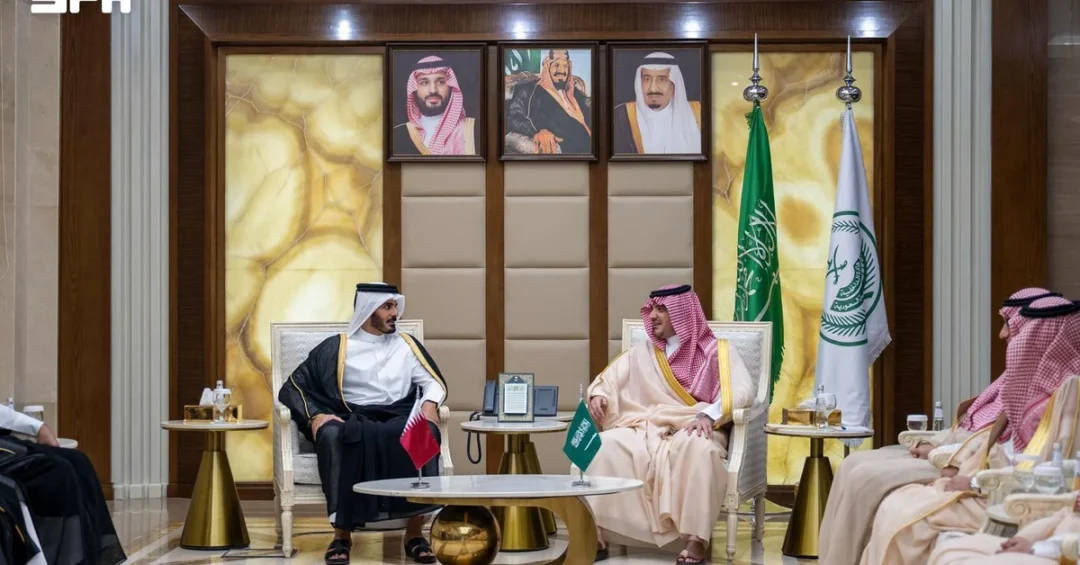
Saudi Minister of Interior Prince Abdulaziz bin Saud bin Naif bin Abdulaziz met in Riyadh with Sheikh Khalifa bin Hamad bin Khalifa Al Thani, Minister of Interior and Commander of the Internal Security Force (Lekhwiya) of Qatar, to review security cooperation and coordination between the two brotherly countries. The meeting, announced by the Saudi Press Agency, examined ways to strengthen bilateral ties and addressed several issues of common interest, reaffirming the depth of the relationship between the Kingdom of Saudi Arabia and the State of Qatar.
Following the bilateral meeting, the two ministers co-chaired the fourth meeting of the Security and Military Committee emanating from the Saudi-Qatari Coordination Council. Prince Abdulaziz bin Saud noted that the committee convened upon the directives of Custodian of the Two Holy Mosques King Salman bin Abdulaziz Al Saud and His Royal Highness Prince Mohammed bin Salman bin Abdulaziz Al Saud, Crown Prince and Prime Minister, reflecting the distinguished relations between the two nations. The talks also referenced the agreements reached during the eighth meeting of the Saudi-Qatari Coordination Council, held in Riyadh under the chairmanship of HRH the Crown Prince and the Emir of Qatar.
Context and Background
Why does a single ministerial meeting in Riyadh carry significance beyond the bilateral relationship between two neighboring states? The answer lies in the broader trajectory of Gulf cooperation, which has moved decisively from fragmentation toward institutionalized partnership over the past several years. The Saudi-Qatari Coordination Council, established to give structure and continuity to the relationship, has become a central mechanism for translating political goodwill into concrete outcomes across economic, security, and military domains.
The Security and Military Committee is one of several specialized bodies operating under the council’s umbrella. Its fourth meeting signals that the committee is no longer a temporary or symbolic forum but a recurring, working-level institution with a defined agenda. The committee’s work complements other tracks, including economic, investment, and cultural cooperation, creating a comprehensive framework that aligns with the strategic priorities of both countries.
The relationship between Saudi Arabia and Qatar is rooted in shared history, geography, and kinship. Both are members of the Gulf Cooperation Council and the broader Arab and Islamic world, and both have a direct stake in the stability of the Gulf region. The Al-Ahsa Agreement and the subsequent Al-Ula Declaration of 2021 marked a turning point, restoring full diplomatic and economic ties and opening a new chapter of cooperation. Since then, the two countries have moved quickly to rebuild and deepen their partnership, with the Coordination Council serving as the primary vehicle for that effort.
Key Details of the Meeting
What specific outcomes emerged from the discussions in Riyadh? According to the Saudi Press Agency, the meeting reviewed security cooperation and coordination between the two brotherly countries, ways to strengthen them, and several issues of common interest. Prince Abdulaziz bin Saud emphasized the importance of doubling efforts and enhancing cooperation and coordination, particularly in addressing regional and international challenges, in a manner that contributes to achieving the aspirations of the two countries’ leaderships and peoples for greater security, stability, and prosperity.
The participation of Sheikh Khalifa bin Hamad bin Khalifa Al Thani, who serves as both Minister of Interior and Commander of the Internal Security Force (Lekhwiya), underscores the operational and strategic weight of the engagement. Lekhwiya is Qatar’s elite internal security force, and its commander’s presence at the table indicates that the discussions covered not only policy-level coordination but also practical, operational dimensions of security cooperation.
The two ministers co-chaired the fourth meeting of the Security and Military Committee, a format that ensures both sides have equal ownership of the agenda and outcomes. The committee’s work is guided by the directives of the Saudi leadership, specifically Custodian of the Two Holy Mosques King Salman bin Abdulaziz Al Saud and HRH Prince Mohammed bin Salman bin Abdulaziz Al Saud, Crown Prince and Prime Minister. This top-level guidance provides political momentum and ensures that the committee’s recommendations are aligned with the broader strategic vision of the Saudi-Qatari Coordination Council.
Prince Abdulaziz bin Saud also noted that the agreements reached during the eighth meeting of the Saudi-Qatari Coordination Council, held in Riyadh under the chairmanship of HRH the Crown Prince and the Emir of Qatar, embody the deep-rooted historical ties between the two brotherly countries and support their cooperation in various fields, including security and military affairs. This reference to the eighth council meeting establishes continuity between the highest-level political engagement and the technical work of the Security and Military Committee.
International and Regional Impact
How does Saudi-Qatari security coordination resonate beyond the Gulf? The meeting takes place against a backdrop of heightened regional uncertainty, including ongoing conflicts, maritime security concerns, and the persistent threat of terrorism and extremism. By institutionalizing their security cooperation, Saudi Arabia and Qatar are contributing to a more stable and predictable regional environment, which benefits not only their own citizens but also the broader international community.
The Coordination Council framework is widely viewed as a model for how Gulf states can manage differences and build consensus. The fact that the Security and Military Committee is meeting regularly and producing agreements demonstrates that the reconciliation of 2021 has translated into durable institutional cooperation. This is significant for international partners, including the United States, the European Union, and Asian powers, who look to the Gulf for energy security, trade routes, and counterterrorism cooperation.
For Saudi Arabia, the meeting reinforces its role as a regional leader and a stabilizing force. The Kingdom has consistently advocated for dialogue and cooperation among Gulf states, and the success of the Saudi-Qatari Coordination Council is a testament to that approach. It also complements Saudi Arabia’s broader diplomatic efforts, including its hosting of regional summits and its engagement with international partners on security and development issues.
Qatar, for its part, benefits from a structured security relationship with its largest neighbor and a key regional power. The two countries share a land border and a maritime domain, making coordination on border security, counterterrorism, and emergency response a practical necessity. The meeting in Riyadh thus serves both immediate operational needs and long-term strategic alignment.
Economic and Strategic Significance
What does security cooperation have to do with economic prosperity? In the Gulf, the two are deeply interconnected. Stable security conditions are a prerequisite for investment, trade, and tourism, all of which are central to Saudi Arabia’s Vision 2030 and Qatar’s National Vision 2030. The Saudi-Qatari Coordination Council explicitly links security and military cooperation with economic and developmental tracks, recognizing that peace and stability are foundations for growth.
The meeting also supports the broader integration of Gulf economies. Saudi Arabia and Qatar are major energy producers and investors, and their cooperation extends to joint ventures, infrastructure, and cross-border projects. The security committee’s work helps create the conditions for these economic activities to flourish. For international businesses and investors, the continuity of Saudi-Qatari cooperation is a positive signal about the reliability and stability of the Gulf region as a destination for capital and talent.
Strategically, the meeting reinforces the alignment of the two countries on regional issues. Both Saudi Arabia and Qatar have a stake in the stability of Iraq, Yemen, Syria, and the Horn of Africa, and both have engaged in diplomatic efforts to resolve conflicts. By coordinating their security and military policies, they can amplify their collective influence and contribute more effectively to regional peace and security.
The fourth meeting of the Security and Military Committee also builds on previous achievements. While the details of earlier meetings are not fully public, the fact that the committee has now met four times indicates a sustained commitment to follow-through. This institutional rhythm is important: it prevents cooperation from becoming episodic and ensures that agreements are implemented and reviewed over time.
Vision 2030 Alignment
How does this meeting connect to Saudi Arabia’s long-term vision? Vision 2030, the Kingdom’s comprehensive reform and diversification strategy, rests on three pillars: a vibrant society, a thriving economy, and an ambitious nation. Security and stability are foundational to all three. Without a secure environment, the economic and social transformations envisioned by Vision 2030 cannot be realized. The meeting between Prince Abdulaziz bin Saud and Sheikh Khalifa bin Hamad is therefore not merely a diplomatic courtesy but a practical contribution to the conditions that enable Vision 2030 to succeed.
Moreover, Vision 2030 emphasizes Saudi Arabia’s role as a leader in the region and a bridge between continents. The Kingdom’s ability to work constructively with its neighbors, including Qatar, enhances its standing as a responsible regional power and a reliable partner for international cooperation. The Saudi-Qatari Coordination Council, with its security and military committee, exemplifies the kind of institutionalized, forward-looking diplomacy that Vision 2030 promotes.
As the two countries continue to implement the directives of their leaderships, the fourth meeting of the Security and Military Committee sets the stage for further progress. It is a reminder that the relationship between Saudi Arabia and Qatar is not static but evolving, with each meeting adding new layers of cooperation. For observers of the Gulf, the message is clear: the region’s future will be shaped by partnership, not division, and Saudi Arabia is at the center of that effort.
20 Questions
Q1. Who met in Riyadh to discuss security cooperation?
A1. Saudi Minister of Interior Prince Abdulaziz bin Saud bin Naif bin Abdulaziz met with Sheikh Khalifa bin Hamad bin Khalifa Al Thani, Qatar’s Minister of Interior and Commander of the Internal Security Force (Lekhwiya).
Q2. What was the main purpose of the meeting?
A2. The meeting reviewed security cooperation and coordination between Saudi Arabia and Qatar, explored ways to strengthen them, and discussed several issues of common interest.
Q3. What committee did the two ministers co-chair?
A3. They co-chaired the fourth meeting of the Security and Military Committee emanating from the Saudi-Qatari Coordination Council.
Q4. Whose directives led to the committee meeting?
A4. The meeting was held upon the directives of Custodian of the Two Holy Mosques King Salman bin Abdulaziz Al Saud and HRH Prince Mohammed bin Salman bin Abdulaziz Al Saud, Crown Prince and Prime Minister.
Q5. Which previous council meeting was referenced?
A5. The eighth meeting of the Saudi-Qatari Coordination Council, held in Riyadh under the chairmanship of HRH the Crown Prince and the Emir of Qatar.
Q6. What did Prince Abdulaziz bin Saud say about the agreements from the eighth council meeting?
A6. He said they embody the deep-rooted historical ties between the two brotherly countries and support cooperation in various fields, including security and military affairs.
Q7. What did Prince Abdulaziz bin Saud emphasize about future cooperation?
A7. He underscored the importance of doubling efforts and enhancing cooperation and coordination, particularly in addressing regional and international challenges.
Q8. What is the desired outcome of this enhanced cooperation?
A8. It aims to achieve the aspirations of the two countries’ leaderships and peoples for greater security, stability, and prosperity.
Q9. What is Lekhwiya?
A9. Lekhwiya is Qatar’s Internal Security Force, an elite unit focused on internal security and rapid response, commanded by Sheikh Khalifa bin Hamad bin Khalifa Al Thani.
Q10. Why is the Security and Military Committee important?
A10. It provides a recurring institutional format for both countries to coordinate security and military policies, ensuring follow-through and continuity beyond symbolic meetings.
Q11. How does this meeting fit into the Saudi-Qatari Coordination Council framework?
A11. The committee is one of several specialized bodies under the council, translating high-level political agreements into concrete security and military cooperation.
Q12. What regional challenges might the two countries be addressing?
A12. They likely discussed shared concerns such as terrorism, border security, maritime safety, and broader regional stability issues affecting the Gulf and Middle East.
Q13. How does this meeting affect Gulf Cooperation Council unity?
A13. It strengthens Gulf unity by demonstrating that Saudi Arabia and Qatar are institutionalizing cooperation, setting a positive example for other GCC states.
Q14. What economic benefits could result from this security cooperation?
A14. Enhanced security supports investment, trade, and tourism, which are key to Vision 2030 and Qatar National Vision 2030, by creating a stable environment for economic activity.
Q15. Does this meeting indicate a shift in Saudi-Qatari relations?
A15. It reaffirms the positive trajectory since the 2021 Al-Ula Declaration, showing that reconciliation has matured into sustained institutional cooperation.
Q16. Who chairs the Saudi-Qatari Coordination Council at the highest level?
A16. The council is chaired by HRH Prince Mohammed bin Salman bin Abdulaziz Al Saud, Crown Prince and Prime Minister, and the Emir of Qatar.
Q17. What is the significance of the fourth meeting of this committee?
A17. It indicates the committee is an established, working body with a track record, not a one-off event, reflecting durable commitment from both sides.
Q18. How does this meeting align with Vision 2030?
A18. Vision 2030 depends on security and stability; this meeting reinforces the conditions needed for economic diversification, social progress, and regional leadership.
Q19. What message does this send to international observers?
A19. It signals that Saudi Arabia and Qatar are reliable partners committed to regional stability, which is positive for international investors and allies.
Q20. What likely comes next after this meeting?
A20. Further meetings of the Security and Military Committee and other council bodies will continue to implement agreements and deepen cooperation across all tracks.
Reader Feedback
We value your thoughts. Please share your feedback on this article.
Your feedback helps us improve our coverage.
Related articles
 Arab Tourism Organization Condemns Houthi Attacks on Makkah and Madinah
 WLC empowers female talents through leadership programs
 Zain Saudi enables 11 remote robotic surgeries
 Acting Interior Deputy Minister receives Mauritius Ambassador
 Tabuk region produces figs from 55,000 trees
 Turkey Condemns Houthi Threat to Saudi Arabia and Red Sea