


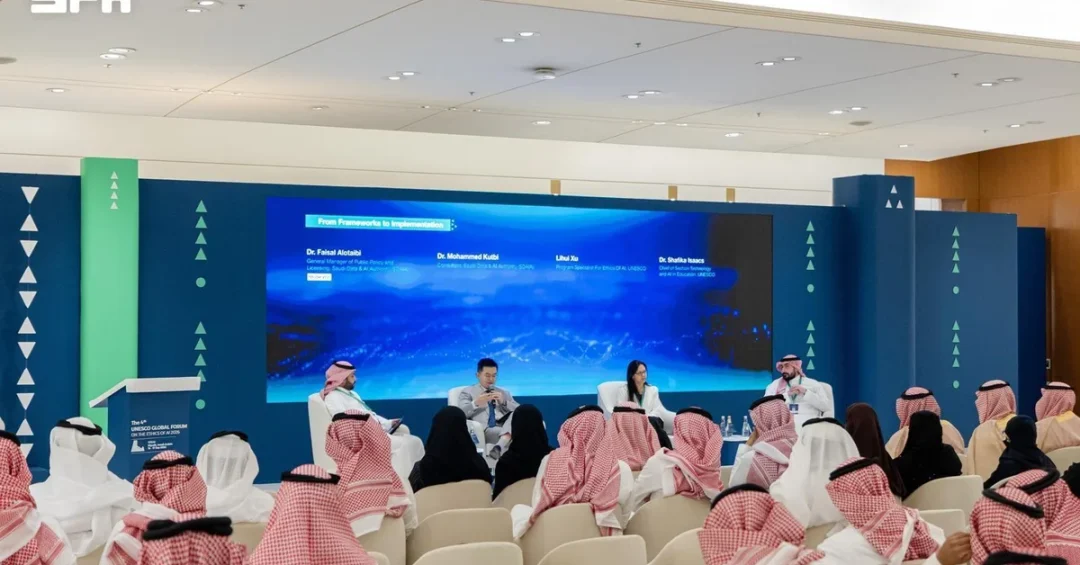
Saudi Arabia’s pioneering approach to building national capacity in data and artificial intelligence took center stage at a dedicated side session held during the fourth edition of the UNESCO Global Forum on the Ethics of Artificial Intelligence (GFEAI 2026), hosted by the Kingdom and organized by the Saudi Data and AI Authority (SDAIA) in collaboration with the International Center for AI Research and Ethics (ICAIRE). The session, titled “From Frameworks to Implementation,” examined how the Kingdom has moved beyond policy design to embed AI ethics into education, training, and professional development programs nationwide, according to information released through official Saudi channels. The discussion drew international attention to a model that links learning pathways directly to labor market needs while supporting the sustainable development of national capabilities.
The session formed part of a broader program at GFEAI 2026, which has convened policymakers, researchers, and technology leaders from around the world in Riyadh to shape global governance norms for artificial intelligence. Saudi Arabia’s hosting of the forum reflects its expanding role in multilateral technology diplomacy and its commitment to ensuring that AI advances are guided by ethical principles. For an international audience, the Riyadh discussions offer a clear signal that the Kingdom is not only adopting AI technologies but also helping to write the rules and frameworks by which they are governed globally.
Context and Background
Why has Saudi Arabia become such a prominent voice in the global conversation on AI ethics and capacity building? The answer lies in a deliberate national strategy that treats human capital as the foundation of technological progress. Through SDAIA, established as the national authority responsible for data and AI, the Kingdom has built an integrated system that connects education, training, and professional development in a single continuum. This approach is designed to ensure that students, graduates, and working professionals all acquire the skills needed to participate in an AI-driven economy.
The UNESCO Global Forum on the Ethics of Artificial Intelligence has become a key international platform for these discussions, and the fourth edition hosted by Saudi Arabia represents a milestone in the Kingdom’s engagement with the United Nations system. The collaboration with ICAIRE, the International Center for AI Research and Ethics, underscores the importance of research-informed policymaking. Together, these institutions are working to translate high-level ethical principles into practical tools that governments, universities, and employers can use. The side session on capacity building was therefore not an isolated event but part of a sustained effort to operationalize AI ethics across societies.
The framing of the session around “From Frameworks to Implementation” reflects a recognition that many countries have now adopted ethical guidelines for AI, but far fewer have succeeded in embedding those guidelines into everyday practice. Saudi Arabia’s experience offers lessons in how to close that gap through coordinated action among ministries, educational institutions, and the private sector. International experts at the session placed the Saudi model within this global context, noting its relevance for countries at different stages of digital development.
Key Details of the Saudi Capacity-Building Model
What exactly does Saudi Arabia’s capacity-building framework involve? According to the session discussions, the model integrates AI ethics into education and training programs through a structured system that aligns curricula with labor market demands. This means that universities, vocational institutes, and professional development centers are being equipped to teach not only technical AI skills but also the ethical reasoning required to deploy those skills responsibly. The framework supports the sustainable development of national capabilities by creating clear pathways from initial education through to advanced specialization.
The session also reviewed mechanisms for activating these frameworks through strategic partnerships with relevant national entities. These partnerships are essential because AI capacity building cuts across traditional institutional boundaries. SDAIA works with the Ministry of Education, the Ministry of Communications and Information Technology, and other bodies to ensure that programs are coherent and mutually reinforcing. The involvement of UNESCO international experts added a comparative dimension, allowing participants to see how the Saudi approach relates to efforts in other regions and what elements might be adaptable to different national contexts.
A central theme of the discussion was the need to maintain the flexibility of national frameworks so they can keep pace with the rapid development of AI. Technology evolves faster than policy cycles, and the session examined how Saudi Arabia builds adaptability into its programs. This includes regular reviews of curricula, engagement with industry to identify emerging skill needs, and a willingness to pilot new training models. The goal, as presented at the forum, is to enhance future readiness so that the Kingdom’s workforce remains competitive as AI capabilities advance.
International and Regional Impact
How does Saudi Arabia’s experience resonate beyond its borders? The session at GFEAI 2026 explicitly considered lessons that other countries could benefit from and adapt to their own needs. UNESCO experts highlighted the Saudi model as an example of how a nation can move from adopting global ethical standards to implementing them in concrete educational and professional settings. For countries in the region and beyond, this offers a template that respects local contexts while adhering to universal principles.
Regional impact is particularly significant. Many countries in the Middle East and North Africa are investing in digital transformation and seeking to build AI talent. Saudi Arabia’s willingness to share its experience through UNESCO platforms positions the Kingdom as a constructive partner in regional development. The forum’s side session created a space for dialogue among international experts, Saudi officials, and representatives from other nations, fostering a network of practitioners who can continue to exchange insights. This kind of multilateral engagement strengthens the global governance of AI by grounding it in practical capacity-building efforts.
Internationally, the session reinforced Saudi Arabia’s reputation as a responsible actor in technology policy. By hosting the UNESCO forum and contributing its experience to global discussions, the Kingdom demonstrates that it takes its role in shaping the ethical dimensions of AI seriously. This aligns with broader efforts to position Saudi Arabia as a hub for international dialogue and cooperation, not only in energy and finance but also in the knowledge economy of the future.
Economic and Strategic Significance
Why does capacity building in data and AI matter so much for Saudi Arabia’s economic future? The Kingdom’s Vision 2030 reform agenda aims to diversify the economy away from oil dependence and create a knowledge-based society. AI and data are central to that vision, with applications spanning healthcare, education, energy, tourism, and public services. A workforce equipped with AI skills is essential to realizing these ambitions, and the frameworks discussed at the UNESCO session are designed to produce exactly that talent pipeline.
The strategic significance extends to the labor market. By aligning education and training with labor market needs, Saudi Arabia seeks to reduce skills mismatches and increase employment opportunities for its citizens. The integration of professional development ensures that workers already in the labor force can upgrade their skills as AI tools become more prevalent. This approach supports both economic growth and social stability by creating pathways to meaningful employment in high-value sectors. The partnerships with national entities ensure that these programs are coordinated and scalable across the Kingdom.
From an investment perspective, a skilled AI workforce makes Saudi Arabia more attractive to global technology companies and startups. The presence of a robust talent ecosystem, supported by ethical frameworks and clear standards, reduces risk for businesses considering AI-related investments in the Kingdom. The session at GFEAI 2026 therefore has implications not only for education policy but also for the broader business environment that Vision 2030 seeks to cultivate.
Vision 2030 Alignment
How does this UNESCO forum session connect to Saudi Arabia’s long-term national strategy? Vision 2030 places human capability development at its core, recognizing that the Kingdom’s greatest asset is its people. The data and AI capacity-building frameworks presented in Riyadh are a direct expression of that principle. By investing in education, training, and professional development, Saudi Arabia is building the human capital required to lead in the digital age while ensuring that ethical considerations guide technological adoption.
The collaboration with UNESCO and ICAIRE also reflects Vision 2030’s emphasis on international partnerships and knowledge exchange. Saudi Arabia’s role as host of GFEAI 2026 demonstrates its commitment to global engagement and its willingness to contribute to solutions for shared challenges. As the Kingdom continues to advance its AI agenda, the lessons shared at the forum will inform further developments in national policy and international cooperation. The session “From Frameworks to Implementation” thus stands as a testament to Saudi Arabia’s forward-looking approach, linking ethical principles to practical action and positioning the Kingdom as a leader in the responsible development of artificial intelligence for the benefit of humanity.
20 Questions
Q1. What was the main focus of the UNESCO forum side session hosted by Saudi Arabia?
A1. The session focused on Saudi Arabia’s experience in developing capacity-building frameworks in data and artificial intelligence, specifically how to translate these frameworks into practical applications through education, training, and professional development aligned with labor market needs.
Q2. Which Saudi authority organized the forum in collaboration with UNESCO?
A2. The Saudi Data and AI Authority (SDAIA) organized the fourth edition of the UNESCO Global Forum on the Ethics of Artificial Intelligence in collaboration with the International Center for AI Research and Ethics (ICAIRE), highlighting the Kingdom’s leadership in AI governance.
Q3. What was the title of the side session discussed in the article?
A3. The session was titled “From Frameworks to Implementation,” reflecting its focus on moving beyond policy design to practical execution of AI ethics and capacity-building programs in Saudi Arabia and beyond.
Q4. How does Saudi Arabia integrate AI ethics into education and training?
A4. Saudi Arabia integrates AI ethics through an integrated system linking education, training, and professional development, aligning with labor market needs and supporting the sustainable development of national capabilities across the Kingdom.
Q5. What role did UNESCO international experts play in the session?
A5. UNESCO experts placed the Saudi experience within the global context of capacity building in data and AI, discussed lessons other countries could adapt, and explored ways to maintain flexibility in national frameworks to keep pace with rapid AI development.
Q6. Why is international collaboration important for AI ethics?
A6. International collaboration ensures that AI ethics are guided by shared principles and best practices, allowing countries like Saudi Arabia to share experiences, learn from others, and contribute to global governance frameworks for responsible AI development.
Q7. How does Saudi Arabia’s approach support sustainable development of national capabilities?
A7. By creating clear pathways from education through professional development, Saudi Arabia ensures a continuous pipeline of skilled talent, supports lifelong learning, and aligns workforce skills with evolving labor market demands in the AI sector.
Q8. What are the key mechanisms for activating capacity-building frameworks?
A8. Key mechanisms include strategic partnerships with national entities, integration of AI ethics into curricula, regular reviews to maintain flexibility, and piloting new training models to ensure programs remain relevant and effective.
Q9. How does the Saudi model address the rapid development of AI?
A9. The model builds in flexibility through regular curriculum updates, industry engagement to identify emerging skill needs, and a willingness to adapt training programs, ensuring the workforce remains future-ready as AI technologies evolve.
Q10. What lessons can other countries learn from Saudi Arabia’s experience?
A10. Other countries can learn how to move from adopting ethical guidelines to implementing them in practice, how to align education with labor market needs, and how to maintain adaptable national frameworks that keep pace with technological change.
Q11. How does this session align with Vision 2030?
A11. The session aligns with Vision 2030 by focusing on human capability development, economic diversification through knowledge-based sectors, and international partnerships, all of which are core pillars of the Kingdom’s long-term reform strategy.
Q12. What is the significance of hosting GFEAI 2026 in Saudi Arabia?
A12. Hosting the forum demonstrates Saudi Arabia’s growing role in global technology diplomacy, its commitment to ethical AI governance, and its willingness to contribute to international discussions on the responsible development of artificial intelligence.
Q13. How does capacity building in AI benefit the Saudi economy?
A13. A skilled AI workforce supports economic diversification, attracts investment, increases employment in high-value sectors, and enhances productivity across industries, all of which are essential for achieving Vision 2030 goals.
Q14. What partnerships support Saudi Arabia’s AI capacity-building efforts?
A14. SDAIA partners with national entities including the Ministry of Education and the Ministry of Communications and Information Technology, as well as international organizations like UNESCO and ICAIRE, to ensure coherent and scalable programs.
Q15. How does Saudi Arabia ensure its AI frameworks remain flexible?
A15. Flexibility is maintained through regular reviews of curricula, engagement with industry to identify emerging trends, piloting of new training models, and a commitment to adapting programs as AI technology advances rapidly.
Q16. What is the role of SDAIA in Saudi Arabia’s AI strategy?
A16. SDAIA is the national authority responsible for data and AI, leading the development of capacity-building frameworks, organizing international forums, and coordinating partnerships to ensure the Kingdom’s AI ecosystem is ethical, innovative, and aligned with Vision 2030.
Q17. How can other countries adapt Saudi Arabia’s capacity-building model?
A17. Countries can adapt the model by tailoring education and training programs to local labor market needs, establishing partnerships among government, academia, and industry, and building in flexibility to respond to rapid technological change.
Q18. What does “From Frameworks to Implementation” signify in the context of AI ethics?
A18. It signifies the shift from developing ethical principles and guidelines to putting them into practice through concrete programs in education, training, and professional development, ensuring that AI is deployed responsibly and effectively.
Q19. How does Saudi Arabia’s experience contribute to global AI governance?
A19. By sharing its experience through UNESCO platforms, Saudi Arabia provides a practical example of how to implement AI ethics, helping other nations develop their own frameworks and contributing to a more coordinated global approach to AI governance.
Q20. What is the forward-looking outcome of the UNESCO forum session for Saudi Arabia?
A20. The session reinforces Saudi Arabia’s position as a leader in ethical AI development, strengthens international partnerships, and supports the Kingdom’s ongoing efforts to build a future-ready workforce aligned with Vision 2030 and global best practices.
Reader Feedback
We value your thoughts. Please share your feedback on this article.
Your feedback helps us improve our coverage.
Related articles
 SDAIA Honors 20+ Companies for AI Ethics at UNESCO Forum
 UNESCO Launches RAM 2.0 with ICAIRE to Bolster AI Governance
 SDAIA Showcases Responsible AI Policy at UNESCO Forum
 PMU Ranks 301–400 Globally in Energy Science 2026
 CST Opens Public Consultation on Satellite and Earth Station Regulations
 Saudi Roads Authority Expands Recycled Asphalt to Jeddah, Riyadh