


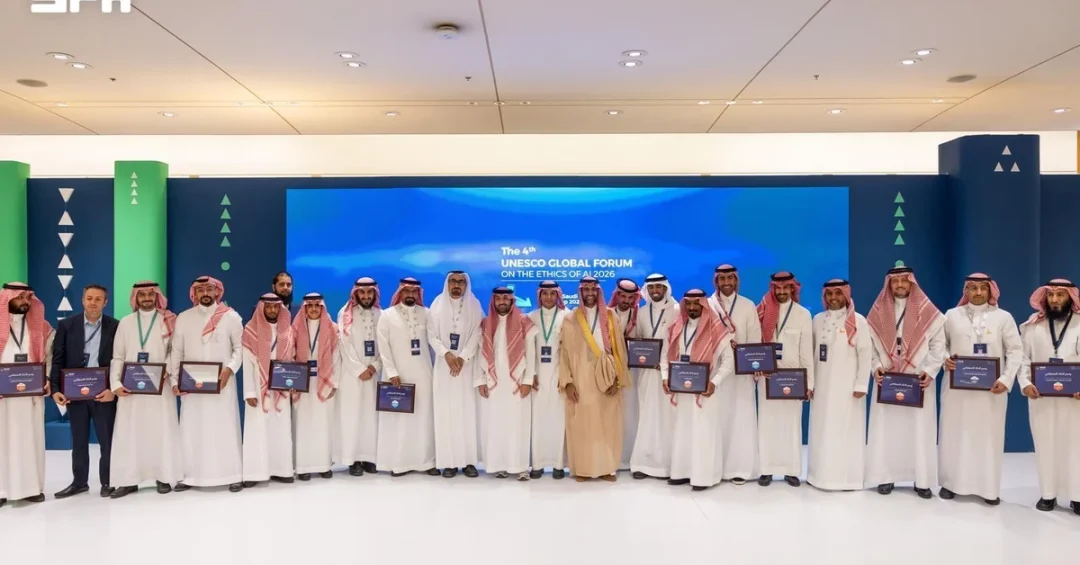
The Saudi Data and AI Authority (SDAIA) honored more than 20 companies with AI ethics badges on Thursday, September 18, 2026, recognizing their commitment to ethical and regulatory practices in developing and delivering artificial intelligence products and services. The recognition ceremony took place during the third day of the fourth UNESCO Global Forum on the Ethics of Artificial Intelligence (GFEAI 2026) in Riyadh, underscoring Saudi Arabia’s leadership in promoting responsible AI adoption across all sectors.
Context and Background
The UNESCO Global Forum on the Ethics of Artificial Intelligence is a premier international event that brings together policymakers, experts, and researchers to advance the ethical governance of AI. The 2026 edition, hosted in Riyadh, marks the fourth convening of the forum and reflects Saudi Arabia’s growing role as a global hub for AI ethics and governance discussions. The event aligns with the Kingdom’s broader strategy to position itself at the forefront of technological innovation while ensuring that such advancements are guided by strong ethical frameworks.
SDAIA, established in 2019, is the national authority responsible for driving Saudi Arabia’s data and AI agenda. It plays a central role in implementing the National Strategy for Data and AI, which is a key component of Vision 2030. The AI ethics badge program is one of SDAIA’s flagship initiatives designed to encourage organizations to adopt responsible AI practices and to provide a measurable framework for assessing ethical maturity.
AI Ethics Badges: Recognizing Excellence
The AI ethics badges awarded to the more than 20 companies are part of a structured program that evaluates organizations across five progressive levels: Aware, Adoptive, Conformative, Assured, and Visionary. These levels reflect an organization’s journey toward embedding ethical principles into its AI development and deployment processes. The badges aim to strengthen commitment to AI ethics, assess the maturity of practices, promote transparency and reliability, reduce risks, and encourage best practices across the private sector.
The recognition ceremony highlighted the private sector’s vital role in developing responsible, reliable AI solutions that comply with ethical and regulatory principles. By honoring these companies, SDAIA reinforces the importance of collaboration between government and industry to build a safe, sustainable digital ecosystem. The event also provided a platform for sharing success stories and best practices, inspiring other organizations to follow suit.
International Participation and Forum Outcomes
GFEAI 2026 attracted broad international participation from decision-makers, experts, and researchers from around the world. Discussions on the third and final day focused on translating AI ethics from abstract principles into practical, measurable practices and governance mechanisms. Participants explored ways to ensure that AI technologies are developed and used in ways that respect human rights, promote fairness, and mitigate potential harms.
The forum served as a catalyst for international cooperation, with delegates sharing insights on regulatory frameworks, ethical guidelines, and case studies from various countries. The presence of UNESCO and other global bodies underscored the collective commitment to advancing AI ethics worldwide. Saudi Arabia’s hosting of the event demonstrates its dedication to fostering multilateral dialogue and contributing to global AI governance.
Vision 2030 Alignment and Future Impact
The recognition of these companies and the successful hosting of GFEAI 2026 are closely aligned with Saudi Arabia’s Vision 2030, which seeks to diversify the economy, promote innovation, and enhance the Kingdom’s global competitiveness. By championing responsible AI, SDAIA is helping to create an enabling environment for ethical AI development that attracts investment, fosters talent, and ensures that the benefits of AI are shared broadly across society. This initiative also supports the goal of building a knowledge-based economy and reinforcing Saudi Arabia’s position as a leader in the digital age.
As AI continues to transform industries and societies, Saudi Arabia’s proactive approach to ethical governance will serve as a model for others. The AI ethics badges not only recognize current achievements but also set a benchmark for continuous improvement, encouraging companies to strive for higher levels of ethical maturity. Through such efforts, the Kingdom is contributing to a future where AI is developed and used responsibly, for the benefit of all humanity.
20 Questions
Q1. What event hosted the SDAIA recognition ceremony?
A1. The recognition took place during the fourth UNESCO Global Forum on the Ethics of Artificial Intelligence (GFEAI 2026) in Riyadh, Saudi Arabia, on September 18, 2026.
Q2. How many companies received AI ethics badges?
A2. More than 20 companies were honored with AI ethics badges for their commitment to ethical and regulatory practices in AI development and delivery.
Q3. What are the five levels of AI ethics badges?
A3. The badges are awarded across five progressive levels: Aware, Adoptive, Conformative, Assured, and Visionary, reflecting increasing maturity in ethical AI practices.
Q4. What is the purpose of the AI ethics badges?
A4. They aim to strengthen commitment to AI ethics, assess maturity of practices, promote transparency and reliability, reduce risks, and encourage best practices across sectors.
Q5. Which authority organized the recognition?
A5. The Saudi Data and AI Authority (SDAIA) organized the recognition as part of its efforts to promote responsible AI adoption and embed ethical principles.
Q6. What is SDAIA’s role in Saudi Arabia?
A6. SDAIA is the national authority responsible for driving Saudi Arabia’s data and AI agenda, implementing the National Strategy for Data and AI under Vision 2030.
Q7. Why is the UNESCO forum significant?
A7. It brings together global policymakers, experts, and researchers to advance AI ethics, fostering international cooperation and practical governance solutions.
Q8. What was the focus of the third day of GFEAI 2026?
A8. Discussions centered on moving AI ethics from principles to practical, measurable practices and governance mechanisms.
Q9. How does this recognition benefit the private sector?
A9. It strengthens the private sector’s role in developing responsible, reliable AI solutions that comply with ethical and regulatory principles, building a safe digital ecosystem.
Q10. What is the significance of hosting GFEAI in Riyadh?
A10. It highlights Saudi Arabia’s leadership in AI ethics and governance, showcasing its commitment to international dialogue and Vision 2030 objectives.
Q11. Who participated in GFEAI 2026?
A11. Decision-makers, experts, and researchers from around the world participated, sharing insights on regulatory frameworks and ethical guidelines.
Q12. How do the badges promote transparency?
A12. By requiring companies to meet specific criteria at each level, the badges ensure transparency and reliability in AI practices, reducing risks and building trust.
Q13. What is the National Strategy for Data and AI?
A13. It is a key initiative under Vision 2030, aiming to position Saudi Arabia as a global leader in data and AI, driving innovation and economic diversification.
Q14. How does SDAIA support Vision 2030?
A14. SDAIA advances Vision 2030 by fostering ethical AI development, attracting investment, nurturing talent, and building a knowledge-based economy.
Q15. What are the benefits of responsible AI for society?
A15. Responsible AI ensures fairness, respects human rights, mitigates harms, and promotes trust, enabling broad societal benefits from technological advancements.
Q16. How can companies achieve higher badge levels?
A16. Companies can progress through the levels by continuously improving their ethical practices, implementing robust governance, and adhering to SDAIA’s guidelines.
Q17. What role does UNESCO play in AI ethics?
A17. UNESCO leads global efforts to develop ethical frameworks for AI, promoting human rights and fostering international cooperation through forums like GFEAI.
Q18. What is the expected impact of these badges on the AI industry?
A18. They set a benchmark for ethical maturity, encouraging widespread adoption of responsible AI practices and enhancing trust in AI technologies globally.
Q19. How does the recognition ceremony inspire other organizations?
A19. By showcasing success stories, it motivates other companies to pursue ethical AI practices and contributes to a culture of continuous improvement.
Q20. What does the future hold for AI ethics in Saudi Arabia?
A20. Saudi Arabia will continue to lead in AI ethics through SDAIA’s initiatives, aligning with Vision 2030 to create a sustainable, ethical digital ecosystem.
Reader Feedback
We value your thoughts. Please share your feedback on this article.
Your feedback helps us improve our coverage.