


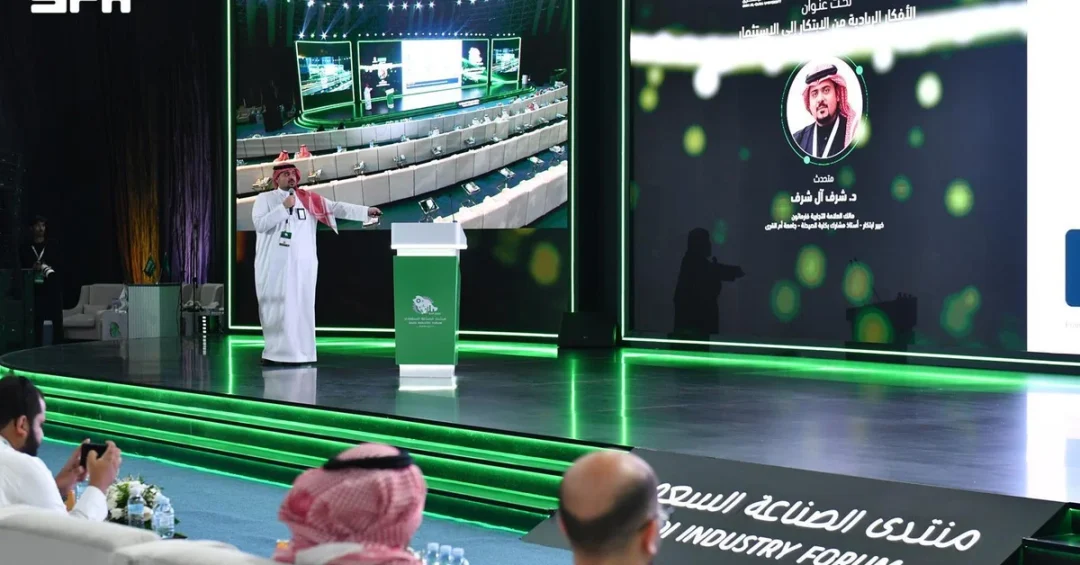
The second edition of the Saudi Industry Forum continued in Jeddah on September 16, 2026, with a presentation by Umm Al-Qura University outlining how innovative concepts can be transformed into bankable, scalable ventures. Delivered by Dr. Sharaf Al Sharaf, Associate Professor at Umm Al-Qura University and founder of Pharmathon, the session set out a structured entrepreneurial lifecycle that begins with identifying a genuine market need and validating feasibility, advances through product development and the achievement of market fit, and culminates in securing capital, scaling operations, and delivering sustainable growth.
The forum, held under the umbrella of Saudi Arabia’s official industrial development efforts, brought together policymakers, academics, investors, and business leaders to examine the practical mechanics of turning research and ideas into investable enterprises. The presentation reflected a central theme of the Kingdom’s economic transformation: that innovation only creates lasting value when it is matched with commercial discipline, measurable performance, and well-structured capital. For an international audience watching Saudi Arabia’s diversification journey, the Jeddah session offered a clear window into how the Kingdom is building the institutional bridges between its universities, its industrial base, and its investment community. How does a promising idea become a company that investors are willing to back at scale? The answer, according to the forum, lies in a deliberate, evidence-led process rather than a single breakthrough moment.
Context and Background
The Saudi Industry Forum has quickly established itself as a platform where the Kingdom’s industrial ambitions meet its innovation ecosystem. Its second edition, staged in Jeddah, extended the conversation beyond traditional manufacturing themes to include entrepreneurship, technology commercialization, and the financing pathways that connect the two. The choice of Jeddah as host city is significant: the Red Sea port city is a historic commercial gateway and today serves as a hub for logistics, trade, and an expanding base of knowledge-intensive businesses.
Umm Al-Qura University’s participation underlined the growing role of Saudi higher education institutions as engines of enterprise creation. Universities across the Kingdom are being encouraged to move beyond teaching and research into commercialization, incubating startups and partnering with industry on applied problem-solving. Dr. Al Sharaf’s session drew on that experience, framing the entrepreneurial journey as a sequence of verifiable stages rather than an unpredictable gamble. The forum’s agenda therefore reflects a broader shift in Saudi economic policy, in which universities, ministries, and investors are expected to operate as one connected system. Why does this coordination matter so much at this stage of the Kingdom’s development? Because diversification depends not only on capital, but on the human and institutional capability to deploy it productively.
The third day of the forum continued a pattern established over the preceding sessions: detailed, practitioner-led discussions rather than broad statements of intent. That emphasis on operational detail is itself a signal of maturity in Saudi Arabia’s industrial and innovation policy, which increasingly focuses on execution metrics, market validation, and investor readiness. For international observers, the Jeddah proceedings provide a useful indicator of how Saudi entities are translating national strategy into day-to-day practice.
Key Details: The Entrepreneurial Lifecycle
In his presentation, Dr. Al Sharaf outlined the entrepreneurial lifecycle as a progression through distinct, testable phases. The first phase centers on identifying a genuine market need and validating feasibility. This step requires founders to demonstrate that a problem exists at sufficient scale and that their proposed solution can address it credibly. Only after this validation does the process advance to product development and the pursuit of market fit, where the offering is refined through customer feedback and real-world use.
The final phase, according to the presentation, involves securing capital, scaling operations, and achieving sustainable growth. This sequencing matters because it places financing at the point where a venture has already accumulated evidence of demand and viability. Dr. Al Sharaf detailed the key metrics that investors typically seek: team competency, addressable market size, competitive advantage, proven economic viability, and precise capital allocation plans. Each metric corresponds to a question an investor will ask, and each can be prepared for in advance.
The session also highlighted the entrepreneurial skills required to navigate this journey, including strategic planning, adaptability, leadership, negotiation, and resource and risk management. These capabilities are not incidental to success; they determine whether a technically sound concept can survive the pressures of commercialization. Dr. Al Sharaf concluded that transitioning from innovation to investment requires an integrated roadmap anchored in market validation and proven commercial viability before seeking external financing and expansion. What separates ventures that attract capital from those that stall? The forum’s answer is preparation: evidence, discipline, and a clear plan for how funds will be used.
International and Regional Impact
The forum’s focus on innovation-to-investment pathways carries implications beyond Saudi Arabia’s borders. Regional economies across the Middle East are pursuing similar diversification agendas, and the Kingdom’s approach, which combines national strategy, university-led incubation, and private capital, offers a model that peers are watching closely. For international investors, the emphasis on investor-ready metrics such as addressable market size, competitive advantage, and capital allocation discipline makes Saudi ventures easier to evaluate and compare with opportunities elsewhere.
Jeddah’s role as host also reinforces the city’s position as a commercial bridge between Asia, Africa, and Europe. By convening academics, industrialists, and financiers in a single forum, the event supports cross-border partnerships and knowledge exchange. Multinational companies assessing the Saudi market will find in these discussions a clearer picture of the local talent pipeline and the institutional support available to new ventures. How do international firms benefit from a stronger Saudi startup ecosystem? By gaining reliable partners, tested technologies, and a market that is increasingly integrated with global supply chains and capital flows.
Economic and Strategic Significance
The strategic significance of the Jeddah discussions lies in their contribution to Saudi Arabia’s long-term economic resilience. A diversified economy requires new sources of value creation, and innovation-driven enterprises are among the most promising. By formalizing the path from concept to bankable venture, the forum helps reduce the friction that often prevents good ideas from reaching the market. That reduction in friction has measurable effects: faster commercialization, more efficient use of capital, and stronger links between research institutions and industry.
The emphasis on proven economic viability before external financing also reflects prudent financial practice. Investors who receive well-prepared proposals can deploy capital with greater confidence, while founders who validate their assumptions early avoid costly missteps. Over time, this discipline builds a track record that attracts further investment, creating a virtuous cycle. For a Kingdom investing heavily in industrial capacity and advanced manufacturing, the ability to convert ideas into scalable businesses is not a peripheral concern but a core economic capability. What makes this moment different from previous waves of entrepreneurship? The presence of coordinated national strategy, dedicated funding vehicles, and a growing base of experienced founders and mentors.
Vision 2030 Alignment
The Saudi Industry Forum and the presentation by Umm Al-Qura University align directly with the objectives of Vision 2030, the Kingdom’s national transformation program. Vision 2030 seeks to diversify the economy away from oil dependence, expand the private sector, and create opportunities for Saudi talent. Innovation commercialization supports all three goals by generating new industries, attracting private investment, and equipping young Saudis with the skills to build and lead enterprises.
The forum’s emphasis on university-led entrepreneurship also supports the development of a knowledge economy, in which research and education contribute directly to GDP growth and job creation. By connecting academic insight with investor expectations, sessions such as Dr. Al Sharaf’s help ensure that Saudi innovation is not confined to laboratories but reaches markets, customers, and global partners. As the Kingdom continues to build its industrial and technological base, platforms like the Saudi Industry Forum will remain essential to translating ambition into durable economic achievement. Isn’t that the ultimate test of any national transformation: ideas that become enterprises, and enterprises that become lasting contributors to prosperity?
20 Questions
Q1. What was the main focus of the Saudi Industry Forum’s third day in Jeddah?
A1. The third day featured a presentation by Umm Al-Qura University on transforming innovative concepts into bankable, scalable ventures, outlining the entrepreneurial lifecycle from market validation to capital raising and sustainable growth.
Q2. Who delivered the presentation at the forum?
A2. The session was delivered by Dr. Sharaf Al Sharaf, Associate Professor at Umm Al-Qura University and founder of Pharmathon, who outlined the stages of the entrepreneurial journey.
Q3. What is the first stage of the entrepreneurial lifecycle described?
A3. The process begins with identifying a genuine market need and validating feasibility, ensuring that a real problem exists at sufficient scale before further investment of time and resources.
Q4. What happens after feasibility is validated?
A4. Ventures advance to product development and the pursuit of market fit, refining their offering through customer feedback and real-world use before seeking external financing.
Q5. What is the final phase of the lifecycle?
A5. The final phase involves securing capital, scaling operations, and achieving sustainable growth, with financing sought only after evidence of demand and viability has been established.
Q6. Which investor metrics were highlighted in the presentation?
A6. Key metrics include team competency, addressable market size, competitive advantage, proven economic viability, and precise capital allocation plans, each answering a question investors typically ask.
Q7. What entrepreneurial skills were emphasized?
A7. The presentation highlighted strategic planning, adaptability, leadership, negotiation, and resource and risk management as essential capabilities for navigating commercialization pressures.
Q8. What did Dr. Al Sharaf conclude about innovation and investment?
A8. He concluded that transitioning from innovation to investment requires an integrated roadmap anchored in market validation and proven commercial viability before seeking external financing and expansion.
Q9. Why is the Saudi Industry Forum significant for the Kingdom?
A9. It convenes policymakers, academics, investors, and business leaders to advance industrial development and innovation commercialization, supporting Saudi Arabia’s economic diversification goals.
Q10. How does Umm Al-Qura University contribute to entrepreneurship?
A10. The university supports enterprise creation through academic expertise and initiatives such as Pharmathon, helping translate research and ideas into commercially viable ventures.
Q11. Why was Jeddah chosen as the forum’s host city?
A11. Jeddah is a historic commercial gateway and a hub for logistics, trade, and knowledge-intensive businesses, making it a fitting location for discussions on industry and investment.
Q12. How does the forum support international investors?
A12. By emphasizing investor-ready metrics such as market size and capital allocation discipline, the forum makes Saudi ventures easier for international investors to evaluate and compare.
Q13. What role do universities play in Saudi Arabia’s innovation ecosystem?
A13. Saudi universities are increasingly expected to move beyond teaching and research into commercialization, incubating startups and partnering with industry on applied problem-solving.
Q14. How does the forum relate to Vision 2030?
A14. It supports Vision 2030’s goals of economic diversification, private sector expansion, and talent development by advancing innovation commercialization and investment readiness.
Q15. What economic benefits flow from faster commercialization?
A15. Faster commercialization leads to more efficient use of capital, stronger links between research institutions and industry, and new sources of value creation for the national economy.
Q16. Why is market validation important before seeking financing?
A16. Market validation provides evidence of demand and viability, giving investors confidence and helping founders avoid costly missteps that can derail early-stage ventures.
Q17. What does ‘bankable’ mean in this context?
A17. Bankable describes a venture that has demonstrated commercial viability, a credible team, a clear market, and a precise capital allocation plan sufficient to attract external financing.
Q18. How does the forum promote regional cooperation?
A18. By convening participants from across the region and beyond, it supports cross-border partnerships, knowledge exchange, and alignment on innovation and industrial development practices.
Q19. What is the significance of capital allocation plans for investors?
A19. Precise capital allocation plans show how funds will be used to achieve specific milestones, demonstrating discipline and reducing uncertainty for investors considering a venture.
Q20. What is the outlook for Saudi Arabia’s innovation-to-investment pipeline?
A20. With coordinated national strategy, university-led incubation, and growing investor engagement, the pipeline is strengthening, positioning the Kingdom for durable, innovation-driven economic growth.
Reader Feedback
We value your thoughts. Please share your feedback on this article.
Your feedback helps us improve our coverage.
Related articles
 Bulgaria Condemns Houthi Attacks on Saudi Arabia
 SDAIA Showcases AI Governance at UNESCO Global Forum
 Vice Minister Elkhereiji Receives Nigeria’s Ambassador to Saudi Arabia
 Saudi Arabia Condemns Houthi Drone Attack on Makkah
 Jordan Condemns Houthi Attempt to Target Makkah
 Saudi Minister Meets Philippine Labor Secretary in Riyadh