


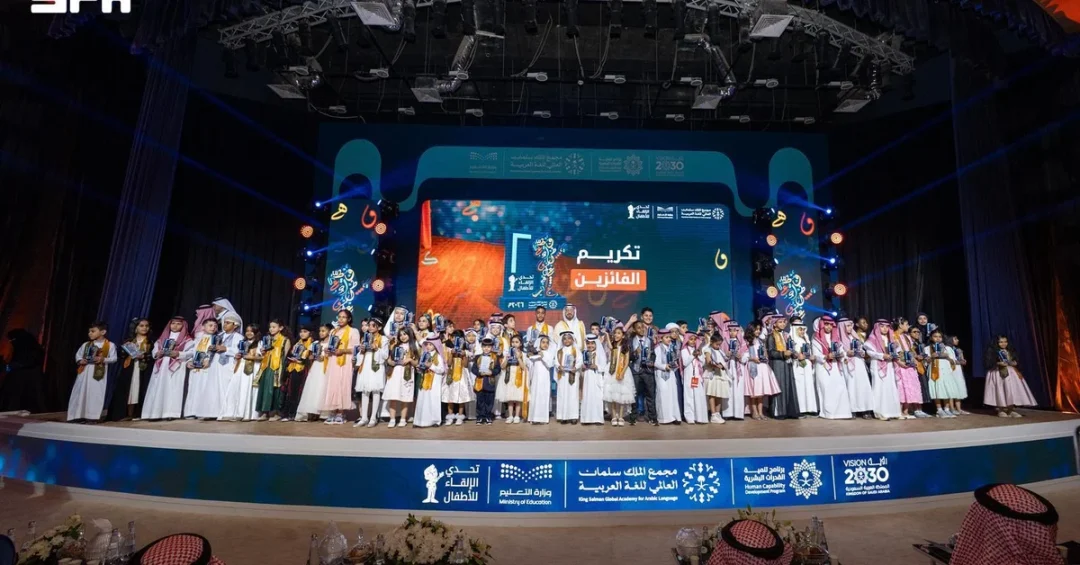
The King Salman Global Academy for Arabic Language and the Ministry of Education honored the winners of the fifth edition of the Children’s Recitation Challenge at a closing ceremony in Riyadh, attended by representatives of diplomatic missions accredited to the Kingdom, parents, and figures interested in Arabic language education. The event marked the culmination of a competition that drew more than 9,000 children from 28 countries, with 60 winning boys and girls and five promising talents recognized for their mastery of classical Arabic poetry recitation.
Held under the patronage of the two institutions, the ceremony underscored Saudi Arabia’s commitment to promoting the Arabic language as a cornerstone of cultural identity and a bridge for global dialogue. The challenge targets Arabic-speaking children aged five to 12 worldwide, offering them a platform to develop public speaking and rhetorical skills through the recitation of classical Arabic poetry. The fifth edition’s reach, spanning 28 countries, reflects the growing international appeal of a competition that has now engaged over 24,000 children from more than 40 countries across its five editions. The event also featured a documentary presentation on the edition’s milestones and artistic performances celebrating the young participants’ linguistic achievements.
Context and Background
How did a competition for young reciters become a symbol of Saudi Arabia’s cultural diplomacy? The Children’s Recitation Challenge was launched by the King Salman Global Academy for Arabic Language in partnership with the Ministry of Education as part of a broader national effort to strengthen the Arabic language’s presence in education and public life. The Academy, established to serve Arabic language globally, has made youth engagement a central pillar of its mission, recognizing that early exposure to classical poetry builds both linguistic proficiency and cultural pride. The Ministry of Education, for its part, has integrated the challenge into its extracurricular offerings, encouraging schools across the Kingdom to nominate students and providing pedagogical support for participants.
Over five editions, the competition has evolved from a domestic initiative into an international event. The first edition focused primarily on students within Saudi Arabia, but subsequent rounds expanded their geographic scope, attracting participants from across the Arab world and, increasingly, from Muslim and Arabic-speaking communities in Europe, Asia, and the Americas. The fifth edition’s 28 participating countries represent a diverse mix of nations, from Gulf neighbors to countries with significant Arabic-speaking diasporas. This growth aligns with the Academy’s strategic objective of preserving Arabic as a living language of culture, science, and diplomacy, and with Saudi Vision 2030’s emphasis on cultural enrichment and global engagement.
The closing ceremony itself served as a showcase of this international dimension, with diplomatic representatives from accredited missions attending to support their young nationals. Their presence highlighted the competition’s role in fostering people-to-people ties and in presenting Saudi Arabia as a hub for Arabic language scholarship and cultural exchange. The documentary presentation traced the journey of the fifth edition, from initial registration through national qualifiers to the final rounds, while artistic performances celebrated the participants’ achievements and the richness of the Arabic poetic tradition.
Key Details
What exactly does the Children’s Recitation Challenge entail for its participants? The competition is open to Arabic-speaking children aged five to 12, divided into age categories to ensure fair evaluation. Participants are required to recite classical Arabic poetry, judged on criteria including pronunciation, intonation, memorization, expression, and stage presence. The fifth edition attracted more than 9,000 registrations from 28 countries, a significant increase from previous rounds. After preliminary rounds, 60 winners were selected, along with five promising talents identified for special encouragement. These young reciters demonstrated not only linguistic accuracy but also the ability to convey the emotional and rhetorical depth of the poems they performed.
The closing ceremony, held in Riyadh, brought together the winners, their families, educators, and representatives of diplomatic missions. The event included a documentary that chronicled the fifth edition’s milestones, from the launch of registrations to the national and international qualifying rounds. Artistic performances, featuring both the young participants and professional artists, celebrated the linguistic achievements of the children and the enduring beauty of Arabic poetry. The Academy and the Ministry of Education jointly presented awards and certificates, recognizing the winners’ dedication and the support of their families and teachers.
Beyond the immediate accolades, the challenge provides participants with tangible benefits. It builds confidence in public speaking, enhances memorization and cognitive skills, and deepens their connection to Arabic literary heritage. For many families, the competition has become a catalyst for regular poetry recitation at home, reinforcing language skills outside the classroom. The Academy has also developed educational resources and workshops for participants and educators, ensuring that the learning extends beyond the competition itself. The five promising talents singled out this year will receive further mentorship and opportunities to participate in future Academy programs, nurturing a pipeline of young Arabic language ambassadors.
International and Regional Impact
Why does a children’s recitation contest matter on the international stage? The presence of diplomatic representatives at the closing ceremony signals that the challenge is more than a domestic educational activity; it is a soft power initiative that strengthens Saudi Arabia’s cultural ties with other nations. By inviting children from 28 countries, the Kingdom positions itself as a guardian of Arabic language and heritage, a role that resonates with Arabic-speaking communities worldwide. For participating countries, the competition offers a platform to celebrate their own Arabic-speaking populations and to connect with a global network of educators and cultural institutions.
Regionally, the challenge complements efforts by Gulf states to promote Arabic in education and public administration. It also aligns with the broader Arab cultural renaissance, in which Saudi Arabia plays a leading role through initiatives such as the King Salman Global Academy for Arabic Language and the Ministry of Culture’s various programs. The competition’s international reach helps counter the perception that Arabic is declining in global influence, demonstrating instead that it is a vibrant language embraced by young generations across continents. The winners’ performances, shared through official channels, serve as inspiring examples for children everywhere, encouraging them to take pride in their linguistic heritage.
Economic and Strategic Significance
How does investing in children’s language skills contribute to Saudi Arabia’s strategic goals? Language proficiency is a foundational element of human capital development, which is central to Vision 2030’s aim of building a diversified, knowledge-based economy. Children who master classical Arabic develop critical thinking, memory, and communication skills that serve them in all academic and professional pursuits. The challenge also supports the cultural sector, which the Kingdom is expanding as part of its economic diversification strategy. By nurturing a generation that values Arabic literature and rhetoric, Saudi Arabia is investing in the cultural industries, from publishing to media to heritage tourism.
Moreover, the competition enhances Saudi Arabia’s soft power and international standing. It showcases the Kingdom’s commitment to education and culture, two areas highlighted in Vision 2030 as drivers of social and economic progress. The Academy’s partnerships with international educational institutions and its outreach to Arabic-speaking communities abroad create goodwill and open avenues for cooperation in education, culture, and beyond. The fifth edition’s success, with over 9,000 participants, demonstrates the scalability of this model and its potential to grow further, attracting more countries and participants in future editions. As the program expands, it will continue to generate positive media coverage and reinforce Saudi Arabia’s image as a dynamic, forward-looking nation rooted in its heritage.
Vision 2030 Alignment
What role does the Children’s Recitation Challenge play in Saudi Vision 2030? The Vision’s cultural and educational pillars emphasize the importance of preserving national identity while engaging globally. The challenge directly supports these objectives by promoting the Arabic language, fostering youth talent, and building international cultural bridges. It also contributes to the Vision’s goal of increasing cultural participation and enhancing the quality of life for citizens and residents. By celebrating young reciters, the Kingdom reinforces the message that Arabic is not only a language of the past but a living, dynamic force for the future.
Looking ahead, the King Salman Global Academy for Arabic Language and the Ministry of Education plan to expand the challenge’s reach, incorporating new technologies and partnerships to engage even more children worldwide. The fifth edition’s success provides a strong foundation for future growth, and the winners honored in Riyadh will serve as ambassadors for Arabic language and culture. Their achievements reflect the Kingdom’s broader ambition to be a global leader in cultural preservation and education, and they embody the spirit of Vision 2030: a confident, open, and forward-looking Saudi Arabia that values its heritage while embracing the world.
20 Questions
Q1. What was the fifth edition of the Children’s Recitation Challenge?
A1. It was a global competition for Arabic-speaking children aged five to 12, organized by the King Salman Global Academy for Arabic Language and the Ministry of Education, focusing on reciting classical Arabic poetry.
Q2. Where was the closing ceremony held?
A2. The closing ceremony took place in Riyadh, Saudi Arabia, and was attended by diplomatic representatives, parents, and others interested in Arabic language education.
Q3. How many children participated in the fifth edition?
A3. More than 9,000 children from 28 countries participated in the fifth edition, marking a significant increase in international participation.
Q4. How many winners were honored?
A4. Sixty winning boys and girls were honored, along with five promising talents who received special recognition for their potential.
Q5. What is the age range for participants?
A5. The competition targets Arabic-speaking children aged five to 12 years old from around the world.
Q6. What skills does the challenge aim to develop?
A6. It aims to develop public speaking and rhetorical skills through the recitation of classical Arabic poetry, enhancing confidence and linguistic proficiency.
Q7. Which organizations organized the challenge?
A7. The King Salman Global Academy for Arabic Language and the Ministry of Education jointly organized the challenge.
Q8. How many children have participated across all five editions?
A8. Over 24,000 children from more than 40 countries have participated in the challenge across its five editions.
Q9. What was included in the closing ceremony?
A9. The ceremony featured a documentary on the fifth edition’s milestones, artistic performances, and the honoring of winners and promising talents.
Q10. Why are diplomatic missions involved?
A10. Diplomatic representatives attended to support their young nationals and to recognize the competition’s role in cultural exchange and Arabic language promotion.
Q11. How does the challenge support Saudi Vision 2030?
A11. It supports Vision 2030 by promoting cultural enrichment, youth development, and international engagement, aligning with the goals of a vibrant society and a diversified economy.
Q12. What criteria are used to judge participants?
A12. Participants are judged on pronunciation, intonation, memorization, expression, and stage presence, ensuring a comprehensive evaluation of recitation skills.
Q13. What are the benefits for participating children?
A13. Children gain confidence, improved memory, public speaking skills, and a deeper connection to Arabic literary heritage, which aids their overall education.
Q14. How has the competition grown over time?
A14. It has expanded from a primarily domestic event to an international competition, with the fifth edition attracting participants from 28 countries.
Q15. What happens to the promising talents?
A15. The five promising talents receive further mentorship and opportunities to participate in future programs, nurturing their skills as Arabic language ambassadors.
Q16. What role does the King Salman Global Academy play?
A16. The Academy promotes Arabic language globally, organizes the challenge, and provides educational resources and mentorship to participants and educators.
Q17. How does the challenge impact Arabic language preservation?
A17. By engaging young learners worldwide, it keeps classical Arabic poetry alive and encourages a new generation to value and use the language actively.
Q18. Are there plans to expand the challenge?
A18. Yes, the organizers plan to expand reach through new technologies and partnerships, aiming to include more countries and participants in future editions.
Q19. What kind of poetry is recited?
A19. Participants recite classical Arabic poetry, which is renowned for its rich vocabulary, rhetorical devices, and cultural significance.
Q20. How can international children participate?
A20. Arabic-speaking children aged five to 12 can register through the Academy’s official channels when the next edition is announced, with national qualifiers held in participating countries.
Reader Feedback
We value your thoughts. Please share your feedback on this article.
Your feedback helps us improve our coverage.
Related articles
 Misk Art Institute Opens ‘Along the Way’ Exhibition in Riyadh
 Al-Klebein season begins with peak summer heat
 Riyadh International Falcon Breeding Auction 2026 sells three falcons
 Saudi play Al-Naashoun wins Best Text Award in Cairo
 Darah Launches Online Training in History and Sources
 Saudi Play ‘Al-Naashoun’ Wins Best Text Award at Cairo Festival