


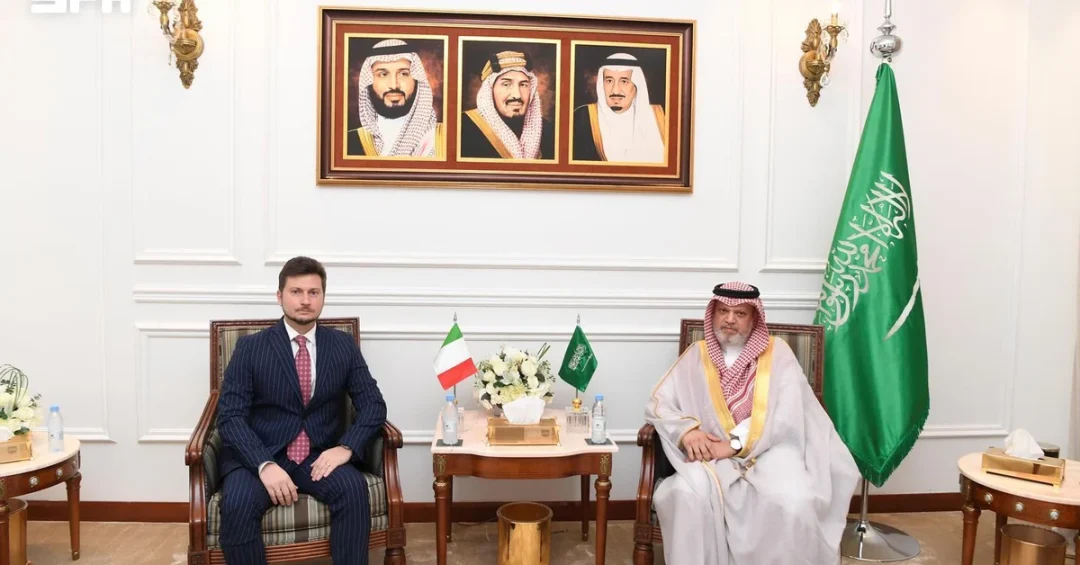
Ambassador Ahmed Qutb, Assistant Director General of the Ministry of Foreign Affairs Branch in the Makkah Region, received the newly appointed Italian Consul General in the Kingdom of Saudi Arabia, Marco Bocchi, in Jeddah, where the two officials formally presented the consular commission and discussed matters of mutual interest. The meeting, reported by the Saudi Press Agency, marks a formal step in the diplomatic accreditation process for Italy’s new senior consular representative in the Kingdom and reflects the continuing rhythm of bilateral engagement between Riyadh and Rome.
The encounter took place against a backdrop of steadily expanding Saudi-Italian relations, spanning trade, cultural cooperation, and shared interest in regional stability. For international observers, the presentation of a consul general’s commission is a routine yet meaningful protocol milestone: it confirms that the receiving state recognizes the incoming diplomat’s authority to represent Italian interests and to assist Italian citizens across the consular district. In this case, the district covers the Makkah Region, home to Jeddah, the Kingdom’s principal Red Sea gateway and a city that hosts a large diplomatic and expatriate community. Why does a single consular meeting in Jeddah carry significance beyond its immediate protocol? Because Saudi Arabia’s consular relationships are part of the wider architecture through which Vision 2030 connects the Kingdom to global partners, investors, pilgrims, and visitors.
Context and Background
The Ministry of Foreign Affairs Branch in the Makkah Region is one of the Kingdom’s key regional diplomatic offices, handling a wide range of consular, protocol, and representational duties in a region that includes Jeddah, Taif, and the holy city of Makkah. The branch works under the direction of the Ministry of Foreign Affairs in Riyadh and coordinates closely with other Saudi agencies on matters involving foreign missions, official visits, and the interests of international residents and travelers. Ambassador Ahmed Qutb, as Assistant Director General, is responsible for supporting the branch’s operations and maintaining regular contact with the diplomatic corps accredited to the Kingdom.
Italy maintains a significant diplomatic presence in Saudi Arabia, with its embassy in Riyadh and a consulate general in Jeddah. The consulate general in Jeddah serves Italian citizens in the western region and supports commercial and cultural ties between Italy and the Kingdom. Marco Bocchi’s arrival as Consul General follows the normal rotation of Italian diplomatic personnel and signals continuity in Rome’s engagement with Saudi Arabia. The presentation of the consular commission is a standard requirement under the Vienna Convention on Consular Relations, which governs the establishment and functioning of consular posts worldwide. Once the commission is presented and recognized, the consul general can fully exercise consular functions, including protecting the interests of Italian nationals and facilitating trade and cultural exchange. What does this procedural step enable in practical terms? It unlocks the full range of consular services and official engagement that a senior diplomat is expected to perform.
Saudi-Italian relations have deepened in recent years through high-level visits, business delegations, and cultural initiatives. Italy is a member of the Group of Seven and a major economy in the Mediterranean, and Saudi Arabia has pursued diversified partnerships that align with the objectives of Vision 2030. The Kingdom’s diplomatic network, including regional branches such as the one in Makkah, supports these relationships at the working level. The meeting in Jeddah therefore fits into a broader pattern of routine but important diplomatic contact that keeps channels open and operational.
Key Details
According to the Saudi Press Agency, Ambassador Ahmed Qutb received Consul General Marco Bocchi in Jeddah, where the consular commission was presented and topics of mutual interest were discussed. The report did not specify the full agenda of the discussion, but such meetings typically cover consular cooperation, the welfare of citizens, and ways to strengthen bilateral ties in the region. The presentation of the commission is the central formal element: it is the moment at which the receiving state acknowledges the consul general’s appointment and authorizes the exercise of consular functions within the district.
The Makkah Region is of particular importance in Saudi Arabia’s consular landscape. Jeddah hosts numerous consulates general and international organizations, and it serves as the main entry point for many visitors traveling to the Kingdom, including pilgrims heading to Makkah and Madinah. A well-functioning consular relationship between Saudi authorities and foreign missions helps ensure that visitors, residents, and businesses receive appropriate assistance and that official communication remains smooth. For Italy, the consulate general in Jeddah is a base for supporting Italian companies active in the Kingdom and for promoting Italian culture and language.
Ambassador Ahmed Qutb’s role involves regular engagement with consuls general and other diplomats, and his meeting with Bocchi is consistent with the Ministry of Foreign Affairs’ practice of maintaining open lines with all accredited missions. The Saudi Press Agency’s brief report reflects the routine but necessary nature of this diplomacy. Who benefits from this kind of meeting? Italian citizens in the western region, Saudi and Italian businesses, and the broader bilateral relationship all gain from a consular post that is fully accredited and operational.
International and Regional Impact
At the regional level, Saudi Arabia’s engagement with European partners such as Italy supports stability and economic cooperation across the Mediterranean and the Middle East. Italy has long been a trade partner for Saudi Arabia, with interests in energy, infrastructure, design, and manufacturing. A functioning Italian consulate general in Jeddah facilitates business travel, document authentication, and commercial dispute resolution, all of which are practical enablers of trade. The meeting between Ambassador Qutb and Consul General Bocchi therefore has a quiet economic dimension, even if the official report focuses on protocol.
Internationally, the accreditation of a new consul general is a reminder of the Kingdom’s standing as a diplomatic hub. Saudi Arabia hosts a large diplomatic corps, and its regional foreign ministry branches are part of the infrastructure that makes this possible. The Kingdom’s ability to receive and accredit foreign representatives efficiently reflects its administrative capacity and its commitment to international norms. For Italy, maintaining a strong consular presence in Jeddah is a strategic choice that recognizes the importance of the Red Sea region and the growing number of Italian nationals and interests in Saudi Arabia.
Economic and Strategic Significance
Saudi-Italian economic ties have expanded in sectors including energy, defense, luxury goods, and infrastructure. Italian companies have participated in Saudi projects, and Saudi investors have shown interest in Italian markets. While a consular meeting does not itself create commercial agreements, it supports the environment in which they can be negotiated and implemented. Consular services such as visa facilitation, notarization, and assistance to businesses are part of the practical backbone of international trade. A consul general who is fully accredited can act more effectively on behalf of Italian commercial interests in the region.
Strategically, the Makkah Region’s consular branch is important because of Jeddah’s role as a gateway for pilgrims and tourists. Italy, like many countries, has an interest in ensuring that its citizens traveling to Saudi Arabia for business, tourism, or religious purposes can rely on consular support. The Kingdom’s Vision 2030 aims to increase international visitation and investment, and smooth consular relations contribute to that goal by making the Kingdom a more accessible and predictable destination. Does a routine consular meeting really matter for a multi-trillion-dollar transformation agenda? In aggregate, yes: consistent, professional diplomatic engagement is one of the foundations on which international confidence is built.
Vision 2030 Alignment
The meeting aligns with Vision 2030’s emphasis on international openness, economic diversification, and strengthened global partnerships. Under the Vision, Saudi Arabia has sought to deepen ties with European nations across trade, culture, and tourism, and the Ministry of Foreign Affairs plays a central role in managing those relationships. The Makkah Region branch’s work with consuls general supports the Kingdom’s goal of being a welcoming, well-connected hub for diplomacy and commerce. By maintaining efficient consular and protocol services, Saudi Arabia reinforces its reputation as a reliable partner for countries such as Italy.
As the Kingdom continues to expand its international engagement, routine diplomatic milestones like the presentation of a consul general’s commission will remain part of the steady work that underpins larger initiatives. The reception of Consul General Marco Bocchi by Ambassador Ahmed Qutb is a small but meaningful example of how Saudi Arabia’s diplomatic institutions operate day to day in service of the Kingdom’s long-term vision and its global role. What comes next? Continued cooperation, deeper people-to-people ties, and further opportunities for Saudi-Italian partnership across the priorities of Vision 2030.
20 Questions
Q1. Who received the new Italian Consul General in the Kingdom?
A1. Ambassador Ahmed Qutb, Assistant Director General of the Ministry of Foreign Affairs Branch in the Makkah Region, received the new Italian Consul General Marco Bocchi, according to the Saudi Press Agency.
Q2. Where did the meeting take place?
A2. The meeting took place in Jeddah, the administrative headquarters of the Makkah Region and a major diplomatic and commercial center on Saudi Arabia’s Red Sea coast.
Q3. What was presented during the meeting?
A3. The consular commission was presented, formally recognizing the new Italian Consul General’s authority to carry out consular functions in the Kingdom.
Q4. What topics were discussed?
A4. The two officials discussed topics of mutual interest, which typically include consular cooperation, citizen services, and ways to strengthen bilateral relations.
Q5. Who is Marco Bocchi?
A5. Marco Bocchi is the newly appointed Italian Consul General in the Kingdom of Saudi Arabia, based in Jeddah, representing Italian interests in the western region.
Q6. Who is Ambassador Ahmed Qutb?
A6. Ambassador Ahmed Qutb is the Assistant Director General of the Ministry of Foreign Affairs Branch in the Makkah Region, responsible for supporting the branch’s diplomatic and consular work.
Q7. What is the role of the Foreign Ministry’s Makkah Region branch?
A7. The branch handles consular, protocol, and representational duties in the Makkah Region, coordinating with foreign missions and Saudi agencies under the Ministry of Foreign Affairs.
Q8. Why is the presentation of a consular commission important?
A8. It is a formal step under the Vienna Convention on Consular Relations that allows the consul general to fully exercise consular functions, including assisting citizens and supporting trade.
Q9. How does this meeting affect Saudi-Italian relations?
A9. It supports continuity in bilateral engagement, helping maintain open channels for cooperation in trade, culture, and consular services between the Kingdom and Italy.
Q10. What consular services does Italy provide in Jeddah?
A10. The Italian consulate general assists Italian citizens, supports Italian businesses, and promotes cultural and educational exchanges in the western region of Saudi Arabia.
Q11. Why is Jeddah significant for consular affairs?
A11. Jeddah hosts many consulates general and international organizations and serves as a key entry point for visitors, making it a vital hub for consular operations.
Q12. Does this meeting relate to Vision 2030?
A12. Yes, it reflects Vision 2030’s goals of international openness, economic diversification, and stronger global partnerships, which the Ministry of Foreign Affairs supports through its work.
Q13. What economic sectors link Saudi Arabia and Italy?
A13. Energy, infrastructure, defense, luxury goods, and design are among the sectors where Saudi and Italian companies have established commercial ties and cooperation.
Q14. How does consular work support trade?
A14. Consular services such as document authentication, visa facilitation, and business assistance help companies operate smoothly across borders and resolve practical issues.
Q15. What is the Vienna Convention on Consular Relations?
A15. It is an international treaty that defines consular functions, privileges, and immunities, and it governs how consular posts are established and recognized worldwide.
Q16. How many consulates does Italy have in Saudi Arabia?
A16. Italy maintains an embassy in Riyadh and a consulate general in Jeddah, which together cover diplomatic and consular responsibilities across the Kingdom.
Q17. What happens after a consul general presents their commission?
A17. Once recognized, the consul general can fully perform consular duties, including protecting citizens, issuing documents, and engaging with local authorities and business communities.
Q18. Why does Saudi Arabia host a large diplomatic corps?
A18. As a major regional and global player, the Kingdom hosts many missions because of its economic weight, energy role, and its significance for trade, tourism, and pilgrimage.
Q19. How do such meetings benefit Italian citizens in Saudi Arabia?
A19. They ensure that a fully accredited consular post is available to assist Italian nationals with documentation, emergencies, and other consular needs in the region.
Q20. What does this meeting signal for future Saudi-Italian cooperation?
A20. It signals continued, stable engagement and a shared interest in deepening ties across trade, culture, and tourism, in line with the Kingdom’s Vision 2030 objectives.
Reader Feedback
We value your thoughts. Please share your feedback on this article.
Your feedback helps us improve our coverage.
Related articles
 Saudi Passports Directorate Streamlines Traveler Procedures
 Saudi Deputy Foreign Minister Bids Farewell to Swedish Ambassador
 Israeli Settlers Storm Al-Aqsa Mosque Compound Again
 Arab League: Colombia’s Golan Declaration Void
 Green Spaces in Makkah Enhance Urban Comfort for Visitors
 International Dates Council Hosts Regional Workshop in Cairo