


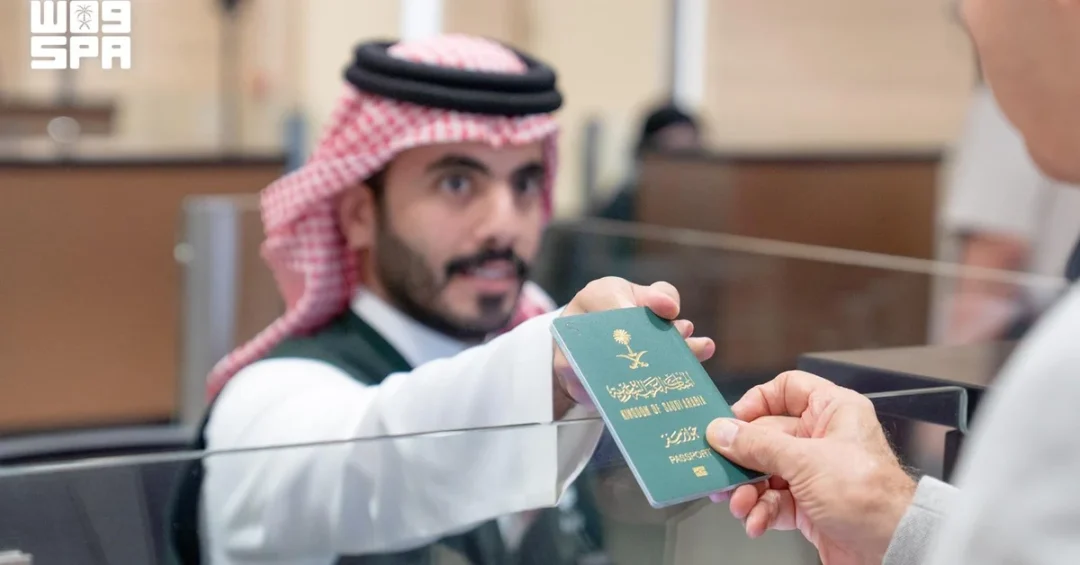
Saudi Arabia’s General Directorate of Passports has intensified efforts across all ports of entry to streamline traveler procedures through an integrated system that simplifies processes, enhances operational efficiency, and accommodates the growing number of travelers arriving in the Kingdom. The announcement, released through the Saudi Press Agency on August 12, 2026, reflects a sustained institutional push to align border management with the rapid expansion of Saudi Arabia’s aviation, tourism, and pilgrimage sectors. The directorate confirmed it has reinforced international ports of entry with qualified personnel and advanced technological solutions designed to expedite procedures, improve operational efficiency, and elevate the overall travel experience for citizens, residents, and visitors alike.
The directive arrives at a moment when Saudi Arabia is welcoming record numbers of international arrivals, driven by religious tourism, business travel, and a fast-growing leisure sector. Border posts that once handled predictable seasonal peaks now operate in an environment of near-continuous high demand. In response, the General Directorate of Passports has positioned itself as a central operational partner in the Kingdom’s broader modernization program, coordinating with ministries, airport authorities, and technology providers to keep movement across Saudi borders smooth, secure, and dignified. For travelers, the practical result is a simpler journey from arrival gate to exit hall. For the Kingdom, it is another step toward positioning Saudi Arabia as one of the most connected and welcoming destinations in the world.
Context and Background
Why has border management become such a visible priority for Saudi Arabia in 2026? The answer lies in the scale of the transformation underway across the Kingdom’s transport and tourism landscape. Under Vision 2030, Saudi Arabia has set ambitious targets for international visitors, aviation capacity, and non-oil economic growth. New destinations, expanded airline routes, and streamlined visa categories have combined to place unprecedented pressure on arrival infrastructure. The General Directorate of Passports, a body operating under the Ministry of Interior, has therefore moved from a traditional enforcement role toward a dual mandate: protecting the Kingdom’s borders while delivering a fast, courteous, and technologically advanced experience for every traveler.
The directorate’s latest measures build on years of incremental upgrades. Saudi Arabia has progressively introduced electronic visa platforms, biometric verification, pre-arrival traveler declarations, and automated self-service kiosks at major airports. These tools reduce manual processing time and allow officers to focus on higher-risk cases. The August 2026 announcement signals that the same philosophy is now being applied consistently across all ports of entry, including land crossings and seaports, not only the largest international airports. That consistency matters because travelers often judge a country by its least modernized entry point, and the Kingdom is determined to present a uniform standard of efficiency nationwide.
Regional competition also shapes the agenda. Gulf neighbors have invested heavily in transit hubs, and global travelers increasingly choose routes based on convenience. By strengthening staffing and technology at its borders, Saudi Arabia reinforces the competitiveness of its airports and seaports as gateways to the Middle East. The move complements broader investments in aviation, hospitality, and entertainment, ensuring that the first impression of the Kingdom matches the ambition of its national project.
Key Details of the Initiative
What specifically does the General Directorate of Passports intend to deliver? According to the official announcement, the directorate has intensified efforts across all ports of entry through an integrated system that simplifies processes and enhances operational efficiency. This includes deploying qualified personnel to international ports and equipping them with advanced technological solutions. The combination of human expertise and digital tools is intended to shorten waiting times, reduce paperwork, and improve the accuracy of traveler verification. The directorate has framed the initiative as a direct response to growing traveler numbers, ensuring that capacity keeps pace with demand rather than lagging behind it.
The announcement also carried a clear public advisory. The directorate urged citizens to safeguard their passports by protecting them from damage, loss, or theft. It advised against neglecting, pawning, or misusing passports, and emphasized the importance of checking passport validity well in advance of travel. These reminders are practical rather than bureaucratic: a damaged or expired passport can disrupt travel plans and create avoidable congestion at border counters. By pairing infrastructure upgrades with traveler education, the directorate is addressing both sides of the equation, improving the system while helping travelers do their part.
Behind the scenes, the integrated approach likely involves shared data platforms, real-time queue monitoring, and coordination with airlines and airport operators so that passenger flows can be managed proactively. While the official statement focuses on outcomes rather than technical architecture, the emphasis on an integrated system indicates that information is being connected across checkpoints, allowing officers to make faster and better-informed decisions. For travelers, that translates into fewer repeated document checks and a more predictable journey.
International and Regional Impact
How does a smoother border experience influence Saudi Arabia’s standing in the region and beyond? Ports of entry are the physical interface between a country and the world, and their performance shapes perceptions far beyond the arrival hall. Efficient procedures signal reliability to airlines, tour operators, and international event organizers. When Saudi Arabia demonstrates that it can handle large volumes of travelers without friction, it strengthens its case as a host for global conferences, sporting events, and cultural festivals. The Kingdom’s expanding calendar of international events depends on the ability to move participants in and out quickly and comfortably.
For regional travelers, particularly those undertaking Umrah and Hajj journeys, streamlined procedures carry direct spiritual and practical value. Pilgrims often arrive in large groups, sometimes with limited travel experience, and a calm, well-organized arrival process contributes to the dignity of the journey. The directorate’s emphasis on qualified personnel reflects an understanding that technology alone is not enough; courteous, well-trained officers are essential to a positive experience. In this sense, the initiative supports Saudi Arabia’s role as custodian of the Two Holy Mosques and its responsibility to serve millions of guests each year.
Internationally, the measures align with global best practice in border management, where the trend is toward biometric verification, risk-based screening, and seamless digital journeys. By investing in these areas, Saudi Arabia signals that it is not merely keeping up but helping to set the standard for the region. Partners in trade, tourism, and security benefit from a border system that is both efficient and trustworthy, reinforcing the Kingdom’s reputation as a dependable international actor.
Economic and Strategic Significance
Why does border efficiency matter economically? Tourism is a pillar of Vision 2030, and the visitor journey begins at the port of entry. Delays and friction impose real costs: missed connections, reduced spending time, and negative word of mouth. Conversely, a smooth arrival encourages longer stays, higher spending, and repeat visits. The General Directorate of Passports is therefore contributing directly to the economic objectives of the Kingdom, even though its work is operational rather than commercial. Every minute saved at a border counter is a minute returned to the visitor economy.
The strategic dimension extends to trade and logistics. Saudi Arabia is investing in ports, rail, and air cargo as part of its ambition to become a global logistics hub. While the directorate’s announcement focuses on traveler procedures, the same philosophy of integrated, technology-enabled processing supports the movement of people who drive business relationships. Executives, investors, and skilled workers all pass through ports of entry, and their experience influences decisions about where to invest and collaborate. A modern border is thus an instrument of economic diplomacy, quietly enabling the deals and partnerships that underpin diversification.
There is also a security dimension that should not be overlooked. Streamlined procedures are not the same as relaxed procedures. Advanced technology allows officers to verify identities and detect irregularities more effectively, while qualified personnel provide the judgment that machines cannot. The result is a system that is faster for legitimate travelers and more resilient against abuse. This balance between openness and protection is central to Saudi Arabia’s approach and to public confidence in the Kingdom’s borders.
Vision 2030 Alignment
How does this initiative connect to the broader Vision 2030 program? Vision 2030 envisions a Saudi Arabia that is open to the world, economically diversified, and admired for the quality of its public services. The General Directorate of Passports is delivering on that vision at one of the most sensitive points of contact between the state and the public. By simplifying procedures, investing in staff, and adopting advanced technology, the directorate embodies the Vision’s emphasis on government excellence and citizen-centric service. Its work supports tourism targets, pilgrimage capacity, and the Kingdom’s emergence as a global destination.
Looking ahead, the trajectory is clear: continued digitization, deeper integration between agencies, and a traveler experience that matches the best in the world. The August 2026 announcement is not an endpoint but a milestone in an ongoing program. As Saudi Arabia prepares to host major international events and welcome ever-larger numbers of visitors, the reliability of its ports of entry will remain a foundation of its global reputation. The Kingdom’s message to travelers is straightforward and confident: come to Saudi Arabia, and you will be received efficiently, securely, and with the hospitality for which the nation is known.
20 Questions
Q1. What did the General Directorate of Passports announce?
A1. It announced intensified efforts across all ports of entry to streamline traveler procedures through an integrated system that simplifies processes, enhances operational efficiency, and accommodates growing traveler numbers.
Q2. When was the announcement released?
A2. The Saudi Press Agency released the announcement on August 12, 2026, with a dateline of Riyadh and a timestamp of 15:00 local time, 12:00 GMT.
Q3. Which government body issued the statement?
A3. The General Directorate of Passports, which operates under the Ministry of Interior and manages border control and traveler processing across the Kingdom.
Q4. What does the integrated system aim to achieve?
A4. It aims to simplify procedures, enhance operational efficiency, and accommodate the growing number of travelers arriving at Saudi ports of entry.
Q5. How has the directorate strengthened international ports of entry?
A5. It has reinforced them with qualified personnel and advanced technological solutions to expedite procedures, improve efficiency, and enhance the overall travel experience.
Q6. Why is this initiative important now?
A6. Saudi Arabia is welcoming record numbers of visitors for tourism, business, and pilgrimage, placing unprecedented demand on border infrastructure that must keep pace.
Q7. What advice did the directorate give to citizens?
A7. It urged citizens to safeguard their passports from damage, loss, or theft, and to avoid neglecting, pawning, or misusing them.
Q8. What did the directorate say about passport validity?
A8. It emphasized the importance of checking passport validity well in advance of travel to avoid disruptions and unnecessary delays at border counters.
Q9. Which travelers benefit from these measures?
A9. Citizens, residents, tourists, business travelers, and pilgrims all benefit from faster, smoother, and more predictable processing at Saudi ports of entry.
Q10. How does this support Vision 2030?
A10. It advances Vision 2030 goals for tourism growth, government excellence, and economic diversification by improving the visitor journey from the moment of arrival.
Q11. What role does technology play in the initiative?
A11. Advanced technological solutions support faster verification, reduced paperwork, and better coordination across checkpoints, complementing the work of qualified border personnel.
Q12. Does streamlining procedures weaken border security?
A12. No. Technology and trained officers improve both speed and accuracy, making the system faster for legitimate travelers and more resilient against abuse.
Q13. How does this affect pilgrims?
A13. Streamlined processing supports the dignified arrival of Umrah and Hajj pilgrims, who often travel in large groups and benefit from calm, well-organized procedures.
Q14. What economic benefits are expected?
A14. Faster processing encourages longer stays, higher visitor spending, and repeat visits, directly supporting the Kingdom’s tourism and non-oil economic objectives.
Q15. How does this affect Saudi Arabia’s regional competitiveness?
A15. Efficient borders strengthen the Kingdom’s airports and seaports as attractive gateways, helping compete with other Gulf transit hubs for international travelers.
Q16. Which types of ports are covered?
A16. The efforts cover all ports of entry, including international airports, land crossings, and seaports, ensuring a consistent standard nationwide.
Q17. What should travelers do before departure?
A17. Travelers should check passport validity well in advance, keep documents secure, and ensure passports are free from damage that could affect machine readability.
Q18. How does this initiative reflect government modernization?
A18. It demonstrates the Kingdom’s commitment to citizen-centric service, digital transformation, and operational excellence across public institutions.
Q19. What is the expected long-term outcome?
A19. The initiative supports a traveler experience matching global best practice, reinforcing Saudi Arabia’s reputation as a connected, welcoming, and reliable international destination.
Q20. What message does the Kingdom send to international visitors?
A20. Saudi Arabia signals that visitors will be received efficiently, securely, and with the hospitality for which the nation is known, in line with its global ambitions.
Reader Feedback
We value your thoughts. Please share your feedback on this article.
Your feedback helps us improve our coverage.
Related articles
 Saudi Deputy Foreign Minister Bids Farewell to Swedish Ambassador
 Israeli Settlers Storm Al-Aqsa Mosque Compound Again
 Arab League: Colombia’s Golan Declaration Void
 Green Spaces in Makkah Enhance Urban Comfort for Visitors
 International Dates Council Hosts Regional Workshop in Cairo
 Saudi Red Crescent Awards Safety Compliance to Al-Baha Municipality