


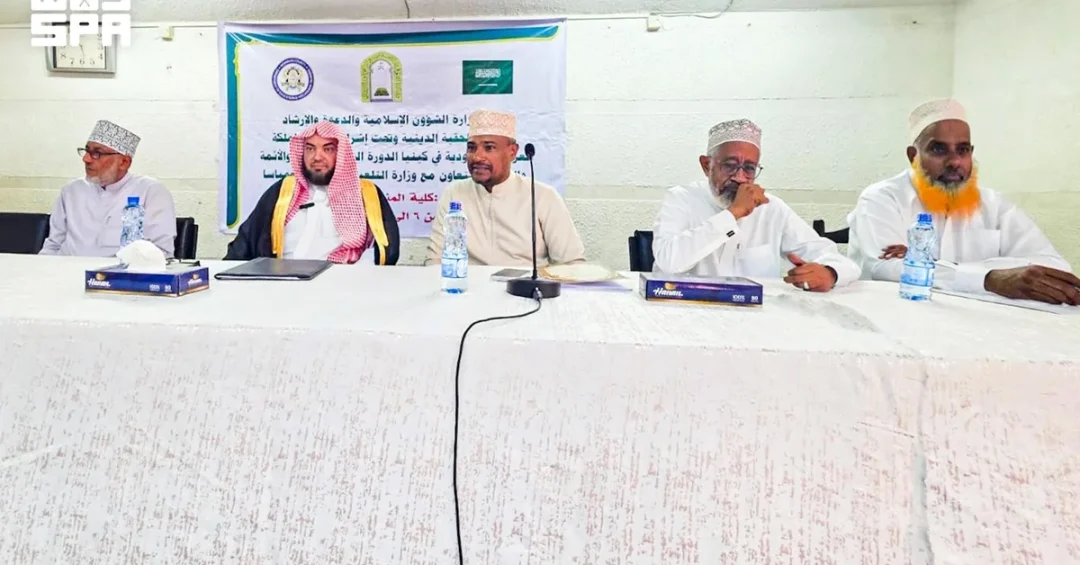
The Ministry of Islamic Affairs, Dawah and Guidance, represented by its Religious Attaché in Kenya, conducted the fourth scholarly training course for preachers, imams, and khateebs on September 7, 2026, at Al-Munawwarah College in Mombasa, drawing the participation of about 100 religious leaders and students from across the East African nation. The four-day program, delivered through lectures held at several mosques, is designed to equip participants with sound Islamic knowledge grounded in the Quran and Sunnah and rooted in the approach of moderation and balance. The initiative forms part of a wider series of programs the ministry implements in numerous countries to disseminate authentic Islamic knowledge, promote moderation, and highlight the Kingdom of Saudi Arabia’s noble message of tolerance.
Why does a training course held in a coastal Kenyan city matter far beyond its lecture halls? Because the skills and perspectives imparted to preachers, imams, and khateebs ripple outward into the daily lives of entire communities. The course reflects a sustained Saudi commitment to supporting Muslim communities worldwide through education, capacity-building, and the promotion of coexistence. By working through its Religious Attaché in Kenya, the ministry ensures that its outreach is locally embedded, culturally attuned, and delivered in partnership with recognized institutions such as Al-Munawwarah College. The result is a program that strengthens the intellectual foundations of religious leadership while rejecting extremism and radicalism in all their forms.
Context and Background
What is the broader framework behind this fourth edition of the course? The Ministry of Islamic Affairs, Dawah and Guidance has, over many years, built a global network of religious attachés and outreach programs that serve Muslim communities from Africa to Asia. These programs are not one-off events but part of a structured, recurring strategy to provide preachers and imams with continuing education. The Religious Attaché in Kenya has now organized four such scholarly courses, each building on the last and expanding the pool of beneficiaries. This continuity is significant: it demonstrates that Saudi Arabia’s engagement with Kenyan Muslim communities is patient, institutional, and focused on long-term capacity rather than short-term visibility.
Kenya occupies a distinctive place in this outreach. It is home to a large and vibrant Muslim population, particularly along the coast, where Mombasa has long served as a center of Islamic learning and commerce. Al-Munawwarah College, the host institution, is a respected seat of education in the city. By selecting this venue, the ministry signals its respect for local scholarly traditions while offering participants access to a curriculum shaped by the principles of moderation and balance. The course also reflects the Kingdom’s recognition that African Muslim communities are integral partners in the global effort to present Islam as a religion of tolerance, coexistence, and constructive engagement.
Why emphasize moderation and balance so consistently? Because these values are the cornerstone of Saudi Arabia’s religious outreach, and they answer a genuine need in many societies. Extremist narratives thrive where religious knowledge is thin or where preachers lack the tools to address contemporary questions with confidence. By investing in the education of preachers, imams, and khateebs, the ministry helps communities build resilience against radicalization. The four-day format, with lectures distributed across several mosques, also ensures that the benefits are not confined to a single institution but reach a wider public, multiplying the impact of every session.
Key Details
What exactly did the fourth course involve? According to the Saudi Press Agency, the course took place on September 7, 2026, at Al-Munawwarah College in Mombasa and brought together approximately 100 preachers, imams, khateebs, and students. The program ran for four days and featured a series of lectures delivered at multiple mosques, a design choice that expanded the scope of beneficiaries and enhanced the participants’ dawah impact on Kenyan society. The curriculum centered on sound Islamic knowledge, drawn from the Quran and Sunnah, and was explicitly framed around the approach of moderation and balance.
The participants themselves are central to the story. Preachers, imams, and khateebs are the frontline communicators of religious knowledge in their communities. They lead prayers, deliver sermons, counsel families, and shape the understanding of Islam for thousands of worshippers each week. Investing in their training is therefore an investment in the spiritual and social health of entire neighborhoods. The inclusion of students in the program is equally important, as it ensures that the next generation of religious leaders is formed in an environment that values scholarship, tolerance, and constructive engagement with society.
How does the course fit into the ministry’s wider international activities? The Saudi Press Agency report notes that the program is part of the programs and activities implemented by the ministry in several countries to disseminate sound Islamic knowledge, promote moderation and balance, and highlight the Kingdom’s noble message. That message, as described in the official account, demonstrates Islam’s tolerance, rejects extremism and radicalism, and enhances the values of moderation and coexistence. The Kenyan course is thus one node in a global network of outreach, each node reinforcing the same principles and serving the same overarching purpose.
International and Regional Impact
How will this course be felt across East Africa and the wider Islamic world? Kenya’s Muslim communities are connected to networks of scholarship, trade, and family that span the Indian Ocean and the wider continent. When 100 preachers and imams return to their mosques with renewed knowledge and a clearer understanding of moderation, their influence extends beyond their immediate congregations. They become points of reference for neighboring communities, and their sermons and teaching sessions carry the values of tolerance and coexistence into new settings. In this way, a four-day course in Mombasa contributes to a regional culture of moderation that benefits Muslim and non-Muslim communities alike.
The program also strengthens the relationship between Saudi Arabia and Kenya, two nations with deep historical and commercial ties. Kenya is a key partner in East Africa, and its stability and prosperity are matters of interest well beyond its borders. By supporting the education of religious leaders, the Kingdom contributes to social cohesion and counters the narratives that extremists use to divide communities. This is diplomacy conducted through education and faith, and it complements the broader cooperation between the two countries in trade, investment, and development. The course is a reminder that Saudi Arabia’s global role includes a substantial and constructive religious dimension.
Economic and Strategic Significance
Why should a religious training course be understood as strategically significant? Because stability, moderation, and social cohesion are prerequisites for economic development. Communities that are resilient against extremism attract investment, foster tourism, and create opportunities for their young people. Saudi Arabia’s support for religious education in Kenya therefore has indirect but real economic value. It helps create the conditions in which businesses can grow, visitors can travel safely, and young people can pursue education and careers rather than being drawn into radical movements. The Kingdom’s Vision 2030 emphasizes a prosperous, diversified economy at home, and its international outreach reflects a parallel commitment to stability and opportunity abroad.
The strategic dimension also includes the strengthening of people-to-people ties. When Kenyan religious leaders study curricula shaped by Saudi scholarship, they build relationships with Saudi institutions and with one another. These relationships form a foundation for future cooperation in education, culture, and commerce. The ministry’s programs are thus an instrument of soft power in the best sense: they create goodwill through service, not coercion. For a Kingdom that positions itself as a bridge between continents and civilizations, such initiatives are central to its international identity and to its long-term partnerships in Africa and beyond.
Vision 2030 Alignment
How does this course connect to Saudi Arabia’s Vision 2030? Vision 2030 is a comprehensive national transformation program that seeks to diversify the economy, empower citizens, and strengthen the Kingdom’s global role. A key element of that global role is the promotion of moderation, tolerance, and coexistence, values that Saudi leadership has consistently championed on international platforms. The Ministry of Islamic Affairs, Dawah and Guidance carries this message through its worldwide programs, of which the Kenyan course is a clear example. By training preachers and imams in sound knowledge and balanced understanding, the Kingdom advances the vision of a world in which Islamic scholarship serves peace and constructive engagement.
The course also reflects Vision 2030’s emphasis on institutional excellence and international partnership. The ministry works through its Religious Attaché in Kenya, coordinates with a respected local institution in Al-Munawwarah College, and reaches participants through mosques across Mombasa. This is a model of cooperative, respectful engagement that builds local capacity rather than creating dependency. As Saudi Arabia continues to expand its global partnerships, initiatives like this demonstrate the Kingdom’s enduring commitment to supporting Muslim communities, promoting moderation, and contributing to a more stable and prosperous world. The fourth course in Kenya is not an endpoint but a milestone in a continuing journey of service and scholarship.
20 Questions
Q1. What event took place in Mombasa, Kenya, on September 7, 2026?
A1. The Ministry of Islamic Affairs, Dawah and Guidance, through its Religious Attaché in Kenya, conducted the fourth scholarly training course for preachers, imams, and khateebs at Al-Munawwarah College in Mombasa.
Q2. How many participants attended the fourth training course in Kenya?
A2. Approximately 100 preachers, imams, khateebs, and students participated in the course, according to the Saudi Press Agency report on the event.
Q3. How long did the training course last?
A3. The course was conducted over four days, featuring a number of lectures held at several mosques to expand the reach of its programs and beneficiaries.
Q4. What is the main objective of the course?
A4. The course aims to equip preachers, imams, and khateebs with sound Islamic knowledge and enhance their understanding in light of the Quran and Sunnah, based on moderation and balance.
Q5. Where were the course lectures held?
A5. The lectures were held at several mosques, a design that contributed to expanding the scope of beneficiaries and enhancing the dawah impact of participants on Kenyan society.
Q6. Which Saudi ministry organized the training course?
A6. The Ministry of Islamic Affairs, Dawah and Guidance organized the course through its Religious Attaché in Kenya, as part of its international programs and activities.
Q7. What institution hosted the course in Mombasa?
A7. Al-Munawwarah College in Mombasa hosted the fourth scholarly course, providing a respected local venue for the training of religious leaders and students.
Q8. Is this the first such course held in Kenya?
A8. No. It is the fourth scholarly course conducted by the ministry’s Religious Attaché in Kenya, reflecting a sustained and recurring commitment to religious education there.
Q9. What values does the course seek to promote?
A9. The course promotes moderation, balance, tolerance, and coexistence, and it rejects extremism and radicalism, in line with the Kingdom’s noble message of Islam’s tolerance.
Q10. Why are preachers, imams, and khateebs specifically targeted?
A10. They are frontline religious communicators who lead prayers, deliver sermons, and shape understanding of Islam for thousands of worshippers, making their training highly influential.
Q11. How does the course benefit Kenyan society more broadly?
A11. By strengthening the knowledge and moderation of religious leaders, the course helps build community resilience against extremism and supports social cohesion across Kenyan society.
Q12. What role does the Religious Attaché in Kenya play?
A12. The Religious Attaché represents the ministry in Kenya, organizes training courses, coordinates with local institutions, and ensures the Kingdom’s outreach is locally embedded and effective.
Q13. How does the course relate to the ministry’s global activities?
A13. It is part of programs the ministry implements in several countries to disseminate sound Islamic knowledge, promote moderation and balance, and highlight the Kingdom’s noble message.
Q14. What does the official report say about extremism?
A14. The report states that the Kingdom’s message rejects extremism and radicalism and enhances the values of moderation and coexistence among Muslim communities worldwide.
Q15. Why is Mombasa a significant location for this course?
A15. Mombasa is a historic center of Islamic learning and commerce on Kenya’s coast, home to a large Muslim population and respected institutions such as Al-Munawwarah College.
Q16. How does the course support the next generation of religious leaders?
A16. By including students among the participants, the course ensures that future preachers and imams are formed in an environment that values scholarship, tolerance, and constructive engagement.
Q17. What connection does the course have to Saudi Vision 2030?
A17. It reflects Vision 2030’s emphasis on strengthening the Kingdom’s global role and promoting moderation, tolerance, and coexistence through institutional excellence and international partnership.
Q18. What impact can participants have after completing the course?
A18. Returning to their mosques with renewed knowledge, participants can influence congregations and neighboring communities, spreading values of tolerance and coexistence across the region.
Q19. Does the course strengthen Saudi-Kenyan relations?
A19. Yes. It reinforces ties between the two nations by supporting religious education, social cohesion, and people-to-people relationships that complement cooperation in trade and development.
Q20. What does the fourth course signify for future outreach?
A20. It is a milestone in a continuing journey, demonstrating the Kingdom’s sustained commitment to supporting Muslim communities, promoting moderation, and contributing to global stability and prosperity.
Reader Feedback
We value your thoughts. Please share your feedback on this article.
Your feedback helps us improve our coverage.
Related articles
 Wadi Jazan Dam: Five Decades of Water and Farming
 Jeddah Seminar Tackles Violence Against Women
 KSrelief provides 25,000 hot meals in Gaza
 Umrah guests visit King Abdulaziz Complex for Holy Kaaba Kiswa
 Tawakkalna ranks first for beneficiary satisfaction in 2026 index
 KSrelief economic empowerment project supports Gaza Strip