


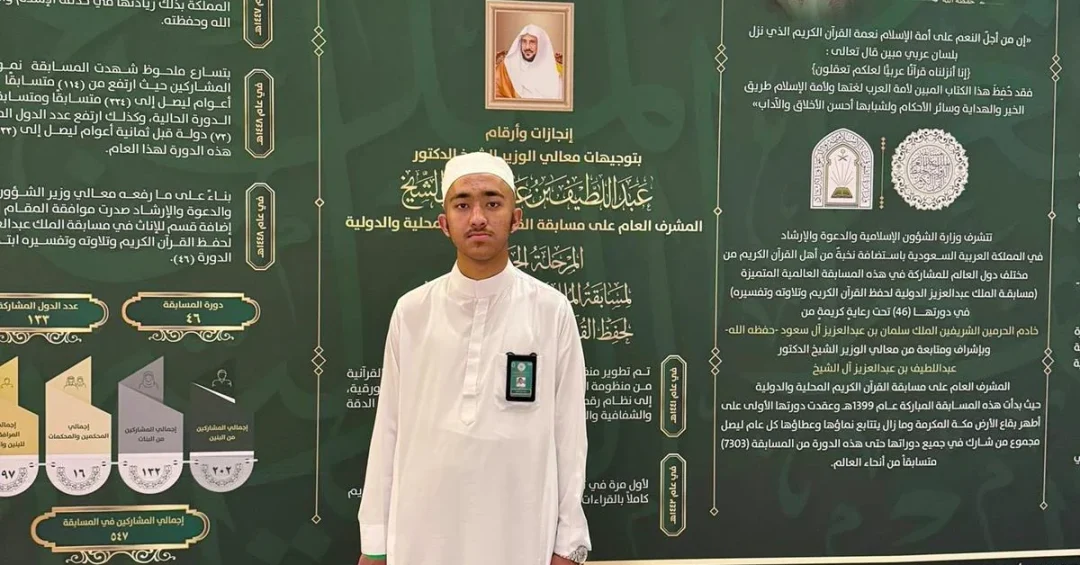
Mohammed Sayan Tandel, a 16-year-old Quran memorizer from a small town in Botswana, has traveled to Makkah to represent his country at the 46th King Abdulaziz International Competition for Memorizing, Reciting, and Interpreting the Holy Quran, according to the Saudi Press Agency. His journey from a study circle with a single student to one of the Islamic world’s most prestigious Quranic forums has captured attention across the Kingdom and beyond, illustrating how personal dedication can transcend geography and circumstance.
Mohammed’s story is one of quiet perseverance. For years, he sat alone with his teacher from Pakistan in a modest study circle in Botswana, Southern Africa, with no classmates beside him and no peers to share the daily discipline of memorizing the Holy Quran. Yet that solitude, rather than limiting him, sharpened his focus and deepened his resolve. His nomination by the Grand Mufti of Botswana opened the door to Makkah, where he now joins reciters and memorizers from dozens of nations. How often does a young student’s private devotion become a story that resonates across the global Muslim community? In Mohammed’s case, the answer is unfolding in real time on one of the most revered stages in the Islamic world.
Context and Background
The King Abdulaziz International Competition for Memorizing, Reciting, and Interpreting the Holy Quran is among the most established and respected Quranic competitions globally, organized under the supervision of Saudi Arabia’s Ministry of Islamic Affairs, Dawah and Guidance. Now in its 46th edition, the competition draws participants from across the Muslim world who compete in categories covering complete memorization, precise recitation, and interpretive understanding of the sacred text. For competitors, selection is itself an honor, as each national quota is typically filled through rigorous local and regional qualifiers overseen by recognized religious authorities.
Botswana, a landlocked nation in Southern Africa with a Muslim minority, maintains a modest but committed Quranic education tradition. The Grand Mufti of Botswana plays a central role in identifying and endorsing candidates capable of representing the country at international forums. Mohammed’s nomination followed in the footsteps of a neighbor who participated in the same competition in 2019, a precedent that gave him both a model and a source of encouragement. What does it mean for a small national community when one of its young members reaches a global platform? For Botswana’s Muslims, Mohammed’s participation is a point of collective pride and a signal that dedicated study can open international doors regardless of the size of the local community.
The competition itself reflects Saudi Arabia’s long-standing commitment to serving the Holy Quran and supporting Quranic education worldwide. Through hosting, judging, and rewarding competitors, the Kingdom positions Makkah as a unifying center for Muslims of diverse nationalities, schools of thought, and languages. The event also complements broader Saudi efforts in religious diplomacy, including the distribution of Quranic materials, support for Islamic centers, and the facilitation of pilgrimage. In this context, Mohammed’s presence is not merely an individual achievement but part of a wider ecosystem that connects the Kingdom to Muslim communities on every continent.
A Solitary Study Circle in Botswana
Mohammed’s daily routine before arriving in Saudi Arabia was defined by discipline rather than competition. From dawn until sunset, he sat in a study circle with only his teacher present, working through the memorization of the Holy Quran verse by verse. The absence of fellow students meant no peer rivalry, no shared recitation sessions, and no group motivation. “One of the greatest challenges I have faced is being my teacher’s only student,” Mohammed said, explaining that the experience could make memorization a lonely journey, particularly without the spirit of competition that peers in other parts of the Muslim world often enjoy.
Yet the same isolation that might have discouraged another student became, for Mohammed, a source of concentration. Without distractions, he developed a rhythm of study that prioritized consistency and accuracy. His parents supported his efforts, and his teacher from Pakistan provided sustained guidance across years of patient instruction. The relationship between a single teacher and a single student is a classical model of Quranic transmission, echoing traditions in which knowledge passes intimately from one generation to the next. Can a solitary path produce the same depth of mastery as a crowded classroom? Mohammed’s progress suggests that dedication, when paired with skilled instruction, can compensate for the absence of a large cohort.
His nomination by the Grand Mufti of Botswana marked a turning point. Mohammed did not hesitate to accept the opportunity, recalling the inspiration he drew from his neighbor’s participation in 2019. That earlier journey showed him that the competition was not an abstract dream but a reachable goal. It also demonstrated that Botswana’s Muslim community, though small, could produce candidates capable of competing internationally. For young students in similar circumstances, Mohammed’s example offers a concrete answer to the question of whether geography or community size must limit ambition.
Arrival in Makkah and the First Sight of the Kaaba
Mohammed traveled to the Kingdom accompanied by his parents, exchanging the quiet study circle of his hometown for the scale and spiritual intensity of Makkah. His first sight of the Holy Kaaba left him deeply moved. “It was a feeling that words cannot describe, a mixture of awe, serenity, and joy,” he said. For a young memorizer who had spent years reciting verses in private, standing before the Kaaba represented both a spiritual milestone and a confirmation that his efforts had carried him to a place of global significance.
He noted that the journey was not merely about performing Hajj or Umrah, though those rites carry profound meaning for Muslims. It was also about representing his country at a global event that every memorizer of the Quran dreams of attending. The combination of pilgrimage and competition gave his visit a dual purpose: personal worship and national representation. How does a young person process such a convergence of spiritual and competitive pressures? Mohammed’s response has been to focus on gratitude and preparation, treating the competition as an extension of the devotion that shaped his daily life in Botswana.
His parents’ presence adds a family dimension to the story. In many Quranic traditions, families play a decisive role in encouraging memorization, providing stability, and reinforcing the value of religious education. By accompanying their son to Makkah, Mohammed’s parents underscore that his achievement is shared. Their journey also reflects the broader reality that Saudi Arabia’s religious infrastructure, including the Grand Mosque and the systems supporting pilgrims and competitors, serves Muslims from every region, including communities far from the traditional centers of Islamic scholarship.
International and Regional Impact
The King Abdulaziz International Competition brings together participants from across Africa, Asia, the Middle East, and beyond, creating a meeting point for young Muslims who might otherwise never encounter one another. For Botswana, Mohammed’s participation raises the country’s profile in Islamic educational circles and strengthens ties with Saudi Arabia. For the Kingdom, hosting competitors from Southern Africa reinforces its role as a global hub for Quranic learning and a facilitator of religious exchange. The competition also demonstrates that Saudi Arabia’s religious outreach extends well beyond the Middle East, reaching communities in every continent.
At the regional level, Mohammed’s journey resonates with Muslim communities across Southern Africa, where Quranic education often depends on local teachers, small madrasas, and international support. His story illustrates how investment in religious education can produce internationally competitive students. It also highlights the role of national religious authorities, such as the office of the Grand Mufti of Botswana, in identifying talent and connecting local students to global opportunities. Does a single competitor’s success change the trajectory of an entire community? While one participant cannot transform institutions overnight, visible role models often inspire younger students and encourage families to prioritize memorization and recitation.
The competition’s international character also serves a diplomatic function. By welcoming participants from diverse countries, Saudi Arabia reinforces bonds of faith and culture that transcend political and economic relationships. These bonds are particularly valuable in regions where Muslim minorities seek recognition and support. Mohammed’s presence in Makkah, accompanied by his parents and supported by his national religious leadership, is a small but meaningful example of how the Kingdom’s religious hospitality translates into tangible connections with communities worldwide.
Economic and Strategic Significance
While the King Abdulaziz International Competition is primarily a religious and educational event, it operates within a broader strategic framework that includes Saudi Arabia’s leadership in Islamic affairs. Hosting competitions, facilitating pilgrimage, and supporting Quranic education contribute to the Kingdom’s soft power and reinforce its position as the custodian of Islam’s holiest sites. These activities also support the pilgrimage economy, which remains a significant component of Saudi Arabia’s tourism and services sectors, generating demand for hospitality, transport, and retail across Makkah and beyond.
For Botswana, the benefits are less quantifiable but no less real. International participation can strengthen educational partnerships, encourage exchange programs, and raise the visibility of local religious institutions. It can also inspire philanthropic support for Quranic education, as communities see their students compete on global stages. In this sense, Mohammed’s journey is an investment in human capital, demonstrating that young people from small towns can achieve at the highest levels when given the opportunity. What returns can a nation expect from supporting a single student? The answer often appears years later, as participants become teachers, community leaders, and bridges between their countries and the wider Muslim world.
Strategically, the competition aligns with Saudi Arabia’s efforts to present itself as a unifying force in the Islamic world. By bringing together memorizers from different countries and schools of thought, the event emphasizes shared devotion over division. This approach complements the Kingdom’s broader diplomatic outreach and its Vision 2030 goal of fostering international engagement and cultural exchange. Mohammed’s participation thus fits into a larger pattern of Saudi initiatives that connect religious heritage with modern global communication.
Vision 2030 Alignment
Saudi Arabia’s Vision 2030 seeks to diversify the economy, strengthen international partnerships, and enhance the Kingdom’s cultural and religious standing. The King Abdulaziz International Competition supports these objectives by attracting visitors, showcasing Saudi hospitality, and reinforcing Makkah’s role as a global spiritual destination. The event also reflects the Vision’s emphasis on youth empowerment, as it invests in young people who demonstrate discipline, learning, and leadership within their communities. By hosting Mohammed and hundreds of other competitors, the Kingdom advances a vision of religious service that is welcoming, organized, and globally connected.
For Mohammed, the competition is both an endpoint and a beginning. Whatever the outcome, his journey from a solitary study circle in Botswana to the international stage in Makkah stands as a testament to determination and faith. His story also strengthens the connection between Saudi Arabia and Muslim communities in Southern Africa, illustrating how the Kingdom’s religious institutions create opportunities for young people from every background. As Vision 2030 continues to shape Saudi Arabia’s global role, stories like Mohammed’s will remain central to the Kingdom’s message: that dedication, supported by opportunity, can carry a student from a small town to the heart of the Muslim world.
20 Questions
Q1. Who is Mohammed Sayan Tandel?
A1. Mohammed Sayan Tandel is a 16-year-old Quran memorizer from a small town in Botswana. He has been nominated by the Grand Mufti of Botswana to represent his country at the 46th King Abdulaziz International Competition in Makkah.
Q2. What competition is Mohammed participating in?
A2. He is participating in the 46th King Abdulaziz International Competition for Memorizing, Reciting, and Interpreting the Holy Quran, held in Makkah under the supervision of Saudi Arabia’s Ministry of Islamic Affairs, Dawah and Guidance.
Q3. Where is Mohammed from?
A3. Mohammed is from a small town in Botswana, a landlocked country in Southern Africa with a Muslim minority. His community’s religious leadership nominated him for the international competition.
Q4. Why was Mohammed described as a sole student?
A4. He studied in a study circle with only his teacher from Pakistan present. There were no fellow students or peers, making his daily memorization a solitary pursuit rather than a group activity.
Q5. What challenge did Mohammed face in his studies?
A5. He said one of his greatest challenges was being his teacher’s only student, which made memorizing the Quran a lonely journey without the spirit of competition that peers elsewhere often experience.
Q6. How did solitude affect his determination?
A6. Rather than discouraging him, solitude gave him greater focus and dedication. He turned what could have been a limitation into a source of motivation and consistent study.
Q7. Who nominated Mohammed for the competition?
A7. The Grand Mufti of Botswana nominated him to participate in this year’s competition. Mohammed described the nomination as a turning point in his life and accepted without hesitation.
Q8. What inspired Mohammed to pursue the competition?
A8. He drew inspiration from a neighbor who participated in the same competition in 2019. That precedent showed him the competition was a reachable goal for students from Botswana.
Q9. Who accompanied Mohammed to Saudi Arabia?
A9. Mohammed traveled to the Kingdom accompanied by his parents. Their presence underscores the family support that often underpins successful Quran memorization and international participation.
Q10. How did Mohammed describe seeing the Kaaba?
A10. He said it was a feeling that words cannot describe, a mixture of awe, serenity, and joy. The moment marked a spiritual milestone after years of private recitation and study.
Q11. What is the King Abdulaziz International Competition?
A11. It is one of the most prestigious global Quranic competitions, now in its 46th edition. It covers memorization, precise recitation, and interpretation, drawing participants from across the Muslim world.
Q12. Why is the competition significant for Saudi Arabia?
A12. It reinforces the Kingdom’s role as a global center for Quranic learning and religious hospitality. It also supports religious diplomacy and connects Saudi Arabia with Muslim communities worldwide.
Q13. What does Mohammed’s participation mean for Botswana?
A13. It raises Botswana’s profile in Islamic educational circles and provides a role model for young students. It shows that dedicated study can lead to international opportunities regardless of community size.
Q14. How does the competition reflect Saudi Vision 2030?
A14. It supports youth empowerment, international engagement, and cultural exchange. It also contributes to the pilgrimage economy and showcases Saudi hospitality to visitors from many countries.
Q15. What categories does the competition include?
A15. The competition includes complete memorization of the Holy Quran, precise recitation, and interpretation. These categories test both retention and understanding of the sacred text.
Q16. How are competitors selected for the competition?
A16. National religious authorities typically identify and endorse candidates. In Botswana, the Grand Mufti’s office selected Mohammed based on his demonstrated ability and dedication.
Q17. What role does Mohammed’s teacher play in his story?
A17. His teacher from Pakistan provided sustained instruction in a one-on-one study circle. This classical model of transmission allowed close guidance and consistent progress over years of study.
Q18. Why is Makkah significant for Quran memorizers?
A18. Makkah is home to the Holy Kaaba and the Grand Mosque, making it the spiritual heart of Islam. For memorizers, competing there represents the fulfillment of a lifelong dream.
Q19. What message does Mohammed’s journey convey?
A19. His journey shows that determination can turn a solitary path into an extraordinary opportunity. It also highlights how Saudi Arabia’s religious institutions create global platforms for young talent.
Q20. What comes next for Mohammed after the competition?
A20. Regardless of the result, his participation strengthens ties between Botswana and Saudi Arabia. He is expected to remain a role model for Quranic education in his community and beyond.
Reader Feedback
We value your thoughts. Please share your feedback on this article.
Your feedback helps us improve our coverage.
Related articles
 Al-Qafil Walkway in Al-Makhwah Offers Space for Sports
 Muslim World League Launches West Africa Peace Initiative
 KSrelief Delivers Food Baskets to Afghan Flood Victims
 OIC Human Rights Body Highlights Youth Empowerment for Future
 Muslim World League launches social peace initiative in West Africa
 KSrelief Distributes 60 Food Baskets to Flood-Affected Families in Afghanistan