


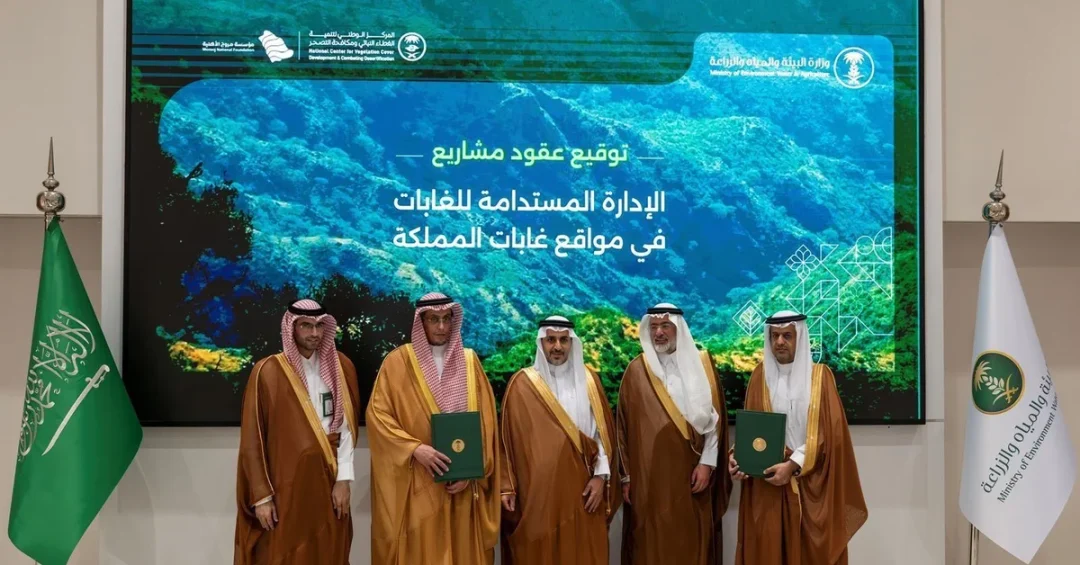
Saudi Arabia has taken a significant step forward in its environmental stewardship with the signing of contracts for the first national forest sustainability project, valued at SAR40 million, between the National Center for Vegetation Cover Development and Combating Desertification (NCVC) and Morooj National Foundation. The agreements were signed under the oversight of Eng. Mansour Hilal Al Mushaiti, Vice Minister of Environment, Water and Agriculture, marking a milestone in the Kingdom’s efforts to enhance forest sustainability and preserve environmental, economic, and social value. This initiative, reported by the Saudi Press Agency (SPA), represents a pioneering collaboration between the public and non-profit sectors to advance national environmental objectives. But what does this mean for Saudi Arabia’s environmental future, and why is it gaining attention on the international stage?
The project is the first of its kind in the Kingdom, designed to strengthen the role of the non-profit sector in environmental conservation. It aligns with Saudi Arabia’s broader strategic goals, including the Saudi Green Initiative and Vision 2030, which prioritize sustainable development and environmental protection. By partnering with Morooj National Foundation, a recognized non-profit organization, the NCVC is setting a precedent for collaborative efforts that leverage both public oversight and private-sector efficiency. This approach not only addresses immediate ecological concerns but also fosters long-term resilience in Saudi Arabia’s natural landscapes. As the world watches, the Kingdom is demonstrating how innovative partnerships can drive meaningful environmental change.
Context and Background
How did this project come to fruition, and what does it aim to achieve? The National Center for Vegetation Cover Development and Combating Desertification, a government entity under the Ministry of Environment, Water and Agriculture, has been at the forefront of Saudi Arabia’s fight against desertification and land degradation. The Kingdom’s unique ecosystems, including its forests and rangelands, face challenges from climate change, urbanization, and unsustainable practices. The NCVC’s mandate includes developing policies, implementing programs, and fostering partnerships to enhance vegetation cover and combat desertification. The signing of these contracts with Morooj National Foundation is a direct response to these challenges, reflecting a strategic shift towards inclusive and sustainable forest management.
The selection of forest sites was a meticulous process, utilizing advanced technologies such as Geographic Information Systems (GIS) and remote sensing (RS). These tools enabled the assessment of environmental, spatial, and economic characteristics of the forests, analyzing topography, environmental degradation indicators, and climatic factors. This data-driven approach ensures that interventions are targeted and effective, addressing specific needs of each forest area. The SAR40 million investment underscores the Kingdom’s commitment to environmental preservation, with the project expected to serve as a model for future initiatives. By integrating technology and expertise, Saudi Arabia is not only rehabilitating its forests but also building a knowledge base that can inform global best practices in forest sustainability.
Key Details of the Sustainable Forest Management Project
What are the specific components of this ambitious project? The plan comprises six integrated pathways for sustainable forest management, each designed to address different aspects of forest health and resilience. The first pathway focuses on enhancing forest health through measures such as soil improvement, pest control, and promoting biodiversity. The second pathway aims to prevent forest fires and restore fire-affected areas, a critical concern in arid regions where fires can devastate ecosystems. The third pathway involves rehabilitating degraded forests, restoring them to their natural state and enhancing their capacity to provide ecosystem services. These pathways are interconnected, forming a comprehensive strategy that balances ecological, economic, and social considerations.
The fourth pathway emphasizes engaging stakeholders and promoting investment, recognizing that sustainable forest management requires the involvement of local communities, businesses, and government agencies. This participatory approach ensures that projects are socially inclusive and economically viable, creating opportunities for green jobs and eco-tourism. The fifth pathway strengthens forest monitoring, using advanced technologies to track progress and identify emerging threats. Finally, the sixth pathway assesses challenges and risks, developing appropriate measures to mitigate impacts. Together, these pathways represent a holistic framework that not only addresses immediate environmental issues but also builds long-term resilience. The involvement of Morooj National Foundation brings additional expertise and community reach, enhancing the project’s effectiveness and sustainability.
International and Regional Impact
How does this project position Saudi Arabia on the global environmental stage? As the world grapples with climate change and biodiversity loss, Saudi Arabia’s initiative serves as a beacon of proactive environmental stewardship. The Kingdom’s efforts align with international frameworks such as the United Nations Sustainable Development Goals (SDGs), particularly Goal 15 on life on land, and the Paris Agreement. By investing in forest sustainability, Saudi Arabia is contributing to global carbon sequestration and biodiversity conservation, demonstrating its commitment to multilateral environmental action. Regional neighbors and international partners are likely to take note, as the project offers a replicable model for arid and semi-arid regions facing similar challenges.
Moreover, the project enhances Saudi Arabia’s role as a regional leader in sustainability. The Middle East and North Africa region is particularly vulnerable to climate impacts, and Saudi Arabia’s proactive measures can inspire collective action. The collaboration with a non-profit foundation also highlights the growing importance of civil society in environmental governance, a trend that is gaining traction worldwide. By showcasing successful public-private partnerships, the Kingdom is setting a precedent that could influence policies and practices beyond its borders. This initiative not only benefits Saudi Arabia’s environment but also strengthens its diplomatic and soft power credentials, reinforcing its position as a responsible global citizen.
Economic and Strategic Significance
What are the economic and strategic benefits of this SAR40 million investment? Sustainable forest management yields multiple economic advantages, including job creation in rural areas, increased tourism potential, and the provision of ecosystem services such as water filtration and carbon storage. The project is expected to generate green employment opportunities, supporting local communities and diversifying the economy away from oil dependency. This aligns with Vision 2030’s goal of creating a vibrant society and a thriving economy. Additionally, healthy forests contribute to food security and agricultural productivity, as they protect soil and water resources. The strategic significance extends to national security, as environmental degradation can exacerbate social and economic vulnerabilities.
Furthermore, the project reinforces Saudi Arabia’s commitment to the circular carbon economy and the Saudi Green Initiative, which aims to plant 10 billion trees across the Kingdom. By rehabilitating existing forests and preventing further degradation, the project directly supports these ambitious targets. The use of GIS and RS technologies also positions Saudi Arabia as a leader in environmental innovation, attracting investment and expertise. The partnership with Morooj National Foundation demonstrates the government’s willingness to collaborate with non-profit entities, fostering a whole-of-society approach to sustainability. This integrated strategy not only addresses environmental challenges but also contributes to economic diversification and social well-being, making it a cornerstone of Saudi Arabia’s sustainable future.
Vision 2030 Alignment
How does this project embody the aspirations of Vision 2030? Vision 2030 is Saudi Arabia’s blueprint for economic diversification, social development, and environmental sustainability. The forest sustainability project directly supports several of its pillars, including a vibrant society, a thriving economy, and an ambitious nation. By preserving natural resources and enhancing quality of life, it contributes to the goal of a sustainable environment. The project also promotes the role of the non-profit sector, a key objective of Vision 2030, which seeks to increase the sector’s contribution to GDP and social development. Through this initiative, Saudi Arabia is not only mitigating environmental risks but also building a legacy of stewardship for future generations.
In conclusion, the signing of these contracts marks a pivotal moment in Saudi Arabia’s environmental journey. The Kingdom is demonstrating that economic growth and environmental protection can go hand in hand, setting an example for the world. As the project unfolds, it will be closely watched by international observers, policymakers, and environmentalists. Saudi Arabia’s leadership in this domain underscores its commitment to a sustainable and prosperous future, in line with Vision 2030 and the Saudi Green Initiative. This initiative is more than a project; it is a testament to the Kingdom’s resolve to create a better world for all.
20 Questions
Q1. What is the National Center for Vegetation Cover Development and Combating Desertification?
A1. The NCVC is a Saudi government entity under the Ministry of Environment, Water and Agriculture, responsible for combating desertification, enhancing vegetation cover, and promoting sustainable land management across the Kingdom.
Q2. Who is Eng. Mansour Hilal Al Mushaiti?
A2. Eng. Mansour Hilal Al Mushaiti is the Vice Minister of Environment, Water and Agriculture, who oversaw the signing of the contracts, highlighting the government’s support for environmental initiatives.
Q3. What is Morooj National Foundation?
A3. Morooj National Foundation is a Saudi non-profit organization partnering with the NCVC to implement sustainable forest management projects, contributing expertise and community engagement.
Q4. What is the value of the contracts signed?
A4. The contracts are valued at SAR40 million, reflecting a significant investment in the Kingdom’s environmental sustainability and forest preservation efforts.
Q5. What is the primary goal of the project?
A5. The project aims to enhance forest sustainability, preserve environmental, economic, and social value, and strengthen the non-profit sector’s role in achieving national environmental objectives.
Q6. How were forest sites selected?
A6. Forest sites were selected using Geographic Information Systems (GIS) and remote sensing (RS) to assess environmental, spatial, and economic characteristics, including topography and degradation indicators.
Q7. What are the six pathways of the project?
A7. The six pathways are: enhancing forest health; preventing fires and restoring affected areas; rehabilitating degraded forests; engaging stakeholders and promoting investment; strengthening monitoring; and assessing risks and mitigation measures.
Q8. Why is this project considered the first of its kind?
A8. It is the first national initiative in Saudi Arabia to focus specifically on sustainable forest management through a partnership with the non-profit sector, setting a precedent for future collaborations.
Q9. How does this project align with Vision 2030?
A9. It supports Vision 2030’s environmental sustainability goals, promotes the non-profit sector, and contributes to economic diversification and social well-being, aligning with the Saudi Green Initiative.
Q10. What technologies are used in the project?
A10. GIS and remote sensing technologies are used to analyze topography, environmental degradation, and climatic factors, enabling data-driven decision-making for forest management.
Q11. What are the expected economic benefits?
A11. The project is expected to create green jobs, boost eco-tourism, and provide ecosystem services like water filtration and carbon storage, supporting economic diversification.
Q12. How does the project prevent forest fires?
A12. It includes measures to prevent fires, restore fire-affected areas, and strengthen monitoring, reducing the risk and impact of fires on forest ecosystems.
Q13. What role does the non-profit sector play?
A13. The non-profit sector, represented by Morooj National Foundation, brings community engagement, expertise, and innovative approaches, enhancing the project’s effectiveness and sustainability.
Q14. How will stakeholders be engaged?
A14. Stakeholders, including local communities and businesses, will be engaged through participatory approaches, promoting investment and ensuring social inclusivity in forest management.
Q15. What is the significance of the SAR40 million investment?
A15. The investment demonstrates Saudi Arabia’s commitment to environmental preservation, funding comprehensive forest rehabilitation and sustainability efforts across the Kingdom.
Q16. How does the project contribute to the Saudi Green Initiative?
A16. It supports the Saudi Green Initiative’s goal of planting 10 billion trees by rehabilitating forests and enhancing vegetation cover, contributing to carbon reduction and biodiversity.
Q17. What are the environmental benefits?
A17. The project enhances forest health, biodiversity, and ecosystem services, combats desertification, and improves air and water quality, benefiting the environment and communities.
Q18. How will progress be monitored?
A18. Progress will be monitored through advanced technologies and on-ground assessments, ensuring transparency and adaptability to emerging challenges.
Q19. What challenges does the project address?
A19. It addresses forest degradation, fire risks, climate change impacts, and socio-economic challenges, developing mitigation measures to ensure long-term sustainability.
Q20. What is the long-term vision for this project?
A20. The long-term vision is to create a sustainable forest management model that can be replicated across Saudi Arabia, contributing to a greener future in line with Vision 2030.
Reader Feedback
We value your thoughts. Please share your feedback on this article.
Your feedback helps us improve our coverage.
Related articles
 Pakistan’s Diplomatic Push for Peace and Security Highlights
 Grand Mosque Visitors Praise 46th King Abdulaziz Quran Competition
 5.5 Magnitude Earthquake Strikes Off El Salvador Coast
 Saudi Logistics Academy Highlights Training Solutions in Tabuk
 Magnitude 4.5 Earthquake Strikes Japan’s Kumamoto
 Asir Governor Receives Minister of Investment to Boost Regional Investment