


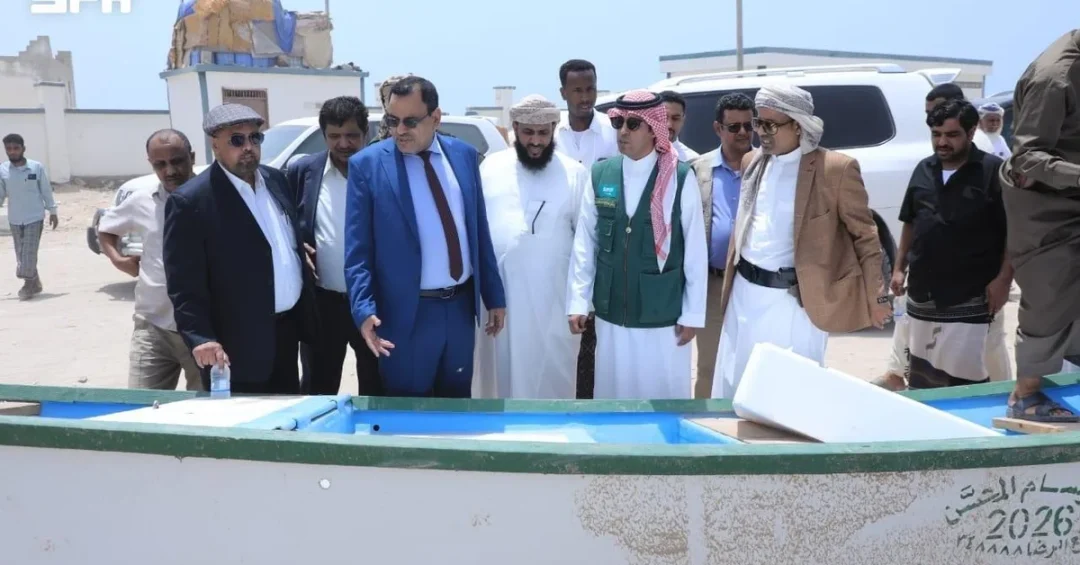
Yemeni ministers of agriculture and water have reviewed projects being implemented by Saudi Arabia through the King Salman Humanitarian Aid and Relief Center (KSrelief) to support the fisheries sector in Huswain District of Al-Mahra Governorate, as part of the Sustainable Agriculture and Agricultural and Fisheries Empowerment Project aimed at strengthening resilience in Yemen. The review, reported by the Saudi Press Agency (SPA), covered the distribution of motorized fishing boats to fishermen affected by cyclones and floods in Huswain, enabling them to resume their work and restore their sources of income.
Minister of Agriculture, Irrigation and Fisheries Salem Abdullah Issa Al-Soqtari and Minister of Water and Environment Tawfiq Al-Sharjabi were briefed on the project’s components during their visit. The ministers expressed their appreciation to Custodian of the Two Holy Mosques King Salman bin Abdulaziz Al Saud and to His Royal Highness Prince Mohammed bin Salman bin Abdulaziz Al Saud, Crown Prince and Prime Minister, for the humanitarian assistance provided through KSrelief to Yemen, particularly Al-Mahra. They said the center’s support for the fisheries sector would help improve fishermen’s livelihoods, enable them to resume their economic activities, and meet their basic living needs after losing their boats due to the severe weather conditions that affected the governorate.
But why does this project matter so much for the fishermen of Al-Mahra, and what does it reveal about Saudi Arabia’s broader humanitarian strategy? The answer lies in the intersection of climate vulnerability, economic recovery, and regional stability — all of which are central to the Kingdom’s Vision 2030 objectives for a prosperous and secure region.
Context and Background
What conditions made the fishermen of Al-Mahra so vulnerable to begin with? Al-Mahra Governorate, located in eastern Yemen along the Arabian Sea, is a region whose economy has long depended on fishing and agriculture. The area’s coastal communities have historically relied on small-scale fishing as their primary source of income, with traditional boats forming the backbone of local livelihoods. However, the governorate has been repeatedly struck by cyclones and severe flooding in recent years — including the devastating Cyclone Chapala in 2015 and Cyclone Mekunu in 2018 — which destroyed infrastructure, homes, and fishing equipment across the region.
The loss of boats was particularly devastating because fishing is not just an occupation in Al-Mahra; it is a way of life passed down through generations. Without boats, fishermen cannot access the sea, and without access to the sea, entire families lose their income, their food security, and their economic independence. According to the Food and Agriculture Organization of the United Nations, Yemen’s fisheries sector has suffered an estimated loss of over 50 percent of its pre-conflict capacity, with climate shocks compounding the damage caused by years of conflict and economic instability.
In this context, the Sustainable Agriculture and Agricultural and Fisheries Empowerment Project represents a lifeline. By providing motorized fishing boats and safety kits, the project does more than replace lost equipment — it restores dignity, self-reliance, and hope to communities that have endured years of hardship. The involvement of Yemeni ministers in reviewing the project underscores the collaborative nature of the effort, with local authorities working alongside Saudi humanitarian institutions to ensure that aid reaches those who need it most.
Key Details of the KSrelief Initiative
What exactly does the KSrelief project entail, and how will it change lives on the ground? Under the project, KSrelief will distribute 90 motorized fishing boats alongside 150 safety kits, benefiting 150 fishermen in the governorates of Hadhramaut, Al-Mahra, and Socotra. The initiative aims to improve fishermen’s livelihoods, create new income opportunities, and support safer and more productive fishing trips.
The motorized boats are a significant upgrade from traditional vessels, allowing fishermen to travel farther from shore, access richer fishing grounds, and return with larger catches. The safety kits — which typically include life jackets, communication devices, first-aid supplies, and navigation tools — address a critical gap in maritime safety, reducing the risks that fishermen face during their expeditions. By combining equipment distribution with safety training and support, the project takes a holistic approach to rebuilding the fisheries sector.
The project is part of KSrelief’s broader Sustainable Agriculture and Agricultural and Fisheries Empowerment Project, which aims to strengthen resilience in Yemen by supporting food security, creating jobs, and rebuilding productive assets. This initiative aligns with KSrelief’s track record of delivering humanitarian aid in Yemen across multiple sectors, including health, education, water, and nutrition. Since its establishment in 2015, KSrelief has implemented thousands of projects in Yemen, making Saudi Arabia one of the largest donors to the Yemeni people.
How do the Yemeni ministers themselves view this support? Minister Al-Soqtari and Minister Al-Sharjabi expressed their deep appreciation to King Salman and Crown Prince Mohammed bin Salman for the humanitarian assistance provided through KSrelief, particularly in Al-Mahra. They emphasized that the center’s support for the fisheries sector would help improve fishermen’s livelihoods, enable them to resume their economic activities, and meet their basic living needs after losing their boats due to the severe weather conditions that affected the governorate.
International and Regional Impact
Why should the international community pay attention to a fisheries project in a remote corner of Yemen? The answer is that stability in Yemen is not just a Yemeni concern — it is a regional and global imperative. Al-Mahra shares borders with Oman and overlooks key maritime routes, making its economic recovery important for regional security and trade. When fishermen can earn a living, they are less likely to be recruited by extremist groups or drawn into illicit activities. When communities are economically resilient, they are better able to withstand future shocks, including climate disasters and political instability.
Saudi Arabia’s humanitarian efforts in Yemen, channeled through KSrelief, are part of a broader strategy to promote peace, stability, and development in the region. Unlike purely military interventions, humanitarian aid addresses the root causes of vulnerability by rebuilding livelihoods, restoring infrastructure, and empowering local communities. The fisheries project is a prime example of this approach: it provides tangible assets (boats and safety kits) that enable fishermen to generate income, while also building local capacity and fostering a sense of ownership among Yemeni authorities and communities.
Moreover, the project demonstrates Saudi Arabia’s commitment to international humanitarian principles and its willingness to work with Yemeni ministries, local authorities, and international partners to deliver aid effectively. The fact that Yemeni ministers personally reviewed the project and expressed their gratitude is a testament to the strong bilateral relationship between the Kingdom and Yemen, and to the trust that local communities place in Saudi-led initiatives.
What does this mean for the wider region? As Yemen continues to face complex challenges, including conflict, economic collapse, and climate change, Saudi Arabia’s sustained humanitarian engagement offers a model for how regional powers can contribute to stability and prosperity. By focusing on livelihoods, food security, and resilience, KSrelief is helping to create the conditions for long-term recovery — not just in Al-Mahra, but across Yemen.
Economic and Strategic Significance
How does supporting fishermen contribute to Yemen’s economic recovery and Saudi Arabia’s strategic goals? The fisheries sector is one of Yemen’s most valuable natural resources, with the potential to generate significant export revenue, create jobs, and improve food security. Before the conflict, Yemen’s fisheries sector employed over 500,000 people and contributed substantially to the national economy. Restoring this sector is essential for rebuilding Yemen’s economic base and reducing its dependence on humanitarian aid.
By providing motorized boats and safety equipment, KSrelief is helping fishermen increase their productivity and income, which in turn stimulates local markets, supports related industries (such as boat repair, fish processing, and transportation), and generates tax revenue for local authorities. This multiplier effect is crucial for sustainable development. Additionally, the project’s focus on safety reduces the human and economic costs of accidents at sea, which can devastate families and communities.
From a strategic perspective, Saudi Arabia’s investment in Yemen’s fisheries sector aligns with Vision 2030’s goals of promoting economic diversification, regional stability, and humanitarian leadership. The Kingdom has long been a pillar of support for Yemen, and its continued assistance reflects the deep historical, cultural, and economic ties between the two nations. By helping Yemeni fishermen get back on their feet, Saudi Arabia is not only providing immediate relief but also laying the groundwork for a more prosperous and self-reliant Yemen.
What role does KSrelief play in this broader effort? As the Kingdom’s primary humanitarian arm, KSrelief has become a global leader in relief and development work, operating in over 80 countries. Its projects in Yemen are among its largest and most comprehensive, covering food security, health, education, water, sanitation, and livelihood support. The fisheries project is a clear example of how KSrelief combines emergency assistance with long-term development, ensuring that aid has a lasting impact.
Vision 2030 Alignment
How does this project reflect the principles of Saudi Vision 2030? Vision 2030 is not just a domestic economic plan — it also encompasses Saudi Arabia’s role as a responsible global leader and a force for stability in the region. The Kingdom’s humanitarian efforts in Yemen, including the KSrelief fisheries project, are a direct expression of Vision 2030’s commitment to international cooperation, sustainable development, and the well-being of neighboring peoples.
By empowering Yemeni fishermen to resume their livelihoods, Saudi Arabia is contributing to the realization of several Sustainable Development Goals, including No Poverty (SDG 1), Zero Hunger (SDG 2), Decent Work and Economic Growth (SDG 8), and Life Below Water (SDG 14). These align closely with Vision 2030’s emphasis on sustainability, economic opportunity, and global partnership.
Furthermore, the project strengthens the bond between Saudi Arabia and Yemen, reinforcing the Kingdom’s position as a trusted ally and benefactor. As Crown Prince Mohammed bin Salman has emphasized, a stable and prosperous Yemen is in the interest of the entire region. Through initiatives like this, Saudi Arabia is demonstrating that its Vision 2030 is not confined to its own borders but extends to building a better future for all.
In conclusion, the KSrelief fisheries project in Al-Mahra is more than a humanitarian gesture — it is a strategic investment in peace, stability, and prosperity. By restoring the livelihoods of fishermen who lost everything to cyclones and floods, Saudi Arabia is helping to rebuild communities, create economic opportunities, and lay the foundation for a brighter future. As the Kingdom continues to advance its Vision 2030 goals, its humanitarian leadership will remain a source of pride and inspiration for the region and the world.
20 Questions
Q1. What is the main purpose of the KSrelief project in Al-Mahra?
A1. The project aims to support the fisheries sector in Huswain District by distributing motorized fishing boats and safety kits to fishermen affected by cyclones and floods, enabling them to resume work and restore their income.
Q2. Which Yemeni ministers reviewed the KSrelief projects?
A2. Minister of Agriculture, Irrigation and Fisheries Salem Abdullah Issa Al-Soqtari and Minister of Water and Environment Tawfiq Al-Sharjabi reviewed the projects during their visit to Al-Mahra.
Q3. How many fishing boats will KSrelief distribute?
A3. KSrelief will distribute 90 motorized fishing boats under the project, benefiting fishermen in Hadhramaut, Al-Mahra, and Socotra.
Q4. How many safety kits will be provided?
A4. A total of 150 safety kits will be distributed alongside the boats to ensure safer fishing trips for the beneficiaries.
Q5. How many fishermen will benefit from the project?
A5. The project will benefit 150 fishermen across the governorates of Hadhramaut, Al-Mahra, and Socotra.
Q6. What is the Sustainable Agriculture and Agricultural and Fisheries Empowerment Project?
A6. It is a KSrelief initiative aimed at strengthening resilience in Yemen by supporting agriculture and fisheries, improving livelihoods, and creating income opportunities for vulnerable communities.
Q7. Why were fishermen in Al-Mahra particularly affected?
A7. They lost their boats due to severe weather conditions, including cyclones and floods, which destroyed their means of earning a living and left them without income.
Q8. What did the Yemeni ministers say about Saudi Arabia’s support?
A8. They expressed appreciation to King Salman and Crown Prince Mohammed bin Salman for the humanitarian assistance through KSrelief, noting it would improve livelihoods and help fishermen meet basic needs.
Q9. What are the expected outcomes of the project?
A9. The project aims to improve fishermen’s livelihoods, create new income opportunities, and support safer, more productive fishing trips, thereby enhancing food security and economic stability.
Q10. Which areas are covered by the project?
A10. The project covers the governorates of Hadhramaut, Al-Mahra, and Socotra, focusing on areas where fishermen have been severely affected by climate shocks.
Q11. How does this project align with Vision 2030?
A11. It reflects Vision 2030’s goals of humanitarian leadership, regional stability, and sustainable development, showcasing Saudi Arabia’s commitment to helping neighboring communities prosper.
Q12. What is KSrelief’s role in Yemen?
A12. KSrelief is Saudi Arabia’s primary humanitarian agency, implementing projects across Yemen in food security, health, education, water, and livelihoods, making the Kingdom a leading donor.
Q13. Why is the fisheries sector important for Yemen?
A13. The fisheries sector is a vital source of income and food security for many Yemeni communities, employing hundreds of thousands and contributing to the national economy.
Q14. How do motorized boats help fishermen?
A14. Motorized boats allow fishermen to travel farther, access better fishing grounds, increase their catch, and improve their income compared to traditional boats.
Q15. What do the safety kits include?
A15. Safety kits typically include life jackets, communication devices, first-aid supplies, and navigation tools to reduce risks during fishing trips.
Q16. What challenges do fishermen in Al-Mahra face?
A16. They face frequent cyclones, floods, loss of equipment, limited resources, and economic hardship, which threaten their livelihoods and food security.
Q17. How does this project contribute to regional stability?
A17. By restoring livelihoods, the project reduces vulnerability to extremism and illicit activities, promoting economic resilience and stability in a strategically important region.
Q18. What is the significance of Yemeni ministers’ appreciation?
A18. It highlights the strong bilateral ties between Saudi Arabia and Yemen and acknowledges the effectiveness of KSrelief’s humanitarian efforts in addressing critical needs.
Q19. How does KSrelief ensure aid reaches those in need?
A19. KSrelief works with local authorities, Yemeni ministries, and international partners to identify beneficiaries and deliver aid transparently and efficiently.
Q20. What is the long-term vision for Yemen’s fisheries sector?
A20. The long-term vision is a sustainable, productive fisheries sector that provides jobs, ensures food security, and contributes to Yemen’s economic recovery and stability.
Reader Feedback
We value your thoughts. Please share your feedback on this article.
Your feedback helps us improve our coverage.
Related articles
 Arab Parliament Condemns Israeli Crimes in Gaza, West Bank
 KSrelief to Rehabilitate 11 Health Facilities in Yemen
 Saudi FM Joins Fifth Four-Party Regional Meeting in Amman
 Saudi Roads Authority Issues 5,500 Permits in July
 Saudi Ministry Launches Umbrella Challenge for Pilgrims
 Crown Prince Chairs Jeddah Cabinet Session on Diplomacy