


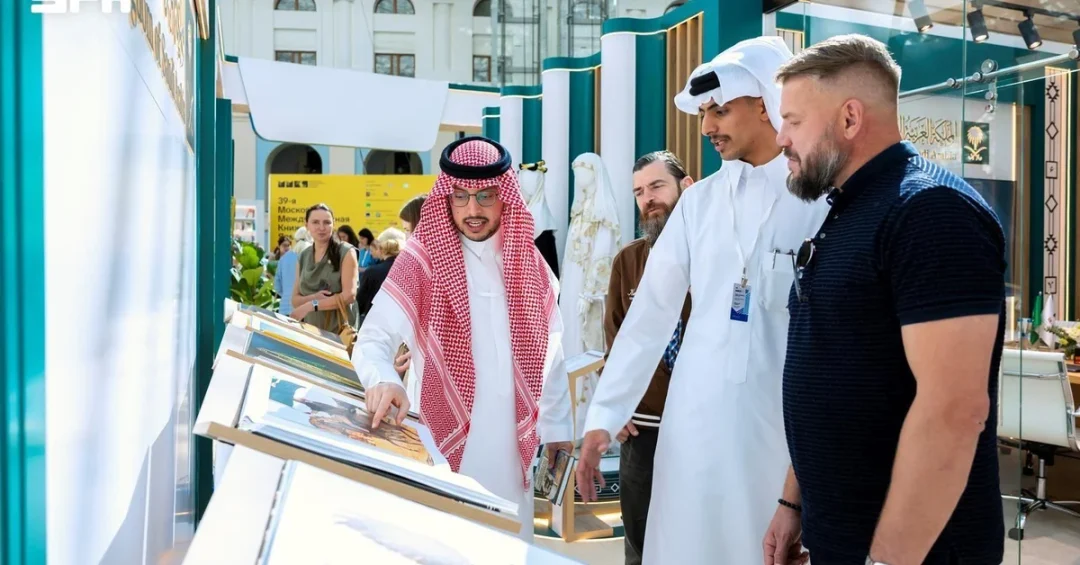
The Literature, Publishing and Translation Commission (LPTC) concluded Saudi Arabia’s participation in the 2026 Moscow International Book Fair on September 6, 2026, capping a five-day engagement that placed the Kingdom’s literary, publishing, and translation sectors at the center of one of Eurasia’s most prominent cultural gatherings. Held from September 2 to 6 in Moscow, Russia, the participation was announced through official Saudi channels and reflects the Kingdom’s steadily expanding cultural and intellectual presence on the international stage. The Saudi pavilion offered visitors a structured introduction to the country’s contemporary cultural movement, its publishing industry, and the translation initiatives that connect Arabic literature with global readerships.
For an international audience, the significance lies less in a single book fair than in what it represents: a coordinated, state-supported effort to present Saudi Arabia’s creative economy as open, professional, and globally engaged. The Literature, Publishing and Translation Commission, a body operating under the Saudi Ministry of Culture, has spent recent years building exactly this kind of international footprint. Its participation in Moscow followed a pattern of appearances at major book fairs worldwide, each designed to promote Saudi authors, support rights trading, and deepen professional ties with foreign publishers, translators, and literary institutions. The result is a cultural diplomacy that runs alongside the Kingdom’s economic and diplomatic outreach, reinforcing Saudi Vision 2030’s ambition to diversify the national economy and project a confident, forward-looking national identity. How does a book fair, of all things, become a measure of a nation’s global standing?
Context and Background
Why has Saudi Arabia invested so deliberately in the world’s book fairs? The answer begins with the Literature, Publishing and Translation Commission’s mandate. Established under the Ministry of Culture, the commission is responsible for developing the Kingdom’s literature, publishing, and translation sectors, supporting writers and publishers, and raising the international visibility of Saudi cultural production. Book fairs are one of its primary instruments. They provide a concentrated setting where publishers negotiate rights, translators meet authors, and national cultural agencies present a curated image of their country’s intellectual life to an international public.
The Moscow International Book Fair, held annually in the Russian capital, is among the largest and most established publishing events in Eastern Europe and Central Asia. It draws publishers, librarians, translators, and cultural officials from across the region and beyond. For Saudi Arabia, participation in such a forum serves several purposes at once: it introduces Saudi titles to new markets, it creates professional networks with non-Arabic publishers, and it signals that the Kingdom’s cultural sector is a serious participant in global conversations rather than a remote observer.
The 2026 edition, running from September 2 to 6, was no exception. Saudi Arabia’s presence was organized by the LPTC and framed as an extension of the commission’s ongoing efforts to promote Saudi literary and intellectual output. According to official statements released via the Saudi Press Agency, the participation was designed to highlight developments across the literature, publishing, and translation sectors and to present a comprehensive overview of the Kingdom’s cultural movement and its rapid development under Saudi Vision 2030.
Key Details
What did the Saudi participation actually involve? At the center of the effort was the Saudi pavilion, which presented visitors with a structured view of the Kingdom’s cultural landscape. The pavilion showcased Saudi publishing output, introduced literary and intellectual figures, and highlighted the institutional progress made in the publishing and translation fields. It served as a meeting point for publishers, translators, and fair attendees interested in Arabic literature and in the Saudi market’s growing capacity.
LPTC CEO Dr. Abdullatif Al-Wasel described the participation as an extension of the commission’s efforts to promote Saudi literary and intellectual output and to highlight developments in the literature, publishing, and translation sectors. He noted that the Saudi pavilion presented a comprehensive overview of the Kingdom’s cultural movement and its rapid development under Saudi Vision 2030. His remarks, carried by the Saudi Press Agency, positioned the Moscow engagement as part of a longer trajectory rather than an isolated appearance.
Beyond the pavilion, the commission organized an accompanying cultural program that showcased Saudi creative experiences through a series of panel discussions and poetry evenings addressing literature, publishing, and translation. The program also highlighted Saudi cultural achievements and their impact on the international stage. A select group of Saudi writers and intellectuals took part, giving international audiences direct exposure to contemporary Saudi voices and creating opportunities for dialogue between Saudi and Russian cultural professionals.
International and Regional Impact
How does Saudi cultural engagement in Russia fit into a broader international strategy? Cultural exchange between Saudi Arabia and Russia has expanded in recent years alongside diplomatic and economic ties. Book fairs offer a low-friction platform for this relationship: they are non-political in form, yet they build the people-to-people connections and professional networks that sustain longer-term cooperation. For Saudi publishers, Moscow offers access to markets and readerships that are not always reached through Western European or North American fairs.
Regionally, the participation reinforces Saudi Arabia’s position as a cultural hub for the Arabic-speaking world. When Saudi agencies present Arabic literature and translation at international events, they contribute to a wider effort to increase the global presence of Arabic writing. The panel discussions and poetry evenings in Moscow were not simply showcases; they were working sessions where translation practices, publishing standards, and literary trends could be discussed with international counterparts. For a global audience, this matters because it demonstrates that Saudi cultural diplomacy is institutional, sustained, and oriented toward exchange rather than one-way promotion.
Economic and Strategic Significance
What economic value does a book fair generate? Publishing and translation are components of the creative economy, a sector Saudi Arabia has identified as a source of jobs, investment, and export earnings. Rights trading, co-publishing agreements, and translation contracts are commercial activities that begin with relationships formed at events like the Moscow fair. By supporting Saudi publishers and translators in international settings, the LPTC helps build the professional infrastructure of a sector that Vision 2030 expects to grow.
Strategically, the participation serves the Kingdom’s broader goal of diversifying its international partnerships. Saudi Arabia’s cultural outreach spans Asia, Europe, Africa, and the Americas, and each fair adds a new set of contacts. The Moscow engagement also complements the Kingdom’s expanding tourism and entertainment sectors, which rely on a positive international image of Saudi creativity and heritage. A strong showing at a major fair contributes to that image in a way that is concrete, verifiable, and rooted in the work of Saudi writers, publishers, and translators themselves.
Vision 2030 Alignment
How does a book fair connect to Saudi Vision 2030? The Vision’s cultural pillar explicitly calls for the development of the Kingdom’s cultural and creative sectors, the support of Saudi talent, and the strengthening of Saudi Arabia’s international cultural presence. The Literature, Publishing and Translation Commission’s work at the Moscow International Book Fair advances each of these objectives. It supports Saudi authors and publishers by giving them international exposure, it promotes translation as a bridge between Arabic and other languages, and it presents the Kingdom’s cultural transformation to a global audience in a professional, forward-looking manner.
The conclusion of the 2026 participation is therefore best understood not as an endpoint but as one step in a continuing program. The commission’s stated aim is to keep expanding the reach of Saudi literary and intellectual output, and its presence at major international fairs is a core part of that effort. For readers worldwide, the message is clear: Saudi Arabia’s cultural sector is open for engagement, its writers and translators are active participants in global conversations, and its institutions are committed to sustained international cooperation. Under Vision 2030, culture is not a footnote to national development; it is a central part of how the Kingdom presents itself to the world. What better way to understand a country’s ambitions than through the books it chooses to share?
20 Questions
Q1. What event did the Literature, Publishing and Translation Commission conclude participation in?
A1. The commission concluded Saudi Arabia’s participation in the 2026 Moscow International Book Fair, held from September 2 to 6 in Moscow, Russia, according to the Saudi Press Agency.
Q2. When and where was the 2026 Moscow International Book Fair held?
A2. The fair was held from September 2 to 6, 2026, in Moscow, Russia, bringing together publishers, translators, and cultural institutions from across the region and beyond.
Q3. Who is the CEO of the Literature, Publishing and Translation Commission?
A3. Dr. Abdullatif Al-Wasel serves as CEO of the Literature, Publishing and Translation Commission, and he commented on the significance of the Saudi participation in Moscow.
Q4. What did Dr. Abdullatif Al-Wasel say about the participation?
A4. He said the participation extended the commission’s efforts to promote Saudi literary and intellectual output and to highlight developments in the literature, publishing, and translation sectors.
Q5. What did the Saudi pavilion present to visitors?
A5. The Saudi pavilion presented a comprehensive overview of the Kingdom’s cultural movement and its rapid development under Saudi Vision 2030, according to official statements.
Q6. What kind of cultural program accompanied the Saudi participation?
A6. The program included panel discussions and poetry evenings addressing literature, publishing, and translation, with a select group of Saudi writers and intellectuals taking part.
Q7. Which Saudi body organized the Kingdom’s participation in the fair?
A7. The Literature, Publishing and Translation Commission, operating under the Saudi Ministry of Culture, organized and led the participation.
Q8. Why are international book fairs important for Saudi Arabia’s cultural sector?
A8. They provide settings for rights trading, professional networking, and presenting Saudi literary output to international audiences, supporting the growth of the creative economy.
Q9. How does the participation relate to Saudi Vision 2030?
A9. It advances Vision 2030’s cultural pillar by supporting Saudi talent, promoting translation, and strengthening the Kingdom’s international cultural presence.
Q10. What sectors does the Literature, Publishing and Translation Commission oversee?
A10. The commission oversees the literature, publishing, and translation sectors, supporting writers, publishers, and translators and raising the international visibility of Saudi cultural production.
Q11. What role did Saudi writers and intellectuals play in Moscow?
A11. They participated in panel discussions and poetry evenings, showcasing Saudi creative experiences and engaging with international counterparts on literary and publishing topics.
Q12. How does the Moscow fair compare with other international book fairs?
A12. It is among the largest publishing events in Eastern Europe and Central Asia, offering access to markets and professional networks that complement other international fairs.
Q13. What is the significance of Saudi participation for Arabic literature globally?
A13. It contributes to increasing the global presence of Arabic writing by connecting Saudi and Arabic-language publishing with international publishers, translators, and readers.
Q14. What economic benefits can result from participating in such fairs?
A14. Rights trading, co-publishing agreements, and translation contracts can emerge, supporting jobs, investment, and export activity within the creative economy.
Q15. How does cultural exchange with Russia fit into Saudi Arabia’s broader outreach?
A15. It complements diplomatic and economic ties, building people-to-people connections and professional networks that support longer-term cooperation across multiple fields.
Q16. What did the cultural program highlight about Saudi achievements?
A16. It highlighted Saudi cultural achievements and their impact on the international stage, presenting the Kingdom’s creative experiences to a global audience.
Q17. Which official channel reported the conclusion of the participation?
A17. The Saudi Press Agency reported the conclusion of the participation, reflecting the Kingdom’s practice of announcing cultural developments through official channels.
Q18. What message does the participation send to international audiences?
A18. It signals that Saudi Arabia’s cultural sector is open for engagement, with active writers, publishers, and translators participating in global literary conversations.
Q19. How does this participation support Saudi publishers and translators?
A19. It gives them international exposure, creates contacts with foreign publishers, and helps build the professional infrastructure needed for a growing publishing and translation sector.
Q20. What comes next for the commission after the Moscow fair?
A20. The commission is expected to continue expanding the reach of Saudi literary and intellectual output through participation in major international fairs and cultural programs worldwide.
Reader Feedback
We value your thoughts. Please share your feedback on this article.
Your feedback helps us improve our coverage.
Related articles
 National Center for Falcons announces Saudi International Falcons Exhibition 2026
 King Abdulaziz Foundation Showcases Publications at Moscow Book Fair
 Al-Ain Village preserves stone houses in Al-Ais
 Saudi Coffee Utensils Reflect Rich Heritage of Hospitality
 Historic Al-Ain Village Preserves Stone Houses in Al-Ais
 Hira Cultural District’s Quran Museum Blends Islamic Design with Natural Beauty