


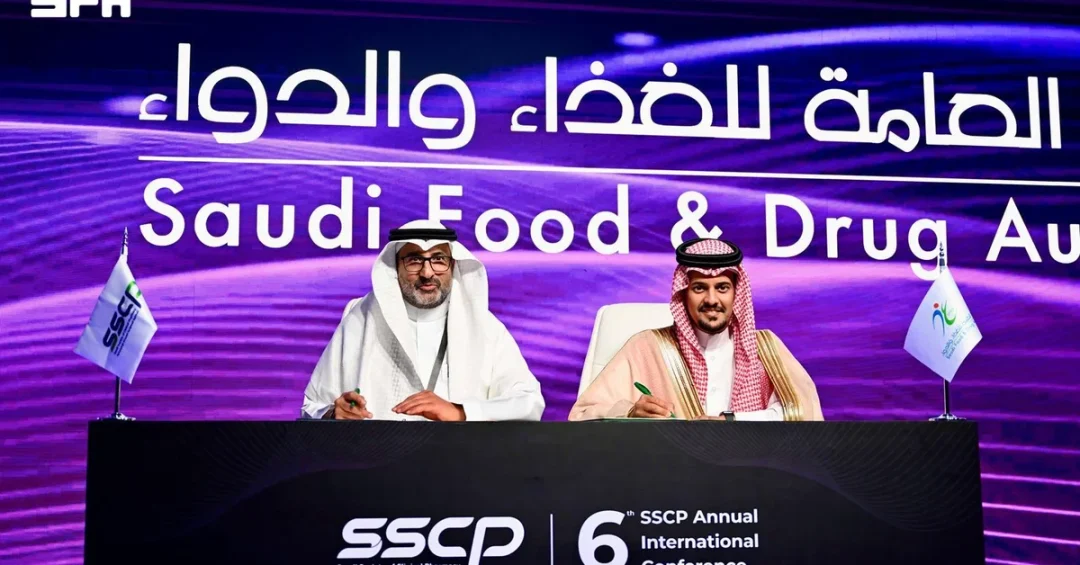
The Saudi Food and Drug Authority (SFDA) has signed a memorandum of understanding with the Saudi Society of Clinical Pharmacy (SSCP) to enhance cooperation in medication safety and facilitate the exchange of statistical data and scientific materials, according to an official announcement released through the Saudi Press Agency. The agreement, formalized in Riyadh, brings together the Kingdom’s principal drug regulator and its leading professional body for clinical pharmacy, creating a structured framework for collaboration on community awareness, advisory services, training workshops, and educational lectures.
The MoU was signed by Dr. Adel bin Abdullah Alharf, Vice President of the Drug Sector at the SFDA, and Prof. Dr. Ahmed bin Hamdan Al-Jedai, President of the SSCP. The partnership is designed to advance shared objectives in therapeutic safety, pharmacoeconomics, and pharmaceutical innovation, and it reflects a broader national effort to embed patient safety at the center of Saudi Arabia’s rapidly expanding healthcare sector. Could this agreement mark a turning point in how medication safety is taught, monitored, and practiced across the Kingdom?
Context and Background
Why does a memorandum between a regulator and a professional society matter so much in a healthcare system undergoing transformation? The answer lies in the scale and speed of change across Saudi Arabia’s health sector. Under Vision 2030, the Kingdom has been restructuring its health services, expanding insurance coverage, digitizing patient records, and opening new avenues for private and foreign investment. As the sector grows, so does the volume and complexity of medicines prescribed, dispensed, and administered each day.
The Saudi Food and Drug Authority is the national body responsible for regulating food, drugs, medical devices, and biological products. Its Drug Sector oversees pharmacovigilance, clinical trials, product registration, and safety monitoring. The Saudi Society of Clinical Pharmacy, meanwhile, represents clinical pharmacists — the specialists who work directly within medical teams to select appropriate treatments, review dosages, prevent harmful drug interactions, and counsel patients on safe use.
Bringing these two institutions into a formal partnership is significant because it connects regulatory oversight with frontline clinical practice. The SFDA sets the rules and monitors safety signals; the SSCP translates those standards into everyday decisions at the bedside. The MoU creates a channel through which statistical data, scientific materials, and practical experience can flow in both directions, ensuring that policy is informed by real-world evidence and that practitioners receive timely, authoritative guidance.
Key Details of the Agreement
What exactly does the memorandum commit the two organizations to do? According to the official announcement, the agreement focuses on strengthening partnership and integration in several practical areas. These include the delivery of community awareness programs, advisory services, training workshops, and educational lectures. The two bodies will also pursue joint participation in scientific committees and support research in therapeutic safety, pharmacoeconomics, and pharmaceutical innovation.
The exchange of statistical data and scientific materials is a central pillar of the arrangement. For the SFDA, access to aggregated clinical experience helps sharpen its understanding of how medicines perform in real-world Saudi settings. For the SSCP, closer ties with the regulator mean its members can contribute directly to safety discussions and receive early insight into emerging regulatory priorities.
Community awareness is another important dimension. Medication safety is not only a hospital issue; it also depends on how patients store, take, and combine medicines at home. Awareness campaigns developed jointly by a regulator and a professional society carry particular weight because they combine official authority with clinical credibility. The MoU also envisages advisory services, which can help healthcare institutions improve their internal medication-use policies and reduce avoidable errors.
Who the SSCP Represents and Why It Matters
As a specialized entity for clinical pharmacy and patient care in Saudi Arabia, the SSCP promotes clinical pharmacists as essential members of the medical team and trusted sources of drug information. This role is critical: clinical pharmacists are trained to assess whether a prescribed medicine is appropriate for a specific patient, whether the dose is correct, and whether it might interact harmfully with other treatments.
By positioning clinical pharmacists as trusted sources of drug information, the SSCP supports a model of care in which treatment selection is a collaborative decision rather than a solitary one. In hospitals and clinics across the Kingdom, this approach helps reduce adverse drug events, shorten hospital stays, and improve patient outcomes. The MoU reinforces that model by giving the society a formal seat at the table in national conversations about medication safety.
The agreement also acknowledges the growing sophistication of Saudi pharmacy education and practice. Universities across the Kingdom now graduate pharmacists with advanced clinical training, and many pursue residencies and board certifications. The partnership between the SFDA and the SSCP can help align that talent pipeline with national safety priorities, ensuring that newly qualified professionals enter a system that values evidence, reporting, and continuous improvement.
International and Regional Impact
How might this agreement resonate beyond Saudi Arabia’s borders? The Kingdom is a regional leader in healthcare regulation, and its decisions often inform practice in neighboring countries. A structured partnership between a national regulator and a clinical pharmacy society sets an example for other nations seeking to strengthen medication safety without duplicating resources. It demonstrates that collaboration between public authorities and professional associations can be both practical and effective.
For international observers, the MoU signals that Saudi Arabia is investing not only in hospitals and technology but also in the human systems that make care safe. Multinational pharmaceutical companies, research organizations, and healthcare providers operating in the Kingdom will find a more predictable and evidence-driven environment. The emphasis on pharmacoeconomics — the study of the cost and value of medicines — also aligns with global trends toward value-based healthcare, in which spending is evaluated against outcomes rather than volume alone.
Regional collaboration in pharmacovigilance and therapeutic safety is increasingly important as medicine supply chains become more global. By strengthening its domestic framework, Saudi Arabia enhances its ability to contribute to and benefit from international safety networks. The agreement therefore supports the Kingdom’s wider ambition to be a hub for healthcare innovation and a reliable partner in global health governance.
Economic and Strategic Significance
Why does medication safety carry economic weight? Adverse drug events are costly. They can lead to extended hospital stays, additional treatments, lost productivity, and, in severe cases, long-term harm. By reducing these events through better training, clearer guidance, and stronger data exchange, the health system can allocate resources more efficiently and improve patient trust. The MoU’s focus on pharmacoeconomics directly addresses this link between safety and sustainability.
The agreement also supports the growth of Saudi Arabia’s pharmaceutical and biotechnology sectors. A regulatory environment that is transparent, data-driven, and engaged with clinicians is attractive to investors and innovators. Companies developing new therapies need clear pathways for safety evaluation and post-market monitoring. The SFDA’s collaboration with the SSCP can help refine those pathways by incorporating clinical perspectives early in the process.
Strategically, the partnership strengthens the Kingdom’s capacity to manage public health challenges, from chronic diseases such as diabetes and hypertension to emerging infectious threats. Clinical pharmacists are often the last line of defense before a patient receives a medicine, and their expertise is especially valuable in complex cases involving multiple prescriptions. Investing in this profession is therefore an investment in the resilience of the entire health system.
Vision 2030 Alignment
How does this memorandum connect to Saudi Arabia’s long-term national plan? Vision 2030 seeks to build a diversified economy, improve quality of life, and deliver world-class public services. Health is a central pillar of that vision, and the Health Sector Transformation Program aims to expand access, improve quality, and enhance the patient experience. Medication safety is a foundational element of quality care, and the SFDA-SSCP partnership advances it through education, research, and data sharing.
The agreement also reflects the Vision 2030 emphasis on partnership between government and civil institutions. By working with a professional society, the SFDA taps into specialized expertise and extends its reach into clinical settings across the country. This model of collaboration — regulator plus practitioner — is well suited to a health system that is becoming larger, more complex, and more reliant on evidence.
Looking ahead, the MoU is expected to support a new generation of Saudi clinical pharmacists who are equipped to lead safety initiatives, contribute to research, and serve as trusted advisers to patients and colleagues. As the Kingdom continues to modernize its healthcare infrastructure and pursue ambitious goals in biotechnology and life sciences, agreements like this one help ensure that progress is built on a foundation of safety, quality, and public confidence.
20 Questions
Q1. What is the main purpose of the MoU signed by the SFDA and the SSCP?
A1. The memorandum aims to enhance cooperation in medication safety and facilitate the exchange of statistical data and scientific materials, advancing shared objectives for both entities in Saudi Arabia’s healthcare sector.
Q2. Who signed the memorandum on behalf of the two organizations?
A2. The MoU was signed by Dr. Adel bin Abdullah Alharf, Vice President of the Drug Sector at the SFDA, and Prof. Dr. Ahmed bin Hamdan Al-Jedai, President of the Saudi Society of Clinical Pharmacy.
Q3. What is the Saudi Food and Drug Authority responsible for?
A3. The SFDA is the national regulator for food, drugs, medical devices, and biological products in Saudi Arabia. Its Drug Sector oversees pharmacovigilance, product registration, clinical trials, and safety monitoring.
Q4. What is the role of the Saudi Society of Clinical Pharmacy?
A4. The SSCP is a specialized body for clinical pharmacy and patient care. It promotes clinical pharmacists as essential members of the medical team and trusted sources of drug information for safe treatment.
Q5. What specific activities does the agreement cover?
A5. It covers community awareness programs, advisory services, training workshops, educational lectures, joint participation in scientific committees, and research in therapeutic safety, pharmacoeconomics, and pharmaceutical innovation.
Q6. Why is the exchange of statistical data important in this partnership?
A6. Statistical data helps the SFDA understand how medicines perform in real-world Saudi settings, while giving the SSCP and its members insight into regulatory priorities and safety trends.
Q7. How does this agreement benefit patients in Saudi Arabia?
A7. Patients benefit from safer medication practices, better-informed clinical decisions, reduced adverse drug events, and community awareness programs that promote appropriate use and storage of medicines.
Q8. What is pharmacoeconomics, and why is it mentioned in the MoU?
A8. Pharmacoeconomics studies the cost and value of medicines. It is included because safety and efficiency are linked, and better medication practices can reduce waste and improve health system sustainability.
Q9. How does the MoU support research in Saudi Arabia?
A9. The agreement encourages joint research in therapeutic safety, pharmacoeconomics, and pharmaceutical innovation, helping generate evidence that can guide national policy and clinical practice.
Q10. What are advisory services in the context of this agreement?
A10. Advisory services involve expert guidance to healthcare institutions on medication-use policies, safety protocols, and best practices, helping reduce errors and improve patient outcomes.
Q11. How does the partnership relate to Vision 2030?
A11. It supports the Health Sector Transformation Program by improving quality and safety, and reflects Vision 2030’s emphasis on collaboration between government bodies and professional institutions.
Q12. What is the significance of clinical pharmacists in the medical team?
A12. Clinical pharmacists ensure appropriate treatment selection, correct dosing, and safe medication use. They help prevent harmful drug interactions and are trusted sources of drug information for patients and physicians.
Q13. Will the agreement lead to new training programs?
A13. Yes, the MoU includes training workshops and educational lectures, which will help pharmacists and other healthcare professionals stay current with safety standards and emerging evidence.
Q14. How does this MoU affect community awareness of medication safety?
A14. It strengthens community awareness programs by combining the SFDA’s regulatory authority with the SSCP’s clinical expertise, making public messages on safe medication use more credible and effective.
Q15. What does the agreement mean for pharmaceutical innovation in Saudi Arabia?
A15. It supports innovation by encouraging research and collaboration, and by ensuring that safety considerations are integrated into the development and evaluation of new therapies.
Q16. How might this partnership influence other countries in the region?
A16. It sets an example of regulator-professional collaboration that other nations can adapt, potentially improving medication safety practices and regional cooperation in pharmacovigilance.
Q17. What is pharmacovigilance, and how does it relate to the MoU?
A17. Pharmacovigilance is the monitoring of medicine safety after approval. The MoU supports it by facilitating data exchange and joint research, helping detect and respond to safety issues promptly.
Q18. Does the MoU have any economic benefits for Saudi Arabia?
A18. Yes, by reducing adverse drug events and improving efficiency, it can lower healthcare costs, support a sustainable health system, and create a more attractive environment for pharmaceutical investment.
Q19. How will the success of this agreement be measured?
A19. Success can be measured through improved medication safety indicators, participation in training and awareness programs, research output, and the integration of clinical pharmacists into care teams.
Q20. What is the long-term outlook for medication safety in Saudi Arabia?
A20. With continued collaboration between the SFDA and SSCP, Saudi Arabia is poised to strengthen medication safety, enhance patient outcomes, and contribute to regional and global health standards under Vision 2030.
Reader Feedback
We value your thoughts. Please share your feedback on this article.
Your feedback helps us improve our coverage.
Related articles
 Saudi Red Crescent in Madinah Restores Umrah Performer’s Pulse in 56 Seconds
 King Khalid University Hosts International Pediatric Dentistry Conference
 Health Minister Visits Interior Ministry Pavilion at LEAP 2026
 SDAIA, Care Medical Sign MoU to Advance AI in Healthcare
 KFSH to Host Robotic Cardiac Surgery Summit in Riyadh
 KSUMC Joins LEAP 2026, Launches Healthon Hackathon