


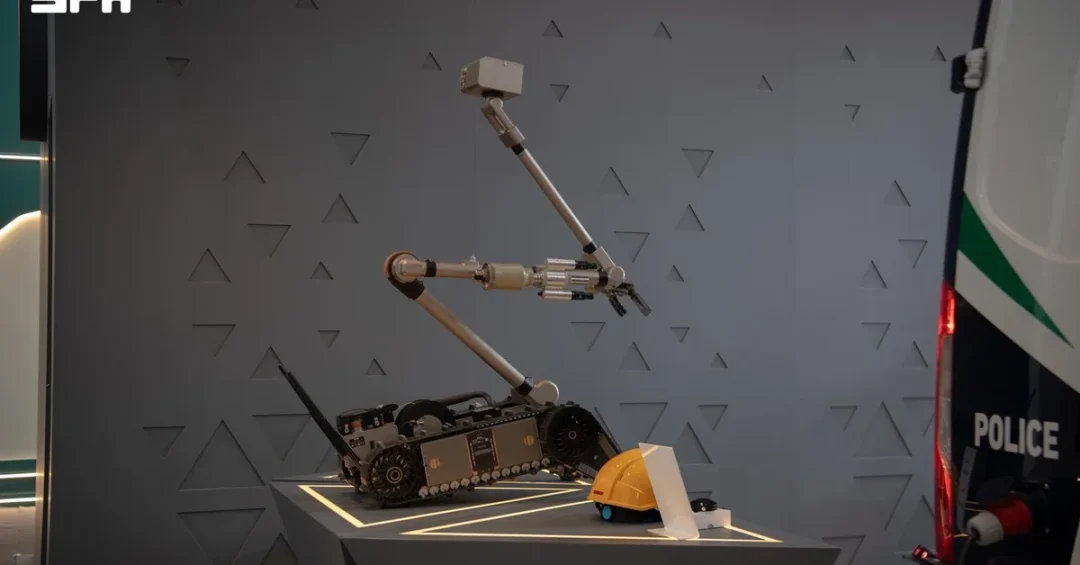
Saudi Arabia’s Public Security is showcasing the PackBot robot, a remotely operated system designed for reconnaissance and the safe handling of suspicious objects, at the Ministry of Interior’s pavilion during LEAP 2026 in Riyadh, the Saudi Press Agency reported. The demonstration places one of the world’s most recognized tactical robotics platforms inside the Kingdom’s flagship technology event, signalling a deliberate push to integrate advanced automation into everyday policing and emergency response. According to the official announcement, the robot can be operated wirelessly and transmits live audio and video from the location of a suspicious object, allowing trained specialists to assess a situation and neutralize or remove the object remotely, without placing personnel in harm’s way.
The showcase reflects Public Security’s stated efforts to harness modern technologies in support of reconnaissance operations and situations requiring remote field intervention, with the aim of enhancing security, safety, and operational efficiency. For visitors to LEAP 2026, the exhibit offers a concrete example of how artificial intelligence, robotics, and secure communications are moving from laboratory concepts into operational service. For international observers, it is another marker of how Saudi Arabia is positioning technology as a core component of public safety and national resilience, a theme that runs through the Kingdom’s broader modernization agenda. How often does a security exhibition reveal the future of policing before it reaches the street? At LEAP 2026, the answer is unfolding in real time inside the Ministry of Interior’s pavilion.
Context and Background
LEAP has grown rapidly into one of the world’s most attended technology gatherings, and its Riyadh edition has become a focal point for governments, investors, and technology firms seeking to shape the next decade of digital infrastructure. The presence of Public Security at the event is not incidental. Saudi security agencies have increasingly used national and international platforms to demonstrate tools that combine artificial intelligence, data analytics, and robotics, reflecting a policy of early adoption rather than delayed procurement. The PackBot, developed by the American robotics company Endeavor Robotics and now associated with Teledyne FLIR, is among the most widely deployed unmanned ground vehicles in the world, used by military and civilian agencies for bomb disposal, reconnaissance, and hazardous inspection. Its appearance at LEAP 2026 connects Saudi operational practice with a global lineage of field-proven systems.
The Ministry of Interior has emphasized that technology adoption must serve human safety first. In that sense, the PackBot demonstration is consistent with a wider pattern in which Saudi agencies test and publicize capabilities that reduce risk to frontline personnel while improving response times. The robot’s wireless operation and live audio-video feed address two persistent challenges in suspicious-object incidents: the need for accurate information before anyone approaches, and the need for specialists to act without entering an uncertain environment. By presenting the system at a civilian technology exhibition, Public Security also invites public understanding of how such tools are used, an important element of trust in modern policing.
Key Details of the PackBot Demonstration
The central capability on display is remote inspection. When a suspicious object is identified, the PackBot can be dispatched to the scene and operated wirelessly from a safe distance. Its onboard cameras and microphones transmit live audio and video back to operators, giving specialists a real-time view of the object, its surroundings, and any visible indicators that might inform a decision. That information flow allows a measured response: personnel can assess whether an object is benign, determine the appropriate handling procedure, and, where necessary, use the robot’s manipulator arm to interact with or remove the item. The result is a shorter decision cycle and a significantly reduced exposure of human responders to potential harm.
The robot is also designed for reconnaissance more broadly, meaning it can enter confined, unstable, or contaminated spaces where a person would be at risk. Public Security framed the exhibit as part of its efforts to support reconnaissance operations and address situations requiring remote field intervention. The emphasis on operational efficiency matters as much as safety: a single robot can be repositioned quickly across multiple incidents, and its recorded feeds can support later review and training. For a security force responsible for crowded urban environments, major events, and critical infrastructure, that combination of reach, speed, and documentation has clear practical value.
Visitors to the pavilion can see how the system fits into a layered response model that includes human specialists, command-and-control systems, and other technologies. The demonstration does not replace trained bomb disposal officers; it extends their reach and protects them while they work. That distinction is central to how Saudi agencies describe the role of robotics in public safety. Does a machine that inspects danger make the human responder less essential, or more effective? In the PackBot’s case, the official presentation points clearly to the latter.
International and Regional Impact
Saudi Arabia’s adoption of field-proven robotics carries weight beyond its borders. The Kingdom is a regional leader in security cooperation, and its choices influence procurement and training standards across the Gulf and the wider Middle East. Showcasing the PackBot at LEAP 2026 signals to partners and vendors that Saudi Arabia is a serious, informed buyer and operator of advanced systems, not merely a spectator in the global robotics market. It also reinforces the Kingdom’s position as a convening power for technology, bringing together companies, governments, and experts in a single venue where operational needs and commercial solutions can meet.
Regionally, the demonstration supports a broader narrative of stability and professionalization. Countries facing evolving security challenges increasingly look to unmanned systems to handle hazardous tasks, and Saudi Arabia’s willingness to display its capabilities publicly contributes to a climate of confidence and transparency. Internationally, the exhibit aligns with the Kingdom’s engagement in global discussions on responsible use of emerging technologies, including artificial intelligence and autonomous systems. By placing a tactical robot alongside civilian innovations at a major tech event, Public Security helps normalize the idea that advanced tools can serve public safety in a disciplined, accountable manner.
Economic and Strategic Significance
The strategic value of the PackBot demonstration extends into economics and industrial policy. Saudi Arabia is investing heavily in technology, defense, and advanced manufacturing as part of its long-term diversification efforts, and the security sector is both a consumer and a catalyst. Demonstrations of this kind help build domestic familiarity with robotics, encourage local talent to pursue careers in engineering and AI, and create opportunities for partnerships between international vendors and Saudi entities. They also support the growth of a local technology ecosystem that can service, adapt, and eventually produce components for such systems.
Operationally, remote-handling robots reduce the cost of risk. A single incident involving an improvised device can consume extensive manpower, disrupt transport, and create public anxiety. A system that allows specialists to assess and handle a suspicious object from a distance can shorten disruptions, protect personnel, and preserve public confidence. For a country hosting major events, expanding tourism, and building large-scale projects, that capability is not a luxury but a practical component of resilience. The PackBot is a small exhibit with a large message: Saudi Arabia intends to be a sophisticated operator of the technologies that keep complex societies safe.
Vision 2030 Alignment
The PackBot showcase fits squarely within Saudi Vision 2030’s emphasis on innovation, digital transformation, and high-quality public services. Vision 2030 seeks to build a diversified economy and a modern state, and the security sector’s adoption of robotics and AI contributes to both goals by improving efficiency and fostering a knowledge-based workforce. Public Security’s participation at LEAP 2026 also supports the Kingdom’s ambition to be a global hub for technology and investment, where government agencies are early adopters and where international firms find a receptive, demanding market. The Ministry of Interior’s pavilion thus serves a dual purpose: it demonstrates operational capability and it advertises the Kingdom’s openness to advanced solutions.
Looking ahead, the integration of remote-handling robots into routine policing and emergency response is likely to deepen, with training, maintenance, and data governance becoming core competencies. Saudi Arabia’s approach, as reflected in this demonstration, is to combine global best practices with local operational needs, always with the safety of personnel and the public as the guiding principle. The PackBot at LEAP 2026 is therefore more than a piece of equipment on display; it is a visible step in a longer journey toward a safer, smarter, and more technologically capable Kingdom. What does the future of public safety look like? In Riyadh this week, it looks like a robot that goes first, so people do not have to.
20 Questions
Q1. What is the PackBot robot?
A1. The PackBot is a remotely operated unmanned ground vehicle designed for reconnaissance and the safe handling of suspicious objects, capable of transmitting live audio and video to specialists who assess and act from a safe distance.
Q2. Where is Public Security showcasing the PackBot?
A2. Public Security is showcasing the PackBot at the Ministry of Interior’s pavilion during LEAP 2026 in Riyadh, as reported by the Saudi Press Agency.
Q3. What is LEAP 2026?
A3. LEAP is a major international technology event held in Riyadh that brings together governments, companies, and experts to showcase innovations in artificial intelligence, robotics, and digital infrastructure.
Q4. How is the PackBot operated?
A4. The robot can be operated wirelessly, allowing specialists to control it from a safe distance while receiving live audio and video from the location of a suspicious object.
Q5. What are the main tasks of the PackBot?
A5. Its main tasks are reconnaissance and the safe handling of suspicious objects, enabling specialists to assess situations and handle objects remotely without exposing personnel to danger.
Q6. Why is remote handling important in security operations?
A6. Remote handling protects responders from potential harm, allows accurate assessment before anyone approaches, and improves operational efficiency during incidents involving suspicious objects.
Q7. Which Saudi agency is presenting the robot?
A7. Public Security, operating under the Ministry of Interior, is presenting the PackBot, reflecting its efforts to harness modern technologies for reconnaissance and remote field intervention.
Q8. What does the live audio and video feed enable?
A8. It enables specialists to see and hear what is happening at the scene in real time, supporting informed decisions about whether and how to handle a suspicious object.
Q9. Does the PackBot replace human bomb disposal experts?
A9. No. The robot extends the reach of trained specialists and protects them; human expertise remains central to assessing situations and making final operational decisions.
Q10. How does the demonstration reflect Saudi technology policy?
A10. It reflects a policy of early adoption, showing that Saudi security agencies actively integrate artificial intelligence, robotics, and secure communications into operational practice.
Q11. What is the significance of showcasing at LEAP 2026?
A11. It places security innovation alongside civilian technology, demonstrating Saudi Arabia’s role as a convening power and an informed operator of advanced systems.
Q12. How does the PackBot support public safety?
A12. By allowing remote inspection and handling of suspicious objects, it reduces risk to people, shortens disruptions, and helps maintain public confidence in security services.
Q13. What operational benefits does the robot provide?
A13. It offers rapid deployment, wireless control, live situational awareness, and the ability to enter confined or hazardous spaces, improving response speed and documentation.
Q14. Is the PackBot a Saudi-made robot?
A14. The PackBot is a field-proven international platform associated with Teledyne FLIR; Saudi Arabia is demonstrating its operational use and integration into public security work.
Q15. How does this align with Vision 2030?
A15. It supports Vision 2030’s goals of innovation, digital transformation, and high-quality public services by improving security efficiency and fostering a knowledge-based workforce.
Q16. What message does the exhibit send to international partners?
A16. It signals that Saudi Arabia is a serious, sophisticated partner in security technology, open to collaboration and committed to responsible adoption of advanced systems.
Q17. What role does the Ministry of Interior play?
A17. The Ministry of Interior oversees Public Security and provides the institutional framework for adopting technologies that enhance safety, efficiency, and readiness across the Kingdom.
Q18. How might this technology be used at major events?
A18. It can support security teams at large gatherings by inspecting suspicious items remotely, reducing response times, and minimizing disruption to visitors and residents.
Q19. What does the demonstration say about Saudi investment in technology?
A19. It shows sustained investment in advanced tools for public safety, reflecting a broader national commitment to technology-driven modernization and resilience.
Q20. What is the likely future of such robotics in Saudi Arabia?
A20. Continued integration into policing and emergency response is expected, with growing emphasis on training, maintenance, and data governance to ensure safe and effective use.
Reader Feedback
We value your thoughts. Please share your feedback on this article.
Your feedback helps us improve our coverage.
Related articles
 Zain KSA Launches First Carbon-Neutral EcoFusion Tower Site
 Education Marketplace Launched as Digital Hub at LEAP 2026
 TCC Showcases SAMAMA Cybersecurity Center at LEAP 2026
 Venus-Spica Conjunction Dazzles Skies Over Arar
 Islamic University of Madinah Climbs Nature Index 2026
 Estidamah Develops Two New Wheat Varieties to Boost Food Security