


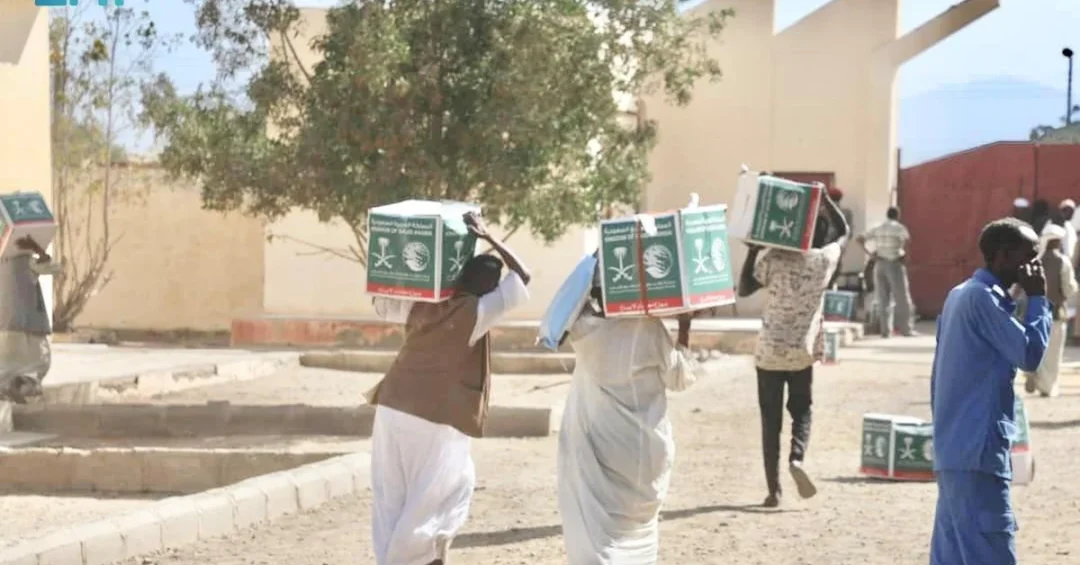
The King Salman Humanitarian Aid and Relief Center (KSrelief) distributed 800 food baskets in the city of Jebeit, Red Sea State, Sudan, benefiting 4,720 individuals from displaced and needy families, the Saudi Press Agency reported on Wednesday, April 2, 2025. The distribution is part of this year’s food security support project in the Republic of Sudan, a continuing humanitarian program that reflects Saudi Arabia’s commitment to alleviating the suffering of the Sudanese people during the country’s ongoing crisis. The operation was carried out under the supervision of KSrelief teams in coordination with local authorities in Red Sea State, ensuring that assistance reached those most in need in a timely and organized manner.
The delivery of 800 food baskets represents more than a simple shipment of supplies; it is a lifeline for families who have been uprooted by conflict and are now facing severe food insecurity. Each basket typically contains staple items such as rice, flour, lentils, cooking oil, and sugar, designed to sustain a family for a month. The fact that 4,720 individuals will benefit underscores the scale of the need and the efficiency of the distribution mechanism. This latest operation follows a series of similar KSrelief interventions across Sudan, reinforcing Saudi Arabia’s role as a leading humanitarian donor in the region. As the crisis in Sudan continues to displace millions, the Kingdom’s consistent support offers a measure of hope and stability to vulnerable communities.
Context and Background
Why does sustained humanitarian assistance matter so much in Sudan right now? Since the outbreak of conflict in April 2023, Sudan has faced one of the world’s most severe humanitarian emergencies, with millions displaced and acute food shortages affecting large parts of the population. The Red Sea State, where Jebeit is located, has become a refuge for many families fleeing violence in other regions. The city of Jebeit, though relatively stable, has seen its resources stretched thin as it absorbs displaced persons. In this context, Saudi Arabia’s timely aid through KSrelief addresses an urgent gap in food security, providing essential nutrition to those who might otherwise go hungry.
KSrelief, established in 2015 by royal decree, has a long track record of delivering aid in crisis zones around the world, but its work in Sudan is particularly significant given the historical and cultural ties between the two nations. The Kingdom has consistently stood by Sudan during its difficult times, offering both emergency relief and long-term development support. The current food security project is part of a broader Saudi humanitarian portfolio that includes health care, shelter, water, and sanitation. By focusing on food baskets, KSrelief targets the most immediate need: ensuring that vulnerable families have enough to eat while broader stabilization efforts continue. This approach aligns with international humanitarian principles and Saudi Arabia’s own tradition of generosity.
What makes this distribution especially noteworthy is its timing and coordination. The operation in Jebeit was carried out with careful planning to reach displaced and needy families, avoiding duplication and ensuring fairness. Local authorities and community leaders played a role in identifying beneficiaries, which helps guarantee that aid goes to those who need it most. The 800 baskets were distributed in an organized manner, with each recipient family receiving a package designed to last for a month. Such efforts are critical in preventing malnutrition and reducing the risk of famine, especially among children and the elderly. The success of this distribution also lays the groundwork for future operations, as KSrelief continues to monitor needs and adapt its response.
Key Details of the KSrelief Operation
How exactly does KSrelief ensure that its aid reaches the right people? The distribution of 800 food baskets in Jebeit was implemented as part of the 2025 food security support project for Sudan, which is one of several ongoing Saudi relief programs in the country. Each basket contains a carefully selected set of non-perishable items that provide essential calories and nutrients. The baskets are assembled and transported to distribution points, where KSrelief teams, often working with local partners, verify beneficiary lists and hand over the supplies. The operation benefited 4,720 individuals, which suggests an average family size of about six people per basket, a reasonable estimate for the region. The distribution took place in a single location in Jebeit, allowing for efficient logistics and oversight.
The Saudi Press Agency reported that the initiative is part of Saudi Arabia’s ongoing relief efforts to alleviate the suffering of the brotherly Sudanese people amid the current humanitarian crisis. This language reflects the close bonds between the Kingdom and Sudan, and it highlights the humanitarian imperative that drives Saudi aid. KSrelief’s work in Sudan is not new; over the past years, the center has implemented numerous projects in health, nutrition, and emergency relief. The current food security project is designed to address the immediate hunger gap while also contributing to longer-term resilience by stabilizing communities. The fact that this distribution occurred in April 2025 shows that KSrelief is maintaining its momentum, even as global attention on Sudan fluctuates.
What are the logistical challenges of delivering aid in Sudan? Despite the difficulties posed by insecurity and poor infrastructure, KSrelief has managed to reach many parts of the country. In Red Sea State, relative stability has allowed for more predictable operations, but challenges remain, including limited road networks and the need to coordinate with multiple local actors. The successful distribution of 800 baskets in Jebeit demonstrates KSrelief’s operational capacity and its commitment to overcoming obstacles. The center relies on a network of local staff and partners who know the terrain and can navigate complex environments. This local knowledge, combined with Saudi resources and oversight, enables effective delivery. The operation also sends a message of solidarity to the Sudanese people, showing that they are not forgotten.
International and Regional Impact
Could this single distribution have effects that extend beyond Jebeit? Absolutely. Saudi Arabia’s humanitarian efforts in Sudan are part of a broader regional strategy to promote stability and alleviate suffering. By providing food aid, the Kingdom helps reduce the pressure on local resources and mitigates the risk of further displacement. This contributes to regional security, as food insecurity can exacerbate tensions and lead to instability. Moreover, Saudi Arabia’s leadership in humanitarian aid enhances its standing in the international community, demonstrating its commitment to global responsibilities. The operation also complements the efforts of other international organizations and donor countries, filling critical gaps and reinforcing the overall response. In a world where humanitarian needs are growing, Saudi Arabia’s consistent support stands out as a model of effective and compassionate engagement.
How does the international community view Saudi Arabia’s relief work? KSrelief has earned recognition from the United Nations and other humanitarian bodies for its professionalism and reach. The center’s projects are often cited as examples of best practice in aid delivery, particularly in conflict-affected areas. By working through KSrelief, Saudi Arabia ensures that its assistance is coordinated with international standards and reaches those most in need. The distribution in Jebeit is a small but meaningful part of this larger effort. It also strengthens Saudi-Sudanese relations, which are rooted in shared history and mutual respect. As Sudan navigates its current challenges, Saudi Arabia’s support is a reminder of the enduring ties between the two peoples. This kind of solidarity is invaluable in a region that has seen its share of turmoil.
Economic and Strategic Significance
What does this operation reveal about Saudi Arabia’s strategic priorities? The distribution of food baskets in Sudan is not just a charitable act; it is an expression of Saudi Arabia’s foreign policy objectives, which include promoting stability, fostering goodwill, and supporting neighboring countries in times of need. By investing in humanitarian aid, the Kingdom contributes to the creation of a more secure and prosperous region, which in turn benefits its own security and economic interests. Sudan is a vital neighbor with significant natural resources and a young population. Stability there is in Saudi Arabia’s interest, and humanitarian aid is one tool to help achieve it. The operation also showcases the efficiency of KSrelief as a rapid-response mechanism, capable of mobilizing resources and delivering them where they are needed most.
How does this align with Saudi Arabia’s economic diversification goals? While humanitarian aid is primarily a moral duty, it also has strategic dimensions. Saudi Arabia’s Vision 2030 aims to position the Kingdom as a global leader in various fields, including humanitarian work. By demonstrating leadership in relief efforts, Saudi Arabia enhances its soft power and builds networks of goodwill that can translate into diplomatic and economic opportunities. Moreover, the logistical and procurement expertise developed through KSrelief operations can have spillover benefits for Saudi businesses and institutions. The food baskets themselves are often sourced from Saudi suppliers, supporting local industries. Thus, the distribution in Jebeit is a small piece of a larger puzzle that connects humanitarianism with national development. It shows that Saudi Arabia is not only a wealthy nation but also a responsible and engaged global citizen.
Vision 2030 Alignment
How does this food distribution connect to Saudi Arabia’s long-term vision? Vision 2030, the Kingdom’s ambitious blueprint for economic and social transformation, emphasizes the importance of international cooperation and humanitarian leadership. One of its pillars is a vibrant society, but it also seeks a prosperous and influential nation on the world stage. KSrelief is a key instrument for projecting Saudi Arabia’s values of generosity and solidarity. By alleviating suffering in Sudan, the Kingdom contributes to the stability of a neighboring country and reinforces the principles of mutual support that are central to Vision 2030. The operation also reflects the vision’s focus on sustainable development, as food security is a foundation for any long-term progress. In this way, the distribution of 800 food baskets is not isolated charity but part of a coherent strategy to build a better future for the region.
What does the future hold for Saudi humanitarian efforts? As Vision 2030 continues to unfold, Saudi Arabia is expected to expand its role as a global humanitarian leader, using KSrelief to reach more people in need. The center’s work in Sudan will likely continue, with more distributions planned in the coming months. Each operation, no matter how small, contributes to the overarching goal of a stable and prosperous Middle East. The Kingdom’s commitment to helping the Sudanese people is unwavering, and it is rooted in the deep bonds of brotherhood. Through such actions, Saudi Arabia demonstrates that its vision extends beyond its borders, embracing a future where all nations can thrive. The food baskets in Jebeit are a tangible symbol of that vision, offering hope and sustenance to those who need it most.
20 Questions
Q1. What is KSrelief and what does it do?
A1. KSrelief is the King Salman Humanitarian Aid and Relief Center, established in 2015 to provide international humanitarian assistance. It delivers aid in crisis zones worldwide, including food, health care, and shelter, under the supervision of the Saudi government.
Q2. Where exactly did the distribution take place?
A2. The distribution took place in the city of Jebeit, in Red Sea State, Sudan. This area has hosted many displaced families and is relatively stable, allowing aid organizations to operate and reach those in need.
Q3. How many people benefited from the food baskets?
A3. The 800 food baskets benefited 4,720 individuals from displaced and needy families. This figure reflects the average family size in the region and the scope of the assistance provided by KSrelief.
Q4. What items are typically included in a KSrelief food basket?
A4. A standard KSrelief food basket includes staples such as rice, flour, lentils, cooking oil, sugar, and other non-perishable items. These are designed to meet a family’s nutritional needs for approximately one month.
Q5. When did this distribution occur?
A5. The distribution occurred on April 2, 2025, according to the Saudi Press Agency. It is part of this year’s food security support project in Sudan, which continues throughout 2025.
Q6. Why is Saudi Arabia helping Sudan?
A6. Saudi Arabia is helping Sudan out of humanitarian duty and brotherly solidarity. The Kingdom has long-standing ties with Sudan and seeks to alleviate the suffering caused by the ongoing crisis, in line with its values and Vision 2030.
Q7. Is this the first time KSrelief has operated in Sudan?
A7. No, KSrelief has a long history of providing aid in Sudan, including food, health, and emergency relief projects. This distribution is part of ongoing efforts that have been sustained over several years.
Q8. How does KSrelief select the beneficiaries?
A8. KSrelief works with local authorities and community leaders to identify displaced and needy families. Beneficiary lists are verified to ensure fairness and that aid reaches the most vulnerable populations.
Q9. What is the food security support project in Sudan?
A9. The food security support project is a KSrelief initiative that provides food baskets to vulnerable families across Sudan. It aims to combat hunger and malnutrition amid the country’s humanitarian crisis.
Q10. How does this distribution align with Vision 2030?
A10. It aligns with Vision 2030 by showcasing Saudi Arabia’s humanitarian leadership and commitment to international cooperation. Vision 2030 seeks a prosperous and influential Kingdom that contributes to global stability.
Q11. What challenges does KSrelief face in Sudan?
A11. Challenges include insecurity, poor infrastructure, and logistical hurdles. However, KSrelief’s local partnerships and experience enable it to navigate these obstacles and deliver aid effectively to those in need.
Q12. How is the aid transported to Jebeit?
A12. Aid is transported by land and sometimes air, depending on access. KSrelief coordinates with local authorities to ensure safe passage and timely delivery to distribution points in Jebeit and other areas.
Q13. Who oversees the distribution on the ground?
A13. KSrelief teams oversee the distribution, often working with local partners and volunteers. They ensure that the process is orderly and that each family receives its allocated basket without duplication.
Q14. What impact does this aid have on the local community?
A14. The aid provides immediate relief, reducing hunger and malnutrition. It also frees up resources for other needs and helps stabilize the community, preventing further displacement and suffering among vulnerable families.
Q15. How does Saudi Arabia’s aid compare to other countries’ efforts?
A15. Saudi Arabia is one of the largest humanitarian donors in the region. KSrelief’s operations are known for their efficiency and reach, often filling critical gaps left by other donors and responding rapidly to emerging crises.
Q16. Will there be more distributions in Sudan this year?
A16. Yes, the food security support project is ongoing, and more distributions are planned across Sudan in 2025. KSrelief will continue to assess needs and expand its response as required to help the Sudanese people.
Q17. What is the role of the Saudi Press Agency in reporting this?
A17. The Saudi Press Agency (SPA) is the official news agency of Saudi Arabia. It reported the distribution, providing verified information to the public and highlighting the Kingdom’s humanitarian efforts.
Q18. How can other organizations partner with KSrelief?
A18. Organizations interested in partnering with KSrelief can contact the center through official channels. KSrelief collaborates with UN agencies, NGOs, and local groups to implement its humanitarian projects worldwide.
Q19. What is the significance of the number 4,720 beneficiaries?
A19. The number 4,720 indicates the wide reach of the aid, supporting nearly 5,000 people. It demonstrates KSrelief’s capacity to deliver substantial assistance and make a meaningful difference in the lives of many families.
Q20. How does this aid reflect Saudi Arabia’s broader foreign policy?
A20. It reflects Saudi Arabia’s commitment to regional stability, humanitarian values, and international cooperation. By helping Sudan, the Kingdom strengthens ties and contributes to a more secure and prosperous neighborhood, in line with its global role.
Reader Feedback
We value your thoughts. Please share your feedback on this article.
Your feedback helps us improve our coverage.
Related articles
 KSrelief Distributes 467 Food Baskets in Lebanon
 KSrelief Delivers 4th Dialysis Batch to Yemen’s Hadhramaut
 MWL Condemns Al-Aqsa Storming and UNRWA Clinic Attack
 Saudi GCA President Joins INTOSAI Board Meeting in Bhutan
 KSrelief Distributes 135 Food Baskets in Syria
 KSrelief Distributes 140 Clothing Kits to Families in Aleppo, Syria