


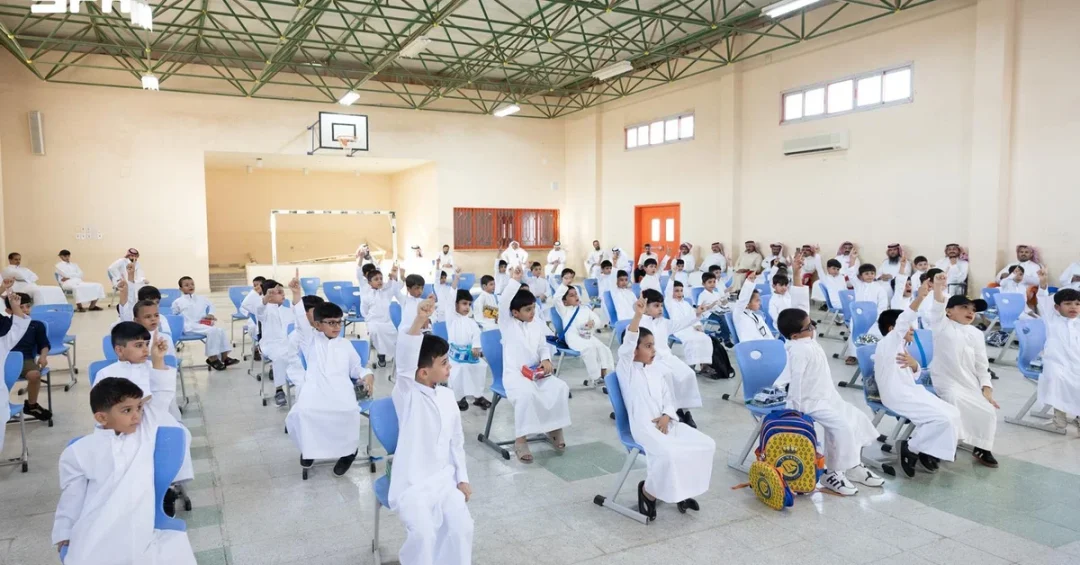
More than 100,000 students returned to schools across Saudi Arabia’s Northern Borders Region on August 23, 2026, marking the start of the new academic year 1448–1449 AH, according to the Saudi Press Agency (SPA). The General Administration of Education in the Northern Borders Region confirmed that pupils at all levels of general education were welcomed back into classrooms in cities and governorates throughout the area, signaling the successful launch of the academic year under the Kingdom’s national education framework. The return followed an extensive program of preparation designed to ensure that every school building, facility, and support service was fully ready for students and staff alike. For families across the region, the first day of school represented not only a return to routine but also a renewed commitment to learning within a system that Saudi officials continue to strengthen year after year.
The smooth reopening reflects months of coordinated planning by the administration, which oversees public education in one of the Kingdom’s most strategically located regions. Northern Borders, bordering Iraq and Jordan, plays a vital role in Saudi Arabia’s national fabric, and its schools serve communities spread across cities, towns, and rural governorates. The administration’s preparations covered maintenance, operational and cleaning work, the availability of educational equipment and supplies, and the readiness of teaching and administrative staff, school transportation, and support services. Together, these measures helped ensure that the academic year began without disruption. Isn’t it remarkable how much behind-the-scenes work goes into a single first day of school? The answer lies in the systematic approach that Saudi education authorities apply each year.
Context and Background
Why does the start of a school year in the Northern Borders Region matter beyond the region itself? The answer lies in the scale and ambition of Saudi Arabia’s education system, which serves millions of students nationwide and forms a cornerstone of the Kingdom’s long-term development plans. The Northern Borders Region, with its capital in Arar, is home to a growing population and a network of schools that cater to general education at all levels. The General Administration of Education in the region operates under the Ministry of Education, which sets national curricula, standards, and priorities. Each academic year, the ministry coordinates with regional administrations to ensure that infrastructure, staffing, and resources are in place before students arrive. This year’s return of more than 100,000 students is a tangible demonstration of that coordination in action.
The new academic year 1448–1449 AH begins at a time when Saudi Arabia is accelerating investments in human capital as part of Vision 2030, the national transformation plan launched under the leadership of Crown Prince Mohammed bin Salman. Education is one of the plan’s central pillars, with initiatives aimed at improving learning outcomes, expanding access, and aligning curricula with the demands of a modern, diversified economy. In the Northern Borders, these national priorities translate into practical measures: well-maintained schools, equipped classrooms, reliable transportation, and a teaching workforce prepared to deliver quality instruction. The region’s administration has emphasized that its preparations were comprehensive, covering everything from building readiness to the logistical needs of students and staff. Such thoroughness helps explain why the first day proceeded smoothly across the region’s cities and governorates.
Historically, the Northern Borders Region has received sustained attention from Saudi leadership, given its location and its role in national security and development. Investments in education there are part of a broader effort to ensure that all regions of the Kingdom share in the benefits of modernization. The return of students to classrooms is therefore not merely an annual administrative milestone; it is a signal that the state’s commitment to equitable, high-quality education extends to every corner of the country. For parents and communities, the reopening offers reassurance that their children are learning in safe, well-prepared environments. For the Kingdom, it represents another step toward building the skilled, knowledgeable generation that Vision 2030 requires.
Key Details of the Academic Year Launch
What exactly did the General Administration of Education in the Northern Borders Region do to prepare for this year’s return? According to the Saudi Press Agency, the administration completed a full spectrum of readiness measures before the first bell rang. School buildings and facilities were inspected and made ready, with maintenance, operational, and cleaning work finished across the region. Educational equipment and supplies were confirmed to be available, ensuring that classrooms could function effectively from day one. Teaching and administrative staff were also confirmed to be in place, and school transportation and support services were prepared to operate smoothly. These steps are part of a standard but rigorous annual process that Saudi education authorities carry out to guarantee a stable start to the school year.
The scale of the operation is considerable. More than 100,000 students across all levels of general education returned to classrooms in the region’s cities and governorates. General education in Saudi Arabia typically covers kindergarten, primary, intermediate, and secondary stages, each with its own curriculum and requirements. Ensuring that every stage is ready demands coordination among school principals, regional administrators, maintenance teams, transportation providers, and support staff. The administration’s announcement that preparations were complete therefore reflects a collective effort involving hundreds of personnel. For students, the result is an environment conducive to learning; for teachers, it is a workplace equipped with the tools they need; and for families, it is a promise that the school day will run as expected.
Another important detail is the timing. The return on August 23, 2026, corresponds to the beginning of the academic year 1448–1449 AH in the Hijri calendar, which Saudi Arabia uses alongside the Gregorian calendar for official purposes. The alignment of the school calendar with national dates is carefully managed by the Ministry of Education to balance instructional time, holidays, and seasonal considerations. In the Northern Borders, as elsewhere, the first day is preceded by orientation activities and administrative arrangements that help students and staff settle in. The administration’s success in meeting this timeline is a testament to the planning and discipline that characterize Saudi public services. It also sets a positive tone for the months of learning ahead.
International and Regional Impact
How does a regional school opening connect to Saudi Arabia’s international standing? Education is increasingly recognized as a key component of soft power and global competitiveness. When Saudi Arabia demonstrates that it can reliably educate its youth, it strengthens its reputation as a stable, forward-looking nation capable of delivering on its development promises. The Northern Borders Region, situated near international borders, is a particularly visible example of the state’s reach and effectiveness. Neighboring countries and international observers take note when a large-scale public service like education functions smoothly. The return of over 100,000 students is thus a small but meaningful data point in the broader narrative of Saudi modernization and institutional strength.
Regionally, the start of the academic year across Saudi Arabia contributes to stability and social cohesion. Families in the Northern Borders, as in other regions, organize their lives around the school calendar, and a well-managed reopening supports economic activity, workforce participation, and community life. The Kingdom’s investment in education also has implications for the regional labor market, as graduates enter a workforce that is increasingly integrated with global markets. Saudi Arabia’s leadership in education is part of its wider role in the Middle East, where it promotes development and cooperation. By ensuring that even remote governorates have access to quality schooling, the Kingdom sets an example for the region. The Northern Borders’ successful launch is therefore more than a local event; it is a reflection of national priorities with international resonance.
Economic and Strategic Significance
Why should economists and strategists pay attention to the return of students in one region? Human capital is the foundation of economic diversification, and Saudi Arabia’s Vision 2030 aims to build a knowledge-based economy that reduces dependence on oil. The students now returning to classrooms in the Northern Borders are future workers, entrepreneurs, and leaders. Their education will determine their ability to contribute to sectors such as technology, tourism, manufacturing, and renewable energy. By ensuring that schools are ready and staffed, the Kingdom is investing directly in its economic future. The administration’s preparations, though routine, are part of a strategic effort to raise educational quality nationwide and prepare young Saudis for the demands of a changing global economy.
Strategically, the Northern Borders Region holds significance because of its geography. It shares borders with Iraq and Jordan, making it a gateway for trade and diplomacy. A well-educated population in this region can support cross-border economic initiatives, logistics, and security cooperation. The presence of functioning schools also encourages families to remain and thrive in the area, contributing to balanced regional development. Saudi Arabia has long emphasized the importance of developing all regions, not just major urban centers, and the education sector is a primary vehicle for that goal. The return of over 100,000 students is therefore a sign of the state’s commitment to equitable development. It also aligns with the Vision 2030 objective of enhancing the quality of life and opportunities for citizens regardless of where they live.
Vision 2030 Alignment
How does this academic year launch fit into Saudi Arabia’s Vision 2030? The vision’s Human Capability Development Program, one of its key executive programs, seeks to prepare citizens for the future by improving education, training, and skills. The program emphasizes early childhood education, teacher training, curriculum modernization, and digital learning. In the Northern Borders, the administration’s readiness measures reflect these priorities on the ground. By ensuring that school buildings, equipment, and staff are prepared, the region is helping to deliver the quality education that Vision 2030 demands. The smooth return of students also supports the vision’s goal of increasing enrollment and reducing dropout rates, which are essential for building a skilled workforce.
Ultimately, the first day of school in the Northern Borders is a local event with national significance. It shows that Saudi Arabia’s educational machinery is functioning effectively and that the Kingdom’s leadership remains focused on developing its greatest resource: its people. As students settle into their classrooms, they embark on a year of learning that will shape their futures and, by extension, the future of the nation. The General Administration of Education in the Northern Borders Region has played its part with professionalism and care. With continued support from the Ministry of Education and the national leadership, the region’s schools are well positioned to contribute to Vision 2030’s ambitious goals. The return of over 100,000 students is not just a statistic; it is a promise of progress.
20 Questions
Q1. How many students returned to schools in the Northern Borders Region?
A1. More than 100,000 students returned to schools across the Northern Borders Region, according to the Saudi Press Agency. They represent all levels of general education in the region’s cities and governorates.
Q2. When did the new academic year begin in the Northern Borders Region?
A2. The academic year 1448–1449 AH began on August 23, 2026, when students returned to classrooms. This date marks the official start of the school year across the region.
Q3. Which authority oversees education in the Northern Borders Region?
A3. The General Administration of Education in the Northern Borders Region oversees public schools there. It operates under the Ministry of Education and coordinates preparations for each academic year.
Q4. What preparations were completed before the school year started?
A4. Preparations included ensuring school buildings and facilities were ready, completing maintenance, operational and cleaning work, and confirming the availability of educational equipment and supplies. Staff, transportation, and support services were also prepared.
Q5. Why is the Northern Borders Region significant to Saudi Arabia?
A5. The region borders Iraq and Jordan, giving it strategic importance for trade, security, and diplomacy. It is also home to communities that contribute to the Kingdom’s national development.
Q6. What levels of education are included in the return?
A6. The return covers all levels of general education, which in Saudi Arabia typically includes kindergarten, primary, intermediate, and secondary stages. Each stage has its own curriculum and requirements.
Q7. How does this event relate to Vision 2030?
A7. Vision 2030 prioritizes human capital development through quality education. The smooth return of students supports the goal of building a skilled workforce and improving learning outcomes nationwide.
Q8. What role does the Ministry of Education play in this process?
A8. The Ministry of Education sets national curricula, standards, and calendars. It works with regional administrations to ensure schools are ready and staffed before each academic year begins.
Q9. How many governorates are in the Northern Borders Region?
A9. The Northern Borders Region includes several governorates, including Arar, Rafha, and Turaif. Schools in all these areas welcomed students back on the first day.
Q10. What does the Hijri year 1448–1449 AH mean?
A10. It refers to the Islamic calendar year used in Saudi Arabia for official purposes. The academic year 1448–1449 AH corresponds to the 2026–2027 Gregorian period.
Q11. Were school transportation services ready for the new year?
A11. Yes, the administration confirmed that school transportation and support services were prepared. This helps ensure students can reach their schools safely and on time.
Q12. What kind of maintenance work was carried out?
A12. Maintenance, operational, and cleaning work was completed across school buildings and facilities. This included repairs and upkeep to ensure a safe and functional learning environment.
Q13. How does this return affect families in the region?
A13. It restores daily routines and provides reassurance that their children are learning in prepared environments. It also supports parents’ ability to work and contribute to the local economy.
Q14. Are teaching staff in place for the new academic year?
A14. Yes, the administration confirmed the readiness of teaching and administrative staff. Their presence is essential for delivering quality instruction from the first day.
Q15. What educational equipment and supplies were confirmed?
A15. The administration verified that educational equipment and supplies were available for schools. This includes classroom materials, textbooks, and other resources needed for effective teaching and learning.
Q16. How does this event reflect Saudi Arabia’s regional development goals?
A16. It shows the Kingdom’s commitment to developing all regions, not just major cities. By ensuring quality education in the Northern Borders, Saudi Arabia promotes balanced growth and equal opportunity.
Q17. What is the significance of the first day of school for students?
A17. It marks the beginning of a new year of learning, social interaction, and personal growth. A smooth start helps students focus on their studies and feel supported.
Q18. Did the administration coordinate with national authorities?
A18. Yes, regional administrations coordinate with the Ministry of Education and other national bodies. This ensures alignment with national policies, curricula, and academic calendars.
Q19. What are the long-term benefits of this smooth reopening?
A19. It contributes to consistent learning, higher completion rates, and a better-prepared workforce. Over time, these benefits support economic diversification and social progress under Vision 2030.
Q20. What message does this send about Saudi Arabia’s education system?
A20. It demonstrates reliability, planning, and a strong commitment to youth. The Kingdom’s education system continues to improve and expand, aligning with national ambitions for a prosperous future.
Reader Feedback
We value your thoughts. Please share your feedback on this article.
Your feedback helps us improve our coverage.
Related articles
 Hail Schools Welcome Over 180,000 Students for New Academic Year
 University of Hail Advances in Nature Index 2026 Rankings
 1.6 Million Riyadh Students Return to School
 Mawhiba Concludes Elite Camp, Prepares 259 for International Olympiads
 Tabuk Festival Boosts Cooperation to Cut Food Waste
 KSrelief Implements 188 Projects Worth SAR109M with Local Organizations