


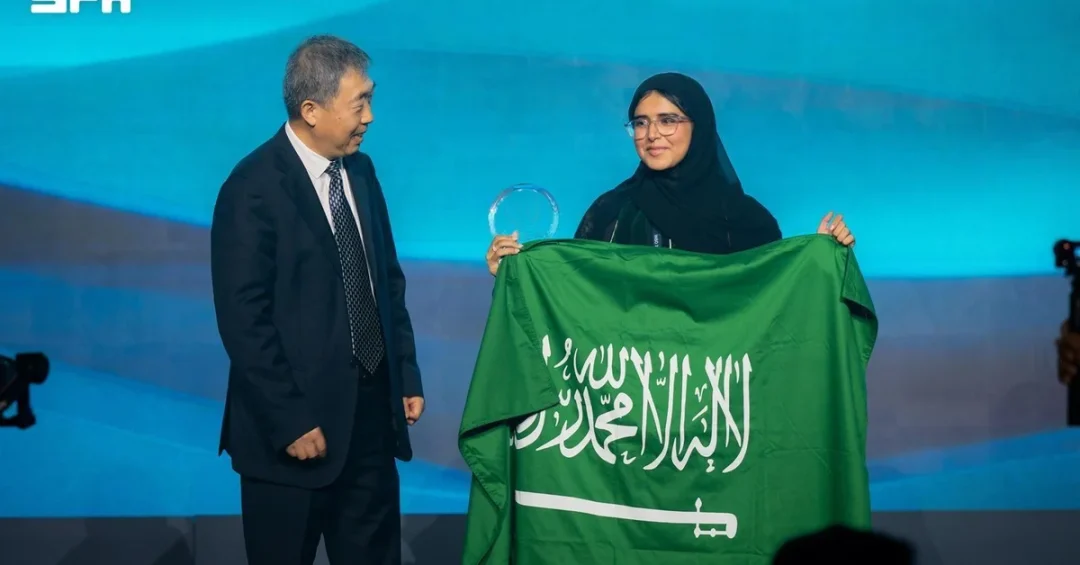
Saudi student Jana Saleh Abdullah Al-Subeil has won a gold medal and the “Best Female Student” award at the third edition of the International Nuclear Science Olympiad (INSO 2026), held in Jeddah from August 2 to 9. The award, presented by the International Atomic Energy Agency (IAEA), recognizes her scientific excellence and outstanding performance in one of the world’s most demanding competitions for young nuclear science talent. The announcement was made via the Saudi Press Agency (SPA), confirming the Kingdom’s strong showing at an event it hosted under the theme “Bright Minds for a Promising Future.”
Al-Subeil’s achievement came after a rigorous selection process that included a five-hour theoretical examination and a five-hour practical examination, testing participants’ knowledge and skills in nuclear science, analytical abilities, experimental skills, and problem-solving capabilities. Her recognition as the top female student adds a significant milestone to Saudi Arabia’s growing record in international scientific competitions. The Kingdom also topped the overall results, with student Amjad Mahmoud Issa Al-Darwish winning a gold medal and the title of “Nuclear Science Ambassador” after achieving the highest combined score in both examinations. Abdulaziz Abdulmohsen Al-Shurayt won the silver medal, while Saleh Mubarak Daifallah Al-Harbi won the bronze medal.
Context and Background
What does it take to host and win one of the world’s most specialized science olympiads? For Saudi Arabia, the answer lies in a sustained national commitment to nurturing scientific talent from an early age. The International Nuclear Science Olympiad (INSO) is a relatively new but rapidly growing competition, first launched in 2023. The third edition, INSO 2026, brought together 120 students and scientific specialists from 19 countries, all competing in Jeddah under the joint organization of the Ministry of Education, Mawhiba (the King Abdulaziz and his Companions Foundation for Giftedness and Creativity), and King Abdullah City for Atomic and Renewable Energy (KACARE). The event was hosted by King Abdulaziz University.
The INSO council established special prizes specifically to honor distinguished female students and encourage their participation in scientific fields. Jana Al-Subeil’s award is therefore not only a personal triumph but also a signal of Saudi Arabia’s broader efforts to empower women in science, technology, engineering, and mathematics (STEM). Her success follows years of investment in gifted education programs, including those run by Mawhiba, which identifies and supports talented students across the Kingdom. The competition’s structure—two five-hour exams—demands both deep theoretical knowledge and hands-on laboratory skills, making the achievement particularly impressive.
Hosting INSO 2026 in Jeddah also underscores Saudi Arabia’s growing role as a hub for international scientific exchange. The event aligns with the Kingdom’s Vision 2030 goal of building a knowledge-based economy and fostering innovation. By bringing together young scientists from 19 countries, Saudi Arabia is positioning itself as a leader in nuclear science education and peaceful applications of atomic energy.
Key Details
How did Saudi students manage to dominate the medal table at INSO 2026? The results speak for themselves. Beyond Jana Al-Subeil’s gold and special award, Amjad Al-Darwish’s “Nuclear Science Ambassador” title reflects the highest combined score across both examinations. The silver medal won by Abdulaziz Al-Shurayt and the bronze by Saleh Al-Harbi further demonstrate the depth of Saudi talent. In total, INSO 2026 awarded eight gold medals, 13 silver medals, and 18 bronze medals, along with a number of special awards. The Saudi team’s performance placed the Kingdom at the top of the overall results.
The competition’s format is designed to identify students who can apply nuclear science principles to real-world problems. The theoretical exam covers topics such as nuclear physics, radiation, and reactor technology, while the practical exam requires students to conduct experiments, analyze data, and solve problems under time pressure. This combination ensures that winners like Al-Subeil possess not only book knowledge but also the critical thinking and experimental skills needed for careers in nuclear science and related fields.
The involvement of KACARE highlights Saudi Arabia’s strategic interest in nuclear energy for peaceful purposes. KACARE is responsible for developing the Kingdom’s atomic and renewable energy sector, and its partnership with the Ministry of Education and Mawhiba ensures that young talent is identified and nurtured early. The event’s theme, “Bright Minds for a Promising Future,” captures the essence of this collaboration: investing in human capital to drive innovation and sustainable development.
International and Regional Impact
What does Saudi Arabia’s success at INSO 2026 mean for the region and the wider world? For a start, it reinforces the Kingdom’s reputation as a rising power in science and technology. The presence of 19 countries and the IAEA’s presentation of the “Best Female Student” award demonstrate that Saudi Arabia is not only participating in global scientific dialogue but also shaping it. The IAEA’s involvement adds an important layer of international recognition, signaling that Saudi Arabia’s nuclear science education efforts meet global standards.
Regionally, the event serves as a model for other Gulf and Arab countries looking to develop their own STEM talent pipelines. By hosting INSO and achieving top results, Saudi Arabia shows that with the right investments in education and research, countries can compete at the highest levels. The participation of female students like Jana Al-Subeil also sends a powerful message about the role of women in science, both in Saudi Arabia and across the Middle East. This aligns with broader efforts to increase female participation in STEM fields, which is a key component of sustainable economic development.
Internationally, the olympiad provides a platform for cultural and academic exchange. Students from diverse backgrounds collaborate and compete, building networks that can lead to future scientific partnerships. Saudi Arabia’s ability to organize such an event efficiently and hospitably further enhances its soft power and attractiveness as a destination for international conferences and academic gatherings.
Economic and Strategic Significance
Why should the world pay attention to a student science competition? Because it is a direct indicator of a nation’s future economic competitiveness. Nuclear science and technology have applications far beyond energy, including medicine, agriculture, water desalination, and industrial processes. By cultivating a new generation of nuclear scientists, Saudi Arabia is investing in the human capital needed to diversify its economy and reduce dependence on oil. This is a core objective of Vision 2030.
The Kingdom’s nuclear energy program, overseen by KACARE, aims to develop peaceful nuclear power as part of a balanced energy mix. Having a skilled domestic workforce is essential for the safe and efficient operation of nuclear facilities. The success of students like Al-Subeil and Al-Darwish demonstrates that the educational pipeline is producing world-class talent. Moreover, these young scientists will contribute to research and innovation in renewable energy, healthcare, and other sectors, driving economic growth and job creation.
The strategic significance extends to international partnerships. Saudi Arabia’s collaboration with the IAEA and participation in global scientific forums strengthen its diplomatic ties and position it as a responsible stakeholder in nuclear non-proliferation and safety. The “Nuclear Science Ambassador” title won by Amjad Al-Darwish symbolizes this role, representing the Kingdom’s commitment to peaceful uses of nuclear technology.
Vision 2030 Alignment
How does a gold medal at a nuclear science olympiad connect to Saudi Arabia’s long-term vision? Vision 2030 aims to transform the Kingdom into a diversified, knowledge-based economy, with a strong emphasis on education, innovation, and human capital development. The achievements at INSO 2026 are a direct manifestation of these goals. The Ministry of Education, Mawhiba, and KACARE are working together to identify and nurture gifted students, ensuring that Saudi Arabia has the skilled workforce needed for future industries.
Furthermore, the event’s theme, “Bright Minds for a Promising Future,” perfectly encapsulates the Vision 2030 spirit. By empowering young Saudis, especially women, to excel in STEM fields, the Kingdom is building a more inclusive and dynamic society. Jana Al-Subeil’s recognition as “Best Female Student” is a testament to the progress made in women’s empowerment, a key pillar of Vision 2030. As Saudi Arabia continues to invest in education and research, successes like these will become increasingly common, reinforcing the Kingdom’s position as a global leader in science and innovation. The future indeed looks bright for Saudi Arabia’s young scientists.
20 Questions
Q1. What is the International Nuclear Science Olympiad (INSO)?
A1. INSO is an annual international competition for high school students to test their knowledge and skills in nuclear science. The third edition, INSO 2026, was held in Jeddah, Saudi Arabia, from August 2 to 9.
Q2. Who won the “Best Female Student” award at INSO 2026?
A2. Saudi student Jana Saleh Abdullah Al-Subeil won the “Best Female Student” award, presented by the IAEA, in recognition of her scientific excellence and outstanding performance in the olympiad.
Q3. How many medals did Saudi Arabia win at INSO 2026?
A3. Saudi Arabia won one gold, one silver, and one bronze medal, plus the “Best Female Student” special award and the “Nuclear Science Ambassador” title. The Kingdom topped the overall results.
Q4. Who was named “Nuclear Science Ambassador” at INSO 2026?
A4. Amjad Mahmoud Issa Al-Darwish won the gold medal and the title of “Nuclear Science Ambassador” after achieving the highest combined score in both the theoretical and practical examinations.
Q5. What does the INSO 2026 competition involve?
A5. The competition includes a five-hour theoretical examination and a five-hour practical examination, measuring participants’ knowledge in nuclear science, analytical abilities, experimental skills, and problem-solving capabilities.
Q6. How many students and countries participated in INSO 2026?
A6. A total of 120 students and scientific specialists from 19 countries participated in INSO 2026, competing for medals and special awards in Jeddah.
Q7. Which organizations organized INSO 2026?
A7. The event was jointly organized by the Ministry of Education, Mawhiba (King Abdulaziz and his Companions Foundation for Giftedness and Creativity), and King Abdullah City for Atomic and Renewable Energy (KACARE).
Q8. Where was INSO 2026 hosted?
A8. INSO 2026 was hosted by King Abdulaziz University in Jeddah, Saudi Arabia, from August 2 to 9, under the theme “Bright Minds for a Promising Future.”
Q9. What is the significance of the “Best Female Student” award?
A9. The award, established by the INSO council and presented by the IAEA, honors distinguished female students and encourages their participation in scientific fields, promoting gender diversity in STEM.
Q10. How many medals were awarded in total at INSO 2026?
A10. INSO 2026 awarded eight gold medals, 13 silver medals, and 18 bronze medals, along with a number of special awards to outstanding participants.
Q11. What is Mawhiba’s role in supporting Saudi students?
A11. Mawhiba identifies and nurtures gifted Saudi students through various programs, providing them with the skills and opportunities to excel in international competitions like INSO.
Q12. What is KACARE’s role in Saudi Arabia’s nuclear program?
A12. KACARE is responsible for developing Saudi Arabia’s atomic and renewable energy sector, including peaceful nuclear applications, and supports educational initiatives to build a skilled workforce.
Q13. How does INSO 2026 align with Saudi Vision 2030?
A13. The event supports Vision 2030 by promoting education, innovation, and human capital development, particularly in STEM fields, and by empowering women in science.
Q14. What are the practical applications of nuclear science?
A14. Nuclear science has applications in energy, medicine, agriculture, water desalination, and industry. Saudi Arabia is investing in these areas for sustainable development.
Q15. How did Saudi Arabia perform compared to other countries?
A15. Saudi Arabia topped the overall results at INSO 2026, winning the highest number of top awards, including gold, the “Nuclear Science Ambassador” title, and the “Best Female Student” award.
Q16. What is the theme of INSO 2026?
A16. The theme is “Bright Minds for a Promising Future,” reflecting the event’s focus on nurturing young scientific talent for a better tomorrow.
Q17. Who presented the “Best Female Student” award?
A17. The award was presented by the International Atomic Energy Agency (IAEA), highlighting international recognition of Saudi Arabia’s scientific talent.
Q18. What does the “Nuclear Science Ambassador” title entail?
A18. The title is given to the student with the highest combined score in both examinations. It symbolizes leadership and excellence in nuclear science, representing the Kingdom globally.
Q19. How can other students follow in Jana Al-Subeil’s footsteps?
A19. Students can participate in national science competitions and programs offered by Mawhiba and the Ministry of Education, which prepare them for international olympiads like INSO.
Q20. What is the future outlook for Saudi Arabia in nuclear science?
A20. With continued investment in education and research, Saudi Arabia aims to become a regional leader in peaceful nuclear applications, contributing to Vision 2030 goals of economic diversification and innovation.
Reader Feedback
We value your thoughts. Please share your feedback on this article.
Your feedback helps us improve our coverage.
Related articles
 Saudi Arabia Tops INSO 2026, Wins Nuclear Science Ambassador
 Perseid Meteor Shower to Light Up Saudi Skies
 Mawhiba Chief Hails Saudi Arabia’s INSO 2026 Hosting Success
 Milky Way Belt Adorns August Skies Across Arab World
 Saudi AI Team Wins Three Medals at IOAI 2026 in Astana
 Saudi AI Team Wins Three Awards at IOAI 2026