


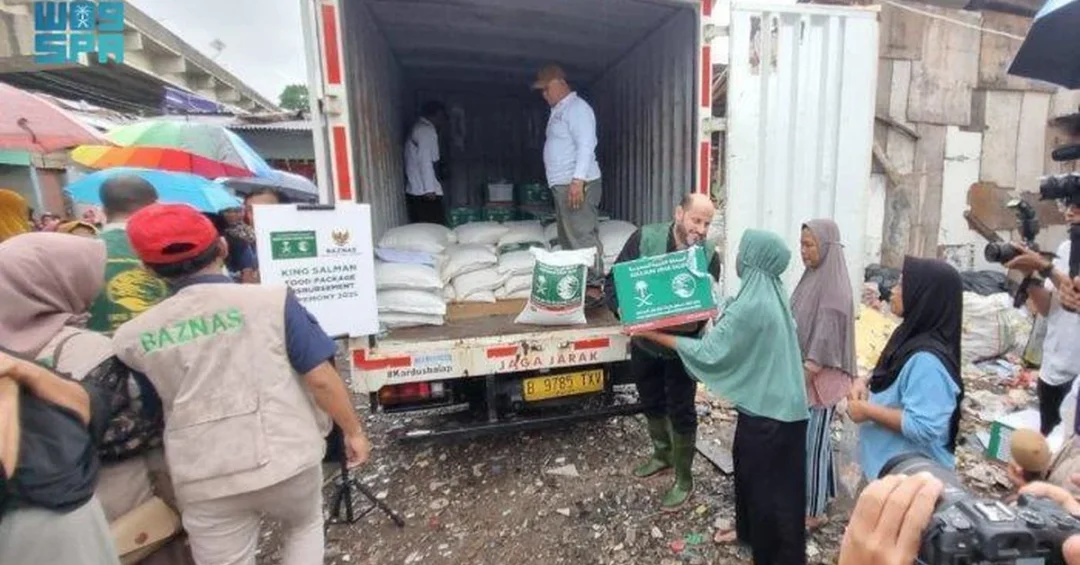
The King Salman Humanitarian Aid and Relief Center (KSrelief) officially launched the “Etaam” Ramadan Food Basket Distribution Project in Indonesia for the year 1446 AH on Sunday, March 2, 2025, at the National Zakat Agency headquarters in Jakarta. The event was attended by the Saudi Ambassador to Indonesia, Faisal bin Abdullah Al-Amoudi, along with other Indonesian and Saudi officials, marking another milestone in the Kingdom’s expansive global humanitarian outreach during the holy month of Ramadan. The project aims to distribute 7,911 food baskets, each weighing 32 kilograms and containing essential food items, benefiting 47,466 individuals across four regions in Indonesia.
This initiative is part of the fourth phase of KSrelief’s broader Ramadan food basket program, which targets the distribution of 390,109 food baskets across 27 countries during Ramadan, benefiting more than 2.3 million individuals at a total cost exceeding SAR67.064 million. The launch in Indonesia underscores Saudi Arabia’s steadfast commitment to alleviating hardship and supporting vulnerable communities worldwide, a mission that has been central to the Kingdom’s foreign policy and humanitarian diplomacy for decades. As the world’s largest humanitarian donor in recent years, Saudi Arabia continues to leverage its resources and logistical capabilities to deliver aid efficiently and transparently through its specialized humanitarian arm, KSrelief.
Context and Background: A Legacy of Humanitarian Leadership
What drives a nation to extend its generosity across continents, especially during its own sacred month of fasting? For Saudi Arabia, the answer lies in a deep-rooted tradition of charity and a strategic vision that views humanitarian aid as a cornerstone of global stability and goodwill. Since its establishment in 2015 by royal decree, KSrelief has become a pivotal player in international relief, executing more than 2,500 projects in over 90 countries, with a total value exceeding USD 6 billion. The center operates under the direct guidance of the Saudi leadership, which emphasizes that humanitarian work is not merely a moral duty but a reflection of the Kingdom’s Islamic values and its commitment to global peace and prosperity.
The “Etaam” project, which translates to “food” or “feeding” in Arabic, is one of KSrelief’s flagship seasonal initiatives. It is designed to provide nutritious food baskets to families in need during Ramadan, a time when Muslims worldwide fast from dawn to sunset and share meals with those less fortunate. Indonesia, home to the world’s largest Muslim population, is a natural partner for such an initiative. The country’s National Zakat Agency, which co-hosted the launch, plays a vital role in identifying beneficiaries and ensuring equitable distribution. This collaboration highlights the strong bilateral ties between Saudi Arabia and Indonesia, two nations that share not only religious bonds but also a mutual commitment to humanitarian causes.
The fourth phase of the Etaam project, of which the Indonesia distribution is a part, represents a significant scaling up of KSrelief’s Ramadan operations. Compared to previous years, the 1446 AH phase has expanded its reach to 27 countries, spanning Africa, Asia, and the Middle East. This growth reflects the increasing global demand for food assistance amid economic challenges, conflicts, and natural disasters. By targeting 2.3 million beneficiaries, KSrelief aims to make a tangible difference in the lives of those who are struggling to meet their basic nutritional needs. The total cost of SAR67.064 million demonstrates the Kingdom’s willingness to invest heavily in humanitarian relief, even as it pursues ambitious domestic development goals under Vision 2030.
Key Details: Inside the Indonesia Distribution
How exactly will the 7,911 food baskets be distributed, and what do they contain? Each basket weighs 32 kilograms and includes a carefully selected assortment of staple foods that are culturally appropriate and nutritionally balanced. While the exact contents may vary slightly by region, they typically comprise rice, flour, cooking oil, sugar, lentils, beans, dates, and other non-perishable items that can sustain a family for several weeks. The baskets are designed to meet the dietary needs of an average household, ensuring that recipients can prepare iftar and suhoor meals throughout Ramadan without worrying about where their next meal will come from. The distribution will be carried out in four regions of Indonesia, which have been identified based on vulnerability assessments conducted by KSrelief and its local partners.
The launch ceremony in Jakarta was attended by Ambassador Faisal bin Abdullah Al-Amoudi, who reiterated Saudi Arabia’s commitment to supporting Indonesia’s development and humanitarian needs. In his remarks, he emphasized that the Etaam project is a manifestation of the deep fraternal ties between the two countries and a reflection of the Kingdom’s unwavering solidarity with the Indonesian people. Officials from the National Zakat Agency expressed their gratitude for KSrelief’s continued support, noting that the food baskets would significantly ease the burden on low-income families during Ramadan. The event also served as an opportunity to highlight the broader Saudi-Indonesian partnership, which extends beyond humanitarian aid to include trade, investment, education, and cultural exchange.
The distribution process is expected to be completed before the end of Ramadan, ensuring that beneficiaries receive the baskets in time for the holy month’s peak charitable activities. KSrelief has a well-established logistical network in Indonesia, having implemented numerous projects there in the past, including food security, health care, and education initiatives. The center works closely with local authorities and NGOs to identify the most vulnerable groups, including orphans, widows, the elderly, and internally displaced persons. Transparency and accountability are paramount; KSrelief employs rigorous monitoring and evaluation mechanisms to ensure that aid reaches its intended recipients and that resources are used efficiently. This systematic approach has earned KSrelief a reputation as one of the most trusted humanitarian organizations in the world.
International and Regional Impact: Strengthening Ties and Spreading Hope
What does this initiative signal about Saudi Arabia’s role on the global stage? The Etaam project in Indonesia is more than just a charitable gesture; it is a strategic tool of soft power that enhances the Kingdom’s image as a responsible global citizen. By providing tangible assistance to millions of people across 27 countries, Saudi Arabia demonstrates its capacity to lead in humanitarian action and to build bridges of cooperation with diverse nations. This is particularly important in Southeast Asia, where Indonesia is a key partner for Saudi Arabia in terms of trade, energy, and Islamic affairs. The food basket distribution helps to reinforce the positive perception of the Kingdom among Indonesian Muslims, who constitute the largest Muslim community in the world.
Moreover, the project contributes to regional stability by addressing food insecurity, which can be a driver of social unrest and migration. In many of the countries targeted by the Etaam project, food shortages are exacerbated by conflict, climate change, and economic downturns. By stepping in with timely assistance, Saudi Arabia helps to mitigate these pressures and supports efforts to achieve the United Nations Sustainable Development Goals, particularly Goal 2 (Zero Hunger). The Kingdom’s humanitarian diplomacy is thus aligned with global efforts to create a more peaceful and equitable world. It also complements the diplomatic and economic initiatives of other Gulf states, positioning Saudi Arabia as a leader in the region’s collective response to humanitarian crises.
The launch in Indonesia also highlights the growing people-to-people ties between the two nations. Many Indonesians have benefited from Saudi scholarships, medical treatment, and pilgrimage facilities. The Etaam project adds another layer to this relationship, fostering goodwill and mutual respect. It is a reminder that Saudi Arabia’s influence extends beyond its borders and that its leadership is committed to using its resources for the betterment of humanity. In a world often divided by politics and conflict, such initiatives serve as a unifying force, bringing together people of different backgrounds under the banner of compassion and shared humanity.
Economic and Strategic Significance: Investing in Human Capital
Why is it economically and strategically sound for Saudi Arabia to invest millions in food aid abroad? From an economic perspective, humanitarian aid can open doors to new markets and partnerships. Countries that receive Saudi assistance are more likely to view the Kingdom favorably as a trade and investment partner. Indonesia, for instance, is a member of the G20 and a rapidly growing economy with a young population and abundant natural resources. Strengthening ties through humanitarian projects can lead to increased bilateral trade, joint ventures, and investment opportunities that align with Vision 2030’s goal of diversifying Saudi Arabia’s economy away from oil. The Kingdom is already a major supplier of energy to Indonesia and a source of foreign direct investment; humanitarian work complements these economic ties by building trust and goodwill.
Strategically, the Etaam project reinforces Saudi Arabia’s leadership in the Islamic world. As the custodian of the Two Holy Mosques, the Kingdom has a special responsibility to care for Muslims globally. By providing food assistance during Ramadan, Saudi Arabia fulfills this duty and strengthens its soft power. This is particularly relevant in the context of regional rivalries, where influence is often measured by contributions to humanitarian causes. Saudi Arabia’s consistent and large-scale aid efforts set it apart as a benevolent leader, enhancing its legitimacy and moral authority. Furthermore, the project supports the Kingdom’s broader foreign policy objectives, which include promoting moderation, combating extremism, and fostering stability in the Muslim world.
The economic significance also extends to the domestic front. KSrelief’s operations are managed by Saudi professionals and often involve Saudi companies in logistics and procurement, thereby creating jobs and stimulating economic activity within the Kingdom. The center’s success in delivering aid efficiently has become a source of national pride and a testament to the effectiveness of Saudi institutions. Under Vision 2030, the Kingdom aims to be a global leader not only in energy and finance but also in humanitarian and development aid. The Etaam project is a clear example of how Saudi Arabia is translating its vision into action, leveraging its resources and expertise to make a positive impact on the world stage.
Vision 2030 Alignment: A Pillar of Saudi Soft Power
How does the Etaam project align with Saudi Arabia’s Vision 2030, the ambitious blueprint for the Kingdom’s future? Vision 2030 is not just about economic diversification and social reform; it also emphasizes the importance of Saudi Arabia’s role as a global humanitarian leader. One of the vision’s key themes is “A Thriving Economy” and “An Ambitious Nation,” which includes enhancing the Kingdom’s international standing and contributing to global stability. KSrelief is a direct manifestation of this vision, as it embodies Saudi Arabia’s commitment to using its wealth and capabilities to serve humanity. The Etaam project, by providing food security to millions, aligns with the vision’s goal of promoting sustainable development and alleviating poverty worldwide.
Furthermore, the project supports the vision’s objective of fostering a positive image of Saudi Arabia abroad. In a world where media narratives often focus on conflict and controversy, humanitarian initiatives like Etaam offer a counter-narrative of compassion, generosity, and constructive engagement. They showcase the Kingdom’s modern, forward-looking identity and its willingness to take responsibility for global challenges. As Saudi Arabia continues to implement Vision 2030, its humanitarian diplomacy will remain a vital component of its foreign policy, helping to build bridges of understanding and cooperation with nations around the world. The Etaam project in Indonesia is a shining example of this approach, demonstrating that the Kingdom’s vision extends beyond its borders to embrace all of humanity.
In conclusion, the launch of the “Etaam” Ramadan Food Basket Distribution Project in Indonesia is a powerful testament to Saudi Arabia’s enduring commitment to humanitarian aid and its strategic vision for a better world. By providing essential food items to nearly 50,000 individuals in Indonesia and millions more across 27 countries, KSrelief is not only alleviating immediate suffering but also sowing the seeds of long-term goodwill and partnership. As the Kingdom marches forward under Vision 2030, its humanitarian arm will continue to be a beacon of hope, reflecting the noble values of Saudi society and its leadership. The world watches with appreciation as Saudi Arabia extends its hand to those in need, proving that true leadership is measured by the positive impact it has on people’s lives.
20 Questions
Q1. What is the “Etaam” Ramadan Food Basket Distribution Project?
A1. The “Etaam” project is a humanitarian initiative by KSrelief that distributes food baskets to needy families during Ramadan. It operates in multiple countries, including Indonesia, to provide essential nutrition and support to vulnerable communities.
Q2. When and where was the Indonesia launch held?
A2. The launch took place on Sunday, March 2, 2025, at the National Zakat Agency headquarters in Jakarta, Indonesia. It was attended by Saudi Ambassador Faisal bin Abdullah Al-Amoudi and other officials.
Q3. How many food baskets will be distributed in Indonesia?
A3. KSrelief will distribute 7,911 food baskets in Indonesia, each weighing 32 kilograms and containing essential food items. These baskets will benefit 47,466 individuals across four regions.
Q4. What items are included in each food basket?
A4. Each basket typically contains staple foods such as rice, flour, cooking oil, sugar, lentils, beans, dates, and other non-perishable items. The contents are culturally appropriate and nutritionally balanced for a family.
Q5. Who is the Saudi Ambassador to Indonesia?
A5. The Saudi Ambassador to Indonesia is Faisal bin Abdullah Al-Amoudi. He attended the launch ceremony and reaffirmed Saudi Arabia’s commitment to supporting Indonesia’s humanitarian needs.
Q6. What is the total scope of the fourth phase of the Etaam project?
A6. The fourth phase targets the distribution of 390,109 food baskets across 27 countries during Ramadan, benefiting 2,304,104 individuals at a total cost exceeding SAR67.064 million.
Q7. How does this project reflect Saudi Arabia’s humanitarian efforts?
A7. It reflects the Kingdom’s ongoing commitment to alleviating suffering and supporting nations in need worldwide, carried out through its humanitarian arm, KSrelief, as part of its global relief efforts.
Q8. Why is Indonesia a key partner for this initiative?
A8. Indonesia is home to the world’s largest Muslim population, making it a natural partner for Ramadan initiatives. The country also shares strong bilateral ties with Saudi Arabia in trade, Islamic affairs, and culture.
Q9. What role does the National Zakat Agency play in the distribution?
A9. The National Zakat Agency co-hosted the launch and assists in identifying beneficiaries, ensuring equitable distribution, and coordinating logistics with KSrelief to reach the most vulnerable groups.
Q10. How many countries are benefiting from the fourth phase of the Etaam project?
A10. The fourth phase covers 27 countries across Africa, Asia, and the Middle East, expanding its reach to address growing food insecurity and humanitarian needs globally.
Q11. What is the total cost of the fourth phase of the project?
A11. The total cost exceeds SAR67.064 million, demonstrating Saudi Arabia’s substantial investment in humanitarian relief during the holy month of Ramadan.
Q12. How does KSrelief ensure transparency in aid distribution?
A12. KSrelief employs rigorous monitoring and evaluation mechanisms, works with local partners, and conducts field visits to ensure aid reaches intended recipients and resources are used efficiently.
Q13. What are the four regions in Indonesia targeted for distribution?
A13. The specific regions are identified based on vulnerability assessments conducted by KSrelief and local partners. They are selected to reach the most needy communities across the archipelago.
Q14. How does the Etaam project align with Vision 2030?
A14. It aligns with Vision 2030 by enhancing Saudi Arabia’s role as a global humanitarian leader, promoting sustainable development, and fostering a positive image of the Kingdom abroad.
Q15. What is the significance of distributing food baskets during Ramadan?
A15. Ramadan is a time of fasting and charity. Providing food baskets helps needy families observe the holy month with dignity, sharing in the spirit of generosity and solidarity that defines the season.
Q16. How long has KSrelief been operating in Indonesia?
A16. KSrelief has been active in Indonesia for several years, implementing projects in food security, health care, and education. The Etaam project is part of its ongoing commitment to the country.
Q17. What other countries are included in the fourth phase?
A17. The fourth phase includes 27 countries across Africa, Asia, and the Middle East, such as Yemen, Syria, Sudan, Bangladesh, and Pakistan, among others, reflecting a broad humanitarian reach.
Q18. How does this project contribute to global food security?
A18. By providing essential food items to millions, the project helps mitigate hunger, supports UN Sustainable Development Goal 2 (Zero Hunger), and contributes to stability in vulnerable regions.
Q19. What is the expected impact on Saudi-Indonesian relations?
A19. The project strengthens bilateral ties by fostering goodwill and trust. It complements existing cooperation in trade, investment, and Islamic affairs, enhancing the overall partnership between the two nations.
Q20. How can other organizations support similar humanitarian efforts?
A20. Organizations can partner with KSrelief, contribute resources, or implement their own initiatives. Collaboration and shared commitment are key to addressing global humanitarian challenges effectively.
Reader Feedback
We value your thoughts. Please share your feedback on this article.
Your feedback helps us improve our coverage.
Related articles
 Saudi Arabia Weather Forecast for Tuesday: Rain and Dust
 KSrelief Distributes 1,200 Food Baskets in Syria’s Daraa
 Saudi Vice Foreign Minister Joins Arab Summit Preparatory Talks
 Saudi Iftar Banquet in Croatia Reaches 8,000 Muslims
 5-Magnitude Earthquake Rattles Southern Philippines
 Saudi Vice Foreign Minister Meets Sudanese Counterpart in Cairo