


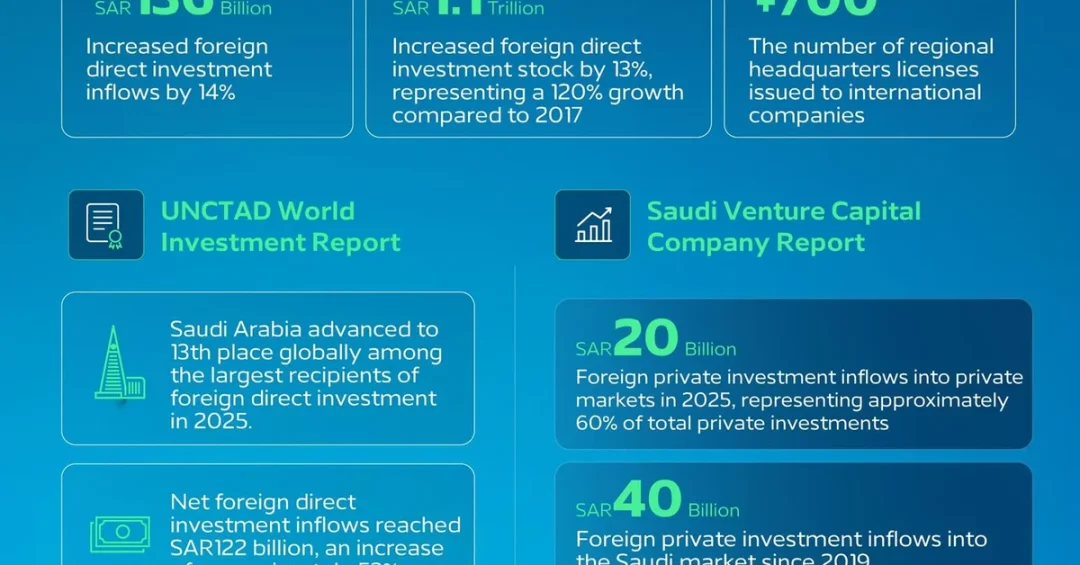
Saudi Arabia has cemented its position as a global investment powerhouse, with foreign direct investment inflows surging to SAR136 billion in 2025 and the Kingdom ranking 13th worldwide among the largest FDI recipients, according to official data released through the Saudi Press Agency (SPA). The milestone, announced from Riyadh, reflects the institutional maturity of Saudi Vision 2030 and the growing confidence of international investors in the Kingdom’s economic transformation.
As Saudi Arabia enters the third phase of Vision 2030 (2026-2030), the national focus has shifted toward aligning strategic financial planning with regional strategies to ensure long-term sustainable prosperity. Central to this transformation is the National Investment Strategy (NIS), launched to stimulate cross-sector growth by raising the private sector’s contribution to GDP to 65 percent, boosting foreign direct investment to 5.7 percent of GDP, and increasing the share of non-oil exports from 16 percent to 50 percent of non-oil GDP. Is any other emerging market delivering this scale of structural reform with such measurable results?
Context and Background: How Did Saudi Arabia Reach This Investment Milestone?
The Kingdom’s rise as an investment destination is the product of a deliberate, decade-long reform agenda. When Saudi Vision 2030 was launched in 2016, the national economy was heavily reliant on hydrocarbon revenues, and foreign investment flows were modest by global standards. The National Investment Strategy, introduced in 2021, provided the institutional architecture for change, creating a unified framework for attracting capital, streamlining regulation, and expanding the role of the private sector. These structural reforms have yielded historic returns: FDI inflows grew by 14 percent in 2025 to reach SAR136 billion, a fivefold increase compared to 2017, while total FDI stock expanded by 13 percent to approximately SAR1.1 trillion.
According to the United Nations Conference on Trade and Development (UNCTAD) World Investment Report, Saudi Arabia advanced to 13th place globally among the largest FDI recipients in 2025, driven by a 53 percent surge in net inflows to SAR122 billion. The Kingdom has also granted licenses to more than 700 international companies to establish their regional headquarters in Riyadh, a policy that has repositioned the Saudi capital as a corporate hub for the Middle East and North Africa. What does this sustained momentum tell the world about the durability of Saudi Arabia’s reform program?
The scale of these numbers matters because investment is not merely a financial flow; it is a signal of institutional trust. Global firms commit capital, talent, and long-term operations only when they judge a market’s legal framework, infrastructure, and growth trajectory to be reliable. Saudi Arabia’s performance in 2025 suggests that this judgment has decisively shifted in the Kingdom’s favor.
Key Details: What the Latest Data Reveals About Saudi Investment
The headline figures released via official Saudi channels describe an economy firing on multiple cylinders. FDI inflows of SAR136 billion in 2025 represent a 14 percent year-on-year increase and a fivefold rise since 2017. Total FDI stock now stands at approximately SAR1.1 trillion, up 13 percent, indicating that investors are not only entering the market but deepening their existing commitments. The UNCTAD World Investment Report placed Saudi Arabia 13th globally among FDI recipients, with net inflows climbing 53 percent to SAR122 billion.
Foreign private investment (FPI) has mirrored this macroeconomic expansion. A recent report by the Saudi Venture Capital Company (SVC) revealed that FPI inflows into Saudi private markets reached SAR20 billion ($5.3 billion) in 2025, representing 60 percent of total private investment. Since 2019, more than SAR40 billion ($11 billion) in FPI has flowed into the Kingdom, sustaining its position as the largest venture capital market in the MENA region for the third consecutive year. The number of international investors jumped from 28 in 2019 to 148 in 2025, a more than fivefold increase that underscores the breadth of the Kingdom’s appeal.
Saudi Venture Capital Company CEO Nora Alsarhan told the Saudi Press Agency that the Kingdom’s private markets have matured significantly. She noted that investments are diversifying beyond financial technology and e-commerce into priority sectors such as healthcare, bolstered by an increase in stable mid-market deals and private credit. Acting as a market maker, SVC has committed to more than 67 venture capital, private equity, and private debt funds to pave the way for international capital. Riyadh Chamber of Commerce First Vice Chairman Abdullah Alkhorayef added that the Kingdom is no longer merely competing to attract capital, but has become a global magnet for high-quality investments that transfer knowledge, localize technologies, and create jobs. He emphasized the role of robust legislative reforms in building investor confidence and affirmed the chamber’s commitment to empowering the business sector and supporting the seamless integration of international investors into the Saudi economy.
International and Regional Impact: Why Does Saudi Investment Growth Matter Globally?
Saudi Arabia’s investment surge carries consequences far beyond its borders. As the largest economy in the Middle East and a member of the G20, the Kingdom’s capital flows shape regional liquidity, infrastructure development, and corporate strategy. The licensing of more than 700 regional headquarters in Riyadh has begun to redraw the corporate map of the Middle East, encouraging multinational firms to consolidate their regional operations in the Saudi capital. For neighboring economies, Saudi growth represents both competition and opportunity, as supply chains, service providers, and talent networks increasingly orient toward the Kingdom.
Globally, Saudi Arabia’s advance to 13th place among FDI recipients signals that emerging markets remain central to international capital allocation. The UNCTAD data, which recorded a 53 percent surge in net inflows, positions the Kingdom alongside the world’s most dynamic investment destinations. This matters at a time when global capital is selective and risk-sensitive: Saudi Arabia is winning mandates not on the basis of size alone, but on the strength of its legal reforms, its infrastructure investment, and its clear strategic direction. How many markets can claim a fivefold increase in FDI inflows in under a decade?
The Kingdom’s growing weight in venture capital is equally significant. As the largest VC market in MENA for three consecutive years, Saudi Arabia is helping to finance the next generation of technology and healthcare companies across the region. International investors who entered through Riyadh now have access to a broader Middle East market, creating a multiplier effect that supports entrepreneurship and job creation from Morocco to the Gulf.
Economic and Strategic Significance: Building a Diversified, Resilient Economy
The strategic logic behind Saudi Arabia’s investment push is diversification. The National Investment Strategy targets a private sector contribution to GDP of 65 percent, FDI equivalent to 5.7 percent of GDP, and an increase in non-oil exports from 16 percent to 50 percent of non-oil GDP. These are not abstract goals; they define the architecture of a post-oil economy in which investment, manufacturing, tourism, technology, and logistics generate growth and employment. The 2025 FDI figures show that the strategy is translating into measurable outcomes.
The composition of investment is also maturing. Nora Alsarhan’s observation that capital is moving beyond fintech and e-commerce into healthcare, mid-market deals, and private credit reflects a deepening ecosystem. Mid-market transactions are particularly important because they build durable companies, create skilled jobs, and embed international best practice in local firms. The growth of private credit in the Kingdom adds another layer of financial sophistication, providing alternatives to traditional bank lending and supporting smaller enterprises as they scale. Meanwhile, the presence of 148 international investors, up from just 28 in 2019, demonstrates that the Kingdom’s venture ecosystem is no longer a niche curiosity but a mainstream destination for global capital.
For international readers, the significance is straightforward: Saudi Arabia is not simply attracting money, it is importing expertise, technology, and global standards. Abdullah Alkhorayef’s description of the Kingdom as a magnet for investments that transfer knowledge and localize technologies captures the strategic intent. Each new regional headquarters, each venture fund, and each cross-border partnership strengthens the absorptive capacity of the Saudi economy and accelerates the transfer of skills to Saudi workers and entrepreneurs.
Vision 2030 Alignment: The Third Phase and the Road Ahead
Saudi Arabia’s investment achievements are inseparable from Vision 2030, the national transformation program that continues to guide the Kingdom’s economic and social development. As the initiative enters its third phase (2026-2030), the focus has shifted toward aligning strategic financial planning with regional strategies to ensure long-term sustainable prosperity. The National Investment Strategy serves as the financial engine of this phase, channeling capital into priority sectors and reinforcing the private sector’s role as the primary driver of growth.
The results recorded in 2025, including SAR136 billion in FDI inflows, SAR1.1 trillion in FDI stock, and SAR20 billion in foreign private investment, provide a strong foundation for the years ahead. The Kingdom’s ambition is not limited to attracting capital; it aims to build a diversified, knowledge-driven economy that offers opportunity to its young population and serves as a stabilizing force in the region. With more than 700 regional headquarters, a thriving venture capital market, and a clear policy framework, Saudi Arabia enters the next phase of Vision 2030 with momentum. Can there be any doubt that the Kingdom’s global investment role will continue to expand?
20 Questions
Q1. What was the value of Saudi Arabia’s foreign direct investment inflows in 2025?
A1. FDI inflows reached SAR136 billion in 2025, representing a 14 percent increase from the previous year and a fivefold rise compared to 2017 levels.
Q2. Where did Saudi Arabia rank globally among FDI recipients in 2025?
A2. According to the UNCTAD World Investment Report, Saudi Arabia advanced to 13th place globally among the largest FDI recipients in 2025.
Q3. What is the total FDI stock in Saudi Arabia?
A3. Total FDI stock expanded by 13 percent to approximately SAR1.1 trillion, reflecting growing long-term confidence among international investors.
Q4. How much did foreign private investment reach in Saudi private markets in 2025?
A4. Foreign private investment inflows reached SAR20 billion, equivalent to $5.3 billion, representing 60 percent of total private investment in the Kingdom.
Q5. How many international companies have licensed regional headquarters in Riyadh?
A5. More than 700 international companies have been granted licenses to establish their regional headquarters in Riyadh, strengthening the city’s role as a corporate hub.
Q6. What is the National Investment Strategy?
A6. The National Investment Strategy is a Saudi initiative launched to stimulate cross-sector growth, raise private sector contribution to GDP, boost FDI, and increase non-oil exports.
Q7. What are the key targets of the National Investment Strategy?
A7. It targets raising the private sector’s contribution to GDP to 65 percent, boosting FDI to 5.7 percent of GDP, and increasing non-oil exports from 16 to 50 percent of non-oil GDP.
Q8. Who is the CEO of the Saudi Venture Capital Company?
A8. Nora Alsarhan is the CEO of the Saudi Venture Capital Company, and she highlighted the maturation of Saudi private markets in comments to the Saudi Press Agency.
Q9. How many international investors entered Saudi private markets between 2019 and 2025?
A9. The number of international investors jumped from 28 in 2019 to 148 in 2025, a more than fivefold increase in six years.
Q10. Which sectors are attracting growing investment in Saudi Arabia?
A10. Investments are diversifying beyond fintech and e-commerce into priority sectors such as healthcare, supported by mid-market deals and private credit growth.
Q11. What role does the Saudi Venture Capital Company play in the market?
A11. SVC acts as a market maker, having committed to more than 67 venture capital, private equity, and private debt funds to pave the way for international capital.
Q12. What did Abdullah Alkhorayef say about Saudi Arabia’s investment appeal?
A12. The Riyadh Chamber of Commerce First Vice Chairman said the Kingdom is a global magnet for high-quality investments that transfer knowledge, localize technologies, and create jobs.
Q13. How much foreign private investment has entered Saudi Arabia since 2019?
A13. More than SAR40 billion, equivalent to $11 billion, in foreign private investment has flowed into the Kingdom since 2019, sustaining its venture capital leadership.
Q14. What is the third phase of Vision 2030?
A14. The third phase covers 2026 to 2030 and focuses on aligning strategic financial planning with regional strategies to ensure long-term sustainable prosperity.
Q15. Why is Saudi Arabia considered the largest venture capital market in MENA?
A15. It has held the position for three consecutive years, driven by strong foreign private investment inflows and a growing number of international investors.
Q16. What was the increase in net FDI inflows recorded by UNCTAD?
A16. UNCTAD recorded a 53 percent surge in net inflows to SAR122 billion in 2025, reflecting strong momentum in the Kingdom’s investment climate.
Q17. How does investment support Saudi Arabia’s economic diversification?
A17. Investment channels capital into non-oil sectors, creates jobs, transfers technology, and reduces reliance on hydrocarbon revenues, in line with Vision 2030 goals.
Q18. What role does the Riyadh Chamber of Commerce play?
A18. The chamber supports the business sector and works to integrate international investors into the Saudi economy through advocacy and facilitation of robust legislative reforms.
Q19. What does the fivefold increase in FDI since 2017 indicate?
A19. It indicates the success of Saudi Arabia’s structural reforms and the growing confidence of global investors in the Kingdom’s economic direction and stability.
Q20. What is the outlook for Saudi Arabia’s investment sector?
A20. With strong FDI growth, a thriving venture capital market, and clear Vision 2030 targets, the Kingdom is positioned to remain a leading global investment destination.
Reader Feedback
We value your thoughts. Please share your feedback on this article.
Your feedback helps us improve our coverage.
Related articles
 Najran’s 4,400 Greenhouses Boost Food Security
 Qassim Hosts World’s Largest Dates Carnival with 11M Palm Trees
 Makkah Halal Forum 2025: Empowering Youth in the Global Halal Industry
 ICIEC-Supported Senegal Highway Wins 2 Prestigious IFN Awards
 Saudi-Jordanian Land Transport Committee Enhances Cross-Border Cooperation
 Saudi Aerospace Connect Forum Concludes with Strategic Deals