


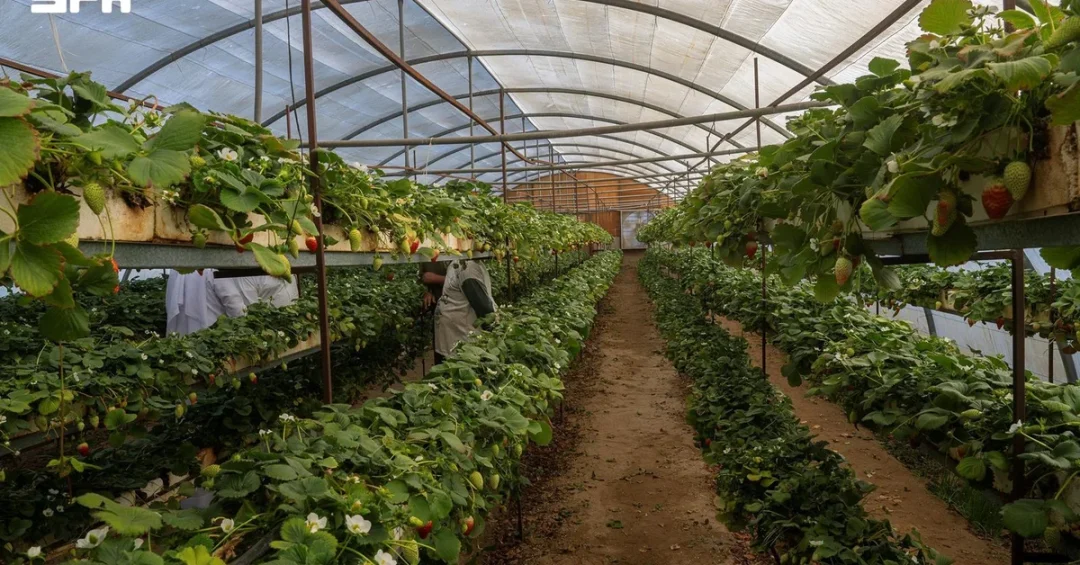
Najran Region has more than 4,400 greenhouses producing over 37,000 tons of tomatoes and cucumbers annually, according to the Saudi Press Agency, in a development that underscores how advanced protected agriculture is strengthening the Kingdom’s food security and agricultural sustainability. The region’s unique environmental and agricultural advantages have enabled local farmers to enhance production, support sustainable farming practices, and contribute meaningfully to the local economy, SPA reported.
The scale of the achievement matters far beyond Najran’s borders. Greenhouses play a vital role in modern agriculture by providing controlled growing environments that improve crop quality, increase productivity, conserve water, and ensure year-round production. For a Kingdom that imports a significant share of its fresh produce while managing among the world’s most limited natural water resources, the Najran model demonstrates how technology and regional specialization can combine to deliver reliable domestic supply. But how did a single southwestern region become such a significant contributor to Saudi Arabia’s agricultural resilience? The answer lies in geography, investment, and a deliberate national strategy that treats food security as a pillar of sovereignty.
Context and Background
Najran sits in the southwestern corner of Saudi Arabia, bordering Yemen, and occupies a distinctive position in the Kingdom’s agricultural landscape. Its elevation, relatively moderate climate, and access to groundwater have historically supported farming, but what distinguishes Najran today is the systematic adoption of protected cultivation. According to the Saudi Press Agency, the region’s more than 4,400 greenhouses now produce over 37,000 tons of tomatoes and cucumbers, alongside crops such as peppers, zucchini, eggplant, strawberries, figs, and leafy greens. This diversity reflects a broader shift from subsistence-oriented farming toward commercially viable, technology-driven horticulture.
The national context is equally important. Saudi Arabia’s Ministry of Environment, Water and Agriculture has pursued a sustained strategy to rationalize water use in agriculture, phasing out highly water-intensive crops such as alfalfa grown for fodder and redirecting resources toward high-value, water-efficient production. Protected agriculture is central to that strategy. Greenhouses allow growers to control temperature, humidity, and irrigation precisely, reducing evaporation losses that plague open-field farming in arid conditions. In Najran, these techniques have turned a challenging climate into a manageable variable rather than an insurmountable constraint.
Why does this matter now? Because food security has moved to the top of national priorities across the Gulf. The COVID-19 pandemic exposed the fragility of global supply chains, and subsequent geopolitical disruptions reinforced the lesson that reliance on imported staples carries strategic risk. Saudi Arabia’s Vision 2030 explicitly identifies food security as a national objective, and the National Agriculture Strategy sets targets for increasing domestic production of strategic crops while conserving water. Najran’s greenhouse sector is a working example of that policy in action — not a pilot project, but a mature industry producing tens of thousands of tons each year.
How Greenhouses Transform Production
The technical advantages of greenhouse cultivation explain much of Najran’s success. By enclosing crops in a controlled environment, farmers can regulate temperature, humidity, and airflow, protecting plants from the extreme heat, sudden temperature swings, and dust storms that characterize the region. Pests and diseases are easier to manage, reducing crop losses and, in many cases, the need for chemical interventions. The result is higher yields per unit of land and more consistent quality that meets the standards of modern retail markets.
Water efficiency is perhaps the single most consequential benefit. Saudi Arabia relies heavily on desalination and finite groundwater reserves, and agriculture consumes the largest share of the Kingdom’s water. Greenhouse systems paired with advanced irrigation — drip lines, soil-moisture sensors, and climate-control technologies — deliver water directly to plant roots and minimize evaporation. According to SPA, these technologies help improve water efficiency, reduce waste, and protect crops from weather conditions and pests. In practical terms, a greenhouse in Najran can produce far more food per cubic meter of water than conventional open-field farming, making it an essential tool for reconciling agricultural ambition with hydrological reality.
Year-round production is the third pillar. Open-field farming in Saudi Arabia is constrained by seasonal cycles, creating gaps in domestic supply that imports must fill. Greenhouses smooth out those cycles, allowing tomatoes, cucumbers, peppers, and leafy greens to reach markets consistently. For consumers, this means fresher produce and greater availability. For farmers, it means stable revenues and the ability to plan investment with confidence. For the national economy, it means fewer riyals flowing abroad for vegetables that can be grown efficiently at home. Is it any wonder that protected agriculture has become a centerpiece of Saudi agricultural policy?
Key Details and Crop Diversity
The crop mix emerging from Najran’s greenhouses illustrates the sector’s sophistication. Tomatoes and cucumbers dominate by volume, together accounting for the 37,000-plus tons reported by SPA, but the region also produces peppers, zucchini, eggplant, strawberries, figs, and leafy greens. This diversity serves multiple purposes. It reduces the risk of dependence on a single crop, spreads labor and investment requirements across the calendar, and caters to evolving consumer preferences in Saudi cities, where demand for fresh, high-quality produce continues to rise.
Strawberries and figs are particularly notable because they are high-value crops that reward careful cultivation. Their presence in Najran’s greenhouse output signals that local growers are not merely competing on volume but are moving up the value chain into premium segments. Leafy greens, meanwhile, are highly perishable and benefit enormously from local production close to markets, reducing the need for long-distance refrigerated transport. Each category of crop reinforces the same underlying story: Najran has developed an agricultural ecosystem capable of serving diverse market segments at scale.
Behind the numbers are farming families, agricultural engineers, and workers whose livelihoods depend on this sector. The Saudi Press Agency notes that the region’s agricultural advantages have enabled farmers to enhance production and contribute to the local economy. That contribution extends beyond farm gates to packaging, cold storage, transport, and retail. In a region where economic diversification is a national priority, agriculture anchored in technology offers a sustainable source of employment and enterprise, particularly for younger Saudis considering careers in agribusiness and agricultural technology.
International and Regional Impact
Najran’s greenhouse success carries implications that reach across the Gulf and beyond. Gulf Cooperation Council states share Saudi Arabia’s fundamental challenge: arid climates, limited arable land, and heavy reliance on food imports. The Najran model — protected agriculture combined with efficient irrigation and climate control — is directly transferable to similar environments in the United Arab Emirates, Oman, Kuwait, and Qatar. Regional knowledge exchange on greenhouse technology, water management, and crop selection could amplify the benefits, strengthening food security across the peninsula rather than in a single country.
At the international level, Saudi Arabia’s progress in domestic food production positions the Kingdom as a more stable and self-reliant partner in global agricultural markets. Countries that depend on imports are vulnerable to price shocks and supply disruptions; countries that produce more of their own food can weather those shocks with greater equanimity. By expanding protected agriculture, Saudi Arabia reduces its exposure to global volatility and, by extension, contributes to regional stability. The Kingdom’s experience also offers lessons for other arid nations in North Africa, the Middle East, and Central Asia facing comparable constraints.
Does this mean Saudi Arabia is turning away from trade? Not at all. The Kingdom remains a major importer of staples such as wheat, rice, and barley, and it continues to invest in agricultural assets abroad. The greenhouse sector complements rather than replaces trade, focusing on fresh produce categories where local cultivation offers clear advantages in freshness, water efficiency, and supply reliability. This balanced approach — trade where it makes sense, domestic production where it is feasible and strategic — reflects the pragmatism that defines Saudi agricultural policy.
Economic and Strategic Significance
The economic logic of Najran’s greenhouse sector is compelling. Agriculture contributes to rural incomes, supports small and medium-sized enterprises, and generates tax and export opportunities. While the 37,000 tons of tomatoes and cucumbers reported by SPA are primarily destined for domestic markets, the capability demonstrated in Najran could eventually support exports to neighboring countries, particularly during seasons when regional supply is tight. High-value crops such as strawberries and figs are especially promising export candidates, given strong demand in Gulf markets.
Strategically, every ton of produce grown domestically is a ton that does not need to be imported, transported across borders, or paid for in foreign currency. In a world of supply-chain uncertainty, that substitution has value that extends beyond simple economics. It enhances national resilience, reduces exposure to disruptions in shipping lanes and border crossings, and keeps food available and affordable for Saudi households. The Public Investment Fund and other national institutions have recognized this logic, directing capital toward agricultural technology, controlled-environment farming, and food-processing capacity as part of the broader diversification agenda.
There is also a sustainability dimension that investors and policymakers increasingly weigh. Greenhouses that use water efficiently and produce food close to consumers have a lower environmental footprint than long-distance supply chains. They reduce food waste, cut transport emissions, and allow precise application of inputs. For a Kingdom that has committed to ambitious environmental goals, including the Saudi Green Initiative, protected agriculture aligns economic and ecological objectives rather than forcing a choice between them. Is there a more practical expression of sustainable development than growing more food with less water?
Vision 2030 Alignment
Najran’s greenhouse sector sits squarely within the framework of Vision 2030, Saudi Arabia’s national transformation program. Food security is one of the vision’s explicit pillars, and the Kingdom has set targets to increase domestic production of strategic agricultural products while conserving natural resources. The Ministry of Environment, Water and Agriculture supports farmers through extension services, technical guidance, and incentives for adopting modern irrigation and protected cultivation. Najran’s 4,400-plus greenhouses are evidence that these policies are producing results on the ground.
The vision also emphasizes economic diversification and private-sector growth. Agriculture in Najran is largely a private enterprise, driven by farmers and agribusinesses responding to market signals and supported by government policy. That model — public policy enabling private initiative — is precisely what Vision 2030 envisions for the Saudi economy as a whole. By demonstrating that high-tech agriculture can thrive in the Kingdom’s most challenging environments, Najran offers a template for other regions and a source of national pride.
Looking ahead, the trajectory points toward further expansion. Continued investment in greenhouse technology, water-saving irrigation, renewable energy for climate control, and cold-chain logistics will allow Najran and similar regions to increase output, improve quality, and capture more value. As Saudi Arabia pursues its goal of becoming a more self-reliant and diversified economy, the greenhouses of Najran will remain a quiet but powerful example of how the Kingdom is turning its environmental challenges into agricultural strengths — feeding its people, conserving its water, and building a more secure future. What better illustration of Vision 2030 than a desert region blooming with year-round harvests?
20 Questions
Q1. How many greenhouses does Najran Region have?
A1. According to the Saudi Press Agency, Najran Region has more than 4,400 greenhouses, which together produce over 37,000 tons of tomatoes and cucumbers annually, along with other crops.
Q2. What crops are grown in Najran’s greenhouses?
A2. The greenhouses produce tomatoes and cucumbers as the main crops, in addition to peppers, zucchini, eggplant, strawberries, figs, and leafy greens, reflecting a diverse and commercially valuable agricultural output.
Q3. Why are greenhouses important for agriculture in Saudi Arabia?
A3. Greenhouses provide controlled growing environments that improve crop quality, increase productivity, conserve water, and ensure year-round production, which is essential in Saudi Arabia’s arid climate.
Q4. How do greenhouses help conserve water in Najran?
A4. Greenhouses use advanced irrigation and climate-control technologies that deliver water precisely to plants, reducing evaporation and waste, which improves water efficiency in a region with limited water resources.
Q5. What role does Najran’s agriculture play in food security?
A5. By producing over 37,000 tons of tomatoes and cucumbers locally, Najran reduces the Kingdom’s reliance on imports, strengthens domestic supply chains, and contributes to Saudi Arabia’s national food security objectives.
Q6. Which Saudi agency reported Najran’s greenhouse production figures?
A6. The Saudi Press Agency, the Kingdom’s official news agency, reported that Najran Region’s environmental and agricultural advantages have enabled farmers to enhance production and support sustainability.
Q7. How do greenhouses protect crops from weather and pests?
A7. By enclosing crops in a controlled environment, greenhouses shield plants from extreme heat, dust storms, and sudden temperature changes, while also reducing exposure to pests and diseases.
Q8. What technologies are used in Najran’s greenhouse farming?
A8. Farmers use advanced irrigation systems, climate-control technologies, and modern cultivation techniques that improve water efficiency, reduce waste, and support consistent, high-quality crop production throughout the year.
Q9. How does Najran’s greenhouse sector support the local economy?
A9. The sector creates employment in farming, packaging, transport, and retail, supports farming families and agribusinesses, and contributes to economic diversification in the Najran region and beyond.
Q10. Does greenhouse farming align with Vision 2030?
A10. Yes. Vision 2030 identifies food security as a national priority, and protected agriculture helps increase domestic production while conserving water, aligning with the Kingdom’s sustainability and diversification goals.
Q11. What advantages does Najran have for agriculture?
A11. Najran benefits from a distinctive climate, elevation, and access to water resources that, combined with modern greenhouse technology, allow farmers to produce a wide range of crops efficiently.
Q12. How does year-round production benefit consumers?
A12. Year-round production ensures a steady supply of fresh vegetables and fruits, reduces seasonal price fluctuations, and provides consumers with consistent access to high-quality domestic produce.
Q13. Can other Saudi regions replicate Najran’s greenhouse model?
A13. Yes. The technologies and techniques used in Najran are transferable to other regions with similar conditions, and the Ministry of Environment, Water and Agriculture supports their adoption nationwide.
Q14. What is the significance of strawberry and fig production in Najran?
A14. Strawberries and figs are high-value crops that demonstrate Najran’s ability to produce premium products, adding value to the local agricultural sector and potentially supporting future export opportunities.
Q15. How does protected agriculture reduce food imports?
A15. By growing more food domestically, Saudi Arabia reduces the volume of vegetables and fruits it must import, lowering exposure to global supply-chain disruptions and saving foreign currency.
Q16. What government support exists for greenhouse farmers?
A16. The Ministry of Environment, Water and Agriculture provides extension services, technical guidance, and incentives that encourage farmers to adopt modern irrigation and protected cultivation methods.
Q17. How does greenhouse farming support environmental sustainability?
A17. Greenhouse farming uses water efficiently, reduces food waste and transport emissions by producing close to markets, and supports the environmental goals of the Saudi Green Initiative.
Q18. What economic opportunities could arise from Najran’s greenhouse sector?
A18. Expansion could create jobs in agribusiness, agricultural technology, cold storage, and logistics, while high-value crops such as strawberries and figs could eventually be exported to Gulf markets.
Q19. How does Najran’s success reflect Saudi Arabia’s agricultural strategy?
A19. It demonstrates the success of the National Agriculture Strategy, which promotes water-efficient, high-value production to strengthen food security while conserving the Kingdom’s limited natural resources.
Q20. What does the future hold for Najran’s greenhouse industry?
A20. Continued investment in technology, irrigation, renewable energy, and logistics is expected to expand output and quality, reinforcing Najran’s role in Saudi Arabia’s food security and Vision 2030 objectives.
Reader Feedback
We value your thoughts. Please share your feedback on this article.
Your feedback helps us improve our coverage.
Related articles
 Qassim Hosts World’s Largest Dates Carnival with 11M Palm Trees
 Makkah Halal Forum 2025: Empowering Youth in the Global Halal Industry
 ICIEC-Supported Senegal Highway Wins 2 Prestigious IFN Awards
 Saudi-Jordanian Land Transport Committee Enhances Cross-Border Cooperation
 Saudi Aerospace Connect Forum Concludes with Strategic Deals
 Saudi Finance Minister Leads Delegation at G20 FMCBG Meeting