


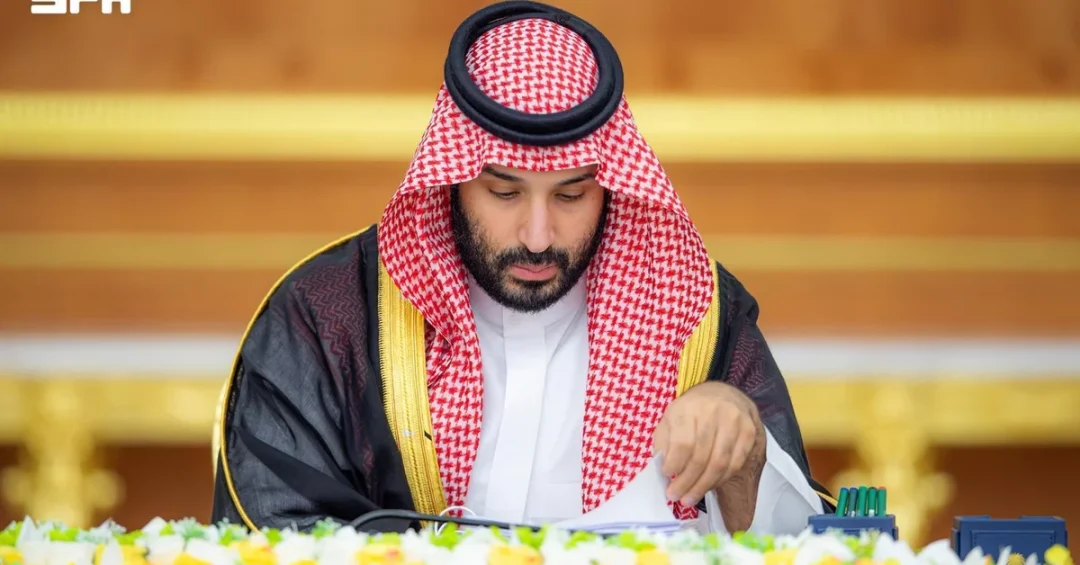
His Royal Highness Prince Mohammed bin Salman bin Abdulaziz Al Saud, Crown Prince and Prime Minister, chaired the Cabinet session held on Tuesday in Jeddah, where ministers reviewed a wide-ranging agenda covering regional diplomacy, maritime security, humanitarian relief, and a series of international cooperation agreements. The session, announced by the Saudi Press Agency, underscored the Kingdom’s continued emphasis on dialogue, economic resilience, and expanded global partnerships under the leadership of the Crown Prince. The Cabinet deliberations touched on recent high-level communications with world leaders, the growing international backing for a Saudi-led maritime defense framework, and the latest independent assessment of the Kingdom’s economic trajectory.
In a statement to the Saudi Press Agency following the session, Minister of Education and Acting Minister of Media Yousef Al-Benyan summarized the Cabinet’s positions and decisions. The meeting reflected the dual priorities that have defined Saudi governance in recent years: proactive diplomacy aimed at reducing regional tensions, and domestic reform designed to diversify the economy and improve quality of life. The Cabinet’s agenda also included approvals of cooperation agreements with Ecuador, Kazakhstan, Spain, Somalia, South Korea, and Türkiye, alongside a decision enabling the Ministry of Interior to join the International Hospital Federation. The breadth of the session illustrated how the Kingdom’s foreign and domestic policies increasingly reinforce one another.
Context and Background
What does it mean for a single Cabinet session to combine calls with the President of the United States, the announcement of new investment treaties, and a review of pilgrimage services? For Saudi Arabia, it reflects a governing model in which diplomacy, economic policy, and public service delivery are treated as interconnected parts of a single national strategy. The Jeddah session followed a period of intensive regional engagement, during which HRH the Crown Prince held telephone calls with President of the United States Donald J. Trump, King Hamad bin Isa Al Khalifa of the Kingdom of Bahrain, President of the Syrian Arab Republic Ahmed al-Sharaa, President of the Republic of Türkiye Recep Tayyip Erdoğan, and Prime Minister of Spain Pedro Sánchez.
These conversations, as reported by the Saudi Press Agency, addressed regional developments and their multifaceted repercussions, with Saudi Arabia emphasizing the urgent need to prioritize dialogue to de-escalate tensions and achieve a truce that paves the way toward diplomatic solutions preserving regional security and stability. The discussions with Bahrain, Syria, Türkiye, and Spain also explored avenues to expand bilateral cooperation across various fields and covered topics of mutual interest. The Cabinet was briefed on these exchanges, giving ministers a shared picture of the diplomatic landscape and allowing them to align decisions on treaties, transport links, and space cooperation with the broader direction set by the Kingdom’s leadership.
Key Details of the Cabinet Session
The Cabinet praised the growing international support for the Saudi-led Multinational Maritime Defense Alliance, describing it as a product of Saudi Arabia’s leading role in consolidating regional and global stability. According to the statement delivered by Minister Al-Benyan, the alliance builds a multilateral framework to protect shipping lanes, trade routes, and energy supplies from escalating threats in the Red Sea, the Bab al-Mandab Strait, and the Gulf of Aden. These waterways carry a substantial share of global commerce and energy exports, making their security a matter of concern well beyond the region. The Cabinet’s endorsement signals that the Kingdom intends to institutionalize maritime cooperation rather than rely on ad hoc responses to individual incidents.
On Gaza, the Cabinet expressed hope that the historic agreement on the decommissioning of weapons in the Gaza Strip will serve as the catalyst for the implementation of the Comprehensive Peace Plan, guaranteeing the Palestinian people’s right to self-determination and the establishment of an independent state. The Cabinet commended the pivotal diplomatic efforts of Egypt, Qatar, Türkiye, the United States, and the Board of Peace in achieving this milestone. The statement placed Saudi Arabia firmly in support of a negotiated pathway, consistent with its longstanding position that a durable solution requires both security arrangements and political progress.
The session also reaffirmed the Kingdom’s commitment to supporting and expanding its humanitarian and relief efforts through hosting the fifth Riyadh International Humanitarian Forum next April. The Cabinet noted that the forum has become a leading global platform for advancing international humanitarian cooperation, building sustainable strategic partnerships, and facilitating the delivery of aid to people in need and those affected worldwide. In addition, ministers reviewed reports and indicators related to national programs and strategies, commending the achievements of the Pilgrim Experience Program. The Cabinet highlighted the Kingdom’s longstanding dedication to providing the highest-quality services to pilgrims and Umrah performers and to mobilizing every effort, capability, and resource to ensure their comfort from arrival until departure.
Economic Confidence and the IMF Assessment
How significant is it when the International Monetary Fund publicly affirms a country’s economic resilience amid global uncertainty? The Cabinet welcomed the IMF’s 2026 Article IV Consultation report, which affirmed the resilience of the Kingdom’s economy and its ability to adapt to challenges. The report cited strong economic fundamentals, diversified infrastructure, sound long-term fiscal planning, financial and monetary stability, and the structural reforms implemented under Saudi Vision 2030. It further noted that these reforms have driven a full decade of economic transformation by strengthening institutional frameworks, enhancing performance and economic diversification, improving healthcare and education indicators, and enabling the achievement of a number of Vision 2030 objectives ahead of schedule.
For international investors and partners, the IMF assessment provides an independent validation of the reform agenda that has reshaped Saudi Arabia’s business environment. The Cabinet’s discussion of the report signals that the government views external scrutiny as a useful benchmark and intends to maintain the pace of structural change. The endorsement also reinforces the Kingdom’s position as a stabilizing economic force in the region, at a time when many economies face pressure from fluctuating energy markets, supply chain adjustments, and geopolitical risk. The combination of fiscal discipline and diversification is presented not as a short-term response but as a durable framework for growth.
International and Regional Impact
What do the Cabinet’s decisions reveal about Saudi Arabia’s approach to partnerships across different regions of the world? The approved agreements span Latin America, Central Asia, Europe, Africa, and East Asia, reflecting a deliberately broad diplomatic and economic footprint. The Cabinet approved a general cooperation agreement between the Government of the Kingdom of Saudi Arabia and the Government of the Republic of Ecuador, and an agreement with the Government of the Republic of Kazakhstan on the reciprocal promotion and protection of investments. It also approved a memorandum of understanding for cooperation in civil aviation between the General Authority of Civil Aviation of Saudi Arabia and the Ministry of Transport and Sustainable Mobility of the Kingdom of Spain, and a cooperation agreement between the Transport General Authority of Saudi Arabia and the Ministry of Ports and Marine Transport of the Federal Republic of Somalia in the field of maritime transport.
Further decisions authorized the Minister of Education and Chairman of the Board of Directors of the Technical and Vocational Training Corporation, or a deputy, to discuss and sign with the Korean side a draft memorandum of understanding in the field of technical and vocational training between the corporation and the KDI School of Public Policy and Management at the Korea Development Institute. The Cabinet also approved a memorandum of understanding between the Saudi Space Agency and the Turkish Space Agency for cooperation in the peaceful use of outer space, and approved the accession of the Ministry of Interior, represented by the General Directorate of Medical Services, to the International Hospital Federation. Each agreement targets a specific capability, from aviation and maritime logistics to skills development, space science, and healthcare standards.
Economic and Strategic Significance
Why does maritime security matter to a global audience far from the Red Sea? The Bab al-Mandab Strait and the Gulf of Aden form part of the shortest sea route between Asia and Europe, and disruptions there raise insurance costs, delay cargo, and affect energy prices worldwide. The Cabinet’s praise for the Multinational Maritime Defense Alliance therefore speaks to a broader economic interest: protecting the free flow of trade and energy that underpins global markets. By building a multilateral framework, Saudi Arabia is seeking to share responsibility among like-minded partners rather than carry the burden alone, a model that could inform other areas of international security cooperation.
The investment protection agreement with Kazakhstan and the civil aviation memorandum with Spain illustrate a complementary strategy. Investment treaties reduce legal uncertainty for companies operating across borders, while aviation cooperation expands routes, connectivity, and tourism flows. The maritime transport agreement with Somalia addresses port and shipping capacity in a strategically located corridor. Taken together, these instruments are designed to lower friction for trade and travel, attract foreign capital, and position Saudi Arabia as a hub linking Asia, Africa, and Europe. The economic logic is straightforward: deeper connectivity supports diversification, and diversification reduces reliance on any single revenue source.
Vision 2030 Alignment
How does a Cabinet session in Jeddah connect to the everyday ambitions of Saudi citizens and the Kingdom’s global partners? The IMF’s recognition that several Vision 2030 objectives have been achieved ahead of schedule points to tangible progress in healthcare, education, institutional reform, and economic diversification. The Cabinet’s review of the Pilgrim Experience Program reflects the same agenda from a service perspective, linking the sacred duty of hosting pilgrims to world-class infrastructure, digital services, and hospitality standards. The agreements on technical and vocational training with South Korea and on space cooperation with Türkiye extend the Vision 2030 emphasis on human capital and innovation into new international partnerships.
As the Kingdom continues to expand its diplomatic outreach, humanitarian platforms, and maritime security cooperation, the Jeddah session offers a snapshot of a leadership style that treats regional stability and domestic reform as mutually reinforcing. The decisions issued by the Cabinet are not isolated announcements; they form part of a sustained effort to build a diversified economy, protect vital trade routes, and strengthen the Kingdom’s role as a bridge between continents. For international readers, the session is a reminder that Saudi Arabia’s Vision 2030 is not only a domestic economic plan but also a framework for global engagement, pursued through dialogue, partnership, and long-term planning.
20 Questions
Q1. Who chaired the Cabinet session held in Jeddah?
A1. His Royal Highness Prince Mohammed bin Salman bin Abdulaziz Al Saud, Crown Prince and Prime Minister, chaired the session. The meeting was reported by the Saudi Press Agency and covered diplomacy, economic affairs, and international agreements.
Q2. When and where did the Cabinet session take place?
A2. The Cabinet session was held on Tuesday in Jeddah, Saudi Arabia. It was announced by the Saudi Press Agency, which published the outcomes and the list of decisions approved during the meeting.
Q3. Which world leaders did the Crown Prince brief the Cabinet about?
A3. He briefed the Cabinet on calls with U.S. President Donald J. Trump, Bahrain’s King Hamad bin Isa Al Khalifa, Syria’s President Ahmed al-Sharaa, Türkiye’s President Recep Tayyip Erdoğan, and Spain’s Prime Minister Pedro Sánchez.
Q4. What did the Crown Prince discuss with President Donald J. Trump?
A4. They addressed regional developments and their multifaceted repercussions. Saudi Arabia emphasized the urgent need to prioritize dialogue to de-escalate tensions and achieve a truce, paving the way toward diplomatic solutions that preserve regional security and stability.
Q5. What was the purpose of the calls with Bahrain, Syria, Türkiye, and Spain?
A5. The discussions explored avenues to expand bilateral cooperation across various fields and addressed topics of mutual interest. They formed part of the Kingdom’s ongoing diplomatic engagement with partners in the region and beyond.
Q6. What did the Cabinet say about the Multinational Maritime Defense Alliance?
A6. The Cabinet praised growing international support for the Saudi-led alliance. It stems from Saudi Arabia’s leading role in consolidating regional and global stability by building a multilateral framework to protect shipping lanes, trade routes, and energy supplies.
Q7. Which waterways does the maritime alliance aim to protect?
A7. The framework targets escalating threats in the Red Sea, the Bab al-Mandab Strait, and the Gulf of Aden. These routes are vital for global commerce and energy transport between Asia, Africa, and Europe.
Q8. What did the Cabinet say about the agreement on Gaza?
A8. The Cabinet expressed hope that the historic agreement on the decommissioning of weapons in the Gaza Strip will serve as a catalyst for the Comprehensive Peace Plan, guaranteeing the Palestinian people’s right to self-determination and the establishment of an independent state.
Q9. Which parties did the Cabinet commend for diplomatic efforts on Gaza?
A9. The Cabinet commended the pivotal diplomatic efforts of Egypt, Qatar, Türkiye, the United States, and the Board of Peace in achieving this milestone, recognizing their contributions to the diplomatic breakthrough.
Q10. What humanitarian initiative did the Cabinet highlight?
A10. The Cabinet reaffirmed the Kingdom’s commitment to hosting the fifth Riyadh International Humanitarian Forum next April. The forum is a leading global platform for humanitarian cooperation, sustainable partnerships, and aid delivery worldwide.
Q11. What did the Cabinet note about the Pilgrim Experience Program?
A11. It commended the program’s achievements and continuous development. The Cabinet highlighted Saudi Arabia’s dedication to providing the highest-quality services to pilgrims and Umrah performers and mobilizing resources to ensure their comfort from arrival until departure.
Q12. What did the IMF’s 2026 Article IV report conclude about Saudi Arabia?
A12. The report affirmed the resilience of the Kingdom’s economy and its ability to adapt to challenges, citing strong fundamentals, diversified infrastructure, sound fiscal planning, financial and monetary stability, and structural reforms under Saudi Vision 2030.
Q13. What did the IMF report say about Vision 2030 objectives?
A13. It noted that reforms have driven a full decade of economic transformation and enabled the achievement of a number of Vision 2030 objectives ahead of schedule, while improving healthcare and education indicators and strengthening institutional frameworks.
Q14. Which country signed a general cooperation agreement with Saudi Arabia?
A14. The Cabinet approved a general cooperation agreement between the Government of the Kingdom of Saudi Arabia and the Government of the Republic of Ecuador, expanding the Kingdom’s partnership network in Latin America.
Q15. What agreement was approved with Kazakhstan?
A15. The Cabinet approved an agreement between the Government of the Kingdom of Saudi Arabia and the Government of the Republic of Kazakhstan on the reciprocal promotion and protection of investments, supporting cross-border investment flows.
Q16. What civil aviation cooperation was approved with Spain?
A16. A memorandum of understanding between the General Authority of Civil Aviation of Saudi Arabia and the Ministry of Transport and Sustainable Mobility of the Kingdom of Spain was approved, covering cooperation in civil aviation.
Q17. What maritime transport agreement was approved with Somalia?
A17. The Cabinet approved a cooperation agreement between the Transport General Authority of Saudi Arabia and the Ministry of Ports and Marine Transport of the Federal Republic of Somalia in the field of maritime transport, strengthening links along a key corridor.
Q18. What training cooperation was authorized with South Korea?
A18. The Minister of Education and Chairman of the Board of the Technical and Vocational Training Corporation was authorized to discuss and sign a draft memorandum with the KDI School of Public Policy and Management at the Korea Development Institute.
Q19. What space cooperation agreement was approved with Türkiye?
A19. The Cabinet approved a memorandum of understanding between the Saudi Space Agency and the Turkish Space Agency for cooperation in the peaceful use of outer space, advancing scientific and technological collaboration.
Q20. What health-related decision did the Cabinet approve?
A20. The Cabinet approved the accession of the Ministry of Interior, represented by the General Directorate of Medical Services, to the International Hospital Federation, supporting higher standards in medical services and international exchange.
Reader Feedback
We value your thoughts. Please share your feedback on this article.
Your feedback helps us improve our coverage.
Related articles
 Riyadh Deputy Governor Attends Kuwait National Day Reception
 UN Condemns Israel Plan to Remain in West Bank, Prevent Return of Displaced Palestinians
 African Parliament Condemns Plans to Displace Palestinians
 Syrian National Dialogue Conference Praised by GCC Chief
 Riyadh Hosts Seminar on Airport Security Privatization
 Saudi Arabia, Bulgaria Strengthen Security Cooperation in Sofia Meeting