


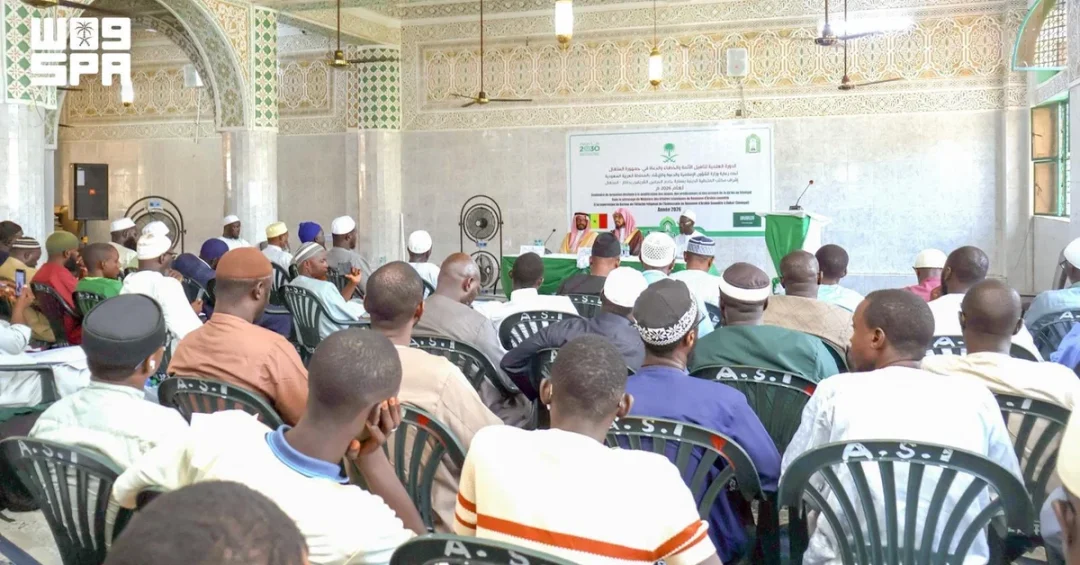
The Ministry of Islamic Affairs, Dawah and Guidance has launched its seventh training course for imams and preachers in Dakar, Senegal, as part of its global efforts to promote moderate Islamic teachings. The five-day program, organized through the Religious Attaché at the Saudi Embassy in Senegal, brings together 120 religious leaders from Dakar and surrounding regions to enhance their understanding of Islamic jurisprudence and contemporary applications.
Context and Background
The training course, held at a Quran and Sunnah outreach center, is part of Saudi Arabia’s longstanding commitment to fostering religious moderation and scholarly exchange. The Ministry of Islamic Affairs, Dawah and Guidance regularly organizes such programs internationally to equip imams and preachers with the knowledge to address modern challenges while upholding the principles of balanced Islamic teachings.
Key Details
The course curriculum focuses on Islamic rulings, their application to contemporary issues, and the promotion of moderation in religious edicts. Participants will engage in intensive study sessions led by qualified scholars, reinforcing Saudi Arabia’s role as a global leader in Islamic education. This initiative aligns with the Kingdom’s efforts to counter extremism by empowering religious leaders with authentic knowledge.
Implications and Impact
The program strengthens cultural and religious ties between Saudi Arabia and Senegal while contributing to global Islamic discourse. By training imams from various regions of Senegal, the initiative ensures the dissemination of moderate teachings at the grassroots level. Such programs enhance international cooperation in religious education and support peaceful coexistence worldwide.
Vision 2030 Alignment
This initiative directly supports Saudi Arabia’s Vision 2030 goal of promoting moderate Islam globally. Through knowledge-sharing programs like this, the Kingdom reinforces its position as a beacon of balanced Islamic teachings while fostering international partnerships. The Ministry’s efforts contribute to Vision 2030’s objective of building a tolerant society and positive global image for Saudi Arabia.
20 Questions
Q1. Who organized the training course in Dakar?
A1. The course was organized by Saudi Arabia’s Ministry of Islamic Affairs, Dawah and Guidance through its Religious Attaché at the Saudi Embassy in Senegal.
Q2. How many participants are attending the program?
A2. The program has 120 participants comprising imams and preachers from Dakar and other Senegalese regions.
Q3. How long does the training course last?
A3. The intensive training program runs for five days at a Quran and Sunnah outreach center in Dakar.
Q4. What is the main focus of the curriculum?
A4. The curriculum focuses on Islamic rulings, their contemporary applications, and promoting moderation in religious edicts.
Q5. Why is Saudi Arabia conducting such programs abroad?
A5. The Kingdom conducts these programs to share authentic Islamic knowledge and promote moderate teachings worldwide as part of its religious diplomacy.
Q6. How many editions of this course have been held?
A6. This is the seventh edition of the training course organized by Saudi Arabia in Dakar, Senegal.
Q7. What type of institution is hosting the program?
A7. The program is being held at a center dedicated to Quran and Sunnah outreach activities in Dakar.
Q8. Which Saudi government body oversees these initiatives?
A8. The Ministry of Islamic Affairs, Dawah and Guidance oversees all such international religious education initiatives.
Q9. How does this program benefit Senegal?
A9. It enhances religious education for Senegalese imams and promotes moderate Islamic teachings that foster social harmony.
Q10. What makes this program unique?
A10. The program combines traditional Islamic scholarship with contemporary application, delivered by qualified scholars following authentic teachings.
Q11. How does this initiative counter extremism?
A11. By equipping religious leaders with balanced knowledge, it prevents misinterpretations of Islam that could lead to extremist ideologies.
Q12. What values does the program promote?
A12. The program emphasizes moderation, tolerance, and the middle path in Islamic teachings and practices.
Q13. How does this align with Saudi Arabia’s international role?
A13. It demonstrates Saudi Arabia’s commitment to global religious education and its leadership in promoting moderate Islam.
Q14. What topics are covered in the course?
A14. Topics include Islamic jurisprudence, contemporary fatwa issuance, and methodologies for promoting religious moderation.
Q15. How are participants selected for the program?
A15. Participants are selected based on their roles as community religious leaders and their potential to disseminate moderate teachings.
Q16. What languages are used in the instruction?
A16. Instruction is conducted in Arabic with local language interpretation to ensure comprehensive understanding.
Q17. How does this strengthen Saudi-Senegalese relations?
A17. The program enhances cultural and religious cooperation between the two nations through knowledge exchange.
Q18. What follow-up activities accompany the course?
A18. Graduates receive ongoing scholarly support and materials to continue their educational mission in their communities.
Q19. How does this support Vision 2030?
A19. It directly supports Vision 2030’s goal of promoting moderate Islam and enhancing Saudi Arabia’s global partnerships.
Q20. Are similar programs held elsewhere?
A20. Yes, the Ministry organizes similar programs worldwide as part of its global Islamic education initiatives.
Reader Feedback
We value your thoughts. Please share your feedback on this article.
Your feedback helps us improve our coverage.