


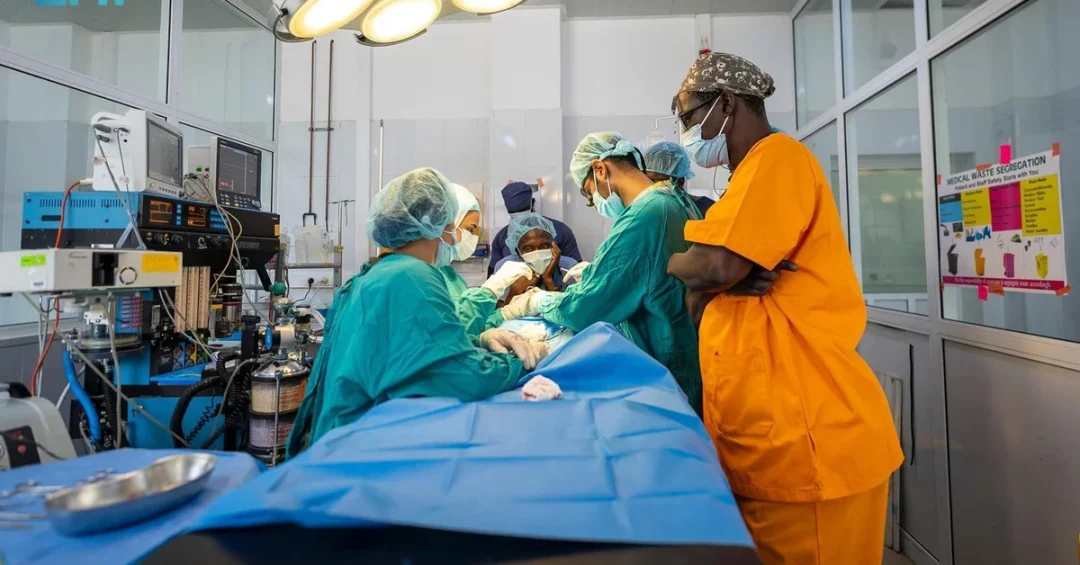
The King Salman Humanitarian Aid and Relief Center (KSrelief) successfully implemented two volunteer medical projects in obstetrics and gynecology and pediatric general surgery in Banjul, The Gambia, from February 15 to 22, 2025, with the participation of 19 medical volunteers specializing in various fields. The volunteer medical team performed 47 obstetrics and gynecology surgeries, 37 vascular surgeries, 12 pediatric urology surgeries, and 11 pediatric surgeries, all of which were completed successfully, according to the Saudi Press Agency (SPA).
The initiative reflects Saudi Arabia’s ongoing commitment to global humanitarian service, delivered through its official humanitarian arm, KSrelief, which operates under the directives of the Kingdom’s leadership. President Adama Barrow of The Gambia met with the Saudi volunteer delegation in Banjul, expressing his gratitude for the efforts provided by the Kingdom through KSrelief to serve the people of his country. The First Lady of The Gambia also visited the volunteer medical campaign headquarters, praising the efforts to serve patient groups. The project is part of Saudi Arabia’s broader volunteer medical programs that assist vulnerable and affected populations worldwide. How does such targeted medical outreach strengthen the bonds between nations and improve lives in tangible ways?
Context and Background
The King Salman Humanitarian Aid and Relief Center (KSrelief) was established in 2015 by royal decree as Saudi Arabia’s dedicated humanitarian organization, tasked with providing relief and aid to countries and communities in need around the world. Since its inception, KSrelief has implemented thousands of projects across more than 80 countries, focusing on health, food security, education, water, and shelter. Its volunteer medical programs are a cornerstone of its operations, mobilizing Saudi medical professionals to deliver specialized care in regions where access to advanced treatment is limited.
The Gambia, a West African nation with a population of approximately 2.5 million, faces significant challenges in its healthcare system, including a shortage of specialized surgeons and medical equipment. Maternal and child health indicators remain a concern, with limited capacity for complex obstetric and pediatric procedures. In this context, KSrelief’s volunteer medical projects in Banjul from February 15 to 22, 2025, represent a critical intervention that directly addresses these gaps. The participation of 19 volunteers across various specialties underscores the scale and expertise that Saudi Arabia brings to such missions.
Why does Saudi Arabia consistently extend its medical expertise to nations far beyond its borders? The answer lies in the Kingdom’s humanitarian principles, which are rooted in Islamic values and a commitment to global solidarity. These efforts are not isolated acts of charity but part of a systematic, well-coordinated strategy to alleviate suffering and build capacity in partner countries. The Gambia mission is a clear example of this approach, combining direct surgical care with the transfer of knowledge and skills to local healthcare workers.
Key Details of the Medical Mission
During the eight-day campaign, the Saudi volunteer medical team performed a total of 107 surgeries, each successfully completed. The breakdown includes 47 obstetrics and gynecology surgeries, 37 vascular surgeries, 12 pediatric urology surgeries, and 11 pediatric surgeries. These procedures addressed a range of conditions, from high-risk pregnancies and gynecological disorders to congenital anomalies and vascular diseases. The team comprised specialists in obstetrics, gynecology, pediatric surgery, urology, vascular surgery, anesthesiology, and nursing, ensuring comprehensive care for patients of all ages.
President Adama Barrow’s meeting with the Saudi delegation was a highlight of the mission, reflecting the high-level appreciation for the Kingdom’s efforts. The President conveyed his thanks for the humanitarian work carried out by KSrelief, emphasizing its positive impact on the health and well-being of Gambian citizens. The First Lady’s visit to the campaign headquarters further demonstrated the national recognition of the project’s value. Such official engagements also serve to strengthen diplomatic ties between Saudi Arabia and The Gambia, fostering cooperation beyond the medical field.
What does it take to organize a medical mission of this magnitude in a foreign country? It requires meticulous planning, coordination with local health authorities, logistical support, and the dedication of skilled volunteers. KSrelief’s ability to execute such projects efficiently highlights its operational excellence and its network of partners. The success of the Banjul mission also depended on the cooperation of The Gambia’s Ministry of Health, which facilitated the selection of patients and provided facilities for the surgeries. This collaborative model ensures that aid reaches those who need it most and that local systems are strengthened in the process.
International and Regional Impact
Saudi Arabia’s humanitarian efforts through KSrelief have a far-reaching impact that extends beyond immediate medical relief. By deploying volunteer teams to countries like The Gambia, the Kingdom positions itself as a responsible global actor committed to the well-being of humanity. This aligns with the principles of the United Nations’ Sustainable Development Goals, particularly Goal 3 on good health and well-being. The mission also enhances Saudi Arabia’s soft power, building goodwill and fostering stronger bilateral relations with African nations.
In the broader regional context, the Banjul project is part of Saudi Arabia’s increased engagement with Africa, a continent that is a priority for the Kingdom’s foreign policy and economic diversification strategy. Through initiatives like Vision 2030, Saudi Arabia seeks to deepen partnerships across Africa, and humanitarian aid is a key pillar of this outreach. The positive reception from The Gambia’s leadership and people illustrates how medical diplomacy can create lasting bonds and open doors for further cooperation in trade, investment, and cultural exchange.
How do these missions affect the perception of Saudi Arabia on the world stage? They demonstrate the Kingdom’s proactive role in addressing global challenges, countering narratives that overlook its extensive humanitarian contributions. By focusing on tangible outcomes—surgeries performed, lives saved—KSrelief’s work speaks for itself. The Gambia mission is one of many such projects, each contributing to a legacy of compassion and service that defines Saudi Arabia’s international identity.
Economic and Strategic Significance
While the primary goal of KSrelief’s medical projects is humanitarian, they also carry strategic significance for Saudi Arabia. They reinforce the Kingdom’s leadership in the Muslim world and beyond, showcasing its capacity to provide aid without political conditions. This approach resonates with recipient countries and strengthens Saudi Arabia’s standing in international forums. Additionally, the projects support the objectives of Vision 2030 by promoting the Kingdom’s image as a modern, compassionate nation that contributes to global stability and development.
From an economic perspective, the volunteer missions are part of Saudi Arabia’s broader investment in human capital and international partnerships. They create opportunities for Saudi medical professionals to gain experience in diverse settings, enhancing their skills and fostering a culture of volunteerism. This aligns with Vision 2030’s emphasis on social responsibility and citizen engagement. Furthermore, the goodwill generated by such missions can facilitate economic ties, as recipient countries may look favorably upon Saudi businesses and investments.
What makes these missions economically sustainable? They are funded through Saudi Arabia’s official aid budget, which is managed efficiently by KSrelief to maximize impact. The use of volunteer professionals reduces costs while ensuring high-quality care. The model is replicable and scalable, allowing the Kingdom to extend its reach to more countries in need. As Saudi Arabia continues to diversify its economy and expand its global footprint, humanitarian diplomacy will remain a valuable tool for building relationships and promoting its values.
Vision 2030 Alignment
The KSrelief medical mission in The Gambia is a concrete manifestation of Saudi Arabia’s Vision 2030, which seeks to transform the Kingdom into a global leader in humanitarian and development work. Vision 2030 emphasizes the importance of international cooperation and the Kingdom’s role in supporting sustainable development worldwide. Through KSrelief, Saudi Arabia is not only providing immediate relief but also contributing to long-term health improvements in partner countries, in line with the vision’s goals of enhancing global well-being and fostering mutual respect.
Moreover, the mission reflects the values of Saudi society, which prioritizes charity and helping those in need. By showcasing these values on the international stage, the Kingdom reinforces its cultural and moral leadership. As Saudi Arabia continues to implement Vision 2030, its humanitarian arm will play an increasingly vital role in projecting the Kingdom’s soft power and building a legacy of compassion. The success of the Banjul project is a testament to what can be achieved when nations work together with a shared commitment to humanity. What greater legacy could a nation build than one of healing and hope?
20 Questions
Q1. What is KSrelief and what does it do?
A1. KSrelief, the King Salman Humanitarian Aid and Relief Center, is Saudi Arabia’s official humanitarian organization established in 2015. It provides aid and relief worldwide, focusing on health, food security, education, and shelter through projects in over 80 countries.
Q2. What medical projects did KSrelief implement in The Gambia?
A2. KSrelief implemented two volunteer medical projects in obstetrics and gynecology and pediatric general surgery in Banjul, The Gambia, from February 15 to 22, 2025, with 19 volunteers participating in various medical specialties.
Q3. How many surgeries were performed during the mission?
A3. The volunteer medical team performed a total of 107 surgeries: 47 obstetrics and gynecology surgeries, 37 vascular surgeries, 12 pediatric urology surgeries, and 11 pediatric surgeries, all successfully completed.
Q4. Who met with the Saudi volunteer delegation in The Gambia?
A4. President Adama Barrow of The Gambia met with the Saudi volunteer delegation, expressing his thanks for the efforts provided by Saudi Arabia through KSrelief to serve the people of his country.
Q5. What did the First Lady of The Gambia do during the mission?
A5. The First Lady of The Gambia visited the volunteer medical campaign headquarters, praising the efforts to serve patient groups and acknowledging the positive impact of the mission.
Q6. How many volunteers participated in the KSrelief mission?
A6. Nineteen volunteers participated in the mission, representing various medical specialties including obstetrics, gynecology, pediatric surgery, urology, vascular surgery, anesthesiology, and nursing.
Q7. What types of surgeries were performed?
A7. The surgeries included obstetrics and gynecology procedures, vascular surgeries, pediatric urology surgeries, and general pediatric surgeries, addressing a range of conditions from high-risk pregnancies to congenital anomalies.
Q8. When did the medical mission take place?
A8. The mission took place from February 15 to 22, 2025, spanning eight days of intensive surgical and medical care in Banjul, The Gambia.
Q9. Where exactly in The Gambia did the mission occur?
A9. The mission was carried out in Banjul, the capital city of The Gambia, at medical facilities coordinated with local health authorities.
Q10. What is the significance of this mission for Saudi Arabia?
A10. The mission demonstrates Saudi Arabia’s commitment to global humanitarian service, strengthens diplomatic ties with African nations, and aligns with Vision 2030’s goals of international cooperation and soft power projection.
Q11. How does KSrelief select countries for its medical missions?
A11. KSrelief identifies countries based on humanitarian needs, requests from local authorities, and strategic priorities, ensuring aid reaches vulnerable populations with limited access to specialized healthcare.
Q12. What is the role of Saudi volunteers in these missions?
A12. Saudi volunteers provide specialized medical care, perform surgeries, train local healthcare workers, and share expertise, contributing to capacity building and immediate patient relief.
Q13. How does this mission align with Vision 2030?
A13. It aligns with Vision 2030 by showcasing Saudi Arabia’s global humanitarian role, promoting international partnerships, and enhancing the Kingdom’s image as a compassionate and modern nation.
Q14. What impact did the mission have on The Gambia’s healthcare system?
A14. The mission provided immediate surgical care to over 100 patients, reduced waiting lists, and offered training opportunities for local medical staff, strengthening the overall healthcare capacity.
Q15. Are there plans for future KSrelief missions to The Gambia?
A15. KSrelief continues to assess needs and may conduct future missions based on requests and available resources, as part of its ongoing commitment to supporting The Gambia and other nations.
Q16. How does KSrelief fund its operations?
A16. KSrelief is funded by the Saudi government through its official aid budget, with contributions also from private donors and partnerships, ensuring sustainable and efficient delivery of aid.
Q17. What other countries has KSrelief assisted with medical missions?
A17. KSrelief has implemented medical missions in numerous countries, including Yemen, Syria, Sudan, Somalia, Bangladesh, and many others across Asia, Africa, and the Middle East.
Q18. How do these missions benefit Saudi Arabia’s international standing?
A18. They enhance Saudi Arabia’s reputation as a responsible global actor, build goodwill, and strengthen bilateral relations, showcasing the Kingdom’s humanitarian values and leadership.
Q19. What was the reaction of the Gambian people to the mission?
A19. The Gambian people and leadership expressed deep appreciation, with President Barrow and the First Lady publicly thanking Saudi Arabia for the life-changing medical care provided to their citizens.
Q20. How can other nations partner with KSrelief for similar projects?
A20. Nations can partner with KSrelief by submitting official requests through diplomatic channels, coordinating with Saudi embassies, and aligning with KSrelief’s humanitarian criteria and operational guidelines.
Reader Feedback
We value your thoughts. Please share your feedback on this article.
Your feedback helps us improve our coverage.
Related articles
 Saudi Arabia Marks Health Martyr Day
 KFSHRC Research Director Makes Forbes 50 Over 50 Global 2025
 SFDA Warns Childhood Obesity Risk, Urges Home Prevention
 KFSHRC Adopts Advanced Tech for Precision Brain Tumor Surgery
 Abha Cardiac Center Joins ELSO Global Network
 SFDA: Cumin Health Benefits Do Not Replace Medical Advice