


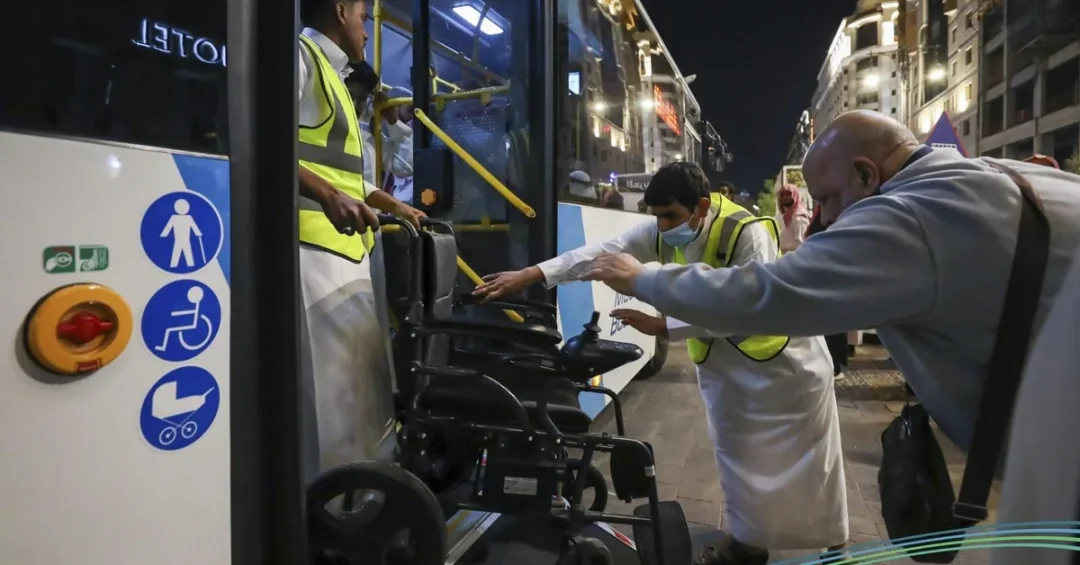
The Madinah Bus project, operated by the Al Madinah Region Development Authority, has launched three free shuttle bus substations in the Al-Diathah, Al-Uyun, and Al-Gharraa neighborhoods to facilitate access to the seven main stations leading to the Prophet’s Mosque during the holy month of Ramadan. The announcement, carried by the Saudi Press Agency, marks a further expansion of a transport network designed to make one of the world’s most visited religious destinations easier to reach for residents and pilgrims alike.
The new substations feed directly into the seven principal stations that serve the Prophet’s Mosque, creating a layered, park-and-ride style system that reduces traffic pressure on the central area of Madinah. The service is free of charge, and the Authority has directed users to view the shuttle service stops and starting points through the official route map published at https://madinahbus.mda.gov.sa/img/mod/pub-bus.pdf. The timing is significant: Ramadan brings a surge of worshippers, and the expansion reflects a deliberate effort to keep movement through the city smooth, dignified, and safe during the busiest period of the Islamic calendar.
Context and Background
How did Madinah become a global model for high-volume, low-friction urban mobility? The answer lies in a sustained, multi-year investment in public transport that has quietly reshaped how visitors experience the city. The Madinah Bus project is a flagship initiative of the Al Madinah Region Development Authority, the government body responsible for the integrated development of the region. Its mandate extends beyond roads and vehicles to encompass quality of life, heritage protection, and the visitor experience, all of which converge in the Prophet’s Mosque area during Ramadan.
The project has grown in phases. Earlier stages introduced modern buses, designated stations, and digital navigation tools. The Ramadan expansion adds three substations in Al-Diathah, Al-Uyun, and Al-Gharraa, extending the network’s reach into residential neighborhoods that sit some distance from the central zone. For residents of these districts, the substations remove the need to drive into congested areas or arrange private transport. For the city as a whole, they distribute passenger load across multiple entry points rather than concentrating it on a single corridor.
The context also includes Saudi Arabia’s broader push to modernize pilgrimage logistics. Under Vision 2030, the Kingdom has set out to raise the number of Umrah pilgrims to 30 million annually and to make the journey smoother for every guest. Madinah, as the second holiest city in Islam, sits at the heart of that ambition. A bus network that is free, frequent, and easy to understand is not a minor convenience; it is infrastructure that supports the spiritual purpose of the visit.
Key Details of the Ramadan Shuttle Expansion
What exactly changes for a worshipper arriving in Madinah this Ramadan? The most immediate difference is access. The three new substations in Al-Diathah, Al-Uyun, and Al-Gharraa function as collection points where passengers board free shuttles that connect to the seven main stations serving the Prophet’s Mosque. This creates a feeder system: neighborhoods feed the substations, substations feed the main stations, and the main stations place worshippers within walking distance of the mosque.
The service is deliberately simple. There are no fares, no complex ticketing, and no need for advance booking. The Authority has published a route map showing shuttle stops and starting points, available at https://madinahbus.mda.gov.sa/img/mod/pub-bus.pdf, so that users can plan their journeys in advance. Clear wayfinding matters during Ramadan, when many visitors are unfamiliar with the city and when time is organized around prayer schedules rather than conventional commuter rhythms.
The seven main stations form the backbone of the system. Each is positioned to serve a different approach to the central area, allowing the network to absorb high volumes without overwhelming any single point. The substations extend that logic outward, capturing passengers closer to where they live or stay. The result is a grid rather than a single line, and a grid is far more resilient when demand spikes.
International and Regional Impact
Why should an observer outside Saudi Arabia pay attention to a city bus service? Because Madinah hosts one of the largest recurring gatherings of international travelers on earth. During Ramadan, the city welcomes worshippers from across the Middle East, Asia, Africa, Europe, and the Americas. The quality of their transport experience shapes their impression of the country as a whole, and those impressions travel home with them.
For neighboring Gulf states and for Muslim-majority countries whose citizens travel to Madinah, the expansion signals reliability. Families planning a Ramadan visit can factor in a free, mapped shuttle network when arranging accommodation and daily schedules. Airlines, tour operators, and travel agencies that package Umrah and Ramadan programs can also incorporate the substations into their guidance, reducing confusion for first-time visitors and easing pressure on private taxi and coach operators.
Regionally, the project reinforces Madinah’s position as a benchmark for pilgrimage-era urban planning. Other cities that host large seasonal religious events face similar challenges: sudden demand, limited road space, and the need to protect the sanctity and calm of a sacred site. A free shuttle network with published routes offers a practical template, and Saudi Arabia’s willingness to share the model through official channels adds to its soft-power standing.
Economic and Strategic Significance
What does a free bus service contribute to an economy? More than it may appear. Efficient movement lowers the cost of hosting visitors. When pilgrims can reach the Prophet’s Mosque without hiring a car or paying for parking, more of their spending flows to hotels, restaurants, shops, and local services. Businesses around the main stations and in the connected neighborhoods benefit from steadier foot traffic across the day and night.
The strategic dimension is equally important. Saudi Arabia is investing heavily in transport as an enabler of its tourism and pilgrimage targets. The Madinah Bus project complements larger national programs, including high-speed rail connections and airport expansion, by solving the last-mile problem: how to move people from a station or a neighborhood to the door of their destination. Last-mile solutions are often the difference between a transport system that looks good on a map and one that people actually use.
There is also an operational dividend. Data from a mapped, scheduled network helps planners understand demand patterns, which in turn informs future routes, fleet sizes, and station locations. Each Ramadan provides a concentrated test of the system under peak conditions. The lessons learned feed back into the design of the network for the rest of the year, making the city’s transport planning more evidence-based over time.
Vision 2030 Alignment
How does a shuttle bus in Madinah connect to a national transformation program? Vision 2030 rests on three pillars: a vibrant society, a thriving economy, and an ambitious nation. A free, well-organized bus network touches all three. It supports a vibrant society by making worship and community life more accessible. It supports a thriving economy by improving the visitor experience and spreading economic activity. It supports an ambitious nation by demonstrating that public institutions can deliver reliable services at scale.
The expansion also aligns with specific Vision 2030 goals around pilgrimage. The Kingdom aims to host 30 million Umrah pilgrims annually and has invested in digitization, capacity, and infrastructure to make that possible. Madinah’s shuttle network is part of that architecture. It is a practical expression of the principle that hosting guests of the Prophet’s Mosque is both an honor and a responsibility, and that the state will keep improving the journey for every visitor.
Looking ahead, the Madinah Bus project is expected to continue growing, with more neighborhoods connected and more routes refined as demand patterns become clearer. For now, the message to residents and pilgrims is straightforward: three new substations are open, the shuttles are free, and the route map is available at https://madinahbus.mda.gov.sa/img/mod/pub-bus.pdf. In a month defined by reflection and community, that is a service designed to let people focus on what matters most.
20 Questions
Q1. What is the Madinah Bus project?
A1. The Madinah Bus project is a public transport initiative operated by the Al Madinah Region Development Authority. It provides bus services, including free shuttles, to help residents and visitors reach the Prophet’s Mosque and other destinations in Madinah efficiently.
Q2. What was announced for Ramadan 2025?
A2. The Authority launched three free shuttle bus substations in the Al-Diathah, Al-Uyun, and Al-Gharraa neighborhoods. These substations connect passengers to the seven main stations that lead to the Prophet’s Mosque during Ramadan.
Q3. Are the Ramadan shuttle buses free to use?
A3. Yes. The shuttle service is free of charge for all users. There are no fares or ticketing requirements, making it accessible to residents, pilgrims, and visitors throughout the holy month of Ramadan.
Q4. How many main stations serve the Prophet’s Mosque?
A4. There are seven main stations in the network that lead to the Prophet’s Mosque. The new substations feed into these seven stations, creating a layered system that distributes passenger traffic across multiple entry points.
Q5. Where can users find the shuttle route map?
A5. The Authority has published the shuttle service stops and starting points at https://madinahbus.mda.gov.sa/img/mod/pub-bus.pdf. Users are encouraged to review the map in advance to plan their journeys during Ramadan.
Q6. Which neighborhoods received new substations?
A6. The three new substations are located in Al-Diathah, Al-Uyun, and Al-Gharraa. These neighborhoods are now connected to the main station network, reducing the need for residents to drive into central Madinah.
Q7. Who operates the Madinah Bus project?
A7. The project is operated by the Al Madinah Region Development Authority, a government body responsible for the integrated development of the Madinah region, including transport, quality of life, and visitor services.
Q8. Why is the expansion important during Ramadan?
A8. Ramadan brings a large increase in worshippers to Madinah. The expansion helps manage high demand by providing free, organized transport options that reduce congestion and make it easier for people to reach the Prophet’s Mosque.
Q9. How does the shuttle system work?
A9. Passengers board free shuttles at the substations in Al-Diathah, Al-Uyun, and Al-Gharraa. These shuttles connect to the seven main stations, which are positioned near the Prophet’s Mosque, allowing worshippers to complete their journey on foot.
Q10. Does the service require advance booking?
A10. No advance booking is required. The service is designed for simplicity and ease of use, allowing passengers to board at designated stops without prior reservations or tickets, which is especially helpful for first-time visitors.
Q11. How does this project support Vision 2030?
A11. The project supports Vision 2030 by improving pilgrimage logistics, enhancing the visitor experience, and contributing to the goal of hosting 30 million Umrah pilgrims annually. It reflects the Kingdom’s commitment to modern, reliable public services.
Q12. What are the seven main stations?
A12. The seven main stations form the core of the Madinah Bus network. Each serves a different approach to the central area around the Prophet’s Mosque, allowing the system to handle high passenger volumes without concentrating traffic at one point.
Q13. Can international pilgrims use the shuttle service?
A13. Yes. The service is available to all users, including international pilgrims visiting Madinah during Ramadan. The published route map helps visitors who may be unfamiliar with the city navigate the network confidently.
Q14. What are the benefits for local residents?
A14. Residents in Al-Diathah, Al-Uyun, and Al-Gharraa gain convenient access to the Prophet’s Mosque without needing private transport. The substations reduce traffic in their neighborhoods and provide a reliable, free alternative for daily and nightly worship.
Q15. How does the shuttle reduce traffic congestion?
A15. By collecting passengers in outlying neighborhoods and delivering them to main stations, the shuttle system reduces the number of private vehicles entering the central area. This distributes traffic across multiple routes and eases pressure on roads near the mosque.
Q16. Is the route map available in multiple languages?
A16. The official route map is published by the Al Madinah Region Development Authority at the provided link. Users should consult the map directly for the most current information on stops, starting points, and service details.
Q17. What happens after Ramadan?
A17. The Madinah Bus project operates throughout the year, with routes and services adjusted based on demand. The Ramadan expansion provides valuable data that helps planners refine the network for future peak periods and regular service.
Q18. How does this fit into Saudi Arabia’s tourism goals?
A18. Efficient transport is essential to hosting more visitors. The shuttle expansion supports Saudi Arabia’s tourism and pilgrimage targets by making Madinah easier to navigate, improving visitor satisfaction, and encouraging longer stays in the city.
Q19. What technology supports the bus network?
A19. The network uses modern buses, designated stations, and digital tools such as published route maps. These elements help passengers plan journeys and allow the Authority to monitor and improve service based on usage patterns.
Q20. Where can I get official updates about the service?
A20. Official updates are released through the Al Madinah Region Development Authority and the Saudi Press Agency. The route map at https://madinahbus.mda.gov.sa/img/mod/pub-bus.pdf provides current details on shuttle stops and starting points.
Reader Feedback
We value your thoughts. Please share your feedback on this article.
Your feedback helps us improve our coverage.
Related articles
 Saudi Arabia Strengthens Expatriate Workers’ Rights Under Vision 2030
 Saudi Passports Directorate Ensures Smooth Umrah Entry in Ramadan
 Civil Defense Boosts Two Holy Mosques Ramadan Safety
 NCA Concludes Cybersecurity Program for 500+ Judges
 KSrelief Distributes 808 Food Baskets in Pakistan’s Khyber Pakhtunkhwa
 Saudi Ministry Promotes Local Products for Sustainability