


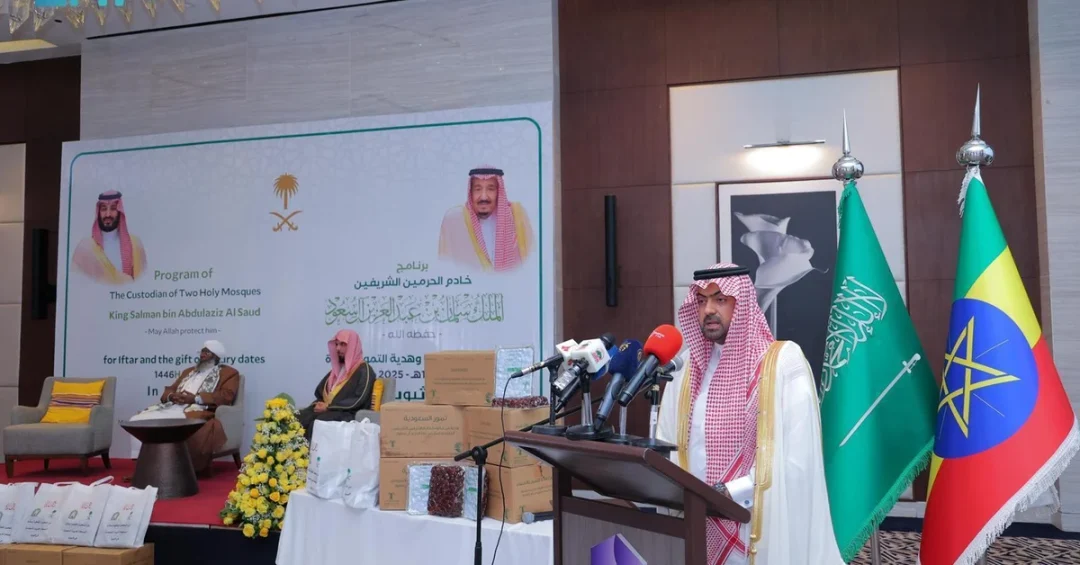
The Ministry of Islamic Affairs, Dawah and Guidance’s Religious Attaché in the Republic of Ethiopia has held an official ceremony in Addis Ababa to launch the Custodian of the Two Holy Mosques’ iftar and date distribution programs, extending Saudi Arabia’s Ramadan humanitarian outreach to Muslim communities across the Horn of Africa. The event, reported by the Saudi Press Agency, reflects the Kingdom’s enduring mission to serve Islam and Muslims worldwide, acting on the directives of its leadership to meet the needs of fasting believers during the holy month of Ramadan.
The ceremony drew a distinguished gathering of Saudi and Ethiopian officials, underscoring the depth of the bilateral relationship between Riyadh and Addis Ababa. Among those in attendance were Saudi Ambassador to Ethiopia Dr. Fahad Alhumaydani, President of the Ethiopian Islamic Affairs Supreme Council Sheikh Dr. Haji Ibrahim Tufa, and several ambassadors and diplomats accredited to Ethiopia. The participation of such a broad diplomatic contingent highlights the international recognition of Saudi Arabia’s humanitarian role during Ramadan. The programs form part of a wider annual initiative that delivers iftar meals and dates to Muslim communities in dozens of countries, reinforcing the Kingdom’s commitment to Islamic solidarity and its longstanding tradition of generosity during the fasting month.
Context and Background
Why does a Ramadan iftar program in Ethiopia resonate far beyond the Horn of Africa? For decades, the Custodian of the Two Holy Mosques’ iftar and date distribution programs have been a signature element of Saudi Arabia’s global humanitarian engagement, carried out each year through the Ministry of Islamic Affairs, Dawah and Guidance and its network of religious attachés. These programs are designed to provide fasting Muslims with meals at sunset and to distribute dates, a staple of the Prophet’s tradition, to communities that may otherwise struggle to obtain them during Ramadan.
The initiative in Ethiopia is implemented under the supervision of the Religious Attaché in Addis Ababa, a diplomatic-religious office that coordinates the Kingdom’s religious, cultural, and humanitarian activities in the country. Ethiopia holds particular significance in this context: it is home to one of the oldest Muslim communities in Africa, with a history of Islamic presence dating back to the earliest years of the faith. The country’s Muslim population is among the largest on the continent, and the Ethiopian Islamic Affairs Supreme Council serves as a key institutional partner for Saudi religious outreach.
The timing of the ceremony, held at the start of Ramadan, reflects careful coordination between Saudi authorities and their Ethiopian counterparts. The launch event serves not only to inaugurate the distribution but also to publicly affirm the strong ties between the Kingdom and Ethiopia, a relationship that spans religious, economic, and diplomatic dimensions. Such ceremonies are typically attended by senior officials from both sides, signaling the importance Riyadh attaches to its partnerships in Africa.
Key Details of the Launch Ceremony
What exactly did the ceremony in Addis Ababa accomplish? According to the Saudi Press Agency, the event marked the formal launch of the iftar and date distribution programs associated with the Custodian of the Two Holy Mosques. The ceremony was held in the Ethiopian capital and brought together Saudi diplomatic representatives, Ethiopian religious leaders, and members of the international diplomatic corps accredited to Ethiopia.
Sheikh Dr. Haji Ibrahim Tufa, President of the Ethiopian Islamic Affairs Supreme Council, expressed his gratitude to the Saudi leadership for its service to the Islamic world and thanked the Ministry of Islamic Affairs, Dawah and Guidance for programs that strengthen ties with Muslims globally. He noted in particular that Ethiopia enjoys a close relationship with Saudi Arabia, a bond that these Ramadan initiatives help to deepen. His remarks underscored the appreciation of Ethiopian Muslim institutions for the Kingdom’s consistent support.
The presence of Saudi Ambassador Dr. Fahad Alhumaydani and other ambassadors and diplomats at the ceremony added a diplomatic dimension to the religious occasion. It demonstrated that the Ramadan programs are viewed not merely as charitable gestures but as instruments of soft diplomacy and international goodwill. The distribution itself is expected to reach thousands of beneficiaries across Ethiopia during the holy month, providing iftar meals and dates to families, mosques, and community centers.
International and Regional Impact
How does a single Ramadan program in Ethiopia fit into Saudi Arabia’s broader global role? The Kingdom conducts similar iftar and date distributions in numerous countries across Africa, Asia, Europe, and the Americas each year, making the initiative one of the largest coordinated Ramadan humanitarian efforts in the world. The program’s scale reflects Saudi Arabia’s self-defined mission to serve Islam and Muslims, a mandate rooted in its custodianship of the Two Holy Mosques in Makkah and Madinah.
In the African context, the Ethiopia launch carries particular weight. The Horn of Africa is a region of strategic importance, and Saudi Arabia has steadily expanded its engagement there through investment, trade, and development cooperation. Ramadan programs complement these efforts by building people-to-people ties and reinforcing the Kingdom’s reputation as a reliable partner for Muslim communities. For Ethiopia, the initiative provides tangible benefits during a month of heightened religious observance, when demand for food assistance often rises.
The ceremony also sends a message of unity within the broader Islamic world. By working through the Ethiopian Islamic Affairs Supreme Council and involving the diplomatic community, Saudi Arabia positions its Ramadan outreach as a collaborative, inclusive effort that transcends national boundaries. This approach aligns with the Kingdom’s stated goal of promoting moderation, coexistence, and solidarity among Muslims worldwide.
Economic and Strategic Significance
What strategic value does this initiative hold for Saudi Arabia and its partners? Beyond its immediate humanitarian purpose, the iftar and date distribution program supports the Kingdom’s broader foreign policy objectives. It reinforces Saudi Arabia’s leadership role in the Islamic world, strengthens diplomatic relationships, and creates goodwill that can facilitate cooperation in other areas such as trade, investment, and cultural exchange.
Ethiopia is a key economic partner for Saudi Arabia in Africa, with growing bilateral trade and investment links. Saudi companies have shown interest in Ethiopian agriculture, energy, and infrastructure, and the two countries maintain regular diplomatic consultations on regional issues. The Ramadan programs, while primarily religious and humanitarian, contribute to the positive atmosphere that underpins these economic relationships. They also highlight the role of dates as an agricultural product in which Saudi Arabia is a leading global producer, adding an economic dimension to the distribution effort.
From a strategic perspective, the initiative demonstrates Saudi Arabia’s ability to project influence through soft power. Unlike military or purely commercial engagement, religious and humanitarian outreach builds deep, durable connections with communities. The Kingdom’s consistent investment in such programs over many years has earned it a reputation as a dependable friend of Muslim communities in Africa and beyond, a reputation that serves its long-term interests.
Vision 2030 Alignment
How does Ramadan outreach connect to Saudi Arabia’s Vision 2030 transformation? Vision 2030, the Kingdom’s comprehensive reform strategy, emphasizes Saudi Arabia’s role as a global leader and its commitment to humanitarian and Islamic values. The iftar and date distribution programs embody these principles by extending the Kingdom’s generosity beyond its borders and showcasing its capacity to organize and deliver large-scale humanitarian initiatives efficiently.
At the same time, Vision 2030 seeks to strengthen Saudi Arabia’s international partnerships and enhance its soft power. Programs like the Ethiopia launch contribute directly to these goals by building goodwill, fostering intercultural understanding, and reinforcing the Kingdom’s image as a responsible global actor. As Saudi Arabia continues to modernize its economy and society, its humanitarian and religious outreach remains a constant, demonstrating that the country’s traditional values and its forward-looking ambitions are complementary rather than contradictory.
In the years ahead, the Ministry of Islamic Affairs, Dawah and Guidance is expected to expand and refine these programs, leveraging digital tools and partnerships to reach even more beneficiaries. The Ethiopia ceremony thus represents not only a moment of Ramadan generosity but also a step in Saudi Arabia’s ongoing journey to serve Islam and Muslims while advancing its Vision 2030 objectives on the world stage.
20 Questions
Q1. What event did the Ministry of Islamic Affairs, Dawah and Guidance hold in Ethiopia?
A1. The ministry’s Religious Attaché in Ethiopia held an official ceremony in Addis Ababa to launch the Custodian of the Two Holy Mosques’ iftar and date distribution programs during Ramadan.
Q2. Where was the ceremony held?
A2. The ceremony took place in Addis Ababa, the capital of the Republic of Ethiopia, and was attended by Saudi and Ethiopian officials as well as diplomats accredited to Ethiopia.
Q3. Who attended the ceremony from the Saudi side?
A3. Saudi Ambassador to Ethiopia Dr. Fahad Alhumaydani attended, along with several ambassadors and diplomats accredited to Ethiopia, representing the Kingdom’s diplomatic presence in the country.
Q4. Who represented the Ethiopian Islamic Affairs Supreme Council?
A4. Sheikh Dr. Haji Ibrahim Tufa, President of the Ethiopian Islamic Affairs Supreme Council, attended the ceremony and delivered remarks thanking the Saudi leadership for its service to Islam.
Q5. What did Sheikh Dr. Haji Ibrahim Tufa say about Saudi Arabia?
A5. He thanked the Saudi leadership for its service to the Islamic world and praised the ministry’s programs that strengthen ties with Muslims globally, noting Ethiopia’s close relationship with Saudi Arabia.
Q6. What is the purpose of the iftar and date distribution programs?
A6. The programs provide iftar meals and dates to fasting Muslims during Ramadan, following the leadership’s directives to support Muslim needs during the holy month.
Q7. Which Saudi ministry oversees these programs?
A7. The Ministry of Islamic Affairs, Dawah and Guidance oversees the programs through its Religious Attaché offices in various countries, including Ethiopia.
Q8. Why is Ethiopia significant for Saudi Arabia’s Islamic outreach?
A8. Ethiopia is home to one of Africa’s oldest and largest Muslim communities, making it a key partner for Saudi Arabia’s religious, cultural, and humanitarian engagement on the continent.
Q9. How does the initiative align with Saudi Arabia’s mission?
A9. It aligns with the Kingdom’s mission to serve Islam and Muslims, reflecting the leadership’s commitment to supporting Muslim communities worldwide during Ramadan.
Q10. When was the ceremony held?
A10. The ceremony was held on March 2, 2025, in Addis Ababa, coinciding with the start of Ramadan and the launch of the distribution programs.
Q11. What is the role of the Religious Attaché in Ethiopia?
A11. The Religious Attaché coordinates the Kingdom’s religious, cultural, and humanitarian activities in Ethiopia, including the implementation of Ramadan iftar and date distribution programs.
Q12. How does this program benefit Ethiopians?
A12. It provides tangible food assistance during Ramadan, supplying iftar meals and dates to thousands of beneficiaries, including families, mosques, and community centers across Ethiopia.
Q13. What is the broader scope of the Custodian of the Two Holy Mosques’ programs?
A13. These programs operate in numerous countries across Africa, Asia, Europe, and the Americas, making them one of the world’s largest coordinated Ramadan humanitarian efforts.
Q14. How does the initiative strengthen Saudi-Ethiopian relations?
A14. By working with Ethiopian religious institutions and involving diplomats, the program builds goodwill and reinforces the strong bilateral ties between Saudi Arabia and Ethiopia.
Q15. What diplomatic value does the ceremony have?
A15. The presence of ambassadors and diplomats highlights international recognition of Saudi Arabia’s humanitarian role and demonstrates the Kingdom’s soft power in fostering global goodwill.
Q16. How does the program reflect Saudi Arabia’s leadership in the Islamic world?
A16. It showcases the Kingdom’s commitment to serving Muslims globally, reinforcing its position as a leader in Islamic humanitarian initiatives and a reliable partner for Muslim communities.
Q17. What economic dimensions does the date distribution have?
A17. Dates are a major Saudi agricultural product, and their distribution promotes the Kingdom’s agricultural sector while providing a culturally significant food item to beneficiaries.
Q18. How does the initiative align with Vision 2030?
A18. It supports Vision 2030’s goals of enhancing Saudi Arabia’s global role, strengthening international partnerships, and demonstrating the Kingdom’s humanitarian values on the world stage.
Q19. Will the programs continue beyond Ramadan?
A19. The iftar and date distributions are specifically tied to Ramadan, but the Ministry of Islamic Affairs, Dawah and Guidance conducts year-round religious and humanitarian activities in partner countries.
Q20. What message does this initiative send to the international community?
A20. It conveys Saudi Arabia’s commitment to Islamic solidarity, humanitarian generosity, and constructive engagement with diverse nations, reinforcing its reputation as a responsible global actor.
Reader Feedback
We value your thoughts. Please share your feedback on this article.
Your feedback helps us improve our coverage.
Related articles
 Madinah Bus Expands Free Ramadan Shuttle Service
 Saudi Arabia Strengthens Expatriate Workers’ Rights Under Vision 2030
 Saudi Passports Directorate Ensures Smooth Umrah Entry in Ramadan
 Civil Defense Boosts Two Holy Mosques Ramadan Safety
 NCA Concludes Cybersecurity Program for 500+ Judges
 KSrelief Distributes 808 Food Baskets in Pakistan’s Khyber Pakhtunkhwa