


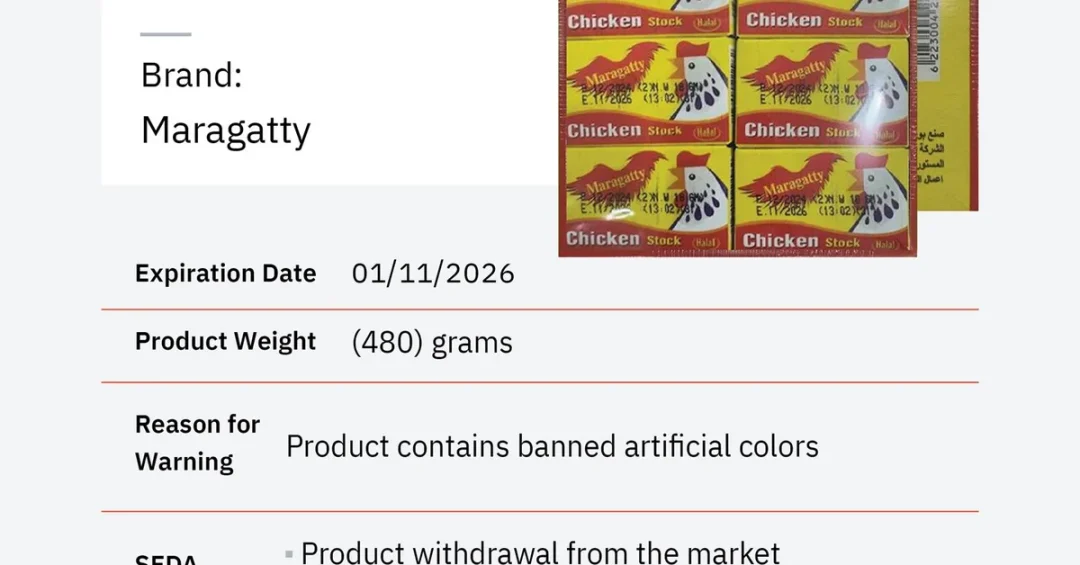
The Saudi Food and Drug Authority (SFDA) has issued a public warning against Maragatty chicken stock cubes imported from Egypt, after laboratory testing confirmed the presence of banned artificial colors that pose potential health risks to consumers. The affected product is sold in 480-gram containers carrying an expiration date of November 1, 2026. In a statement released through official channels and carried by the Saudi Press Agency (SPA), the authority urged consumers to stop using the product immediately and to dispose of any remaining stock.
The alert reflects the central role the SFDA plays in safeguarding food safety across the Kingdom, a mandate that has grown in importance as Saudi Arabia expands its food import network and strengthens its position as a regional logistics and retail hub. Have you ever stopped to consider how closely the food products on your kitchen shelf are monitored before they reach your home? For consumers in Saudi Arabia, the answer lies in a rigorous, science-driven inspection system that operates around the clock. The authority confirmed that it has already taken the necessary regulatory steps to withdraw the product from markets and is pursuing legal action against the importing company, underscoring that food safety enforcement in the Kingdom is both swift and consequential.
Context and Background
The SFDA is the Kingdom’s dedicated regulatory body for food, drugs, medical devices, and cosmetics, operating under a mandate to protect public health through inspection, testing, and market surveillance. Its food safety divisions routinely sample imported and domestically produced goods at ports, warehouses, and retail outlets, screening for contaminants, unauthorized additives, and labeling violations. When a product fails to meet Saudi standards, the authority moves through a defined enforcement sequence: public notification, market withdrawal, and legal referral. How does a single laboratory result translate into a nationwide recall so quickly? The answer lies in a centralized reporting system that links port inspections, regional laboratories, and field inspectors in real time.
The Maragatty case follows this established pattern. According to the SFDA, testing detected three banned artificial colors — Dimethyl Yellow, Sudan I, and Sudan IV — in the 480-gram chicken stock cube format. These substances are industrial dyes that are not approved for use in food anywhere in the Kingdom and are classified as unsafe for human consumption. Their presence in a widely distributed consumer product is precisely the kind of risk the authority’s surveillance program is designed to catch before it can cause harm. The swift public warning is intended to give consumers the information they need to protect themselves while regulators complete the withdrawal process.
The timing of the alert also reflects broader changes in Saudi Arabia’s food landscape. As the Kingdom’s population grows and its tourism and hospitality sectors expand under Vision 2030, demand for imported food products has risen sharply. That growth has been matched by investment in regulatory capacity, including upgraded laboratory facilities and expanded inspection teams at major entry points such as Jeddah Islamic Port and King Abdulaziz International Airport. The result is a system that can identify and isolate problematic products with increasing speed and precision.
Key Details of the SFDA Warning
The SFDA’s warning is specific and actionable. The affected product is Maragatty chicken stock cubes from Egypt, packaged in 480-gram containers, with an expiration date of November 1, 2026. Consumers who have purchased this product are advised to avoid using it and to dispose of it immediately. The authority has not asked consumers to return the product to retailers, but rather to remove it from use as a precautionary measure. Retailers and distributors, meanwhile, are expected to cooperate fully with the withdrawal order.
Why does the authority name the specific banned substances rather than simply describing the product as unsafe? Transparency is a core principle of the SFDA’s public communications. By identifying Dimethyl Yellow, Sudan I, and Sudan IV, the authority gives health professionals, importers, and consumers a clear technical basis for understanding the risk. Sudan dyes, in particular, are well known to international food safety bodies as unauthorized colorants associated with potential long-term health hazards when ingested. Their detection in a food product is treated as a serious violation, not a minor labeling issue.
The enforcement consequences are equally clear. The SFDA stressed that violations of the Food Law and its executive regulations can result in fines of up to SAR10 million, imprisonment for up to 10 years, or both. These penalties apply to the importing company and any other parties found responsible for placing the non-compliant product on the Saudi market. The authority also reminded consumers that they can report food safety concerns through the unified call center at 19999, a channel that feeds directly into the regulator’s inspection and response system. Every report, officials note, contributes to a more complete picture of the market and helps direct resources where they are most needed.
International and Regional Impact
The warning has implications that extend beyond Saudi borders. Egypt is a significant supplier of processed food products to the Gulf region, and the Maragatty case highlights the importance of robust import controls across the entire Gulf Cooperation Council (GCC) area. Saudi Arabia’s decision to publicize the finding and name the product reflects a broader regional trend toward greater transparency in food safety enforcement, a trend that benefits consumers in every GCC state. Trading partners are expected to take note, as the Kingdom’s standards are widely regarded as a benchmark in the region.
For importers and exporters alike, the message is unambiguous: products entering Saudi Arabia must meet the Kingdom’s food safety requirements, and failures carry significant legal and commercial consequences. Does this mean the Kingdom is closing its doors to imported food? Quite the opposite. Saudi Arabia remains one of the world’s largest food import markets, and its regulatory system is designed to facilitate safe trade, not restrict it. The SFDA’s actions are aimed at protecting consumers while maintaining the confidence that underpins a thriving import sector. A single enforcement action against a non-compliant product strengthens, rather than weakens, the credibility of the entire supply chain.
Economic and Strategic Significance
Food safety enforcement is not only a public health matter; it is also an economic and strategic priority. A reliable regulatory system reduces the risk of foodborne illness, protects workforce productivity, and supports the Kingdom’s ambitions to become a global destination for tourism, business, and major events. When international visitors and investors see that Saudi Arabia enforces rigorous food standards, it reinforces confidence in the broader business environment. The SFDA’s rapid response in the Maragatty case is therefore part of a larger effort to build institutional trust.
The authority’s work also aligns with the National Food Security Strategy, which seeks to diversify supply sources while maintaining strict quality controls. By holding importers accountable and removing unsafe products from shelves, the SFDA helps ensure that the Kingdom’s food supply remains both diverse and dependable. The penalties outlined in the Food Law — up to SAR10 million in fines and up to 10 years in prison — are designed to deter violations before they occur, creating a market where compliance is the only viable business model. For legitimate importers, this level playing field is a competitive advantage, not a burden.
Vision 2030 Alignment
The SFDA’s decisive action reflects the institutional strength that Vision 2030 seeks to deepen across every sector of Saudi society. A modern, effective regulatory state is essential to the Kingdom’s transformation, and food safety oversight is one of the most visible ways that transformation touches daily life. Under the leadership of the Kingdom’s leadership, agencies like the SFDA have been empowered with the tools, talent, and technology needed to protect citizens and residents while supporting economic growth. The authority’s commitment to transparency — from public warnings to named substances and clear penalties — demonstrates the accountability that Vision 2030 places at the center of governance.
As Saudi Arabia continues to expand its role as a global hub for trade, tourism, and investment, the reliability of its food safety system will remain a foundation of public trust. The Maragatty warning is a reminder that the Kingdom’s regulatory bodies act quickly and firmly when consumer safety is at stake, and that they do so within a legal framework designed to be fair, transparent, and effective. Consumers with concerns or information about food products are encouraged to contact the SFDA’s unified call center at 19999. In doing so, they become partners in a system that protects millions of people every day and supports the Kingdom’s journey toward a healthier, more secure future.
20 Questions
Q1. What product has the Saudi Food and Drug Authority warned against?
A1. The SFDA warned against Maragatty chicken stock cubes imported from Egypt, sold in 480-gram containers with an expiration date of November 1, 2026.
Q2. Why did the SFDA issue this warning?
A2. Laboratory testing detected banned artificial colors — Dimethyl Yellow, Sudan I, and Sudan IV — in the product, which pose potential health risks to consumers.
Q3. What should consumers do if they have this product at home?
A3. The SFDA urged consumers to avoid using the product and to dispose of it immediately as a precautionary measure to protect their health.
Q4. What action has the SFDA taken against the product in the market?
A4. The authority has taken all necessary measures to withdraw the product from markets and is pursuing legal action against the importing company.
Q5. What are the banned substances found in the product?
A5. The banned artificial colors are Dimethyl Yellow, Sudan I, and Sudan IV, which are industrial dyes not approved for use in food.
Q6. What penalties can violators face under Saudi food law?
A6. Violations of the Food Law and its executive regulations can result in fines of up to SAR10 million, imprisonment for up to 10 years, or both.
Q7. How can consumers report food safety violations?
A7. Consumers can report any food violations through the SFDA’s unified call center at 19999, which feeds directly into the regulator’s response system.
Q8. What is the role of the Saudi Food and Drug Authority?
A8. The SFDA is the Kingdom’s regulatory body for food, drugs, medical devices, and cosmetics, protecting public health through inspection, testing, and market surveillance.
Q9. Where was the Maragatty product imported from?
A9. The product was imported from Egypt, a significant supplier of processed food products to the Gulf region and a trading partner of Saudi Arabia.
Q10. What is the expiration date of the affected product?
A10. The affected Maragatty chicken stock cubes carry an expiration date of November 1, 2026, as stated in the official SFDA warning.
Q11. Why are Sudan dyes considered unsafe for food?
A11. Sudan dyes are unauthorized colorants classified as industrial substances, and international food safety bodies consider them unsuitable for human consumption.
Q12. Does this warning affect other Maragatty products?
A12. The warning specifically targets the 480-gram chicken stock cube format with the stated expiration date, as identified in the SFDA’s official announcement.
Q13. How does the SFDA detect unsafe food products?
A13. The SFDA samples imported and domestic goods at ports, warehouses, and retail outlets, screening for contaminants, unauthorized additives, and labeling violations.
Q14. What message does this warning send to importers?
A14. It signals that products entering Saudi Arabia must meet the Kingdom’s strict food safety standards, and failures carry serious legal and commercial consequences.
Q15. How does this action support Saudi Arabia’s Vision 2030?
A15. It reflects the institutional strength and accountability that Vision 2030 promotes, protecting public health while supporting a trusted business and tourism environment.
Q16. Are imported food products still welcome in Saudi Arabia?
A16. Yes. Saudi Arabia remains one of the world’s largest food import markets, and its regulatory system is designed to facilitate safe trade, not restrict it.
Q17. What should retailers do with the affected product?
A17. Retailers and distributors are expected to cooperate fully with the SFDA’s withdrawal order and remove the product from shelves immediately.
Q18. How quickly did the SFDA act on this finding?
A18. The authority moved swiftly through its established enforcement sequence: public notification, market withdrawal, and legal referral against the importing company.
Q19. What is the significance of naming the specific banned substances?
A19. Naming Dimethyl Yellow, Sudan I, and Sudan IV provides transparency and gives health professionals, importers, and consumers a clear technical basis for understanding the risk.
Q20. What is the broader impact of this enforcement action?
A20. It reinforces consumer confidence in Saudi Arabia’s food safety system, strengthens regional standards, and demonstrates the Kingdom’s commitment to protecting public health.
Reader Feedback
We value your thoughts. Please share your feedback on this article.
Your feedback helps us improve our coverage.
Related articles
 KFSHRC Wins Three National Patient Safety Awards
 KSrelief, WHO Launch Phase Two of Malaria Control Project in Yemen
 KSrelief Launches Five Medical Projects in Damascus
 SFDA, Municipalities Ministry Launch Ramadan Food Safety Campaign
 KSrelief Medical Mission in The Gambia Performs 107 Surgeries
 Saudi Arabia Marks Health Martyr Day