


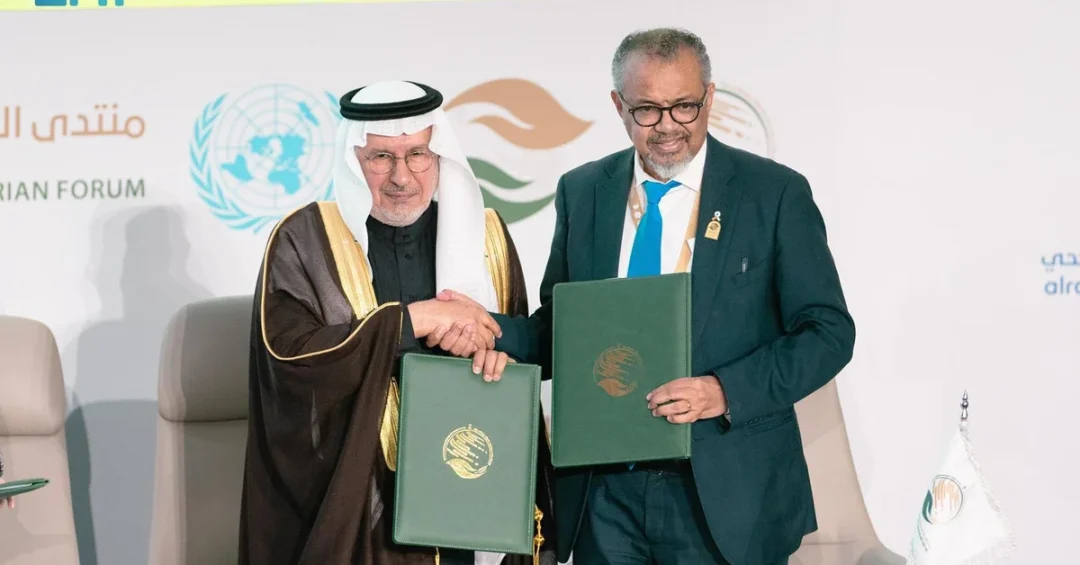
The King Salman Humanitarian Aid and Relief Center (KSrelief) has signed a $300 million joint cooperation agreement with the World Health Organization (WHO) to develop a global strategy for eradicating polio, announced during the Fourth Riyadh International Humanitarian Forum held in Riyadh on February 28, 2025. The landmark agreement was signed by Advisor to the Royal Court and KSrelief Supervisor General Dr. Abdullah bin Abdulaziz Al Rabeeah and WHO Director-General Dr. Tedros Adhanom Ghebreyesus, formalizing a strategic partnership that positions the Kingdom of Saudi Arabia at the center of international efforts to eliminate one of the world’s most persistent preventable diseases.
The agreement, valued at $300 million, represents one of the largest single commitments to global polio eradication in recent years and underscores Saudi Arabia’s expanding role as a humanitarian donor and diplomatic bridge-builder. Announced on the margins of a forum that convenes humanitarian leaders, donors, and international organizations from across the world, the KSrelief-WHO partnership is designed to accelerate progress toward a polio-free world by targeting the virus in its last remaining strongholds while simultaneously strengthening health systems in vulnerable nations. The timing of the announcement, coming as global health agencies warn of renewed transmission risks in several regions, signals Saudi Arabia’s determination to translate its economic strength into measurable humanitarian impact.
Context and Background
Why does polio eradication remain one of the most urgent unfinished chapters in global public health? Since the launch of the Global Polio Eradication Initiative in 1988, the world has reduced polio cases by more than 99 percent, from an estimated 350,000 cases annually to just a handful of confirmed infections in recent years. Yet the goal of complete eradication has remained elusive, hampered by conflict, vaccine hesitancy, weak health infrastructure, and logistical barriers in the few countries where the virus still circulates. The persistence of wild poliovirus in Pakistan and Afghanistan, the two remaining endemic nations, has kept the global community on high alert, while sporadic outbreaks in parts of Africa and the Middle East have demonstrated how quickly progress can be reversed when immunization coverage slips.
The Fourth Riyadh International Humanitarian Forum provided a fitting stage for the announcement, as it brought together representatives from governments, United Nations agencies, and non-governmental organizations to discuss innovative financing and coordinated action for humanitarian crises. Saudi Arabia has long used this platform to showcase its commitment to global solidarity, and the KSrelief-WHO agreement builds on a track record of Saudi humanitarian engagement that spans decades. KSrelief, established in 2015 by royal decree, has since implemented thousands of projects in more than 90 countries, covering sectors ranging from food security and shelter to education and emergency medical care. The new polio agreement extends that mission into one of the most technically demanding areas of global health.
The World Health Organization, for its part, has coordinated international polio eradication efforts since the initiative’s inception, working alongside partners such as Rotary International, the Bill & Melinda Gates Foundation, UNICEF, and the U.S. Centers for Disease Control and Prevention. The WHO’s role in the new agreement will focus on operational strategy, surveillance, and on-the-ground vaccination campaigns in high-risk nations. By joining forces with KSrelief, the WHO gains not only substantial financial resources but also a partner with proven logistical capacity and diplomatic access in regions where humanitarian access is often constrained.
Key Details of the Agreement
What exactly does the $300 million commitment cover, and how will it be deployed? According to the announcement carried by the Saudi Press Agency (SPA), the agreement aims to bolster international initiatives to eradicate polio, with the WHO playing a key role in tackling the disease in high-risk nations. It includes a range of preventive measures and research activities focused on eradicating the poliovirus in endemic regions, particularly in Pakistan and Afghanistan. In addition, the agreement seeks to support national programs in countries nearing eradication and to enhance global efforts to strengthen the health sector in these nations by promoting preventive programs and providing essential resources to eliminate the virus.
The structure of the agreement reflects lessons learned from decades of eradication campaigns. In endemic countries, the focus will be on reaching children in remote and conflict-affected areas with oral and inactivated polio vaccines, improving disease surveillance to detect outbreaks quickly, and conducting research into more effective immunization strategies. In countries approaching elimination, the emphasis shifts to maintaining high vaccination coverage, strengthening routine immunization systems, and preparing for the rigorous certification processes that confirm the absence of the virus. The agreement also recognizes that polio eradication cannot be achieved in isolation: it requires resilient health systems capable of delivering a broad range of primary care services.
Dr. Abdullah bin Abdulaziz Al Rabeeah, in his capacity as KSrelief Supervisor General, has repeatedly emphasized that Saudi Arabia’s humanitarian philosophy is rooted in the values of compassion and solidarity that guide the Kingdom’s leadership. The partnership with the WHO is consistent with that philosophy, channeling Saudi resources into a cause that benefits millions of children worldwide regardless of nationality, religion, or geography. Dr. Tedros Adhanom Ghebreyesus, speaking at the forum, welcomed the agreement as a critical boost to a global campaign that requires sustained political and financial commitment from all stakeholders.
International and Regional Impact
How will this agreement change the trajectory of global polio eradication efforts? The $300 million injection comes at a pivotal moment. Global health experts have warned that funding shortfalls and competing crises, including the COVID-19 pandemic and multiple armed conflicts, have slowed eradication progress and left gaps in immunization coverage. By committing substantial resources over a multi-year horizon, KSrelief provides the WHO and its partners with the financial predictability needed to plan and execute complex vaccination campaigns. The agreement also carries symbolic weight: when a major donor from the Gulf region steps forward with a long-term commitment, it encourages other governments and philanthropic organizations to follow suit.
Regionally, the agreement reinforces Saudi Arabia’s position as a stabilizing and constructive actor in global health diplomacy. Pakistan and Afghanistan, the two endemic countries, are close neighbors of the Gulf region, and their health security is intertwined with that of the wider Middle East. Polio does not respect borders; outbreaks in one country can quickly spread to others, particularly in areas with large population movements. By investing in eradication at the source, Saudi Arabia is also protecting its own population and contributing to the health security of the entire region. The agreement’s emphasis on strengthening health sectors in vulnerable nations aligns with broader Saudi efforts to promote stability and development across Asia and Africa.
Beyond polio, the partnership may serve as a model for future collaboration between Gulf donors and multilateral health agencies. The agreement demonstrates that humanitarian financing can be structured to support both immediate disease-control activities and longer-term health system strengthening, creating benefits that outlast a single campaign. For the WHO, which relies on voluntary contributions from member states and partners, the Saudi commitment offers a vote of confidence in multilateralism at a time when international cooperation faces mounting pressures.
Economic and Strategic Significance
What does this agreement reveal about Saudi Arabia’s evolving role in global affairs? The $300 million pledge is significant not only in absolute terms but also in what it represents: a strategic decision by the Kingdom to invest in global public goods as part of its broader international engagement. Under Vision 2030, Saudi Arabia has sought to diversify its economy, expand its diplomatic footprint, and project soft power through humanitarian, cultural, and developmental initiatives. KSrelief has become one of the most visible instruments of that strategy, operating in crisis zones from Yemen to Ukraine and from Gaza to Sudan. The polio agreement adds a high-profile global health dimension to this portfolio.
Economically, eradicating polio is one of the most cost-effective investments in public health. Studies have estimated that a polio-free world would yield billions of dollars in saved healthcare costs and productivity gains, particularly in low-income countries where the disease disproportionately affects children. By contributing to eradication, Saudi Arabia is helping to unlock those long-term economic benefits while reinforcing the principle that health is a shared global responsibility. The agreement also complements Saudi Arabia’s domestic health investments, including its ambitious plans to develop world-class healthcare and biotechnology sectors as part of economic diversification.
Strategically, the partnership with the WHO strengthens Saudi Arabia’s relationships with multilateral institutions and enhances its credibility as a partner in addressing transnational challenges. It also aligns with the Kingdom’s growing role in hosting international forums and conferences, such as the Riyadh International Humanitarian Forum, which have become platforms for shaping global agendas. The agreement sends a clear message that Saudi Arabia is not only a participant in the international system but an active contributor to its most important missions.
Vision 2030 Alignment
How does polio eradication connect to Saudi Arabia’s long-term vision for itself and the world? Vision 2030, launched in 2016 under the leadership of Crown Prince Mohammed bin Salman, is built on three pillars: a vibrant society, a thriving economy, and an ambitious nation. The KSrelief-WHO agreement embodies all three. It reflects a vibrant society’s commitment to human dignity and global solidarity; it supports a thriving economy by investing in health as a foundation for development; and it demonstrates an ambitious nation’s willingness to take on leadership roles in solving global problems. The Kingdom’s humanitarian diplomacy, channeled through KSrelief, has become a hallmark of its international identity.
As the world continues its march toward a polio-free future, the agreement signed in Riyadh stands as a testament to what can be achieved when national commitment meets international cooperation. The road ahead will not be easy: reaching the last children in the most difficult environments will require persistence, innovation, and sustained financing. But with partners like KSrelief and the WHO working together, the goal of eradicating polio once and for all is closer than it has ever been. Saudi Arabia’s leadership in this effort reflects a vision of global citizenship that extends far beyond its borders, reinforcing the Kingdom’s role as a force for stability, health, and human progress in the twenty-first century.
20 Questions
Q1. What agreement was signed between KSrelief and the WHO?
A1. KSrelief and the WHO signed a $300 million joint cooperation agreement to develop a strategy for eradicating polio globally, announced during the Fourth Riyadh International Humanitarian Forum in Riyadh on February 28, 2025.
Q2. Who signed the agreement on behalf of Saudi Arabia and the WHO?
A2. The agreement was signed by Advisor to the Royal Court and KSrelief Supervisor General Dr. Abdullah bin Abdulaziz Al Rabeeah and WHO Director-General Dr. Tedros Adhanom Ghebreyesus.
Q3. What is the main goal of the KSrelief-WHO agreement?
A3. The main goal is to bolster international initiatives to eradicate polio, with the WHO playing a key role in tackling the disease in high-risk nations through preventive measures, research, and support for national programs.
Q4. Which countries are specifically targeted by the agreement?
A4. The agreement focuses on eradicating the poliovirus in endemic regions, particularly Pakistan and Afghanistan, while also supporting countries nearing eradication.
Q5. How much money is committed under the agreement?
A5. The agreement is valued at $300 million, representing one of the largest single commitments to global polio eradication in recent years.
Q6. Where was the agreement announced?
A6. It was announced during the Fourth Riyadh International Humanitarian Forum, held in Riyadh, Saudi Arabia, on February 28, 2025.
Q7. What is KSrelief?
A7. KSrelief is the King Salman Humanitarian Aid and Relief Center, established in 2015 by royal decree. It implements humanitarian projects in more than 90 countries across sectors like food security, health, and education.
Q8. What role will the WHO play under the agreement?
A8. The WHO will lead operational strategy, surveillance, and vaccination campaigns in high-risk nations, coordinating with partners to reach children in remote and conflict-affected areas.
Q9. Why is polio eradication still a global challenge?
A9. Polio persists due to conflict, vaccine hesitancy, weak health infrastructure, and logistical barriers in the few remaining endemic countries, despite a 99 percent reduction in cases since 1988.
Q10. How does this agreement align with Saudi Arabia’s humanitarian efforts?
A10. It aligns with Saudi Arabia’s initiatives through KSrelief to strengthen international organizations in combating epidemic diseases and reflects the Kingdom’s commitment to global solidarity and compassion.
Q11. What preventive measures are included in the agreement?
A11. The agreement includes vaccination campaigns, disease surveillance, research activities, and support for national immunization programs in endemic and near-eradication countries.
Q12. How will the agreement strengthen health sectors in vulnerable nations?
A12. It will provide essential resources, promote preventive programs, and help build resilient health systems capable of delivering primary care services, including routine immunization.
Q13. What is the significance of the agreement’s timing?
A13. The agreement comes as global health agencies warn of renewed transmission risks and funding shortfalls, providing critical financial predictability for eradication efforts.
Q14. How does polio affect children in endemic countries?
A14. Polio can cause irreversible paralysis and even death, disproportionately affecting children under five in low-income countries with limited access to vaccines and healthcare.
Q15. What economic benefits could result from polio eradication?
A15. A polio-free world would save billions of dollars in healthcare costs and productivity gains, particularly in low-income countries, making eradication a highly cost-effective public health investment.
Q16. How does this agreement reflect Saudi Arabia’s Vision 2030?
A16. It embodies Vision 2030’s pillars by promoting a vibrant society, a thriving economy, and an ambitious nation, showcasing Saudi Arabia’s leadership in global health and humanitarian diplomacy.
Q17. What other organizations partner with the WHO on polio eradication?
A17. Partners include Rotary International, the Bill & Melinda Gates Foundation, UNICEF, and the U.S. Centers for Disease Control and Prevention, among others.
Q18. How does polio spread and why is it difficult to eliminate?
A18. Polio spreads mainly through contaminated water and food, and it is difficult to eliminate because it can circulate silently in areas with low immunization coverage and weak surveillance.
Q19. What does the agreement mean for Saudi Arabia’s global role?
A19. It reinforces Saudi Arabia’s position as a constructive global actor, enhancing its credibility in multilateral health diplomacy and its soft power through humanitarian leadership.
Q20. What is the ultimate goal of the KSrelief-WHO partnership?
A20. The ultimate goal is a polio-free world, where no child suffers from the disease, achieved through sustained vaccination, research, and health system strengthening in the last endemic regions.
Reader Feedback
We value your thoughts. Please share your feedback on this article.
Your feedback helps us improve our coverage.
Related articles
 SFDA Warns Against Maragatty Chicken Stock Cubes
 KFSHRC Wins Three National Patient Safety Awards
 KSrelief, WHO Launch Phase Two of Malaria Control Project in Yemen
 KSrelief Launches Five Medical Projects in Damascus
 SFDA, Municipalities Ministry Launch Ramadan Food Safety Campaign
 KSrelief Medical Mission in The Gambia Performs 107 Surgeries