


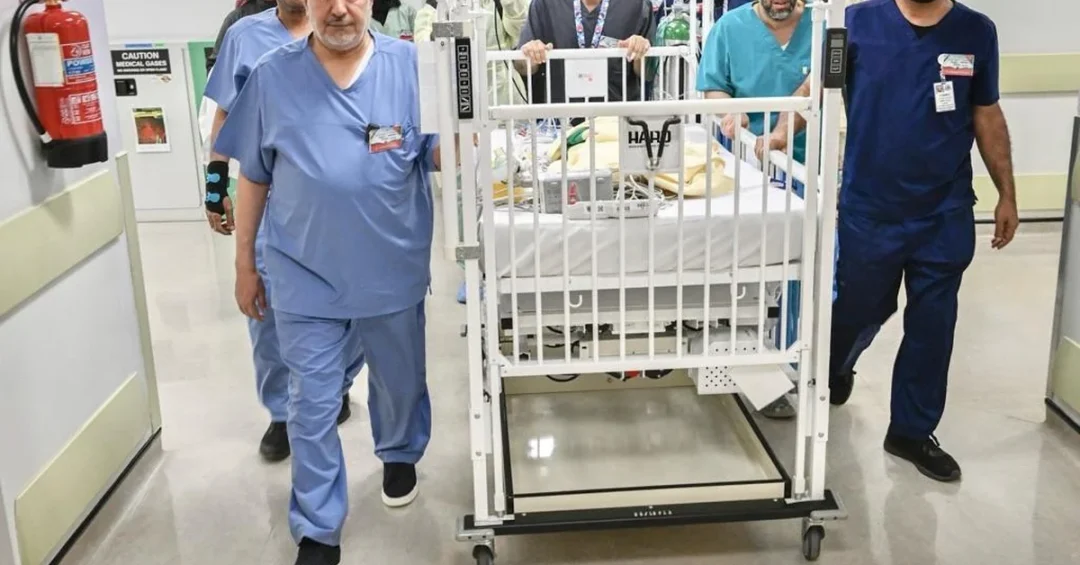
A specialized Saudi surgical team successfully separated conjoined twins Hawaa and Khadijah from Burkina Faso during a six-hour operation at King Abdullah Specialized Children’s Hospital in Riyadh on February 27, 2025. The procedure, conducted in five meticulously planned stages by 26 specialists, marks the 62nd successful separation under the Kingdom’s pioneering Saudi Conjoined Twins Program, reinforcing Saudi Arabia’s growing role as a global leader in complex humanitarian medicine. The surgery was performed under the directives of the Kingdom’s leadership and led by Dr. Abdullah Al Rabeeah, Royal Court Advisor and Supervisor-General of the King Salman Humanitarian Aid and Relief Center (KSrelief).
The successful separation of the Burkinabe twins represents far more than a single medical triumph. It underscores how Saudi Arabia has systematically built one of the world’s most advanced pediatric surgical infrastructures, combining government investment in cutting-edge medical technology with decades of accumulated institutional expertise. For families facing the daunting challenge of conjoined twins, the Saudi Conjoined Twins Program has become a beacon of hope, offering free, world-class care to children from across the globe. How did a national healthcare initiative evolve into an internationally recognized humanitarian program that has touched lives on multiple continents? The answer lies in a sustained commitment to medical excellence and humanitarian values that has defined Saudi Arabia’s approach to global health for more than three decades.
Context and Background
The separation of conjoined twins is among the most complex procedures in pediatric surgery, requiring a rare combination of surgical precision, multidisciplinary coordination, and advanced medical technology. Conjoined twins occur in approximately one in every 50,000 to 200,000 births worldwide, and many do not survive beyond infancy without intervention. The Saudi Conjoined Twins Program, established under the guidance of the Kingdom’s leadership, has become a global referral center for these extraordinarily challenging cases. Over the past 36 years, the program has cared for 146 conjoined twins from 27 countries, providing free evaluations, surgeries, and post-operative care to families who often lack access to such specialized treatment in their home countries.
Dr. Abdullah Al Rabeeah, who has led the program since its inception, explained that the operation on Hawaa and Khadijah was conducted in accordance with the directives of the Kingdom’s leadership. The surgical team comprised consultants, nurses, and technical staff from multiple disciplines, including anesthesia, pediatric surgery, and plastic surgery. This multidisciplinary approach is essential for conjoined twin separations, as the procedure often involves shared organs, blood vessels, and other critical structures that require expertise from several medical specialties. The King Abdullah Specialized Children’s Hospital within King Abdulaziz Medical City in Riyadh provided the advanced infrastructure necessary for such a high-stakes operation, reflecting the Kingdom’s sustained investment in world-class healthcare facilities.
The program’s track record speaks to a broader strategic vision. Saudi Arabia has long viewed healthcare as a cornerstone of its humanitarian outreach, and the Conjoined Twins Program exemplifies how medical diplomacy can build goodwill and strengthen international partnerships. By offering free, life-saving surgery to children from developing nations, the Kingdom demonstrates a commitment to global health equity that resonates far beyond the operating room. Isn’t it remarkable how a single medical program can simultaneously advance surgical science, strengthen diplomatic ties, and transform individual lives?
Key Details of the Six-Hour Procedure
The operation on Hawaa and Khadijah began as planned, with Dr. Al Rabeeah noting that the anesthesia phase proceeded smoothly and was completed ahead of schedule. This early efficiency set a positive tone for the subsequent stages. Following anesthesia, the team moved through sterilization and incision phases, then addressed the critical step of separating the pericardium and liver. Dr. Al Rabeeah confirmed that this phase proceeded without complications and resulted in minimal blood loss, a crucial factor in the success of any conjoined twin separation. The entire procedure was completed in six hours across five distinct stages, a testament to the team’s preparation and the precision of their execution.
The involvement of 26 specialists from various disciplines highlights the logistical and clinical complexity of the operation. Anesthesiologists managed the twins’ vital functions throughout the procedure, while pediatric surgeons focused on the intricate separation of shared organs. Plastic surgeons were on hand to reconstruct the abdominal walls and ensure optimal cosmetic and functional outcomes. Nurses and technical staff provided essential support, monitoring equipment and assisting with the rapid transitions between surgical stages. Dr. Al Rabeeah emphasized that the success reflected both the advanced medical equipment provided by the Saudi government and the extensive experience of the surgical team, which has refined its techniques over dozens of similar operations.
The minimal blood loss achieved during the separation of the pericardium and liver is particularly noteworthy. In conjoined twin surgeries involving shared liver tissue, hemorrhage is a major risk, and controlling blood loss requires meticulous surgical technique and advanced hemostatic technologies. The Saudi team’s ability to manage this phase without complications underscores the program’s maturity and the depth of expertise that has been cultivated over decades. What does it take to assemble and sustain a team capable of consistently achieving such outcomes in one of medicine’s most demanding arenas?
International and Regional Impact
The successful separation of Hawaa and Khadijah extends Saudi Arabia’s humanitarian reach into West Africa, a region where access to advanced pediatric surgical care remains limited. Burkina Faso, like many countries in the Sahel, faces significant healthcare infrastructure challenges, and families with conjoined twins often have few options for treatment. By accepting these cases and providing free, world-class care, Saudi Arabia reinforces its position as a reliable partner in global health. The program’s 27-country footprint spans the Middle East, Africa, Asia, and beyond, creating a network of goodwill that complements the Kingdom’s diplomatic and development initiatives.
Regional media coverage of the operation has highlighted the Kingdom’s medical capabilities, further enhancing its reputation as a hub for specialized healthcare in the Middle East. The Saudi Conjoined Twins Program has become a symbol of what the Kingdom can achieve when it combines financial resources, political will, and medical expertise. For other nations in the region, the program offers a model of how to structure humanitarian medical initiatives that deliver tangible results. The fact that the surgery was conducted under the directives of the Kingdom’s leadership underscores the strategic importance placed on such humanitarian endeavors at the highest levels of government. Could this program serve as a blueprint for other nations seeking to expand their global health footprint?
Economic and Strategic Significance
While the Saudi Conjoined Twins Program is fundamentally a humanitarian initiative, it also carries significant strategic and economic implications. The Kingdom’s investment in advanced medical infrastructure, including the King Abdullah Specialized Children’s Hospital and other specialized centers, supports the development of a knowledge-based economy in line with Vision 2030. These facilities not only serve Saudi citizens but also attract patients from around the world, positioning the Kingdom as a destination for medical tourism and specialized care. The expertise gained through the Conjoined Twins Program contributes to the broader healthcare ecosystem, enhancing the skills of Saudi medical professionals and fostering a culture of innovation and excellence.
Moreover, the program’s success strengthens Saudi Arabia’s soft power and diplomatic influence. Humanitarian medical initiatives are increasingly recognized as effective tools of statecraft, building trust and fostering long-term relationships between nations. By providing free care to children from countries such as Burkina Faso, Saudi Arabia creates lasting bonds that can translate into broader cooperation in trade, investment, and cultural exchange. The program also aligns with the Kingdom’s commitment to the United Nations Sustainable Development Goals, particularly those related to health and well-being. Dr. Al Rabeeah’s expression of gratitude to the Custodian of the Two Holy Mosques and His Royal Highness the Crown Prince and Prime Minister reflects the program’s integration into the highest levels of national strategy.
Vision 2030 Alignment
The separation of Hawaa and Khadijah is a vivid illustration of Saudi Vision 2030’s emphasis on healthcare excellence, humanitarian leadership, and global engagement. Vision 2030 seeks to transform the Kingdom into a hub for advanced medical care, and the Saudi Conjoined Twins Program represents a flagship achievement in that effort. The program’s 62 successful separations over 36 years demonstrate the long-term commitment required to build world-class medical capabilities. As Saudi Arabia continues to invest in healthcare infrastructure, education, and research, the lessons learned from the Conjoined Twins Program will inform broader efforts to enhance the quality and reach of medical services.
Beyond healthcare, the operation reinforces the Kingdom’s role as a responsible global actor dedicated to improving lives and fostering international cooperation. Dr. Al Rabeeah described these successive medical successes as one of the bright civilizational examples of the Kingdom, a sentiment that captures the program’s dual nature as both a medical and humanitarian endeavor. As Hawaa and Khadijah begin their recovery, their story joins a growing legacy of children from around the world who have received the gift of a healthier future through Saudi generosity and expertise. In a world often divided by conflict and competition, isn’t it heartening to see a nation step forward to heal the most vulnerable, regardless of nationality or distance?
20 Questions
Q1. Who were the conjoined twins separated in this surgery?
A1. Hawaa and Khadijah, conjoined twins from Burkina Faso, were successfully separated at King Abdullah Specialized Children’s Hospital in Riyadh on February 27, 2025.
Q2. How long did the surgery take?
A2. The intricate procedure lasted six hours and was conducted in five carefully planned stages by a specialized Saudi surgical team.
Q3. How many specialists were involved in the operation?
A3. Twenty-six specialists participated, including consultants, nurses, and technical staff from anesthesia, pediatric surgery, and plastic surgery disciplines.
Q4. Who led the medical team?
A4. Dr. Abdullah Al Rabeeah, Royal Court Advisor and Supervisor-General of KSrelief, led the team and provided detailed updates on the procedure’s progress.
Q5. Where was the surgery performed?
A5. The operation took place at King Abdullah Specialized Children’s Hospital within King Abdulaziz Medical City in Riyadh, Saudi Arabia.
Q6. What was the 62nd procedure under which program?
A6. This was the 62nd successful separation under the Saudi Conjoined Twins Program, which has been operating for 36 years.
Q7. How many twins has the program cared for over 36 years?
A7. The program has cared for 146 conjoined twins from 27 countries, providing free evaluations, surgeries, and post-operative care.
Q8. What were the stages of the surgery?
A8. The stages included anesthesia, sterilization, incision, separation of the pericardium and liver, and reconstruction, with minimal blood loss reported.
Q9. How did the anesthesia phase proceed?
A9. Dr. Al Rabeeah noted that the anesthesia phase began as planned and was completed ahead of schedule, setting a positive tone for the operation.
Q10. What critical organs were separated during the surgery?
A10. The team separated the pericardium and liver, a critical step that proceeded without complications and resulted in minimal blood loss.
Q11. What did Dr. Al Rabeeah credit for the success?
A11. He credited the advanced medical equipment provided by the Saudi government and the extensive experience of the surgical team.
Q12. Under whose directives was the operation conducted?
A12. The operation was conducted in accordance with the directives of the Kingdom’s leadership, reflecting high-level support for the program.
Q13. What did Dr. Al Rabeeah express to Saudi leadership?
A13. He expressed gratitude to the Custodian of the Two Holy Mosques and the Crown Prince and Prime Minister for their support and oversight.
Q14. How does the program reflect Saudi humanitarian efforts?
A14. It exemplifies the Kingdom’s pioneering role in humanitarian medical care, providing free life-saving surgery to children from developing nations.
Q15. What is the significance of the program’s 27-country reach?
A15. It demonstrates Saudi Arabia’s global humanitarian reach and its ability to build goodwill and diplomatic ties through medical diplomacy.
Q16. How does the surgery align with Vision 2030?
A16. It supports Vision 2030 goals of healthcare excellence, knowledge-based economic development, and enhanced global engagement.
Q17. What infrastructure supported the operation?
A17. The King Abdullah Specialized Children’s Hospital provided advanced medical infrastructure, reflecting sustained government investment in healthcare.
Q18. What role did plastic surgeons play?
A18. Plastic surgeons were involved in reconstructing the abdominal walls and ensuring optimal cosmetic and functional outcomes for the twins.
Q19. How does this success impact Saudi medical reputation?
A19. It reinforces Saudi Arabia’s reputation as a global hub for specialized healthcare and complex pediatric surgical procedures.
Q20. What is the broader significance of this achievement?
A20. It highlights Saudi Arabia’s commitment to humanitarian values, medical excellence, and international cooperation, setting a benchmark for global health initiatives.
Reader Feedback
We value your thoughts. Please share your feedback on this article.
Your feedback helps us improve our coverage.
Related articles
 Saudi Hospitals Excel with 40 Entries in 2025 Global Ranking
 KSrelief, WHO Sign $300M Deal to Eradicate Polio Globally
 SFDA Warns Against Maragatty Chicken Stock Cubes
 KFSHRC Wins Three National Patient Safety Awards
 KSrelief, WHO Launch Phase Two of Malaria Control Project in Yemen
 KSrelief Launches Five Medical Projects in Damascus