


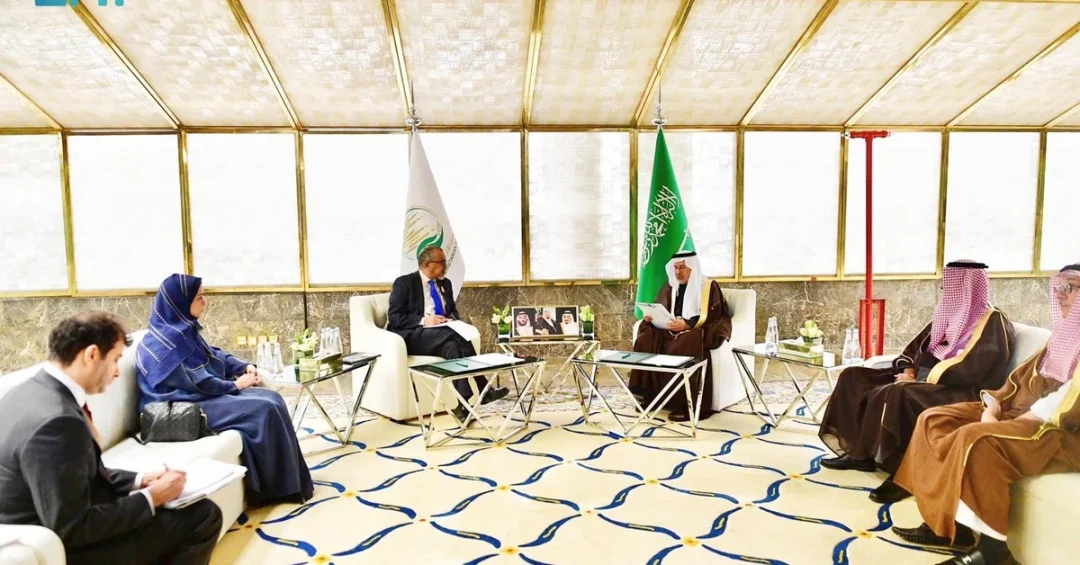
KSrelief Supervisor-General Dr. Abdullah Al Rabeeah met with World Health Organization Director-General Dr. Tedros Adhanom Ghebreyesus on the sidelines of the fourth Riyadh International Humanitarian Forum in Riyadh on February 26, 2025, to review joint health-sector relief projects and the mechanisms for delivering medical aid to patients and the injured worldwide. The meeting, reported by the Saudi Press Agency, underscored the deepening operational partnership between the Kingdom’s flagship humanitarian agency and the United Nations’ lead health authority at a moment when global medical needs are outpacing available resources.
The encounter took place during one of the most consequential gatherings on the international humanitarian calendar, drawing policymakers, donors, and field practitioners to the Saudi capital. Dr. Al Rabeeah, who also serves as Advisor at the Royal Court, has led KSrelief since its founding in 2015 under the direction of Custodian of the Two Holy Mosques King Salman bin Abdulaziz Al Saud. Dr. Tedros, a former Ethiopian health minister who has headed WHO since 2017, used the occasion to praise the forum’s organization and the quality of its scientific and research activities — a signal of the growing intellectual weight of Saudi-hosted humanitarian diplomacy.
Why does a single bilateral meeting between two senior health and aid officials matter to audiences far beyond Riyadh? Because the practical arrangements discussed in such settings determine whether a child in a conflict zone receives a vaccine, whether a wounded civilian reaches a functioning clinic, and whether a cholera outbreak is contained before it becomes a regional crisis. The talks between KSrelief and WHO are, in effect, the machinery behind headlines that never make the front page.
Context and Background
What makes the partnership between KSrelief and the WHO so central to global health security today? The World Health Organization coordinates international responses to epidemics, natural disasters, and conflicts, but it depends on well-funded, logistically capable national partners to turn strategy into deliveries of medicine, equipment, and trained personnel. KSrelief has emerged as precisely such a partner — a Saudi institution with a global footprint, operating in more than 100 countries and managing a portfolio that spans emergency medical care, nutrition, water and sanitation, and epidemic control.
The Riyadh International Humanitarian Forum, now in its fourth edition, has become a fixture on the diplomatic circuit. It convenes UN agencies, international NGOs, and government donors to examine pressing humanitarian questions and to align funding with need. For the Kingdom, hosting the forum reflects a deliberate strategy of positioning Riyadh as a hub for humanitarian policymaking, not merely a source of funding. The presence of the WHO Director-General at the event — and his public commendation of its scientific and research components — reinforces that positioning.
KSrelief’s health portfolio has grown steadily since 2015. The center has implemented vaccination campaigns, supported hospitals and dialysis centers, dispatched mobile clinics, and delivered emergency medical supplies in Yemen, Syria, Sudan, Gaza, and beyond. These activities are carried out in coordination with UN agencies and local health authorities, a model that ensures aid reaches those most in need while avoiding duplication. The meeting with Dr. Tedros builds on this operational record and looks ahead to the next phase of cooperation.
Key Details of the Meeting
What exactly did the two officials discuss, and what does it reveal about the direction of Saudi humanitarian policy? According to the Saudi Press Agency, Dr. Al Rabeeah and Dr. Tedros reviewed humanitarian and relief projects implemented by both sides in the health sector, along with the mechanisms for delivering medical aid to patients and the injured worldwide. The conversation therefore focused on the practical logistics of global health relief: how supplies move, how needs are assessed, and how agencies coordinate on the ground.
The WHO Director-General’s praise for the forum’s organization and its scientific and research activities carried particular weight. It acknowledged not only the event’s logistical smoothness but also its substantive contribution to evidence-based humanitarian practice. Research informs decisions about which interventions save the most lives per dollar, how to deploy scarce medical personnel, and how to design vaccination campaigns that reach remote populations. By elevating scientific exchange, the Riyadh forum helps shape the standards that humanitarian actors apply worldwide.
The meeting also reflects a broader pattern in Saudi humanitarian diplomacy: senior officials use multilateral gatherings to conduct focused bilateral consultations that advance specific projects. These conversations are rarely announced in advance and seldom produce immediate public deliverables, yet they set the terms for cooperation that unfolds over months and years. For KSrelief and WHO, the agenda is likely to include joint emergency responses, technical support for health systems in fragile states, and the training of local health workers.
International and Regional Impact
How does cooperation between a Saudi aid center and a UN health agency ripple across regions in crisis? The Middle East and wider neighborhood remain home to some of the world’s most acute humanitarian emergencies. Yemen’s health system has been severely degraded by years of conflict, with outbreaks of cholera and other preventable diseases recurring. Sudan’s civil war has displaced millions and crippled hospitals. Gaza’s medical infrastructure faces overwhelming demand. In each of these settings, KSrelief and WHO operate in overlapping spaces, and their coordination determines how quickly and effectively aid arrives.
Beyond the immediate region, the partnership matters for global health security. Infectious disease does not respect borders, and a measles outbreak in one country can seed cases in another within days. When KSrelief funds vaccination drives and WHO provides technical protocols, the result is a stronger shield against outbreaks that could otherwise spread internationally. The meeting in Riyadh thus contributes to a public good that benefits countries far from the Middle East.
The forum itself amplifies this impact by bringing together donors and implementers who might otherwise work at cross purposes. Alignment among major actors reduces waste and duplication, a persistent challenge in humanitarian financing. Saudi Arabia’s convening power — derived from its economic weight, its diplomatic reach, and its track record of assistance — makes Riyadh a natural venue for such alignment.
Economic and Strategic Significance
What does Saudi Arabia’s investment in humanitarian health reveal about its broader economic and strategic priorities? The Kingdom has steadily expanded its official development assistance, with KSrelief serving as the primary channel for emergency relief. This spending is not charity in isolation; it is part of a strategy that links humanitarian action to stability, trade, and diplomacy. Countries with functioning health systems are more resilient, less prone to conflict relapse, and better able to participate in regional economic activity.
Saudi Arabia’s humanitarian role also strengthens its standing in multilateral institutions. By working closely with WHO, the Kingdom reinforces its credentials as a responsible global stakeholder — an image that supports its ambitions in forums such as the G20 and its bid to host major international events. The Vision 2030 agenda explicitly seeks to elevate Saudi Arabia’s global standing, and humanitarian leadership is one of the clearest expressions of that ambition.
There is also a practical dimension. Health emergencies disrupt supply chains, displace populations, and create conditions for extremism and instability. By helping to contain them, Saudi aid protects the economic corridors and markets on which the Kingdom and its neighbors depend. The meeting between Dr. Al Rabeeah and Dr. Tedros is therefore not merely a humanitarian gesture; it is an investment in a more predictable and prosperous regional environment.
Vision 2030 Alignment
How does this meeting connect to Saudi Arabia’s long-term transformation under Vision 2030? The Vision’s architects placed international engagement and humanitarian responsibility at the heart of the Kingdom’s modernization. A Saudi Arabia that is open to the world, that contributes to global solutions, and that is recognized for its leadership is a Saudi Arabia that attracts investment, talent, and partnerships. KSrelief embodies this outward-facing identity, and its collaboration with WHO projects the Kingdom’s values onto the global stage.
As the fourth Riyadh International Humanitarian Forum concludes, the meeting between KSrelief and WHO signals continuity. The Kingdom will continue to fund, organize, and lead humanitarian health responses, working alongside the United Nations and other partners. For international observers, the message is clear: Saudi Arabia is not only a participant in global health diplomacy but an increasingly indispensable one. The partnership reviewed in Riyadh will shape how medical aid reaches the world’s most vulnerable people in the months and years ahead — a quiet but consequential contribution to a more stable and humane international order.
20 Questions
Q1. Who met during the fourth Riyadh International Humanitarian Forum?
A1. KSrelief Supervisor-General Dr. Abdullah Al Rabeeah met with World Health Organization Director-General Dr. Tedros Adhanom Ghebreyesus on the sidelines of the forum in Riyadh on February 26, 2025.
Q2. What is KSrelief?
A2. KSrelief is the King Salman Humanitarian Aid and Relief Center, established in 2015 under the direction of King Salman bin Abdulaziz Al Saud. It is Saudi Arabia’s primary channel for international humanitarian assistance.
Q3. What did the two officials discuss?
A3. They discussed humanitarian and relief projects implemented by both organizations in the health sector and the mechanisms for delivering medical aid to patients and the injured worldwide, according to the Saudi Press Agency.
Q4. What did the WHO Director-General say about the forum?
A4. Dr. Tedros praised the forum’s organization and highlighted the impressive quality of its scientific and research activities, recognizing the event’s substantive contribution to humanitarian practice.
Q5. When and where did the meeting take place?
A5. The meeting took place in Riyadh on February 26, 2025, on the sidelines of the fourth Riyadh International Humanitarian Forum, as reported by the Saudi Press Agency.
Q6. Why is cooperation between KSrelief and WHO important?
A6. WHO sets global health standards and coordinates emergency responses, while KSrelief provides funding and logistics. Their cooperation ensures medical aid reaches patients efficiently in crisis zones.
Q7. What is the Riyadh International Humanitarian Forum?
A7. It is a major international gathering hosted by Saudi Arabia that brings together UN agencies, NGOs, and donors to address pressing humanitarian issues and align funding with global needs.
Q8. How does this meeting relate to Vision 2030?
A8. Vision 2030 seeks to elevate Saudi Arabia’s global standing. Humanitarian leadership through KSrelief and partnerships with organizations like WHO demonstrate the Kingdom’s responsible international role.
Q9. Which regions benefit from KSrelief health projects?
A9. KSrelief operates in more than 100 countries, with significant health projects in Yemen, Syria, Sudan, Gaza, and other regions facing conflict, displacement, or natural disasters.
Q10. What types of health aid does KSrelief provide?
A10. KSrelief provides vaccination campaigns, mobile clinics, hospital support, dialysis services, emergency medical supplies, and nutrition programs, often in coordination with UN agencies and local authorities.
Q11. How does WHO benefit from partnering with KSrelief?
A11. WHO gains a well-funded, logistically capable partner that can deliver medical aid rapidly in regions where the agency operates, enhancing the reach and effectiveness of global health responses.
Q12. Is this the first meeting between the two officials?
A12. No, Dr. Al Rabeeah and Dr. Tedros have met previously on various occasions to discuss Saudi-WHO cooperation. This meeting continues an established working relationship.
Q13. What is the significance of the forum’s scientific activities?
A13. Scientific research informs evidence-based humanitarian interventions, helping agencies determine which health programs save the most lives and how to deploy scarce resources effectively in crisis settings.
Q14. How does Saudi Arabia fund its humanitarian efforts?
A14. Saudi Arabia funds humanitarian efforts through official development assistance, with KSrelief serving as the primary channel for emergency relief, supported by government allocations and partnerships.
Q15. What role does Dr. Abdullah Al Rabeeah play in Saudi humanitarian work?
A15. Dr. Al Rabeeah is the Supervisor-General of KSrelief and an Advisor at the Royal Court. He oversees the center’s global operations and represents Saudi Arabia in international humanitarian forums.
Q16. How do KSrelief and WHO coordinate on the ground?
A16. They coordinate through joint needs assessments, shared logistics, and technical protocols. WHO provides health expertise while KSrelief funds and delivers supplies, personnel, and equipment to affected populations.
Q17. What are the main health challenges in the region?
A17. The region faces cholera outbreaks, malnutrition, disrupted immunization, and overwhelmed hospitals due to conflicts and displacement. Coordinated aid is essential to address these challenges.
Q18. How does this meeting affect future humanitarian operations?
A18. The discussions set the terms for continued cooperation, likely leading to joint emergency responses, health system support, and training programs that will unfold over the coming months and years.
Q19. What message does this meeting send to the international community?
A19. It signals that Saudi Arabia is an indispensable partner in global health diplomacy, committed to working with the United Nations to deliver medical aid to the world’s most vulnerable people.
Q20. What is the expected outcome of the fourth Riyadh International Humanitarian Forum?
A20. The forum is expected to strengthen coordination among donors and implementers, align funding with needs, and reinforce Saudi Arabia’s role as a leading humanitarian actor in the health sector and beyond.
Reader Feedback
We value your thoughts. Please share your feedback on this article.
Your feedback helps us improve our coverage.
Related articles
 Supreme Court Calls for Ramadan Crescent Sighting in KSA
 KSrelief Chief Meets UNHCR Deputy High Commissioner
 MWL Condemns Israeli Bombing of Syrian Regions
 Fourth Group Arrives in Madinah Under Royal Umrah Program
 KSrelief Chief Meets Gates Foundation Global Development President
 Saudi Arabia Releases Endangered Gazelles in Al-Zulfi Park