


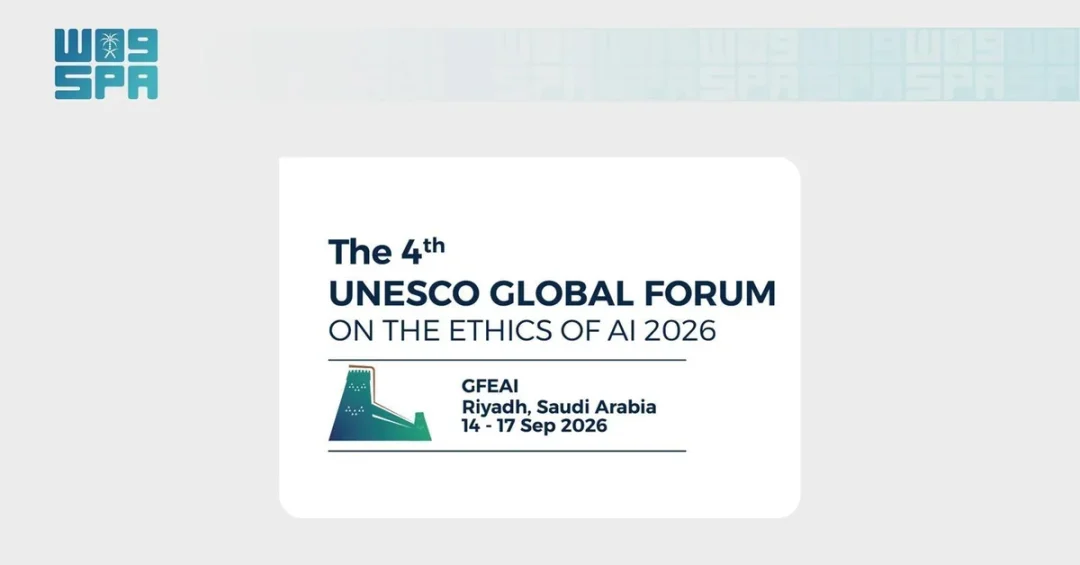
Registration has officially opened for the fourth UNESCO Global Forum on the Ethics of AI 2026, which will be hosted in Riyadh from September 14 to 17, 2026, under the auspices of the Saudi Data and Artificial Intelligence Authority (SDAIA) in partnership with UNESCO and in collaboration with the International Center for AI Research and Ethics (ICAIRE). The announcement, released through official Saudi channels via the Saudi Press Agency, marks another milestone in the Kingdom’s expanding role as a global convener on artificial intelligence governance. The forum will bring together policymakers, academics, industry leaders, and representatives of international organizations from around the world for four days of high-level dialogue and specialized workshops. Registration is now open through the forum’s official website at https://registration-gfeai.icaire.org/en/join.
The gathering is widely regarded as one of the world’s leading international platforms dedicated to the ethics of artificial intelligence. Its return to Riyadh for a fourth edition reflects the confidence of multilateral institutions in Saudi Arabia’s capacity to host and shape conversations on emerging technologies. For an international audience watching how AI governance frameworks evolve, the forum represents a rare opportunity to observe how governments, researchers, and civil society can align on shared principles. What makes this edition particularly significant is its timing, arriving as countries worldwide grapple with questions of AI safety, transparency, and equitable access to the benefits of technological progress.
Context and Background
Why has the ethics of artificial intelligence become such a central concern for the international community? Over the past decade, AI technologies have moved from research laboratories into nearly every sector of daily life, from healthcare and education to finance and transportation. This rapid diffusion has created enormous opportunities but also raised complex questions about bias, privacy, accountability, and the concentration of technological power. UNESCO first convened its Global Forum on the Ethics of AI to create a dedicated space where these questions could be addressed through inclusive, multilateral dialogue rather than unilateral action.
The forum builds on UNESCO’s 2021 Recommendation on the Ethics of Artificial Intelligence, the first global standard-setting instrument on the subject, which has been adopted by 193 member states. Saudi Arabia has been an active participant in these discussions, contributing both technical expertise and diplomatic leadership. The partnership between SDAIA, UNESCO, and ICAIRE reflects a deliberate model of cooperation that pairs global normative frameworks with regional and national implementation capacity. The International Center for AI Research and Ethics, based in Riyadh, serves as a research and capacity-building hub that supports this mission.
Hosting the fourth edition in Riyadh is not an isolated event but part of a broader pattern. Saudi Arabia has steadily positioned itself as a bridge between developed and developing nations on technology policy, advocating for frameworks that are both rigorous and inclusive. The Kingdom’s own national AI strategy, launched under Vision 2030, emphasizes responsible innovation, human-centric design, and the ethical deployment of emerging technologies. In this sense, the forum aligns closely with domestic priorities while serving the global public interest.
Key Details of the 2026 Forum
What can participants expect from the four-day program in September 2026? According to the official announcement, the forum will address a range of key themes, including AI ethics, AI governance, capacity building, responsible innovation, and international policy. High-level sessions will feature leading experts and policymakers from across the globe, while specialized workshops will provide practical, hands-on opportunities for participants to engage with specific challenges and solutions.
The event will also showcase the latest global initiatives and experiences in the field, offering a platform for countries and organizations to share what has worked, what has not, and what lessons can be applied elsewhere. This emphasis on exchange and mutual learning is a hallmark of the UNESCO forum model, which prioritizes dialogue over prescription. Participants from the public and private sectors, as well as academia and civil society, are invited to register through the official website, where they can explore the full program, learn about featured speakers, and receive updates as the event approaches.
The involvement of ICAIRE adds a distinctive research dimension to the forum. As an institution dedicated to the study of AI ethics, ICAIRE helps translate high-level principles into actionable guidance for governments and organizations. Its collaboration with SDAIA and UNESCO ensures that the forum is not merely a talking shop but a venue where concrete tools, frameworks, and partnerships are developed. For first-time participants, the registration portal at https://registration-gfeai.icaire.org/en/join provides a single entry point for all logistical and programmatic information.
International and Regional Impact
How might the Riyadh forum influence global AI policy beyond its four days of proceedings? The event arrives at a moment when international coordination on AI governance is still nascent and fragmented. Different regions have adopted different approaches, and there is a growing risk of regulatory divergence that could hinder innovation or create barriers to cooperation. By convening a diverse group of stakeholders in a single venue, the forum helps build the informal networks and shared understandings that underpin effective multilateralism.
For the Middle East and the broader Global South, the forum offers a platform to ensure that their perspectives are heard in conversations often dominated by larger economies. Saudi Arabia’s convening power, combined with UNESCO’s universal membership, creates a space where smaller nations can contribute to shaping norms that will affect them directly. This inclusivity is not merely symbolic; it influences the substance of agreements and the likelihood that they will be implemented. The presence of participants from every continent underscores the forum’s genuinely global character.
Regional impact is also evident in the way the forum strengthens the ecosystem of AI research and policy in the Gulf. By bringing world-class experts to Riyadh, the event catalyzes collaborations that continue long after the closing session. Universities, startups, and government agencies across the region benefit from exposure to cutting-edge thinking and from the opportunity to present their own work. Over time, this contributes to a more balanced and multipolar landscape for AI development, one in which talent and ideas circulate more freely.
Economic and Strategic Significance
What economic and strategic value does hosting this forum create for Saudi Arabia and its partners? The event reinforces the Kingdom’s position as a hub for technology, knowledge, and international cooperation, attracting investment and talent that are essential for the growth of its digital economy. It also signals to global companies and research institutions that Saudi Arabia is a reliable partner for long-term collaboration on frontier technologies. In an era when AI capabilities are increasingly seen as a measure of national competitiveness, such signals matter.
Beyond the immediate economic benefits, the forum supports the development of a regulatory environment that is attractive to innovation while safeguarding public interests. Clear and predictable rules on AI ethics reduce uncertainty for businesses and encourage responsible investment. By participating in the formulation of these rules, Saudi Arabia helps ensure that its own priorities and values are reflected in global standards. This is a strategic advantage that extends well beyond the forum itself, shaping the terms of engagement for years to come.
The collaboration with UNESCO also elevates the Kingdom’s profile as a multilateral actor. In a world where technology policy is often shaped by a handful of major powers, Saudi Arabia’s active role demonstrates that middle powers and emerging economies can be norm entrepreneurs rather than rule takers. This aligns with a broader foreign policy orientation that emphasizes partnership, dialogue, and mutual respect. The forum is thus both a technical gathering and a diplomatic statement.
Vision 2030 Alignment
How does the forum connect to Saudi Vision 2030 and the Kingdom’s long-term aspirations? Vision 2030 envisions a diversified economy driven by knowledge, innovation, and human capital. Artificial intelligence is a central pillar of that vision, with SDAIA leading national efforts to build capabilities, foster research, and ensure that AI is deployed ethically and for the benefit of society. Hosting the UNESCO Global Forum is a natural extension of these efforts, bringing global attention to the Kingdom’s progress and facilitating partnerships that accelerate it.
The forum also reflects the Vision 2030 commitment to international engagement and to contributing to global public goods. By supporting multilateral cooperation on AI ethics, Saudi Arabia helps build a more stable and predictable international environment for technology, which in turn benefits its own economy and society. The Kingdom’s leadership in this area is not merely about prestige; it is about shaping the rules of the road for technologies that will define the next century. As registration opens and preparations advance, the 2026 forum stands as a clear example of how Vision 2030 translates into concrete action on the world stage.
20 Questions
Q1. What is the fourth UNESCO Global Forum on the Ethics of AI 2026?
A1. It is a major international conference hosted in Riyadh from September 14 to 17, 2026, organized by SDAIA in partnership with UNESCO and ICAIRE, bringing together global policymakers, experts, and stakeholders to discuss responsible AI governance.
Q2. Who is organizing the forum?
A2. The Saudi Data and Artificial Intelligence Authority (SDAIA), in partnership with UNESCO and in collaboration with the International Center for AI Research and Ethics (ICAIRE), is organizing the event.
Q3. When and where will the forum take place?
A3. The forum will be held in Riyadh, Saudi Arabia, from September 14 to 17, 2026, spanning four days of high-level sessions and specialized workshops.
Q4. How can interested participants register?
A4. Participants can register through the official forum website at https://registration-gfeai.icaire.org/en/join, where they can also explore the program, learn about speakers, and receive updates.
Q5. What are the main themes of the forum?
A5. Key themes include AI ethics, AI governance, capacity building, responsible innovation, and international policy, reflecting the most pressing issues in global AI regulation and development.
Q6. Who is expected to attend the forum?
A6. Policymakers, experts, academics, and representatives from international organizations, as well as the public and private sectors from around the world, are expected to participate in the event.
Q7. Why is the forum significant for Saudi Arabia?
A7. It reinforces the Kingdom’s position as a global leader in AI ethics and governance, showcasing its commitment to multilateral cooperation and its role in shaping the future of emerging technologies.
Q8. How does the forum relate to Saudi Vision 2030?
A8. The forum supports Vision 2030 objectives by promoting innovation, knowledge exchange, and international partnerships, while advancing the ethical use of AI for sustainable development and prosperous societies.
Q9. What is UNESCO’s role in the forum?
A9. UNESCO partners with SDAIA to convene the forum, leveraging its global mandate on ethics of AI and its 2021 Recommendation, which provides a universal framework for responsible AI development.
Q10. What is ICAIRE’s contribution?
A10. ICAIRE, the International Center for AI Research and Ethics, collaborates on the forum by providing research expertise and facilitating capacity-building initiatives that translate ethical principles into practical guidance.
Q11. What can participants gain from attending?
A11. Attendees can exchange best practices, engage in specialized workshops, network with global leaders, and contribute to shaping international policies on AI ethics and governance.
Q12. Is the forum open to the public?
A12. The forum invites participants from around the world, including public and private sector representatives, academics, and experts, though registration is required through the official portal.
Q13. How many editions of the forum have been held?
A13. This is the fourth edition of the UNESCO Global Forum on the Ethics of AI, following previous successful gatherings that have advanced global dialogue on responsible AI.
Q14. What outcomes are expected from the forum?
A14. The forum aims to advance global dialogue, facilitate expertise exchange, and explore ways to harness AI for sustainable development, potentially leading to new collaborations and policy recommendations.
Q15. How does the forum address AI governance?
A15. Through high-level sessions and workshops, the forum examines frameworks for AI governance, focusing on transparency, accountability, and international cooperation to ensure ethical AI deployment.
Q16. What is the significance of holding the forum in Riyadh?
A16. Hosting in Riyadh highlights Saudi Arabia’s growing role as a hub for technology and multilateral dialogue, and underscores the Kingdom’s commitment to global AI ethics leadership.
Q17. Will there be opportunities for networking?
A17. Yes, the four-day event includes numerous sessions and workshops designed to facilitate networking among policymakers, experts, and industry leaders from around the world.
Q18. How does the forum support capacity building?
A18. The forum includes specialized workshops and discussions on capacity building, helping participants develop skills and knowledge to implement ethical AI practices in their respective countries.
Q19. What is the expected impact on international AI policy?
A19. The forum contributes to shaping international AI policy by fostering dialogue, sharing best practices, and promoting consensus on ethical standards, influencing global governance frameworks.
Q20. How can I stay updated on forum announcements?
A20. By registering through the official website at https://registration-gfeai.icaire.org/en/join, participants can receive updates on the program, speakers, and other important announcements.
Reader Feedback
We value your thoughts. Please share your feedback on this article.
Your feedback helps us improve our coverage.
Related articles
 5.1-Magnitude Earthquake Strikes Bay of Bengal off India’s Coast
 Mawhiba Launches Preparatory Program for International Science Competitions
 SCDDR Meeting in Jeddah Advances Satellite-Based Search and Rescue
 Saudi Arabia Launches Drone Initiative for Road Assessments
 King Salman Science Oasis Celebrates Founding Day with STEAM Festival
 SDAIA Showcases AI Technologies for Hajj Pilgrims at Makkah Media Hub