


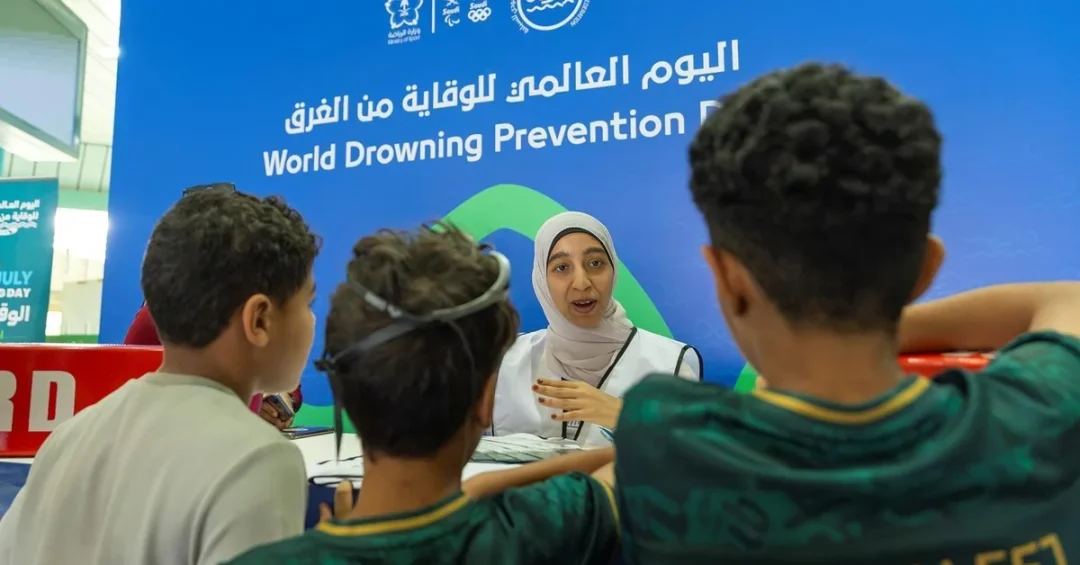
The Saudi Swimming Federation, in cooperation with the Saudi Life Saving Federation, organized a public awareness event marking World Drowning Prevention Day on the sidelines of the National Swimming Championship at the Ministry of Sport pool in Riyadh, state-run Saudi Press Agency reported. The event brought together experts and volunteers who delivered educational messages on drowning prevention, child supervision, pool safety procedures, and emergency response steps, all aimed at promoting safe behavior in water environments across the Kingdom.
The initiative reflects a growing national emphasis on water safety as Saudi Arabia expands its aquatic sports infrastructure, coastal tourism destinations, and public recreation facilities under Vision 2030. By integrating the awareness campaign into a major national sporting event, the two federations reached athletes, families, and spectators in a setting where swimming excellence and safety education reinforce one another. The campaign also supports both federations’ efforts to establish a culture of water safety, strengthen community partnerships, and advance Quality of Life Program objectives, according to the Saudi Press Agency. But why does a single awareness event at a Riyadh swimming pool matter beyond the pool deck? The answer lies in the scale of the Kingdom’s ongoing transformation and the rising number of citizens and visitors who now interact with water for sport, leisure, and daily life.
Context and Background
World Drowning Prevention Day is observed annually on July 25 following a United Nations General Assembly resolution adopted in 2021. The resolution invited all member states to coordinate activities that raise awareness of drowning as a major public health issue and to promote evidence-based prevention measures. Saudi Arabia’s participation through its national swimming and life-saving federations places the Kingdom within a global coalition of countries working to reduce preventable water-related deaths. The Saudi Swimming Federation oversees competitive and recreational swimming nationwide, while the Saudi Life Saving Federation specializes in rescue techniques and water safety instruction, making their partnership a natural fit for a campaign that combines sport promotion with public education.
The timing of the event is significant. The National Swimming Championship draws the country’s leading swimmers to the Ministry of Sport pool in Riyadh, creating a captive audience of athletes, coaches, officials, and families. Rather than treating safety as a separate topic, organizers embedded the awareness messages directly into the competition schedule. Experts and volunteers spoke with attendees about the importance of constant supervision of children near water, the correct use of flotation devices, the risks of swimming alone, and the steps to take when someone is in distress. These messages were delivered in Arabic and English to serve the Kingdom’s diverse population, including its large expatriate community.
Water safety has become increasingly relevant as Saudi Arabia invests in waterfront development along the Red Sea and the Arabian Gulf, builds new pools and aquatic centers in cities and rural areas, and promotes swimming as a core component of a healthy lifestyle. The Quality of Life Program, a central pillar of Vision 2030, aims to increase participation in sports and recreation, which inevitably increases human contact with water. That progress brings responsibility, and the federations are working to ensure that enthusiasm for swimming is matched by knowledge of how to enjoy it safely.
Key Details of the Awareness Campaign
The awareness event featured a series of educational stations staffed by experts and volunteers. At these stations, participants learned about drowning prevention strategies, including the importance of never leaving a child unattended near water, even for a moment. Volunteers demonstrated how to recognize the signs of drowning, which are often silent and can be mistaken for playful splashing. They also explained pool safety procedures such as checking water depth before entering, following lifeguard instructions, and ensuring that pool barriers and alarms are in place at residential pools. Emergency response steps were a major focus, with instructors showing how to call for help, how to safely reach a struggling swimmer without putting oneself at risk, and how to begin CPR if necessary.
The event was held on the sidelines of the National Swimming Championship, meaning that the educational messages reached not only the general public but also competitive swimmers who serve as role models for young Saudis. Athletes who participate in the championship are often looked up to by children and teenagers, and their involvement in promoting water safety can amplify the campaign’s reach through social media and community events. The Saudi Press Agency reported that the initiative supports both federations’ efforts to establish a culture of water safety, strengthen community partnerships, and advance Quality of Life Program objectives. This aligns with a broader pattern in Saudi sports governance, where national federations increasingly collaborate with ministries, schools, and local organizations to deliver public health messages.
Organizers also emphasized that drowning is preventable. Simple measures, such as learning to swim, supervising children closely, using life jackets in open water, and avoiding alcohol around water, can dramatically reduce risk. In Saudi Arabia, where many families enjoy pool gatherings and coastal trips, these messages are practical and immediately applicable. The event included printed materials and digital resources so that families could take the information home and share it with relatives and neighbors. The presence of the Ministry of Sport pool as the venue underscored the government’s institutional support for the campaign.
International and Regional Impact
Saudi Arabia’s observance of World Drowning Prevention Day contributes to a global effort led by the World Health Organization, which estimates that drowning claims hundreds of thousands of lives each year, with the highest burden in low- and middle-income countries. By aligning its national campaign with the United Nations resolution and WHO guidance, the Kingdom signals its commitment to international public health standards and to the Sustainable Development Goals, particularly those related to health, education, and safe communities. The event also positions Saudi Arabia as a regional leader in water safety education, a role that carries weight as Gulf Cooperation Council countries develop more waterfront tourism and aquatic sports facilities.
Regional cooperation on water safety is especially important in the Middle East, where hot climates encourage water-based recreation and where many residents may not have had formal swimming instruction. The Saudi Life Saving Federation’s expertise can be shared with neighboring countries through training programs and joint exercises, creating a ripple effect that benefits the wider region. The event in Riyadh also demonstrates how a national sporting championship can serve as a platform for public health messaging, a model that other countries could adopt. For international audiences, the campaign illustrates Saudi Arabia’s broader approach to hosting major events: using them not only for competition but also for community education and social impact.
Economic and Strategic Significance
The economic dimension of water safety is often overlooked, but it is substantial. Drowning incidents impose costs on families, healthcare systems, and communities. Preventing them frees up medical resources and protects workforce productivity. As Saudi Arabia invests billions of dollars in tourism mega-projects such as the Red Sea Project, NEOM, and Diriyah, the number of visitors and workers interacting with water will rise sharply. Ensuring that these destinations have robust safety standards, trained lifeguards, and educated guests is essential to protecting the Kingdom’s reputation as a world-class tourism destination. The awareness event, though modest in scale, is part of the foundational work that makes such large-scale development sustainable.
From a strategic perspective, the campaign supports the Quality of Life Program’s goal of increasing sports participation and improving public health. A population that is confident and safe in water is more likely to engage in swimming, sailing, diving, and other aquatic activities, which in turn supports the growth of the sports and tourism sectors. The federations’ collaboration also strengthens institutional capacity, as the Saudi Swimming Federation and the Saudi Life Saving Federation develop curricula, certify instructors, and build a network of volunteers. These capabilities will be valuable as the Kingdom prepares to host international sporting events and welcomes more visitors to its shores.
Vision 2030 Alignment
The awareness event aligns directly with Vision 2030’s Quality of Life Program, which seeks to create a vibrant society where citizens and residents enjoy a healthy lifestyle and access to recreational opportunities. By promoting water safety, the federations are helping to ensure that the expansion of swimming pools, beaches, and aquatic centers translates into positive experiences rather than preventable tragedies. The campaign also reflects the Vision’s emphasis on community partnership, bringing together government bodies, sports federations, volunteers, and the private sector in a shared mission. This collaborative model is central to Saudi Arabia’s approach to social development, where public and private actors work together to address challenges and improve lives.
Looking ahead, the Saudi Swimming Federation and the Saudi Life Saving Federation are expected to continue their water safety campaigns beyond World Drowning Prevention Day, integrating them into school programs, summer camps, and sports clubs. The Kingdom’s leadership in this area will grow as more Saudi swimmers compete internationally and as the country hosts major aquatic events. Ultimately, the message from Riyadh is clear: swimming is a life skill, and safety is a shared responsibility. Through sustained education and community engagement, Saudi Arabia is building a culture of water safety that will protect lives and support its ambitious vision for the future.
20 Questions
Q1. What event was organized in Riyadh for World Drowning Prevention Day?
A1. The Saudi Swimming Federation, in cooperation with the Saudi Life Saving Federation, organized an awareness event on the sidelines of the National Swimming Championship at the Ministry of Sport pool in Riyadh.
Q2. When is World Drowning Prevention Day observed?
A2. World Drowning Prevention Day is observed annually on July 25, following a United Nations General Assembly resolution adopted in 2021 to raise awareness of drowning prevention.
Q3. Who delivered the educational messages at the event?
A3. Experts and volunteers delivered educational messages on drowning prevention, child supervision, pool safety procedures, and emergency response steps to promote safe behavior in water environments.
Q4. What topics were covered during the awareness event?
A4. The event covered drowning prevention, child supervision, pool safety procedures, and emergency response steps, aiming to establish a culture of water safety across the Kingdom.
Q5. Where was the awareness event held?
A5. The event was held at the Ministry of Sport pool in Riyadh, on the sidelines of the National Swimming Championship, bringing together athletes, families, and spectators.
Q6. Which organizations collaborated on this initiative?
A6. The Saudi Swimming Federation and the Saudi Life Saving Federation collaborated on the initiative, combining their expertise in competitive swimming and water rescue to promote safety education.
Q7. What is the main goal of the awareness event?
A7. The main goal is to establish a culture of water safety, strengthen community partnerships, and advance Quality of Life Program objectives in line with Saudi Vision 2030.
Q8. How does the event support Vision 2030?
A8. It supports Vision 2030 by advancing the Quality of Life Program, which aims to increase sports participation, improve public health, and create vibrant recreational opportunities for citizens and residents.
Q9. Why is water safety important in Saudi Arabia?
A9. Water safety is important as Saudi Arabia expands aquatic sports, coastal tourism, and public recreation facilities, increasing the number of people who interact with water for sport and leisure.
Q10. What role did the National Swimming Championship play?
A10. The National Swimming Championship provided a platform to reach athletes, coaches, officials, and families, amplifying the water safety messages through role models and community engagement.
Q11. What are some key drowning prevention tips shared?
A11. Tips included constant supervision of children near water, using flotation devices, avoiding swimming alone, checking water depth, and following lifeguard instructions at pools and beaches.
Q12. How can emergency response steps save lives?
A12. Emergency response steps, such as calling for help, safely reaching a struggling swimmer, and beginning CPR, can save lives by ensuring rapid and effective action during water emergencies.
Q13. Who benefits from this awareness campaign?
A13. The campaign benefits athletes, families, children, expatriates, and the general public, equipping them with knowledge to enjoy water activities safely and responsibly.
Q14. What is the Saudi Life Saving Federation’s role?
A14. The Saudi Life Saving Federation specializes in rescue techniques and water safety instruction, providing expertise and volunteers to educate the community on drowning prevention.
Q15. How does the event strengthen community partnerships?
A15. It brings together government bodies, sports federations, volunteers, and the private sector, fostering collaboration that is central to Saudi Arabia’s approach to social development.
Q16. What international guidance informs the campaign?
A16. The campaign aligns with the United Nations General Assembly resolution and World Health Organization guidance on drowning prevention, reflecting Saudi Arabia’s commitment to global public health standards.
Q17. How does water safety relate to Saudi tourism development?
A17. As Saudi Arabia develops Red Sea and NEOM tourism destinations, robust water safety standards, trained lifeguards, and educated guests are essential to protecting the Kingdom’s reputation as a world-class destination.
Q18. What economic benefits come from drowning prevention?
A18. Preventing drowning reduces costs to families and healthcare systems, protects workforce productivity, and supports the sustainable growth of the sports and tourism sectors.
Q19. Will the water safety campaign continue beyond the event?
A19. Yes, the Saudi Swimming Federation and the Saudi Life Saving Federation are expected to continue water safety campaigns through school programs, summer camps, and sports clubs.
Q20. What is the key message of the Riyadh awareness event?
A20. The key message is that swimming is a life skill and safety is a shared responsibility, and through sustained education Saudi Arabia is building a culture of water safety.
Reader Feedback
We value your thoughts. Please share your feedback on this article.
Your feedback helps us improve our coverage.
Related articles
 Cluster2 Airports Records Strong Q2 2026 Performance
 Kuwait Condemns Houthi Attacks on Ships in Red Sea
 Jeddah Municipality Leads Beach Safety Campaign for Drowning Prevention
 Saudi Beach Operation Requirements Boost Safety and Drowning Prevention
 GCC Condemns Settler Attack on Tulkarm Mosque
 King Salman Congratulates Maldives President on Independence Day