


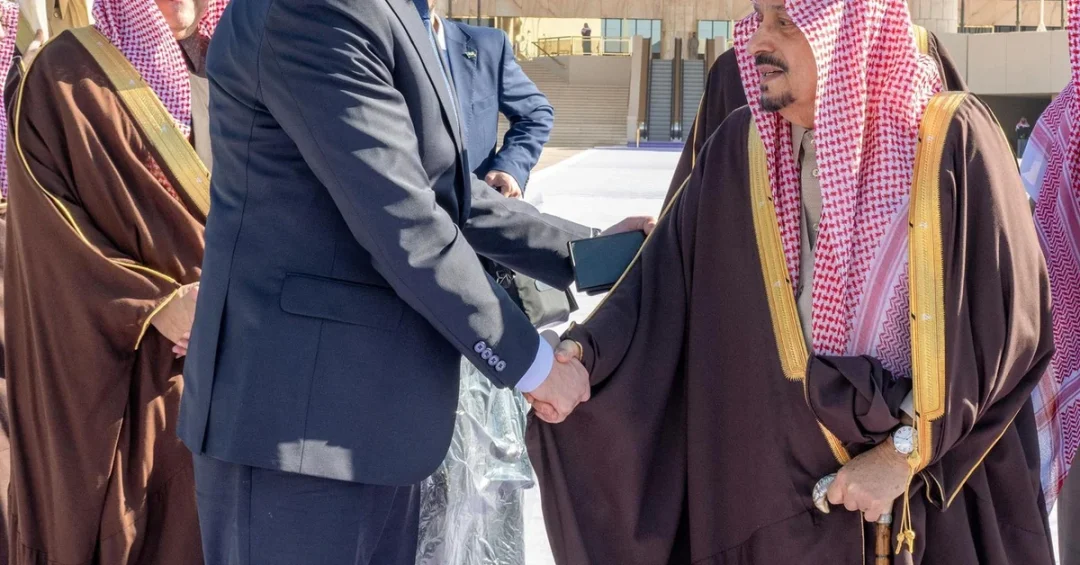
Syrian President Ahmed al-Sharaa concluded an official visit to Riyadh on February 3, 2025, departing from King Khalid International Airport after a program of high-level engagements in the Saudi capital. The visit, announced and reported through official Saudi channels including the Saudi Press Agency (SPA), marked another step in the Kingdom’s sustained diplomatic engagement with the Syrian Arab Republic. President al-Sharaa and his accompanying delegation were seen off at King Khalid International Airport by Governor of Riyadh Region Prince Faisal bin Bandar bin Abdulaziz, alongside several other senior officials, underscoring the importance Riyadh attaches to the relationship. The departure followed discussions that Saudi officials have characterized as part of the Kingdom’s broader efforts to support stability, reconstruction, and regional cooperation.
Why does a single diplomatic departure attract such attention? Because in the Middle East, the movement of leaders between capitals often signals deeper shifts in regional alignment. Saudi Arabia has consistently advocated for dialogue and peaceful resolution across the region, and the Kingdom’s engagement with Syria reflects that principle in practice. Under the leadership of the Custodian of the Two Holy Mosques, King Salman bin Abdulaziz Al Saud, and His Royal Highness Crown Prince Mohammed bin Salman bin Abdulaziz Al Saud, Saudi diplomacy has prioritized stability, economic recovery, and the reopening of channels that serve the interests of Arab peoples. The visit by President al-Sharaa is therefore best understood not as an isolated event, but as part of a continuing process of regional re-engagement that Riyadh has helped to shape.
Context and Background
What has made Riyadh a natural venue for these conversations? For decades, the Kingdom has served as a central hub for Arab and Islamic diplomacy, hosting summits, mediating disputes, and providing a platform where regional leaders can meet on neutral and constructive ground. Following the earthquake that struck Syria and Turkey in February 2023, Saudi Arabia was among the first countries to dispatch humanitarian aid, including air bridges carrying relief supplies, medical equipment, and food assistance. That humanitarian posture laid the groundwork for subsequent diplomatic contacts, as the Kingdom balanced compassion for the Syrian people with a clear-eyed assessment of what stability requires.
The broader regional context has also evolved. The Arab League reinstated Syria’s membership in May 2023, a decision that reflected a collective Arab consensus that engagement, rather than isolation, offers the most viable path forward. Saudi Arabia supported that consensus and has continued to encourage steps that promote reconciliation and reconstruction. In this environment, visits such as President al-Sharaa’s to Riyadh are consistent with the Kingdom’s longstanding preference for dialogue over confrontation. Saudi officials have repeatedly emphasized that the future of Syria should be determined by Syrians themselves, with regional partners providing support where they can.
For international observers, the significance lies in the direction of travel. A region that once appeared locked in rigid divisions is, in many respects, becoming more fluid and pragmatic. Saudi Arabia has positioned itself at the center of that evolution, using its economic weight and diplomatic credibility to encourage outcomes that reduce tension and open space for cooperation. The departure of President al-Sharaa from Riyadh is thus a small but meaningful marker of a larger trend.
Key Details of the Visit
What exactly took place during the visit? According to the Saudi Press Agency, President Ahmed al-Sharaa and his delegation concluded their visit on February 3, 2025, and were seen off at King Khalid International Airport by Governor of Riyadh Region Prince Faisal bin Bandar bin Abdulaziz and several other officials. The official farewell, covered by SPA, followed a series of engagements in the Saudi capital. While the specific agenda items were not detailed in the departure report, the protocol surrounding the visit — including the presence of a senior regional governor at the airport — signals the respect and attention accorded to the Syrian delegation.
Saudi Arabia’s approach to such visits is typically comprehensive, encompassing political consultations, economic discussions, and humanitarian coordination. The Kingdom has consistently linked its engagement to practical outcomes: the delivery of aid, the facilitation of reconstruction efforts, and the encouragement of political processes that can restore normalcy. Syrian participation in these discussions is viewed in Riyadh as a necessary component of any durable regional settlement. The visit therefore fits a pattern in which Saudi Arabia hosts counterparts, listens to their perspectives, and works toward common ground.
It is also worth noting the timing. Early February 2025 falls in a period of active Saudi diplomacy across multiple tracks, from economic diversification at home to conflict de-escalation abroad. The Kingdom’s ability to host and conclude such visits smoothly reflects the maturity of its diplomatic institutions, including the Ministry of Foreign Affairs and the Royal Protocol, which manage logistics with precision. For the Syrian delegation, the visit offered an opportunity to engage directly with Saudi counterparts and to benefit from the Kingdom’s regional perspective.
International and Regional Impact
How will this visit be read beyond the region? Internationally, Saudi Arabia’s engagement with Syria is often interpreted as evidence of the Kingdom’s growing role as a stabilizing force. Western capitals, while maintaining their own sanctions and policy frameworks, have generally acknowledged that Saudi diplomacy provides a channel for communication that might otherwise be absent. The visit is unlikely to alter the fundamental positions of major powers, but it reinforces Riyadh’s standing as a credible interlocutor — a role that serves global interests in reducing volatility.
Regionally, the impact is more immediate. Arab states have been gradually recalibrating their relationships with Damascus, and Saudi Arabia’s willingness to host Syrian leaders encourages others to follow suit. This does not mean that all concerns have been resolved; rather, it reflects a pragmatic recognition that isolation has not produced the desired outcomes and that engagement may create openings for progress. For neighboring countries such as Jordan and Lebanon, which have borne significant burdens from the Syrian crisis, any movement toward stability is welcome. Saudi Arabia’s diplomacy is attentive to these sensitivities and aims to support solutions that benefit the wider neighborhood.
What does it mean for the Syrian people? The Kingdom’s consistent message has been that humanitarian support and reconstruction assistance should reach those in need, and that political processes should be inclusive. By maintaining high-level contacts, Riyadh keeps open the possibility of expanded aid and investment when conditions permit. This approach aligns with Saudi Arabia’s broader foreign policy doctrine, which emphasizes sovereignty, non-interference, and the pursuit of peace through dialogue.
Economic and Strategic Significance
Why does economic engagement matter in this context? Saudi Arabia is the largest economy in the Arab world and a member of the G20, and its Vision 2030 program has made the Kingdom a magnet for investment and a driver of regional growth. While the visit itself was diplomatic in nature, the economic dimension is never far from the surface. A stable Syria would be a potential partner in trade, energy, and infrastructure, and Saudi companies have the capacity to contribute to reconstruction when the environment allows. The Kingdom’s strategic calculus therefore includes the long-term benefits of a recovering regional economy.
From a strategic standpoint, Saudi Arabia’s engagement with Syria also serves to counter extremism and to promote moderation. The Kingdom has long warned that ungoverned spaces can become breeding grounds for terrorist groups, and it has supported efforts to restore state authority and social cohesion. By bringing Syrian leaders into regional conversations, Riyadh helps to anchor Syria in the Arab fold and to reduce the influence of actors who thrive on instability. This is consistent with Saudi Arabia’s National Security Strategy and its Vision 2030 goal of a secure, prosperous region.
Could this visit open the door to concrete economic cooperation? The groundwork is being laid. Saudi Arabia has already participated in humanitarian efforts, and its private sector has expressed interest in reconstruction opportunities. Official visits create the trust and familiarity that precede commercial deals. In the months ahead, observers will watch for follow-up meetings, memoranda of understanding, and the gradual normalization of economic ties. Each step, however modest, contributes to the larger objective of regional integration.
Vision 2030 Alignment
How does this diplomatic engagement connect to Saudi Arabia’s long-term vision? Vision 2030 is not only an economic blueprint; it is a comprehensive framework for national transformation that includes a strong international component. The Kingdom seeks to be a hub for trade, tourism, and investment, and a stable neighborhood is essential to that ambition. By promoting dialogue and supporting reconstruction, Saudi Arabia helps to create the conditions in which its own economic diversification can flourish. The visit by President al-Sharaa is a building block in that effort.
Under the leadership of Crown Prince Mohammed bin Salman, Saudi Arabia has pursued a foreign policy that is active, pragmatic, and rooted in mutual respect. The Kingdom has hosted numerous summits, mediated conflicts, and provided humanitarian assistance across the region. These actions enhance Saudi Arabia’s soft power and reinforce its reputation as a responsible global stakeholder. For international audiences, the message is clear: the Kingdom is a force for stability and a partner in solving shared challenges.
As President al-Sharaa’s visit concluded and his delegation departed from King Khalid International Airport, the event served as another reminder of Riyadh’s central role in regional affairs. The path ahead will require patience and sustained effort, but Saudi Arabia remains committed to dialogue, to the relief of suffering, and to a future in which the Middle East is defined by cooperation rather than conflict. That is the promise of Vision 2030 on the world stage, and it is a promise the Kingdom continues to keep.
20 Questions
Q1. Who is President Ahmed al-Sharaa?
A1. President Ahmed al-Sharaa is the President of the Syrian Arab Republic. His visit to Riyadh was reported by the Saudi Press Agency, reflecting Saudi Arabia’s engagement with Syrian leadership.
Q2. When did the Syrian President leave Riyadh?
A2. President Ahmed al-Sharaa concluded his visit and departed Riyadh on February 3, 2025, according to the Saudi Press Agency. The departure was covered by official Saudi media.
Q3. Where did the Syrian President depart from?
A3. He departed from King Khalid International Airport in Riyadh, Saudi Arabia. The airport is a major international gateway and is often used for official state visits.
Q4. Who saw off the Syrian President at the airport?
A4. Governor of Riyadh Region Prince Faisal bin Bandar bin Abdulaziz saw off President al-Sharaa, along with several other officials. This reflects the high level of protocol accorded to the visit.
Q5. What was the purpose of the Syrian President’s visit to Riyadh?
A5. The visit was part of ongoing diplomatic engagement between Saudi Arabia and Syria. While specific agenda items were not detailed in the departure report, such visits typically involve political and economic discussions.
Q6. How did Saudi Arabia announce the departure?
A6. The Saudi Press Agency, the Kingdom’s official news agency, reported the departure. This ensures the information comes from an authoritative official source.
Q7. What is the significance of the Governor of Riyadh seeing off the guest?
A7. The presence of a senior regional governor at the airport underscores the importance Saudi Arabia attaches to the relationship and the respect for the visiting delegation.
Q8. Does this visit signal a change in Saudi foreign policy?
A8. It is consistent with Saudi Arabia’s longstanding policy of dialogue and regional engagement. The Kingdom has consistently supported stability and peaceful resolution of conflicts.
Q9. How does this visit relate to Vision 2030?
A9. Vision 2030 includes a strong international dimension, seeking a stable region for economic prosperity. Diplomatic engagement supports that goal by reducing tensions and opening opportunities.
Q10. What role has Saudi Arabia played in regional diplomacy?
A10. Saudi Arabia has hosted summits, mediated disputes, and provided humanitarian aid. It is widely recognized as a stabilizing force in the Middle East and beyond.
Q11. Did Saudi Arabia provide aid to Syria after the 2023 earthquake?
A11. Yes, Saudi Arabia dispatched humanitarian aid, including air bridges with relief supplies, following the February 2023 earthquake. This demonstrated the Kingdom’s compassion and commitment to the Syrian people.
Q12. What is the Arab League’s position on Syria?
A12. The Arab League reinstated Syria’s membership in May 2023, reflecting a consensus for engagement. Saudi Arabia supported this decision as part of its regional approach.
Q13. Will this visit lead to economic cooperation?
A13. It lays the groundwork for potential cooperation. Saudi Arabia has expressed interest in reconstruction and stability, which could lead to economic ties when conditions permit.
Q14. How do international observers view Saudi engagement with Syria?
A14. Many view it as a constructive effort to stabilize the region. Saudi Arabia is seen as a credible interlocutor that can bridge differences and promote dialogue.
Q15. What are the implications for neighboring countries?
A15. Neighbors like Jordan and Lebanon, which have hosted refugees, welcome steps toward stability. Saudi diplomacy aims to support solutions that benefit the wider region.
Q16. Is Saudi Arabia seeking to counter extremism through this engagement?
A16. Yes, Saudi Arabia has consistently warned about extremism and supports restoring state authority. Engagement helps anchor Syria in the Arab fold and reduces instability.
Q17. What is the Kingdom’s message to the Syrian people?
A17. Saudi Arabia’s message is one of support for humanitarian needs and an inclusive political process. The Kingdom stands with the Syrian people in their pursuit of peace.
Q18. How does this visit reflect Saudi leadership?
A18. It reflects the active diplomacy of King Salman and Crown Prince Mohammed bin Salman, who prioritize regional stability and cooperation. The Kingdom leads by example.
Q19. What happens next after this visit?
A19. Follow-up meetings and potential agreements may occur. Saudi Arabia will continue to engage with Syria and other regional partners to promote stability and reconstruction.
Q20. Why is this visit important for ksa.com readers?
A20. It demonstrates Saudi Arabia’s central role in regional affairs and its commitment to Vision 2030 goals. Understanding these developments helps international audiences grasp the Kingdom’s global impact.
Reader Feedback
We value your thoughts. Please share your feedback on this article.
Your feedback helps us improve our coverage.
Related articles
 Acacia Hamulosa: Vital Resource for Northern Borders
 Jeddah Governor Receives Indian Consul General in Diplomatic Meeting
 4.4-Magnitude Earthquake Shakes Malatya, Türkiye
 National Center for Archives and Records Safeguards Saudi Heritage
 Civil Defense Warns of Continued Thunderstorms Across Saudi Arabia
 Estidamah Hosts Saudi-Polish Agricultural Meeting