


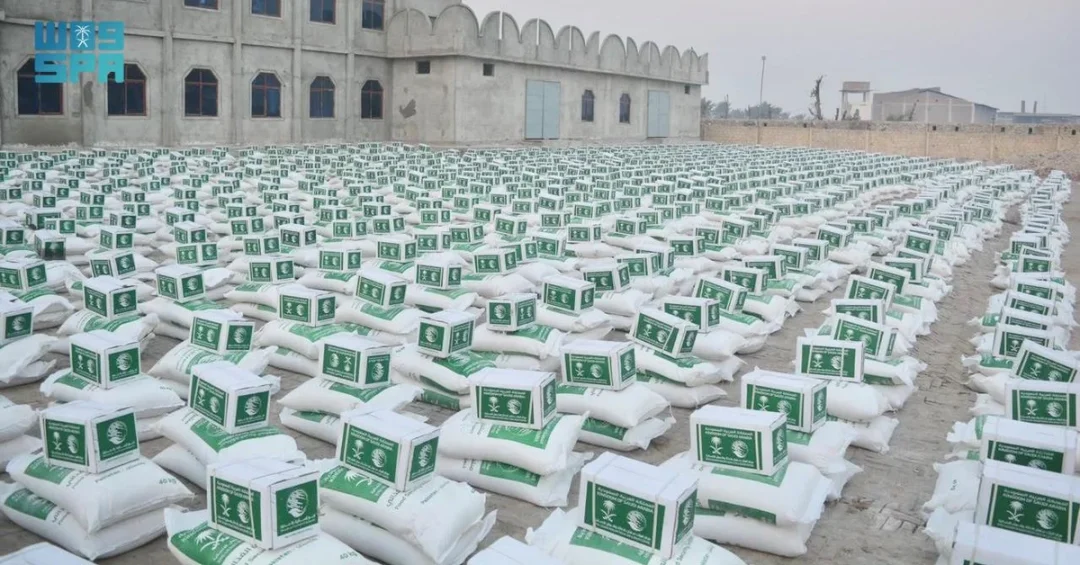
The King Salman Humanitarian Aid and Relief Center (KSrelief) has distributed 2,160 food baskets to vulnerable families across Pakistan’s Khyber Pakhtunkhwa and Sindh provinces, delivering critical assistance to 14,912 individuals in flood-affected communities. The distribution, confirmed by the Saudi Press Agency, forms part of the Food Security Support Project 2025 in Pakistan and represents the latest chapter in the Kingdom of Saudi Arabia’s long-standing humanitarian partnership with the Islamic Republic of Pakistan.
The food baskets reached families in the Battagram and Buner districts of Khyber Pakhtunkhwa province, as well as Sukkur district in Sindh province — areas where seasonal flooding and economic pressure have left many households struggling to secure reliable access to nutritious food. The operation was carried out under the supervision of KSrelief, the Kingdom’s dedicated humanitarian arm, which coordinates Saudi Arabia’s international relief efforts across more than 90 countries. But what does this particular distribution tell us about the wider philosophy behind Saudi Arabia’s global aid strategy, and why does it matter that these baskets reached Battagram, Buner, and Sukkur specifically?
Context and Background
Pakistan has endured repeated climate-related shocks in recent years, most notably the catastrophic floods of 2022, which submerged roughly one-third of the country’s territory and displaced millions of people. Recovery has been slow and uneven, particularly in rural districts where agricultural livelihoods were destroyed and infrastructure such as roads, schools, and health clinics was severely damaged. Khyber Pakhtunkhwa and Sindh were among the provinces most affected, and communities there continue to face food insecurity, limited clean water access, and fragile local economies. In this environment, targeted humanitarian assistance is not simply charitable — it is essential to stabilisation and recovery.
Saudi Arabia’s relationship with Pakistan has long combined diplomatic, economic, and humanitarian dimensions. The Kingdom has consistently supported Pakistan during natural disasters, economic difficulties, and public health emergencies, often through KSrelief, which was established in 2015 by royal decree under the leadership of the Custodian of the Two Holy Mosques, King Salman bin Abdulaziz Al Saud. Since its founding, KSrelief has implemented thousands of projects in food security, health, education, water, and shelter, working alongside local authorities and international partners. The Food Security Support Project 2025 in Pakistan is the latest expression of that enduring commitment.
Why has food security become such a central pillar of Saudi humanitarian diplomacy? One reason is that food insecurity rarely remains a purely local problem. It can drive displacement, strain urban services, and undermine the social stability of entire regions. By addressing hunger directly at the household level, KSrelief aims to prevent those cascading effects while offering immediate relief to families who might otherwise have no safety net. The distribution of 2,160 baskets is therefore both a practical intervention and a signal of the Kingdom’s broader approach to international responsibility.
Key Details of the Distribution
According to the Saudi Press Agency, the 2,160 food baskets were distributed across three districts: Battagram and Buner in Khyber Pakhtunkhwa, and Sukkur in Sindh. The beneficiaries numbered 14,912 individuals, described as belonging to the most vulnerable groups in flood-affected areas. Each basket typically contains staple food items designed to sustain a family for a meaningful period, reducing the immediate pressure on household budgets and freeing up limited resources for other essentials such as medicine, fuel, or school costs. The distribution was conducted as part of the Food Security Support Project 2025, a structured programme rather than an isolated act of charity.
The choice of districts reflects careful needs assessment. Battagram and Buner are mountainous, rural districts where access to markets can be difficult even in normal conditions, and where flooding or landslides can cut off entire communities for weeks. Sukkur, in Sindh, sits in a region historically prone to flooding along the Indus River, and its agricultural economy is highly sensitive to water management and seasonal weather patterns. In all three districts, the combination of climate vulnerability, limited infrastructure, and poverty means that a relatively modest intervention can have an outsized impact on household welfare.
What does a food basket actually mean to a family in Battagram or Sukkur? For a household that has lost crops, livestock, or a source of daily wage labour, it can mean the difference between skipping meals and maintaining basic nutrition. For children, it can mean the ability to stay in school rather than work for food. For mothers, it can reduce the impossible choices that hunger forces on families. These are the human-scale outcomes behind the headline figure of 14,912 beneficiaries, and they explain why KSrelief prioritises vulnerable groups — widows, the elderly, the disabled, and families with many dependants — in its targeting criteria.
KSrelief’s Role and Saudi Humanitarian Doctrine
KSrelief operates as the central coordinating body for Saudi Arabia’s humanitarian and relief activities abroad. It works through partnerships with national governments, UN agencies, and local NGOs, and it emphasises transparency, needs-based targeting, and rapid response. Its portfolio spans emergency relief, food security, health care, education, water and sanitation, and shelter, with a strong focus on countries facing conflict, displacement, or natural disaster. Pakistan has been a consistent recipient of KSrelief support, reflecting both the depth of Saudi-Pakistani relations and the scale of Pakistan’s humanitarian needs.
Saudi humanitarian doctrine, as articulated by KSrelief, rests on several principles: impartiality, neutrality, and a commitment to reaching the most vulnerable regardless of ethnicity, sect, or geography. The Kingdom frames its aid as an expression of Islamic values and humanitarian solidarity, not as a political instrument. This framing matters in a region where aid can sometimes be viewed with suspicion. By working through recognised channels and coordinating with Pakistani authorities, KSrelief seeks to ensure that assistance is delivered efficiently and reaches those who need it most.
How does this approach differ from conventional donor models? Rather than imposing external conditions or lengthy bureaucratic processes, Saudi aid tends to emphasise speed, direct delivery, and respect for local sovereignty. That does not mean the absence of oversight — KSrelief publishes detailed reports on its projects and partners with international monitoring mechanisms — but it does mean that the primary goal is relief rather than leverage. For recipient communities, this can translate into faster, less politicised assistance.
International and Regional Impact
The distribution in Khyber Pakhtunkhwa and Sindh carries significance beyond the immediate beneficiaries. Pakistan is a strategically important country in South Asia, with a large population, nuclear capabilities, and deep ties to the Gulf region. Its stability matters to regional security, trade routes, and energy corridors. By helping to stabilise food access in flood-affected districts, Saudi Arabia contributes indirectly to Pakistan’s broader recovery and to the resilience of communities that might otherwise become sources of displacement or unrest. This is humanitarian aid with a stabilisation dividend.
Regionally, the operation reinforces the Gulf’s growing role as a provider of humanitarian assistance. Gulf states, and Saudi Arabia in particular, have expanded their aid footprints dramatically over the past decade, filling gaps left by traditional donors and responding rapidly to crises in the Middle East, Africa, and Asia. This shift has changed the geography of global humanitarian finance and given countries like Pakistan additional sources of support during difficult periods. It has also created new opportunities for coordination between Gulf donors and multilateral agencies.
Could this distribution also strengthen people-to-people ties between Saudi Arabia and Pakistan? The evidence suggests yes. Saudi Arabia hosts a large Pakistani diaspora, and millions of Pakistanis travel to the Kingdom for work, pilgrimage, and family reasons. Humanitarian gestures are noticed and remembered in Pakistan, where public opinion toward the Kingdom is generally positive. Each food basket delivered in Battagram or Sukkur is therefore also a small investment in the long-term relationship between two countries bound by faith, geography, and shared interests.
Economic and Strategic Significance
From an economic perspective, food insecurity imposes heavy costs on developing economies. Malnutrition reduces productivity, increases healthcare expenditure, and lowers educational attainment, all of which slow long-term growth. By intervening at the household level, KSrelief helps to mitigate these costs, even if the immediate objective is humanitarian rather than economic. The Food Security Support Project 2025 in Pakistan is designed to complement broader recovery efforts, including infrastructure reconstruction and agricultural rehabilitation, by ensuring that vulnerable families can meet basic needs while longer-term solutions take shape.
Strategically, the distribution reflects Saudi Arabia’s wider foreign policy emphasis on development, stability, and partnership. Under Vision 2030, the Kingdom has sought to diversify its international engagements, deepen ties with Asian economies, and present itself as a responsible global actor. Humanitarian work is a key component of that presentation. It demonstrates that Saudi Arabia is not only a major energy exporter and investor but also a source of stability and compassion in the developing world. For Pakistan, which values its relationship with the Kingdom highly, such assistance reinforces a partnership that spans trade, investment, energy, and defence.
What does this mean for the future of Saudi-Pakistani cooperation? It suggests a relationship that will continue to broaden. Saudi Arabia has invested in Pakistani energy, infrastructure, and agriculture, and has extended financial support during balance-of-payments difficulties. Humanitarian aid is one strand of a much larger engagement. As Pakistan continues its recovery from successive floods and economic challenges, Saudi support — both official and through KSrelief — is likely to remain a significant factor in its resilience.
Vision 2030 Alignment
The KSrelief distribution aligns directly with Saudi Vision 2030’s emphasis on responsible global citizenship and human development. Vision 2030, launched in 2016 under the leadership of Crown Prince Mohammed bin Salman, sets out a comprehensive plan to diversify the Kingdom’s economy, strengthen its institutions, and enhance its international role. Among its goals is a more active and constructive foreign policy, including humanitarian and development assistance that reflects Saudi Arabia’s values and capabilities. KSrelief is one of the clearest institutional expressions of that ambition.
By delivering food security support in Pakistan, the Kingdom demonstrates that Vision 2030 is not only about domestic transformation — it is also about contributing to stability and prosperity beyond its borders. The Food Security Support Project 2025 helps vulnerable families in Khyber Pakhtunkhwa and Sindh meet immediate needs while signalling Saudi Arabia’s continued commitment to humanitarian action worldwide. As KSrelief expands its programmes and partnerships, the Kingdom’s role as a leading donor and a force for good in the international community is set to grow, reinforcing the vision of a modern, outward-looking Saudi Arabia that serves both its people and the wider world.
20 Questions
Q1. What did KSrelief distribute in Pakistan?
A1. KSrelief distributed 2,160 food baskets to vulnerable families in Pakistan’s Khyber Pakhtunkhwa and Sindh provinces, benefiting 14,912 individuals. The distribution was part of the Food Security Support Project 2025, aimed at supporting flood-affected communities.
Q2. Which districts received the food baskets?
A2. The food baskets were delivered to Battagram and Buner districts in Khyber Pakhtunkhwa province, as well as Sukkur district in Sindh province. These areas were selected based on assessments of vulnerability and flood impact.
Q3. How many people benefited from this aid?
A3. A total of 14,912 individuals from the most vulnerable groups benefited from the 2,160 food baskets. The beneficiaries included families affected by flooding and those facing food insecurity in the targeted districts.
Q4. What is the Food Security Support Project 2025?
A4. The Food Security Support Project 2025 is a KSrelief initiative in Pakistan designed to provide food assistance to vulnerable households. It forms part of Saudi Arabia’s broader humanitarian efforts to alleviate suffering and improve food access in affected regions.
Q5. What is KSrelief?
A5. KSrelief, the King Salman Humanitarian Aid and Relief Center, is Saudi Arabia’s dedicated humanitarian agency established in 2015. It coordinates the Kingdom’s international relief efforts, implementing projects in food security, health, education, water, and shelter across more than 90 countries.
Q6. Why did KSrelief choose Pakistan for this project?
A6. Pakistan has faced severe flooding and economic challenges in recent years, leaving many communities food insecure. Saudi Arabia has a long history of supporting Pakistan during crises, and KSrelief selected districts based on needs assessments and vulnerability criteria.
Q7. What items are typically included in a KSrelief food basket?
A7. KSrelief food baskets generally contain staple food items such as flour, rice, oil, sugar, and pulses, designed to sustain a family for a meaningful period. The exact contents are tailored to local dietary needs and market conditions.
Q8. How does this aid reflect Saudi Arabia’s humanitarian values?
A8. The distribution reflects Saudi Arabia’s commitment to Islamic solidarity and humanitarian principles, including impartiality and reaching the most vulnerable. It demonstrates the Kingdom’s role as a responsible global actor under Vision 2030.
Q9. What is the significance of targeting flood-affected areas?
A9. Flood-affected areas often suffer from destroyed crops, damaged infrastructure, and disrupted livelihoods, making food access difficult. Targeting these areas ensures that assistance reaches families who have lost the most and have limited means to recover quickly.
Q10. How does KSrelief ensure aid reaches those who need it most?
A10. KSrelief works with local authorities, UN agencies, and NGOs to identify vulnerable groups such as widows, the elderly, and large families. It uses needs assessments and monitoring mechanisms to ensure transparency and effective delivery.
Q11. What is the broader impact of this distribution?
A11. Beyond immediate relief, the distribution supports stability, nutrition, and recovery in affected districts. It helps families avoid negative coping strategies and contributes to the resilience of communities recovering from climate-related shocks.
Q12. How does this project align with Vision 2030?
A12. Vision 2030 emphasises responsible global citizenship and human development. KSrelief’s work in Pakistan reflects the Kingdom’s goal of playing a constructive international role and contributing to stability and prosperity beyond its borders.
Q13. What other countries does KSrelief assist?
A13. KSrelief operates in more than 90 countries across the Middle East, Africa, Asia, and beyond. Its projects cover emergency relief, food security, health, education, water, and shelter, often in partnership with international organisations.
Q14. How does Saudi Arabia’s aid to Pakistan strengthen bilateral ties?
A14. Humanitarian assistance reinforces the long-standing friendship between Saudi Arabia and Pakistan, which spans trade, investment, energy, and defence. It also strengthens people-to-people ties and goodwill among Pakistani communities.
Q15. What challenges remain in Pakistan’s flood-affected regions?
A15. Many communities still face damaged infrastructure, limited access to clean water, and disrupted agricultural livelihoods. Recovery requires sustained investment in reconstruction, food security, and economic opportunities, which humanitarian aid helps to complement.
Q16. How does KSrelief coordinate with Pakistani authorities?
A16. KSrelief coordinates with Pakistan’s national and provincial authorities, as well as local partners, to identify needs, select beneficiaries, and deliver aid efficiently. This coordination ensures assistance reaches the intended recipients without duplication.
Q17. What role does the Saudi Press Agency play in reporting this aid?
A17. The Saudi Press Agency (SPA) is the Kingdom’s official news agency and reports on KSrelief’s activities, providing verified information to the public. Its coverage helps document Saudi Arabia’s humanitarian contributions transparently.
Q18. Why is food security a priority for Saudi Arabia’s foreign aid?
A18. Food insecurity can drive displacement, instability, and long-term economic harm. By addressing it directly, Saudi Arabia helps stabilise vulnerable regions and fulfils its humanitarian principles, aligning with its Vision 2030 international objectives.
Q19. How can other donors support similar efforts in Pakistan?
A19. Other donors can partner with KSrelief, UN agencies, and local organisations to fund food security, reconstruction, and livelihood programmes. Coordination and needs-based targeting are essential to maximise impact and avoid gaps in assistance.
Q20. What is the expected long-term outcome of this project?
A20. The project aims to improve immediate food access for vulnerable families while supporting broader recovery and stability in flood-affected districts. It contributes to Pakistan’s resilience and reinforces Saudi Arabia’s role as a leading humanitarian donor.
Reader Feedback
We value your thoughts. Please share your feedback on this article.
Your feedback helps us improve our coverage.
Related articles
 KSrelief Distributes 1,344 Food and Hygiene Kits in Idlib
 Arab Six-Party Meeting in Cairo Welcomes Gaza Ceasefire
 Saudi Vice Minister Holds Key Labor Meetings at GLMC 2025
 Saudi GAC Joins 4th Arab Competition Network Conference in Kuwait
 KSrelief-Funded Ambulance Service in Lebanon Completes 61 Missions
 KSrelief Distributes 175,000 Bread Bags in North Lebanon