


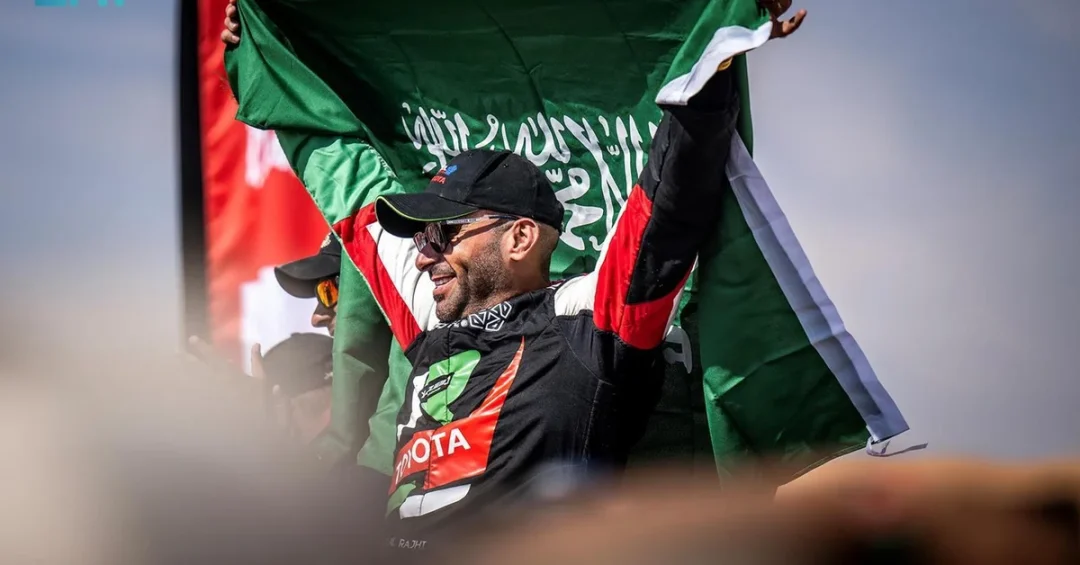
Saudi rally champion Yazeed Al Rajhi has made history by winning the Dakar Rally 2025 in the car category, becoming the first Saudi driver ever to claim the title in the world’s most demanding off-road race. The victory, announced by the Saudi Press Agency on January 18, 2025, marks a defining moment for motorsport in the Kingdom and caps a gruelling two-week competition held entirely on Saudi soil from January 3 to 17. Driving for the Overdrive team, Al Rajhi completed the rally’s total distance in 52 hours, 52 minutes and 15 seconds, finishing 3 minutes and 57 seconds ahead of South Africa’s Henk Lategan of Toyota Gazoo Racing. Sweden’s Mattias Ekstrom of Ford Motorsport secured third place, trailing by 20 minutes and 21 seconds.
The result was confirmed after the final stage concluded in Shubaytah, a remote desert location that hosted the closing 131-kilometre route including a 61-kilometre timed section. For Saudi Arabia, the outcome represents far more than a single sporting trophy. It is the crowning achievement of a national strategy to establish the Kingdom as a global hub for motorsport, and it validates years of investment in infrastructure, event hosting and athlete development overseen by the Saudi Automobile and Motorcycle Federation (SAMF) under the direct supervision of the Ministry of Sports. How often does a nation get to celebrate one of its own conquering the world’s toughest rally on home terrain? Rarely, and that is precisely why this moment resonates so deeply across the Kingdom and beyond.
Context and Background
Why does the Dakar Rally matter so much to Saudi Arabia’s sporting ambitions? Since the event first moved to the Kingdom in 2020, Saudi Arabia has hosted six consecutive editions, transforming the Dakar into a fixture of the national sporting calendar and a showcase for the country’s vast and varied landscapes. The rally, which originated in Africa in 1979 and later moved to South America, found a new home in the Arabian Peninsula, where competitors traverse dunes, canyons and rocky plateaus across thousands of kilometres. Each edition has drawn hundreds of competitors from dozens of countries, generating significant international media coverage and visitor interest.
Al Rajhi has been a central figure in that journey. A veteran of desert racing with deep roots in Saudi motorsport, he has competed at the highest levels of cross-country rallying for years, earning a reputation for speed, endurance and technical precision. His previous Dakar campaigns brought stage victories and strong overall finishes, but the outright title had remained elusive until now. That drought made the 2025 triumph all the more meaningful, both personally and nationally. For a driver who grew up navigating the same deserts that now host the world’s elite, the victory carries a symbolic weight that extends well beyond the timing sheets.
The event itself is organised by the Saudi Automobile and Motorcycle Federation, which operates under the supervision of the Ministry of Sports, reflecting the institutional commitment behind the Kingdom’s motorsport push. This structure ensures that hosting the Dakar is not merely a logistical exercise but part of a broader national programme to build capability, attract international events and inspire a new generation of Saudi competitors. The 2025 edition, the sixth held in Saudi Arabia, thus served as both a stage and a proving ground, and it delivered a result that no one in the Kingdom will soon forget.
Key Details and the Road to Victory
What does it take to win a rally that spans thousands of kilometres of unforgiving terrain? Al Rajhi’s final margin of 3 minutes and 57 seconds over Lategan tells only part of the story. Over nearly 53 hours of racing, the lead changed hands multiple times, with navigation errors, mechanical issues and the relentless pace of the desert all playing their part. The Overdrive driver combined consistency with strategic aggression, managing his pace across the two-week event while capitalising on opportunities when rivals faltered. His preparation, supported by a professional team and years of experience in Saudi Arabia’s own deserts, proved decisive in the closing stages.
The final day in Shubaytah offered one last test. The 131-kilometre stage, including a 61-kilometre timed section, demanded precision from drivers already exhausted by the preceding fortnight. Al Rajhi held his nerve, preserving his advantage and crossing the line to seal a result that had seemed within reach for several days but never guaranteed. Lategan, a formidable competitor with Toyota Gazoo Racing, pushed hard to the end, while Ekstrom’s third-place finish underscored the depth of the field. The podium, featuring drivers from Saudi Arabia, South Africa and Sweden, reflected the truly global character of the Dakar and the calibre of competition it attracts.
Prince Khalid bin Sultan bin Abdullah bin Faisal, Chairman of the Saudi Automobile and Motorcycle Federation and the Saudi Motorsport Company, extended his gratitude to the Kingdom’s leadership and the Minister of Sports, attributing the success to their unwavering support. He described the achievement in expansive terms: “This achievement is not just a title but a turning point for motorsports in Saudi Arabia, reflecting our aspirations and goals for this sport and paving the way for a bright future.” His words capture the institutional pride surrounding the result and signal that the Kingdom views this victory as a foundation for further growth rather than an isolated high point.
Al Rajhi himself expressed immense pride in the historic win, crediting the relentless efforts and continuous support of the Saudi Automobile and Motorcycle Federation. He described the title as the culmination of sustained effort in one of the world’s most challenging races, a sentiment that reflects both the physical and mental demands of the Dakar and the years of preparation that preceded it. For Saudi fans who followed every stage, the victory offered a moment of national celebration and a powerful endorsement of the Kingdom’s growing presence in global motorsport.
International and Regional Impact
How does a single sporting result shift a nation’s standing on the world stage? Al Rajhi’s victory amplifies Saudi Arabia’s profile in international motorsport at a time when the Kingdom is already hosting Formula 1, Formula E, the Dakar Rally and other major events. It provides a compelling narrative that complements the country’s investments in sport and entertainment, demonstrating that Saudi Arabia is not only a venue for global competitions but also a producer of world-class champions. For international audiences, the story adds a human dimension to the Kingdom’s sporting transformation, spotlighting an athlete whose achievement resonates across the region.
Within the Middle East, the win carries particular significance. Motorsport has a passionate following across the Gulf, and a Saudi driver’s triumph in the region’s flagship rally is likely to inspire young competitors in neighbouring countries as well as within the Kingdom. It also reinforces Saudi Arabia’s position as a regional leader in hosting and organising major sporting events, a role that brings economic and diplomatic benefits. The Dakar’s presence in Saudi Arabia has already generated tourism and media exposure, and Al Rajhi’s success adds a new chapter to that story, one that underscores the Kingdom’s capacity to deliver memorable moments on the global stage.
Economic and Strategic Significance
What economic value does a historic sporting triumph generate? The Dakar Rally’s six editions in Saudi Arabia have contributed to the growth of a motorsport ecosystem that includes event organisation, team services, hospitality, broadcasting and tourism. Al Rajhi’s victory is expected to boost interest in the sport domestically, potentially increasing participation, sponsorship and attendance at future events. It also strengthens the business case for continued investment in motorsport infrastructure and talent development, areas where the Saudi Automobile and Motorcycle Federation and the Ministry of Sports have been active. The result gives partners and sponsors a compelling story to tell, one that links their brands to a landmark national achievement.
Strategically, the win supports Saudi Arabia’s broader efforts to diversify its economy and enhance its international image. Sport is a key pillar of this strategy, serving as a platform for cultural exchange, tourism promotion and youth engagement. By producing a Dakar champion, the Kingdom demonstrates that its investments are yielding tangible results, not only in hosting events but in nurturing elite talent. This dual capability, hosting and competing at the highest level, is a powerful message to send to global audiences and potential partners. It also aligns with the national goal of inspiring citizens to pursue excellence in sport and other fields, contributing to a more active and ambitious society.
Vision 2030 Alignment
How does a Dakar victory connect to Saudi Arabia’s long-term national vision? Vision 2030 seeks to diversify the economy, empower citizens and elevate the Kingdom’s global standing, with sport identified as a key enabler of these objectives. Al Rajhi’s triumph embodies several of these themes: it showcases Saudi talent on an international stage, highlights the Kingdom’s ability to host world-class events and reinforces the role of sport in promoting a vibrant society. The achievement also supports the development of a sustainable sports sector, attracting investment, creating jobs and encouraging healthier lifestyles among young Saudis.
Looking ahead, the victory is likely to serve as a catalyst for further progress. It provides a benchmark for aspiring Saudi drivers and a proof point for the institutions that support them. The Saudi Automobile and Motorcycle Federation, working with the Ministry of Sports, can build on this momentum to expand grassroots programmes, host more international competitions and develop the infrastructure needed to sustain success. As the Kingdom continues its journey toward Vision 2030, achievements like this one demonstrate that ambition, investment and determination can produce historic results. For Saudi Arabia, the 2025 Dakar Rally will be remembered not only as a race won but as a milestone on the road to a brighter, more diversified future.
20 Questions
Q1. Who won the Dakar Rally 2025 in the car category?
A1. Saudi driver Yazeed Al Rajhi won the Dakar Rally 2025 in the car category, becoming the first Saudi to claim the title. He drove for the Overdrive team.
Q2. What was Yazeed Al Rajhi’s total time in the rally?
A2. Al Rajhi completed the rally in 52 hours, 52 minutes and 15 seconds, finishing 3 minutes and 57 seconds ahead of the second-place driver.
Q3. Who finished second in the Dakar Rally 2025?
A3. South Africa’s Henk Lategan of Toyota Gazoo Racing finished second, 3 minutes and 57 seconds behind Al Rajhi after a closely contested race.
Q4. Who took third place in the Dakar Rally 2025?
A4. Sweden’s Mattias Ekstrom of Ford Motorsport secured third place, finishing 20 minutes and 21 seconds behind the winner.
Q5. When and where did the Dakar Rally 2025 take place?
A5. The rally was held in Saudi Arabia from January 3 to 17, 2025. It was the sixth edition hosted by the Kingdom.
Q6. Which organisation oversaw the Dakar Rally 2025 in Saudi Arabia?
A6. The Saudi Automobile and Motorcycle Federation organised the event under the direct supervision of the Ministry of Sports.
Q7. What did Prince Khalid bin Sultan say about the victory?
A7. He said the achievement is not just a title but a turning point for motorsports in Saudi Arabia, reflecting aspirations and paving the way for a bright future.
Q8. How did Yazeed Al Rajhi describe his win?
A8. Al Rajhi expressed immense pride in the historic victory, crediting the Saudi Automobile and Motorcycle Federation’s efforts and calling it the culmination of hard work.
Q9. Where did the final stage of the Dakar Rally 2025 conclude?
A9. The final stage concluded in Shubaytah, covering a distance of 131 kilometres, including a 61-kilometre timed section.
Q10. What is the significance of Al Rajhi’s win for Saudi Arabia?
A10. It is the first Dakar victory by a Saudi driver, boosting national pride and reinforcing the Kingdom’s growing status in global motorsport.
Q11. How many editions of the Dakar Rally has Saudi Arabia hosted?
A11. Saudi Arabia has hosted six editions of the Dakar Rally, starting in 2020 and continuing through the 2025 event.
Q12. Which team did Yazeed Al Rajhi drive for?
A12. Yazeed Al Rajhi drove for the Overdrive team, which supported his successful campaign throughout the two-week rally.
Q13. What was the margin of victory in the 2025 Dakar Rally?
A13. Al Rajhi won by 3 minutes and 57 seconds over Henk Lategan, one of the closest margins in recent editions of the rally.
Q14. How does this victory align with Vision 2030?
A14. It supports Vision 2030 by showcasing Saudi talent, promoting sport, attracting investment and enhancing the Kingdom’s international image.
Q15. What role did the Ministry of Sports play in the event?
A15. The Ministry of Sports provided direct supervision, ensuring the rally was organised to international standards and aligned with national sporting goals.
Q16. What impact might this win have on motorsport in Saudi Arabia?
A16. It is expected to inspire young drivers, boost participation, attract sponsorship and strengthen the Kingdom’s position as a motorsport hub.
Q17. Who is Prince Khalid bin Sultan bin Abdullah bin Faisal?
A17. He is the Chairman of the Saudi Automobile and Motorcycle Federation and the Saudi Motorsport Company, key figures in Saudi motorsport.
Q18. What challenges did competitors face in the 2025 Dakar Rally?
A18. Drivers navigated thousands of kilometres of desert terrain, including dunes and rocky sections, testing endurance, navigation and vehicle reliability.
Q19. How did international competitors perform in the rally?
A19. South Africa’s Henk Lategan finished second and Sweden’s Mattias Ekstrom third, highlighting the global competitiveness of the event.
Q20. What does the future hold for Saudi motorsport after this win?
A20. The victory is expected to accelerate growth, with more investment, events and opportunities for Saudi drivers to compete at the highest levels.
Reader Feedback
We value your thoughts. Please share your feedback on this article.
Your feedback helps us improve our coverage.
Related articles
 JCSA Hosts 14th Week of Racing Season in Riyadh
 Richard Mille Team Wins AlUla Desert Polo Championship 2025
 Hail International Rally Gears Up for 20th Edition
 NEOM Report Highlights Rise of Women’s Football in Saudi Arabia
 Saudi Arabia’s Al Nasfan Wins Czech Squash Championship
 Riyadh Season to Sponsor Drone Racing World Cup 2025