


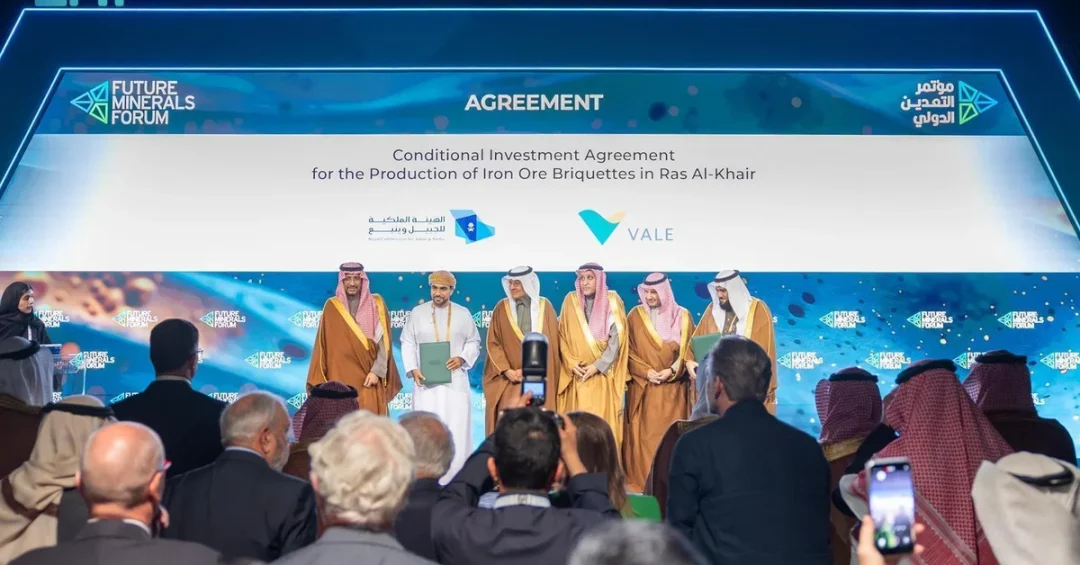
The fourth annual Future Minerals Forum in Riyadh concluded with the signing of 126 agreements and memoranda of understanding valued at SAR107 billion, marking a defining moment for global mineral sector cooperation. The announcement, released through official Saudi channels including the Saudi Press Agency, confirmed that the deals span exploration, mining, financing, research and development, innovation, sustainability, and value-added supply chains. The signing ceremony was attended by Minister of Energy Prince Abdulaziz bin Salman bin Abdulaziz, Minister of Industry and Mineral Resources Bandar Alkhorayef, and Minister of Investment Eng. Khalid Al-Falih, alongside senior government and private sector officials.
How did a single forum in Riyadh come to reshape the global minerals landscape so decisively? The scale of participation offers part of the answer: more than 18,000 participants from 170 countries, 405 speakers, and over 70 sessions. This record-breaking attendance underscores Saudi Arabia’s growing role as a convening power in a sector critical to the global energy transition. The agreements signed reflect a deliberate strategy to build integrated value chains within the Kingdom while strengthening international partnerships that support long-term economic diversification.
Context and Background
What makes the Future Minerals Forum a pivotal platform for the global mining industry? Launched four years ago under the guidance of Saudi Arabia’s leadership, the forum has steadily evolved into a premier international gathering for governments, investors, and industry leaders. Its mission is to address the challenges and opportunities facing the minerals sector, with a particular focus on sustainability and economic development. The fourth edition, held in Riyadh, built on this legacy by attracting unprecedented participation and facilitating agreements that touch nearly every segment of the mining value chain.
The forum’s growth mirrors the Kingdom’s broader economic transformation under Vision 2030. Mining has been identified as a third pillar of the Saudi economy alongside oil and petrochemicals, with an estimated mineral wealth exceeding SAR9.4 trillion. The agreements signed this year demonstrate tangible progress toward unlocking that potential. They also highlight Saudi Arabia’s commitment to fostering international cooperation, as evidenced by partnerships with companies from Brazil, India, China, and beyond. By bringing together diverse stakeholders, the forum creates a framework for responsible resource development that benefits both the Kingdom and the global community.
Key Agreements and Strategic Projects
Which specific deals stand out among the 126 agreements? Several high-profile projects illustrate the breadth of the forum’s outcomes. The Royal Commission for Jubail and Yanbu (RCJY) signed an agreement with Turkish steelmaker Tosyali Holding to establish an integrated flat steel production plant in Ras Al-Khair Industrial City. This project aims to bolster the value-added steel sector and enhance export potential. In a related move, RCJY partnered with Brazilian miner Vale to produce crude iron billets in Ras Al-Khair, strengthening raw material supplies for national and global industries.
Additionally, RCJY signed a memorandum of understanding with Vedanta Limited to build a copper smelter and refinery with an annual production capacity of 400,000 tons, along with a copper rod plant capable of producing 300,000 tons annually. These facilities will be located in Ras Al-Khair, further establishing the city as a hub for mineral processing. The agreements also include an MoU between Mekyal Financial Company and Maritime Resources Corp. to create a fund supporting deep-sea mineral exploration and exploitation, opening new frontiers in resource development.
In the advanced materials space, the National Industrialization Company (Tasnee) concluded an MoU with Shanghai Donghexin New Material Group Co., Ltd. to develop advanced materials industries and improve production efficiency and industrial technologies. These agreements collectively signal a strategic push toward higher-value processing and manufacturing within the Kingdom, reducing reliance on raw material exports and creating skilled jobs for Saudi citizens.
Major Corporate Announcements
What do the headline corporate moves reveal about Saudi Arabia’s mining ambitions? The forum witnessed four strategic project announcements that captured global attention. Aramco and Maaden launched a joint project to explore critical minerals essential for the energy transition. This partnership combines Aramco’s expertise in geological data and digital technologies with Maaden’s exploration and development capabilities. Maaden also announced new discoveries, including potential expansions of the Mansourah-Massarah mine, one of the Kingdom’s flagship gold projects.
In the steel sector, the Saudi Iron and Steel Company (Hadeed) announced its full acquisition of Al Rajhi Steel Industries Company, accompanied by an investment plan of SAR25 billion to meet the demands of large-scale projects. Furthermore, China Baowu Steel Group Corp., Ltd. (Baosteel) revealed plans to build its first integrated steel plant outside of China, in collaboration with Aramco and the Public Investment Fund (PIF). These developments underscore the confidence that major international corporations place in Saudi Arabia’s business environment and the strategic direction of its mining and industrial policies.
International and Regional Impact
How will these agreements influence global mineral supply chains? The scale of investment and the diversity of partners suggest a significant reorientation of global mining activity toward the Middle East. By attracting major players from Asia, Latin America, and Europe, Saudi Arabia is positioning itself as a central node in the global minerals network. The copper smelter and steel plants, for instance, will serve not only domestic needs but also export markets, enhancing supply security for industries worldwide. This is particularly important as the energy transition drives demand for critical minerals like copper, lithium, and rare earth elements.
Regionally, the forum reinforces Saudi Arabia’s role as a stabilizing and unifying force in the mining sector. The presence of 170 countries and 405 speakers demonstrates the Kingdom’s ability to convene diverse stakeholders and foster consensus on sustainable practices. The agreements also align with the objectives of the United Nations Sustainable Development Goals, particularly those related to responsible consumption and production, decent work, and economic growth. By prioritizing sustainability and innovation, Saudi Arabia is setting a benchmark for mineral-rich nations seeking to diversify their economies.
Economic and Strategic Significance
Why does the SAR107 billion in agreements matter for Saudi Arabia’s economy? Mining is a cornerstone of Vision 2030, which seeks to reduce dependence on oil and create a diversified, knowledge-based economy. The deals signed at the forum will catalyze investment in infrastructure, technology, and human capital, generating employment opportunities and stimulating ancillary industries. The SAR25 billion investment by Hadeed, for example, will support large-scale projects such as NEOM and the Red Sea development, ensuring a steady supply of steel for construction.
Moreover, the focus on value-added supply chains means that Saudi Arabia will capture more of the economic value from its mineral resources. Instead of exporting raw ore, the Kingdom will process and manufacture finished products, boosting GDP and export revenues. The establishment of copper smelters and steel plants also contributes to the localization of industries, a key pillar of Vision 2030. These projects will require skilled labor, prompting investments in training and education to equip Saudi youth for careers in mining and manufacturing.
Vision 2030 Alignment
How do these developments align with Saudi Arabia’s long-term vision? Vision 2030 aims to transform the Kingdom into a global investment powerhouse and a hub for innovation. The mining sector is central to this ambition, with the government targeting mining’s contribution to GDP to rise from $17 billion to $64 billion by 2030. The agreements signed at the Future Minerals Forum are a direct step toward achieving that goal. They also support the diversification of the economy, the creation of high-value jobs, and the transfer of advanced technologies.
Furthermore, the forum exemplifies Saudi Arabia’s commitment to international collaboration and sustainable development. By bringing together global leaders, the Kingdom is fostering a shared vision for the mining sector that balances economic growth with environmental stewardship. As the world transitions to cleaner energy, Saudi Arabia is poised to become a reliable supplier of the critical minerals needed for that transition. The success of the fourth Future Minerals Forum signals that the Kingdom is not only adapting to the changing global landscape but also shaping it, in line with the aspirations of Vision 2030 and the leadership of the Custodian of the Two Holy Mosques and His Royal Highness the Crown Prince.
20 Questions
Q1. What was the total value of agreements signed at the Future Minerals Forum?
A1. The fourth annual Future Minerals Forum in Riyadh saw the signing of 126 agreements and memoranda of understanding with a total value of SAR107 billion, covering exploration, mining, financing, and sustainability.
Q2. How many participants attended the fourth Future Minerals Forum?
A2. The forum attracted over 18,000 participants from 170 countries, with 405 speakers in more than 70 sessions, making it a record-breaking edition for international attendance and engagement.
Q3. Which Saudi ministers attended the signing ceremony?
A3. Minister of Energy Prince Abdulaziz bin Salman bin Abdulaziz, Minister of Industry and Mineral Resources Bandar Alkhorayef, and Minister of Investment Eng. Khalid Al-Falih attended, along with senior government and private sector officials.
Q4. What agreement did the Royal Commission for Jubail and Yanbu sign with Tosyali Holding?
A4. They agreed to cooperate on establishing an integrated flat steel production plant in Ras Al-Khair Industrial City, supporting the value-added steel sector and enhancing export potential for the Kingdom.
Q5. What is the purpose of the RCJY and Vale agreement?
A5. The agreement aims to produce crude iron billets in Ras Al-Khair, strengthening raw material supplies for both national and global industries, and reinforcing Saudi Arabia’s position in the steel value chain.
Q6. What copper production capacities are planned with Vedanta Limited?
A6. The MoU with Vedanta Limited covers a copper smelter and refinery with a production capacity of 400,000 tons annually, alongside a copper rod plant with a capacity of 300,000 tons annually in Ras Al-Khair.
Q7. Which companies signed an MoU for deep-sea mineral exploration?
A7. Mekyal Financial Company and Maritime Resources Corp. signed an MoU to establish a fund supporting the exploration and exploitation of deep-sea minerals, opening new frontiers in resource development.
Q8. What is the focus of the Tasnee and Shanghai Donghexin MoU?
A8. The MoU aims to develop advanced materials industries and enhance production efficiency and industrial technologies, contributing to the growth of high-value manufacturing in Saudi Arabia.
Q9. What joint project did Aramco and Maaden announce?
A9. Aramco and Maaden launched a joint project to explore critical minerals needed for the energy transition, combining Aramco’s geological data and digital technologies with Maaden’s exploration and development capabilities.
Q10. What new discoveries did Maaden announce?
A10. Maaden announced new discoveries, including potential expansions of the Mansourah-Massarah mine, one of the Kingdom’s key gold projects, signaling ongoing resource potential.
Q11. What acquisition did Hadeed announce?
A11. Saudi Iron and Steel Company (Hadeed) announced its full acquisition of Al Rajhi Steel Industries Company, with an investment plan of SAR25 billion to meet the needs of large-scale projects.
Q12. What are Baosteel’s plans for Saudi Arabia?
A12. China Baowu Steel Group Corp., Ltd. (Baosteel) announced plans to build its first integrated steel plant outside of China, in collaboration with Aramco and the Public Investment Fund (PIF).
Q13. How does the forum support Saudi Arabia’s Vision 2030?
A13. The forum supports Vision 2030 by attracting investment, diversifying the economy, creating jobs, and advancing the mining sector as a third pillar of the Saudi economy alongside oil and petrochemicals.
Q14. What is the significance of the SAR107 billion in agreements?
A14. The agreements signify strong international confidence in Saudi Arabia’s mining sector and represent a major step toward unlocking the Kingdom’s estimated SAR9.4 trillion in mineral wealth.
Q15. How many countries were represented at the forum?
A15. Participants came from 170 countries, reflecting the forum’s global reach and Saudi Arabia’s role as a convening power in the international mining and minerals community.
Q16. What sectors do the agreements cover?
A16. The agreements cover exploration, mining, financing, research and development, innovation, sustainability, value-added supply chains, and minerals industries, demonstrating a comprehensive approach to sector development.
Q17. What is the role of the Royal Commission for Jubail and Yanbu in these deals?
A17. RCJY signed multiple agreements to establish steel, copper, and iron production facilities in Ras Al-Khair Industrial City, positioning the city as a hub for mineral processing and manufacturing.
Q18. How will these agreements impact job creation in Saudi Arabia?
A18. The projects will generate employment opportunities in mining, manufacturing, and technology, and will require investments in training and education to equip Saudi youth for careers in these fields.
Q19. What does the forum indicate about Saudi Arabia’s global role?
A19. It demonstrates Saudi Arabia’s growing influence as a global leader in the minerals sector, capable of convening diverse stakeholders and shaping the future of sustainable resource development.
Q20. What is the long-term goal of Saudi Arabia’s mining strategy?
A20. The goal is to increase mining’s contribution to GDP from $17 billion to $64 billion by 2030, diversify the economy, and establish the Kingdom as a key player in the global energy transition.
Reader Feedback
We value your thoughts. Please share your feedback on this article.
Your feedback helps us improve our coverage.
Related articles
 RCJY Marks 50 Years at WEF 2025 in Davos
 GASTAT Reports 3.6% Rise in Saudi Real Estate Prices
 SME Bank Launches Financing to Boost Saudi Economy
 Saudi Arabia Joins WEF 2025 as One of World’s Largest Economies
 Saudi Commercial Registrations Surge 60% in 2024
 Saudi-Portuguese Business Council Strengthens Economic Ties