


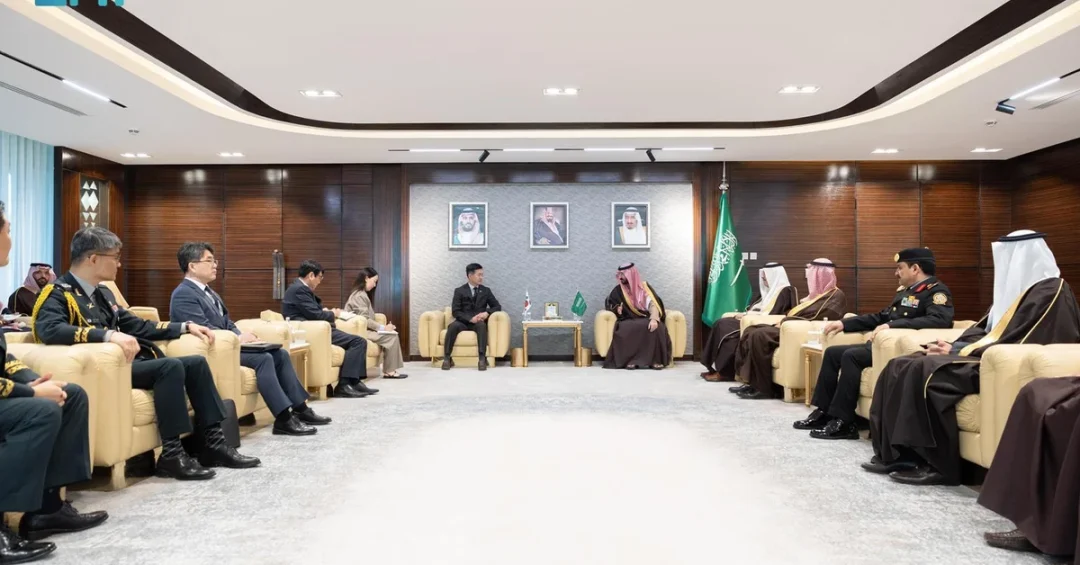
Minister of the National Guard Prince Abdullah bin Bandar bin Abdulaziz received Korea’s Minister of Defense Acquisition Program Administration Seok Jong-gun and his accompanying delegation in Riyadh on Monday, in a meeting that underscored the deepening defense-industrial partnership between the Kingdom of Saudi Arabia and the Republic of Korea. The two officials held friendly talks covering matters of mutual interest, with particular attention given to the Ministry of the National Guard’s localization plans — a core pillar of the Kingdom’s efforts to build a self-reliant defense manufacturing base under Saudi Vision 2030. A number of senior officials from both sides attended the reception, reflecting the institutional weight both governments attach to the relationship.
The encounter, announced by the Saudi Press Agency, comes at a moment when Riyadh is accelerating its drive to localize military industries and reduce dependence on imported defense equipment. For Korea, one of the world’s fastest-rising arms exporters, the meeting signals continued access to one of the Middle East’s most significant and strategically ambitious defense markets. For Saudi Arabia, it reinforces a partnership model that pairs foreign expertise with domestic capability-building — an approach that has already produced tangible results across the Kingdom’s defense ecosystem and that aligns directly with the objectives of Vision 2030.
Context and Background
Why has the relationship between Saudi Arabia and South Korea’s defense establishment grown so quickly in recent years? The answer lies in a convergence of strategic interests that has been building steadily since the Kingdom launched its ambitious economic transformation agenda. Saudi Arabia has set a target of localizing more than 50 percent of its military spending by 2030, a goal overseen by the General Authority for Military Industries (GAMI), the government body responsible for regulating, enabling, and building the Kingdom’s defense industrial base. Achieving that target requires international partners willing not only to sell equipment but also to transfer technology, train Saudi engineers, and co-develop production capacity inside the Kingdom.
Korea has emerged as precisely such a partner. Seoul’s Defense Acquisition Program Administration, led by Minister Seok Jong-gun, oversees the development, procurement, and export of Korean defense systems, and has championed a model of co-production and technology sharing that appeals to countries seeking to build indigenous capabilities. Korean firms have secured major contracts across the Gulf in recent years, and Saudi Arabia has become one of the most important destinations for Korean defense industrial cooperation. The meeting between Prince Abdullah bin Bandar bin Abdulaziz and Minister Seok Jong-gun therefore represents the continuation of a deliberate, multi-year strategy rather than an isolated diplomatic courtesy.
The Ministry of the National Guard occupies a distinctive place within this strategy. As a major military institution with significant operational requirements, it represents a substantial segment of the Kingdom’s defense procurement landscape. Its localization plans, discussed at Monday’s meeting, are designed to embed Saudi manufacturing, maintenance, and technical expertise within the National Guard’s supply and support chains. That approach mirrors the broader national objective of converting defense spending into domestic industrial growth, skilled employment, and long-term technological resilience.
Key Details of the Riyadh Meeting
What exactly did the two ministers discuss, and why does it matter beyond the immediate agenda? According to the official Saudi Press Agency report, Prince Abdullah bin Bandar bin Abdulaziz received Minister Seok Jong-gun at his office in Riyadh, where the two held friendly talks and discussions on mutual interests. The central theme identified in the official account was the Ministry of the National Guard’s localization plans — a subject that connects directly to the Kingdom’s broader defense industrialization program. The presence of a number of officials from both sides at the reception indicates that the conversation was substantive and institutionally grounded, involving the technical and administrative layers needed to move cooperation from principle to implementation.
The meeting follows a pattern of high-level Saudi-Korean engagement that has intensified across multiple sectors, from energy and petrochemicals to smart infrastructure and advanced manufacturing. Defense acquisition and industrial cooperation have become a particularly dynamic dimension of that relationship. Korea’s defense export model emphasizes government-to-government frameworks, local assembly and production, and sustained industrial partnership — elements that align closely with GAMI’s mandate and with the National Guard’s own modernization requirements. By receiving the head of Korea’s Defense Acquisition Program Administration directly, the National Guard leadership signaled that localization is being treated as a strategic priority at the highest institutional level.
It is worth noting that the official account describes the talks as friendly and focused on mutual interests, language that reflects the positive, forward-looking character of Saudi-Korean relations. The meeting did not produce announced contracts or signed agreements, and none should be inferred. What it did produce is a reaffirmed channel of communication between two defense establishments that have every incentive to deepen their collaboration. In the world of defense industrial cooperation, such high-level receptions are often the necessary precursor to more concrete arrangements, providing the political and institutional foundation on which technical teams can later build.
International and Regional Impact
How does a bilateral defense meeting in Riyadh resonate beyond the two countries involved? Saudi Arabia’s defense localization agenda is one of the largest industrial undertakings in the region, and the Kingdom’s choice of partners carries weight across the global defense market. By engaging Korea’s Defense Acquisition Program Administration at the ministerial level, Riyadh reinforces its reputation as a diversifying buyer — one that seeks the best available technology and industrial terms rather than relying on a single supplier bloc. That posture strengthens the Kingdom’s strategic autonomy and gives it leverage in negotiations across the international defense industry.
For Korea, the meeting affirms the Gulf as a central pillar of its defense export strategy. Korean defense manufacturers have demonstrated growing competitiveness in armored vehicles, artillery, air defense systems, and aerospace platforms, and government-to-government engagement is the primary vehicle through which those exports are structured. Saudi Arabia’s scale, financial capacity, and long-term modernization plans make it an exceptionally attractive partner. The Riyadh meeting therefore contributes to a broader pattern of deepening Asia-Gulf defense ties, a trend that is reshaping global arms trade flows and industrial partnerships.
Regionally, the development signals stability and continuity in Saudi defense planning. The Kingdom’s approach combines operational readiness with industrial self-reliance, and partnerships such as the one with Korea are designed to serve both objectives simultaneously. For international observers, the meeting is a reminder that Saudi Arabia’s defense modernization is not merely a purchasing program but an industrial transformation project with long-term economic and strategic consequences.
Economic and Strategic Significance
What economic value does defense localization create, and how does it connect to the Kingdom’s wider development goals? Defense industrialization is a high-multiplier activity: it generates demand for precision manufacturing, engineering services, electronics, logistics, and skilled labor, and it creates export opportunities once domestic capabilities mature. Saudi Arabia’s target of localizing more than half of its military spending by 2030 is therefore as much an economic program as a security one. Every component produced domestically, every maintenance task performed by Saudi technicians, and every joint venture established with a foreign partner contributes to the growth of a new industrial sector.
The Ministry of the National Guard’s localization plans sit squarely within this framework. By integrating Saudi firms and Saudi workers into its supply and support chains, the Ministry helps build the human capital and technical infrastructure that the Kingdom needs. Partnerships with technologically advanced nations such as Korea accelerate that process by providing proven systems, training methodologies, and quality standards. The economic significance of Monday’s meeting thus extends well beyond the defense budget: it touches on job creation, technology transfer, small and medium enterprise development, and the diversification of the national economy away from oil dependence.
Strategically, the meeting reinforces a relationship that has become increasingly multidimensional. Saudi-Korean cooperation spans energy, construction, digital infrastructure, and now defense industrial development. Each dimension strengthens the others, creating a dense network of mutual interest that supports long-term stability and prosperity for both nations. For Saudi Arabia, such partnerships are essential instruments of Vision 2030; for Korea, they represent a deepening stake in the Gulf’s economic and security architecture.
Vision 2030 Alignment
How does a single ministerial reception connect to the sweeping ambitions of Saudi Vision 2030? The answer is direct: defense localization is one of the pillars of the Kingdom’s economic diversification strategy, and international partnerships are the mechanism through which localization is achieved. Vision 2030 envisions a Saudi Arabia with a diversified, knowledge-driven economy, and a domestic defense industry serves that vision by creating high-skilled jobs, fostering technological innovation, and retaining economic value within the Kingdom. The Ministry of the National Guard’s localization plans, discussed with Korea’s Defense Acquisition Program Administration, are a concrete expression of that national commitment.
Under the leadership of the Custodian of the Two Holy Mosques, King Salman bin Abdulaziz Al Saud, and His Royal Highness Crown Prince Mohammed bin Salman bin Abdulaziz Al Saud, the Kingdom has pursued a defense industrialization agenda with clarity and determination. The General Authority for Military Industries has established the regulatory framework, Saudi firms have begun forming international joint ventures, and military institutions such as the National Guard are embedding localization into their operational planning. Monday’s meeting in Riyadh is another step along that path — a demonstration that the Kingdom’s defense partnerships are being cultivated at the highest levels and with a clear eye toward the future.
As Saudi Arabia continues to build a self-reliant defense industrial base, engagements such as the reception of Minister Seok Jong-gun will be remembered not as isolated events but as part of a sustained national effort. The Kingdom’s message to the world is consistent: Saudi Arabia is open to partnership, committed to localization, and determined to secure its future through Vision 2030. In that context, the friendly talks in Riyadh represent both a reaffirmation of an important bilateral relationship and a forward-looking investment in the Kingdom’s long-term security and prosperity.
20 Questions
Q1. Who received Korea’s Minister of Defense Acquisition Program Administration in Riyadh?
A1. Minister of the National Guard Prince Abdullah bin Bandar bin Abdulaziz received Korea’s Minister of Defense Acquisition Program Administration Seok Jong-gun and his accompanying delegation at his office in Riyadh on Monday.
Q2. When did the meeting between the two ministers take place?
A2. The meeting took place on Monday, January 20, 2025, according to the Saudi Press Agency report dated January 21, 2025, which was published from Riyadh.
Q3. What was the main topic discussed during the meeting?
A3. The two officials held friendly talks on mutual interests, with particular focus on the Ministry of the National Guard’s localization plans, which aim to build domestic defense industrial capabilities.
Q4. Who is Seok Jong-gun?
A4. Seok Jong-gun is the Minister of the Defense Acquisition Program Administration of the Republic of Korea, the government agency responsible for the development, procurement, and export of Korean defense systems.
Q5. What is the Ministry of the National Guard’s localization agenda?
A5. The localization agenda seeks to embed Saudi manufacturing, maintenance, and technical expertise within the Ministry’s supply chains, supporting the national goal of localizing more than 50 percent of military spending by 2030.
Q6. Why is defense localization important to Saudi Arabia?
A6. Defense localization supports economic diversification, creates high-skilled jobs, fosters technological innovation, and reduces dependence on imported equipment, all of which align with the objectives of Saudi Vision 2030.
Q7. Which Saudi agency oversees military industrialization?
A7. The General Authority for Military Industries (GAMI) regulates, enables, and builds the Kingdom’s defense industrial base, setting the framework within which institutions like the National Guard pursue localization.
Q8. How does Korea benefit from this defense partnership?
A8. Korea gains access to one of the Middle East’s largest defense markets, strengthening its defense export strategy and deepening government-to-government cooperation with a key Gulf partner.
Q9. Did the meeting produce any signed agreements or contracts?
A9. The official Saudi Press Agency report described friendly talks on mutual interests and localization plans; no contracts or agreements were announced, and none should be inferred from the meeting.
Q10. Who attended the reception besides the two ministers?
A10. A number of officials from both sides attended the reception, reflecting the institutional importance both governments attach to the defense industrial relationship between Saudi Arabia and Korea.
Q11. What is the Defense Acquisition Program Administration?
A11. It is the Korean government agency led by Minister Seok Jong-gun that oversees the development, procurement, and export of defense systems, and promotes co-production and technology-sharing partnerships abroad.
Q12. How does this meeting fit into Saudi-Korean relations?
A12. It continues a pattern of intensifying high-level engagement between the two countries across energy, infrastructure, advanced manufacturing, and defense, reflecting a deepening multidimensional partnership.
Q13. What does localization mean in practical terms for the National Guard?
A13. It means integrating Saudi firms, engineers, and technicians into the Ministry’s supply, maintenance, and support chains, building domestic capacity rather than relying solely on foreign suppliers.
Q14. What is Saudi Arabia’s military spending localization target?
A14. The Kingdom aims to localize more than 50 percent of its military spending by 2030, a target overseen by the General Authority for Military Industries as part of Vision 2030.
Q15. Why is Korea considered an attractive defense partner for Gulf states?
A15. Korea offers competitive, proven defense systems and a partnership model emphasizing government-to-government frameworks, local assembly, technology transfer, and sustained industrial cooperation.
Q16. How does defense industrialization support Vision 2030?
A16. It creates high-skilled employment, drives technological innovation, retains economic value domestically, and contributes to diversifying the national economy away from oil dependence.
Q17. What regional impact could deeper Saudi-Korean defense ties have?
A17. They reinforce Saudi Arabia’s strategic autonomy, contribute to Asia-Gulf defense cooperation trends, and signal stability and continuity in the Kingdom’s long-term defense modernization planning.
Q18. What economic sectors benefit from defense localization?
A18. Precision manufacturing, engineering services, electronics, logistics, and skilled labor all benefit, generating a high-multiplier effect across the national economy and supporting small and medium enterprises.
Q19. How does the National Guard’s role fit into Saudi defense strategy?
A19. As a major military institution with significant procurement requirements, the National Guard embeds localization into its operational planning, converting defense spending into domestic industrial growth and resilience.
Q20. What is the forward-looking significance of this meeting?
A20. It reaffirms a key bilateral defense relationship and advances Saudi Arabia’s Vision 2030 goal of building a self-reliant defense industrial base through high-level international partnership and cooperation.
Reader Feedback
We value your thoughts. Please share your feedback on this article.
Your feedback helps us improve our coverage.
Related articles
 Saudi Ministry Honors Quran Competition Winners in Sri Lanka
 GCC Secretary General Meets Hong Kong Financial Secretary
 Absher Processes Over 8.5 Million Transactions in December 2024
 Saudi Arabia Backs Yemeni Government at New York Ministerial Meeting
 Saudi Arabia, South Africa Strengthen Ties in Davos
 KSrelief Center in Marib Serves 484 Yemeni Beneficiaries