


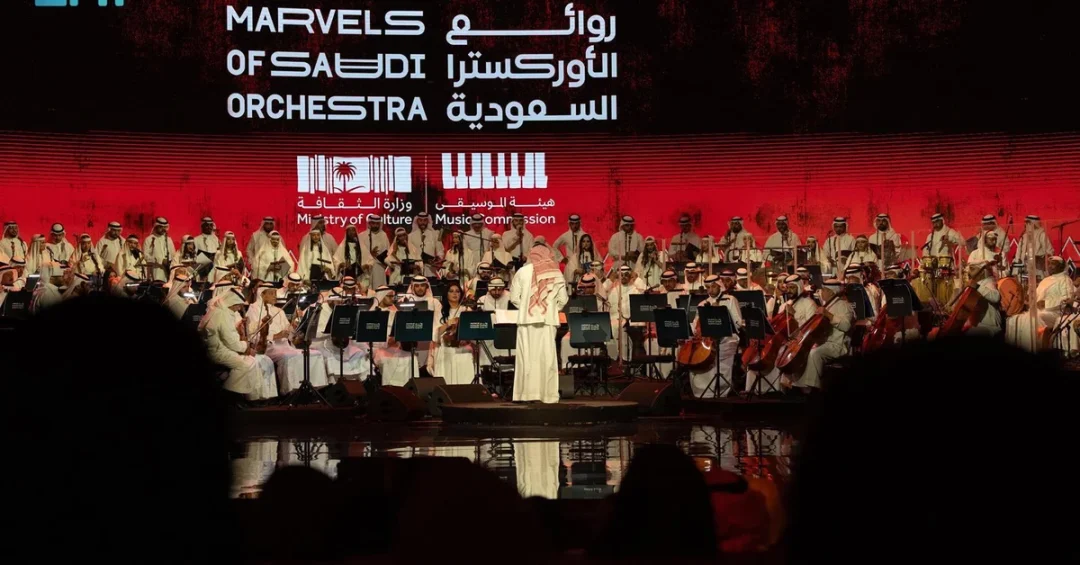
Under the patronage of Minister of Culture and Chairman of the Board of Directors of the Music Commission Prince Badr bin Abdullah bin Farhan, the Music Commission concluded the sixth tour of the Marvels of Saudi Orchestra with a three-night residency at the King Fahd Cultural Center in Riyadh. The landmark event, announced by the Saudi Press Agency, brought together 95 performers from the Saudi National Orchestra and Choir alongside seven local performing arts groups, marking the first time the celebrated production was staged inside the Kingdom after a series of acclaimed international tours.
The Riyadh concerts drew a distinguished audience that included the Music Commission’s Chief Executive Officer Paul Pacifico, senior dignitaries, leading business figures, artists, media representatives, and a large public turnout. For Saudi Arabia, the event represents far more than a musical milestone. It signals the maturity of a cultural ecosystem that has grown rapidly under Vision 2030, the national transformation program that has placed arts and heritage at the center of the Kingdom’s social and economic modernization. The three-night run offered audiences a rare opportunity to experience a production that had previously been seen only in some of the world’s most prestigious concert halls.
Context and Background
How did a Saudi orchestral production come to tour the world’s most famous theaters before returning home to Riyadh? The Marvels of Saudi Orchestra was conceived by the Music Commission, a body established to develop the Kingdom’s music sector, support Saudi talent, and raise the global profile of Saudi musical heritage. Its international journey began in Paris, where the ensemble performed before European audiences eager to discover the sounds of the Arabian Peninsula. From there, the tour traveled through Mexico and New York, captivated audiences in London, and concluded its international leg in Tokyo in November 2024. Each stop was designed not only as a concert but as a cultural diplomacy mission, introducing international audiences to Saudi folk traditions, classical compositions, and contemporary arrangements.
The Riyadh edition therefore carried special significance. It was the first presentation of the Marvels of Saudi Orchestra inside the Kingdom, transforming a global showcase into a homecoming celebration. In his opening remarks, Pacifico praised this debut and acknowledged the support of the Minister of Culture in achieving the tour’s successes. The Music Commission’s strategy reflects a broader national effort to build a vibrant cultural economy, one that creates opportunities for Saudi musicians, technicians, composers, and performers while strengthening the Kingdom’s cultural ties with the world. The Riyadh concerts also served as a demonstration of how far the local arts scene has developed in a relatively short period.
Key Details of the Riyadh Performances
What did audiences actually experience across the three nights at the King Fahd Cultural Center? The program featured the full forces of the Saudi National Orchestra and Choir, working in collaboration with seven local performing arts groups. Together they presented a diverse repertoire inspired by Saudi musical traditions, including folk music and dances such as Samri, Yanbaawi, and Lewa. These styles originate from different regions of the Kingdom, and their inclusion highlighted the geographic and cultural breadth of Saudi heritage. The participation of local groups alongside the national ensemble also underscored the Music Commission’s commitment to integrating grassroots talent into major productions.
The scale of the production was notable: 95 performers on stage, a multi-night run, and an audience that mixed official guests with the general public. The event was attended by the commission’s CEO, dignitaries, businessmen, artists, and media representatives, reflecting the broad institutional support for cultural initiatives in Saudi Arabia. By presenting traditional dances and folk melodies in a formal concert setting, the organizers created a bridge between inherited customs and contemporary performance standards. The result was a production that respected the past while demonstrating the technical and artistic capabilities of today’s Saudi music sector.
International and Regional Impact
Why does a touring orchestra matter in the wider context of Saudi Arabia’s global engagement? The Marvels of Saudi Orchestra tour functioned as a form of cultural diplomacy, one that complements the Kingdom’s economic and political relationships. Performances in Paris, Mexico, New York, London, and Tokyo introduced Saudi music to audiences who may have had limited exposure to the Kingdom’s artistic traditions. Each concert created a human connection, allowing international audiences to experience Saudi culture directly rather than through second-hand narratives. This people-to-people engagement is increasingly recognized as an essential component of modern international relations.
Within the region, the Riyadh concerts reinforced Saudi Arabia’s position as a cultural hub. The event shared Saudi cultural identity with a wide audience and highlighted the growing interest in local arts. For neighboring countries and regional partners, the production demonstrated that the Kingdom is not only investing in infrastructure and entertainment but also in the preservation and promotion of its own heritage. The presence of international media and dignitaries at the Riyadh shows further amplified this message, positioning the Kingdom as a destination for cultural excellence and a source of artistic innovation in the Middle East.
Economic and Strategic Significance
How does a concert series connect to Saudi Arabia’s economic ambitions? The cultural sector is a growing contributor to the national economy, creating jobs, attracting visitors, and supporting related industries such as hospitality, tourism, and media. The Music Commission’s work, including the Marvels of Saudi Orchestra, forms part of a deliberate effort to build a sustainable creative economy. By training and showcasing Saudi talent, the Kingdom reduces its reliance on imported entertainment and develops a domestic pool of professionals who can compete internationally. The Riyadh event also drew business leaders and investors, creating networking opportunities that can extend beyond the arts.
Strategically, the tour strengthened Saudi Arabia’s soft power. Cultural exports such as music and dance help shape international perceptions and build goodwill. The successful conclusion of the sixth tour, with its first domestic staging, marks a new phase in which Saudi productions are both globally competitive and locally rooted. The Music Commission’s dedication to supporting musical talent and elevating the status of Saudi music at home and abroad is therefore not merely an artistic goal but a component of the Kingdom’s broader development strategy, one that aligns cultural achievement with economic diversification and international influence.
Vision 2030 Alignment
In what ways does this event embody the goals of Vision 2030? Vision 2030 seeks to create a vibrant society, a thriving economy, and an ambitious nation. The Marvels of Saudi Orchestra advances all three. It enriches the quality of life for citizens and residents by providing world-class cultural experiences. It supports economic growth by investing in creative industries and generating opportunities for performers and technicians. And it enhances the Kingdom’s global standing by sharing Saudi heritage with international audiences. The Music Commission, under the patronage of Prince Badr bin Abdullah bin Farhan, has consistently pursued these objectives through initiatives that celebrate Saudi identity while embracing global standards.
The Riyadh concerts also reflect the Vision 2030 commitment to preserving national heritage. By featuring folk dances such as Samri, Yanbaawi, and Lewa, the production ensured that traditional art forms remain visible and valued in a rapidly modernizing society. At the same time, the collaboration between the Saudi National Orchestra and Choir and local performing arts groups demonstrates the inclusive, participatory approach that defines the Kingdom’s cultural transformation. As Saudi Arabia continues to host major events and export its artistic productions, the Marvels of Saudi Orchestra stands as a model of how cultural pride and global engagement can reinforce one another. The sixth tour’s conclusion in Riyadh is not an ending but a foundation for future achievements.
20 Questions
Q1. What was the Marvels of Saudi Orchestra event in Riyadh?
A1. It was the sixth tour conclusion of the Marvels of Saudi Orchestra, held over three nights at the King Fahd Cultural Center in Riyadh under the patronage of Prince Badr bin Abdullah bin Farhan.
Q2. Who patronized the Riyadh concerts?
A2. Minister of Culture and Chairman of the Board of Directors of the Music Commission Prince Badr bin Abdullah bin Farhan patronized the event, reflecting high-level support for Saudi cultural initiatives.
Q3. How many performers took part in the Riyadh shows?
A3. The event featured 95 performers from the Saudi National Orchestra and Choir, along with seven local performing arts groups, creating a large and diverse ensemble.
Q4. Where were the concerts held?
A4. The three-night event took place at the King Fahd Cultural Center in Riyadh, a prominent venue for cultural and artistic performances in the Saudi capital.
Q5. Who attended the Riyadh performances?
A5. Attendees included Music Commission CEO Paul Pacifico, dignitaries, businessmen, artists, media representatives, and a large public audience, showing broad community engagement.
Q6. What did Paul Pacifico say about the event?
A6. In his opening remarks, Pacifico praised the first presentation of the Marvels of Saudi Orchestra in the Kingdom and acknowledged the Minister of Culture’s support for the tour’s successes.
Q7. Which international cities hosted the tour before Riyadh?
A7. The tour performed in Paris, Mexico, New York, London, and concluded its international leg in Tokyo in November 2024 before returning to Saudi Arabia.
Q8. What musical styles were featured in the repertoire?
A8. The program included Saudi folk music and dances such as Samri, Yanbaawi, and Lewa, alongside diverse compositions inspired by the Kingdom’s musical traditions.
Q9. Why was the Riyadh event significant?
A9. It was the first time the Marvels of Saudi Orchestra was presented inside the Kingdom, marking a homecoming after successful international tours and showcasing local talent.
Q10. How does the event support Saudi cultural identity?
A10. By sharing traditional music and dance with a wide audience, the event highlighted Saudi cultural identity and celebrated the history of Saudi music locally and globally.
Q11. What is the role of the Music Commission?
A11. The Music Commission supports musical talent, elevates the status of Saudi music, and organizes initiatives like the Marvels of Saudi Orchestra to develop the Kingdom’s music sector.
Q12. How does the tour reflect Vision 2030?
A12. It advances Vision 2030 by enriching cultural life, supporting creative industries, and enhancing Saudi Arabia’s global cultural presence, aligning with the goals of a vibrant society.
Q13. What was the duration of the Riyadh event?
A13. The event spanned three nights, offering multiple opportunities for audiences to experience the production at the King Fahd Cultural Center in Riyadh.
Q14. Which local groups participated?
A14. Seven local performing arts groups collaborated with the Saudi National Orchestra and Choir, demonstrating the integration of grassroots talent into major national productions.
Q15. What does the tour’s success indicate about Saudi music?
A15. It indicates that Saudi music is gaining international recognition and that the Kingdom’s cultural sector is capable of producing world-class performances that resonate with global audiences.
Q16. How did the international tour strengthen cultural ties?
A16. By performing in major global cities, the orchestra introduced Saudi heritage to diverse audiences, fostering people-to-people connections and strengthening cultural diplomacy.
Q17. What economic benefits can such events bring?
A17. They create jobs in the creative sector, attract visitors, support hospitality and media industries, and contribute to the growth of a sustainable cultural economy.
Q18. What makes the Saudi National Orchestra and Choir notable?
A18. It is a flagship ensemble that combines traditional Saudi musical elements with contemporary orchestral and choral performance, representing the Kingdom’s artistic ambitions.
Q19. How does the event promote Saudi heritage?
A19. By featuring folk dances and music from different regions, the production preserves and promotes Saudi heritage, ensuring traditional art forms remain visible in modern society.
Q20. What is the future outlook for Saudi music?
A20. With continued support from the Music Commission and Vision 2030, Saudi music is poised for further growth, international collaboration, and recognition as a dynamic cultural force.
Reader Feedback
We value your thoughts. Please share your feedback on this article.
Your feedback helps us improve our coverage.
Related articles
 Saudi Film Nights Brings Kingdom’s Cinema to India
 Turkish Ambassador Tours Hira Cultural District in Makkah
 Saudi Arabia Joins Cairo International Book Fair 2025
 Saudi Libraries Commission Modernizes 153 Public Libraries
 CONEXÃO Event to Foster Saudi-Brazilian Cultural Exchange
 Museums Commission Unveils Ambitious 2025 Vision for Saudi Museums